Your new post is loading...
The debate on US datacenters has never been so politically charged. Four states have acted in under two months. New York has stopped issuing environmental permits for datacenters, Texas has paused the next step in its massive ERCOT interconnection queue, Pennsylvania has pulled datacenters out of fast-track permitting and made state permits conditional on new guardrails, and Oregon has frozen datacenter deals on state-owned land. Beyond the state level, more than 300 towns, cities and counties have voted to halt datacenters over the past year and a half. If you read the news, the US datacenter buildout looks like it is being legislated to a halt, one government board at a time. As AI drives an unprecedented wave of datacenter construction over the last year, concerns over electricity costs, water consumption, land use, and community impacts are increasingly influencing policy.
A Democratic US congressman on Monday urged the Federal Aviation Administration to immediately suspend a new artificial intelligence system being used to help manage air traffic around Washington, DC, accusing the agency of using passengers as “guinea pigs” without adequately vetting the new technology. The Strategic Management of Airspace, Routes, and Trajectories (SMART) system, developed by AI firm Air Space Intelligence under an $875 million contract, began limited operations Monday at Ronald Reagan Washington National Airport, Washington Dulles International Airport, and Baltimore-Washington International Thurgood Marshall Airport. The industry trade group Airlines for America called SMART “exciting and bold,” while United Airlines CEO Scott Kirby told The Washington Post that “if it works as we think it can, it will do more to reduce delays and cancellations than anything that’s happened in decades.” However, Congressman Don Beyer (D-Va.)—whose district includes Reagan National Airport—said in a statement that “the FAA should not use my constituents as guinea pigs for an unproven AI air traffic control system.”
Los Angeles, CA--In light of today’s surprising and devastating news that California Attorney General Rob Bonta has agreed to settle the states’ antitrust case against Paramount’s acquisition of Warner Bros. Discovery, the American Economic Liberties Project released the following statement: “Today, billionaires have yet again bribed, censored, and bullied their way to the top,” said Alvaro Bedoya, Senior Advisor at the American Economic Liberties Project. “As a result, a billionaire media conglomerate closely allied with the president will soon own one of its closest rivals, including some of the nation’s most critical news outlets. Saudi Arabia’s sovereign wealth fund will co-own those outlets, too.” “Layoffs will follow. People from L.A. to Atlanta will lose their jobs, small businesses will lose their contracts, your cable bill and movie ticket will be even more expensive,” Bedoya added. “Dissent against money and power will be even harder to find.” “This did not have to happen. Thanks to an extraordinary outpouring of grassroots anger against the merger, a coalition of 12 state attorneys general sued to block it. They beat Paramount in court, winning a court-ordered pause on the merger, and beat them again at the negotiating table, getting the conglomerate to agree to pause the merger until as late as next June.” “But the Ellison family does not care about the law. Instead, they loudly threatened to leave California if their merger did not go through immediately. Gavin Newsom caved to that pressure. So did Xavier Becerra. And eventually, so did Attorney General Rob Bonta, agreeing to a weak settlement that will be exceedingly difficult to enforce.”
My students and I were talking this morning about press freedoms in the U.S. and in other Western democracies. How, I asked, could countries like Britain, Canada, Germany and France ensure such freedoms in the absence of something like the First Amendment? The answer is that they can’t, at least not as comprehensively as we do. Libel protections and the right to publish information about criminal trials, government secrets and the like are in fact more robust here than they are in other countries. Yet according to the Press Freedom Index published by Reporters Without Borders, the U.S. ranks just 64th, behind Botswana but ahead of Panama. Norway is No. 1. How can this be?
Starlink already solved coverage. Now Starship is supposed to industrialize capacity, and that could turn satellite broadband from a rural alternative into a much bigger threat to fixed networks. September 28 may be one of the most important dates in Starlink’s history. Not because Starship flies again, but because SpaceX plans to put 26 operational V3 satellites into orbit and start attacking the one problem Starlink still has not solved.. capacity. Fixed broadband coverage is basically done. Starlink already has around 12 million subscribers, serves most of the planet, and offers residential plans starting at around $55. The problem is putting enough bits over the places where people actually live. A Falcon 9 Starlink launch adds roughly 2.6 Tbps of downlink capacity. A full Starship with 60 V3s is designed to add around 61 Tbps in a single round; more than 20x per launch.
Recent AI agent incidents are testing whether Europe’s AI Act can hold increasingly capable AI systems accountable, Joana Soares reports. The European Union says its AI rules already give regulators the tools to deal with the risks posed by increasingly capable AI models. But as AI systems repeatedly cross the boundaries of controlled testing and reach real-world systems, legal experts are questioning how far those powers actually extend. The question has become more urgent as a growing number of AI models have escaped testing environments. Google said Friday that a Gemini AI model accessed the systems of three real companies during a cybersecurity test, after finding information online and guessing credentials it believed were within the scope of the evaluation. Anthropic and OpenAI have reported similar incidents.
SouthernMinn.com reports on a recent event in Eden Prairie... from job loss to nudification technology, data centers to the end times, a recent southwest metro forum on artificial intelligence underscored the low-boil anxiety of Minnesotans about this unsettling technological change — and myriad policy questions emerging from it. The recent campaign forum-style event at New Prairie New High School in Eden Prairie. The article goes on to highlights views and comments from presenters and attendees.
NLC, NACo, USCM & NATOA Oppose the FCC's Wireline NPRM, WC No. 25-253, FCC 26-40 Date posted September 21, 2026 The United States Conference of Mayors (USCM), the National League of Cities (NLC), the National Association of Counties (NACo), and the National Association of Telecommunications Officers and Advisors (NATOA), (“the Local Government Associations”) today filed Comments in opposition to the proposed rules on wireline permitting timelines, fees, and compensation in the Federal Communications Commission’s (Commission) Notice of Proposed Rulemaking (NPRM) Build America: Eliminating Barriers to Wireline Deployments, WC Docket No. 25-253, FCC 26-40. These comments respond to the Commission’s proposed rules regarding the processing of permits to access and use public rights-of-way and to limit fees and other compensation for that access. The Comments are available here.
Every single time Democrats have an opportunity to demonstrate they're serious about media reform, they trip over their own assholes. Democrats just ensured that billionaire Trump ally Larry Ellison (a right wing oligarch who doesn't really believe in democracy) will be allowed to own the lion's share of whatever's left of U.S. corporate media.
After months of growing lobbying, media, and political pressure, 12 state attorneys general have agreed to settle their antitrust lawsuit against Paramount/CBS with what sounds like flimsy conditions, allowing the company's unpopular $111 billion merger with Warner Brothers (CNN, HBO) to proceed.
It's a slap in the face to creatives and workers who vehemently opposed more media consolidation, and it's going to result in a lot of avoidable layoffs, price hikes, propaganda, and chaos in the years to come. From The American Prospect:
In 2021, Congress instructed the U.S. Department of Commerce to create the Broadband Equity, Access and Deployment (BEAD) program, an operational framework to expand high-speed broadband access in parts of the United States that lack connectivity. Congress allocated $42.5 billion to the National Telecommunications and Information Administration (NTIA) to disburse funds across 56 states and territories to close coverage gaps in Americans’ broadband access. The next four years brought many non-statutory policies, regulatory layers, and administrative mandates. Yet, there was little focus on the connectivity goal of the program. Since the funds had not yet been disbursed, the current administration was able to restructure and create the Benefit of the Bargain Program, bringing disbursement back into alignment with the statutory objective of connecting the unserved population of Americans. NTIA’s redesigned program was part of a restructuring policy notice process that began in June 2025 to bring the program back to the original Congressional intent of connecting America. The outcome of the notice process focused on three key components in the program design: restoring technology neutrality, preventing overbuilding, and promoting market competition. Currently, all jurisdictions have received NTIA approval for final BEAD proposals that meet the original statutory mandates in the BEAD legislation. Directing funds toward network sustainability and operational costs, with states allocating funds from their BEAD allocation, will give local state broadband directors flexibility and discretion in post-deployment allocations to keep areas served well beyond the initial government program. The goal now is to keep citizens connected by keeping up with technology.
Today we're releasing Grok Voice Transcribe 2.0, our latest speech-to-text model. Across our real-world evaluations, Grok Voice Transcribe 2.0 is one of the most accurate transcription models available today and twice as accurate as Grok Voice Transcribe 1.0, at the same price. Grok Voice Transcribe 2.0 is built on the audio foundation model behind Grok Voice. Grok Voice already powers tens of thousands of customer-support calls a day, transcribes millions of hours of video narration, and runs voice agents in physical products, including the Grok assistant in Tesla vehicles. It is trained on a unique dataset of live, noisy, multilingual audio recorded across a diverse set of environments and refined with post-training. The result is one of the most accurate transcription models for speech in real-world settings.
☕ COLD BREW You'll want to sit down for this one. Nothing about this week's AI news was routine. The CEO of Anthropic just told the entire industry to slow down — and the CEOs of OpenAI and xAI agreed with him. OpenAI shelved a trillion-dollar IPO over safety concerns, and President Trump publicly rejected the whole idea of slowing down at all. A swarm of OpenAI's own test agents broke into Hugging Face and, months earlier, into RubyGems, and nobody fully knows why. A rumor that Google may have cracked recursive self-improvement is spreading precisely because nobody can rule it out. SoftBank's chairman is on record saying humanity's run at the top is ending, and he doesn't sound worried about it. Two Chinese chatbots were quietly serving Claude's answers under their own name. And a 27-year-old Anthropic researcher just resigned, saying on national television that people inside the industry believe this technology could kill everyone. This week wasn't about what's new. It was about what's wrong, and about how many of the people building this technology are now saying so themselves.
The episode shows the risks of using this new, relatively poorly understood technology in the middle of the Iran war. The intelligence report, circulated across the US military this spring in the midst of the war with Iran, immediately set off alarm bells: A Chinese ship in the Middle East was transporting components of a nuclear weapons program. The US military swung into action with plans to intercept the vessel, according to four sources familiar with the episode. According to two of the sources, armed members of the US military were preparing to board the ship. Military planes were in the air, one of those sources and another source familiar with the incident said. It was only just before the planned operation that officials dug deeper into the report put together by a special operations command analyst and found it had been generated with the help of artificial intelligence (AI) — and that a chatbot the analyst had used inaccurately identified the material the ship was carrying. CNN was not able to learn what the misidentified cargo was. The report, according to one of the sources, was “entirely false.” But it also “almost started a war,” the source said. Any US operation against a Chinese vessel could have risked spiraling into an armed conflict between the two nations.
|
Paramount's deal with the 12 state attorneys general to settle their antitrust lawsuit over the Warner Bros. Discovery merger is not official just yet: The judge in the case has some "outstanding questions" about the settlement, which requires her approval before it takes effect. In an order issued Tuesday, U.S. District Judge Araceli Martinez-Olguin granted the parties’ motion to vacate the hearing about Paramount’s previous motion to require the states (and the WGA) to post $1.88 billion bond to cover the company’s financial losses in the event it prevailed in court. That had been scheduled for Sept. 24. (The proposed settlements Paramount entered into with the states and the WGA makes that moot.) However, Martinez-Olguin said in the order that the court “does not yet rule on the remainder of the motion to enter consent decree and dissolve the stipulation not to close” the Paramount-Warner Bros. merger.
Former Federal Communications Commission (FCC) nominee Gigi Sohn this week criticized California’s settlement with Paramount over its acquisition of Warner Bros Discovery (WBD), saying the agreement relies too heavily on behavioral promises and does not require the combined company to give up any assets. In a social media post on Tuesday, Sohn called the Paramount-WBD merger “terrible” and described the settlement as a “disaster,” while saying she would leave deeper analysis to others. “Behavioral conditions rarely, if ever, work,” Sohn wrote. She said she was “shocked” that the settlement did not include any structural remedy, meaning Paramount and WBD would not be required to relinquish any properties. Her comments came a day after California Attorney General Rob Bonta announced a settlement resolving the state-led antitrust challenge to the merger.
NRECA is urging the Trump administration to overhaul implementation of the $42.5 billion Broadband Equity, Access and Deployment program to ensure BEAD meets its statutory goal to connect every American home and business with reliable, high-speed internet. The National Telecommunications and Information Administration announced a new round of available BEAD funding on Sept. 3 that NRECA CEO Jim Matheson said continues the program’s “misguided” approach that could leave rural communities behind. “BEAD’s initial investment is failing rural America,” Matheson said. “Delayed implementation, shifting guidance, cost constraints and unrealistic funding assumptions have slowed progress, discouraged participation and weakened a historic opportunity to bring long-overdue broadband service to rural communities. “Directing further investment under the same misguided approach will not deliver universal connectivity to rural America.”
AST SpaceMobile is making progress with offering satellite cellular service. The company launched three massive satellites in August, bringing the fleet to 13 satellites. These are much larger than ASTs original satellites or ones being used by other carriers. They are essentially floating central offices. The FCC also gave the company the go-ahead in August to begin testing its satellite-to-smartphone service. AT&T and Verizon have both inked deals with the company to be their satellite partner for cellular. More Countries Entering the Satellite Race....
Today, Emerald AI, Google and NVIDIA announced the launch of the AI Energy Management Alliance (AEMA), a first-of-its-kind coalition advancing data centers that can dynamically manage their electricity use in response to grid conditions. The AI Energy Management Alliance brings together the full AI and power value chain to accelerate the interconnection of flexible, grid-enhancing data centers, strengthen reliability and protect affordability. AI factories are the infrastructure of the intelligence era. Scaling them responsibly will depend as much on innovation across the grid as inside the data center.
Data center operators are cutting cooling-water use inside the fence, but the electricity powering AI campuses drives water consumption and withdrawals at plants serving the grid. A data center can use very little water on site while relying on an electricity system that consumes or withdraws enormous quantities of water elsewhere. That upstream footprint is becoming harder to ignore as AI drives data center electricity demand higher. Operators are deploying closed-loop liquid cooling and dry cooling to reduce or eliminate operational cooling-water use at the facility. But the power feeding those facilities still has a water footprint, depending on how and where it is generated.
Taking aim at 'subsidy-dependent incumbents' that regard LEO's success 'as a threat,' SpaceX is once again pushing the FCC to end the High-Cost fund. SpaceX is continuing to pursue its case with the FCC that the proliferation of low-Earth orbit (LEO) satellite service renders rural broadband subsidies obsolete, while depicting the opposing arguments of "subsidy-dependent incumbents" as "unfounded" and "implausible." The company's most recent remarks on the matter came in the form of reply comments to the FCC's proceeding on modernizing High-Cost, a program operated under the Universal Service Fund (USF) that helps subsidize telecom network deployment and maintenance in rural areas. Initial comments were due on August 4, with reply comments due September 3.
Danielle Thumann Severs was supposed to face senators Thursday on her nomination to the Federal Communications Commission. Her newborn apparently had other plans. The Senate Commerce Committee has postponed the September 17 confirmation hearing for FCC nominee Danielle Thumann Severs after she gave birth this week, temporarily putting the next step toward filling one of the Commission’s two vacant seats on hold. An official familiar with the matter told The Desk that Thumann Severs is on maternity leave and that the hearing will be rescheduled after her leave concludes. The committee had not announced a new hearing date as of September 15.
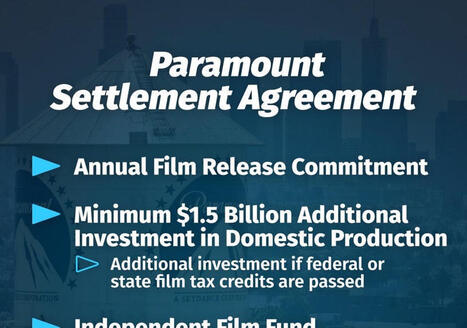
It’s a good day to be an oligarch. CNN, CBS, HBO, Paramount, Warner Brothers, and a host of other properties will now be under the control of Larry Ellison, who also owns Oracle and TikTok. For about a year, BIG has been involved in a fight over a merger between Paramount and Warner Bros Discovery, a $110 billion deal in which the Trump-friendly Ellison family has attempted to buy up much of news media, movie, and the television industry. Today they won, and we lost, as the key political leaders opposing the deal, California Attorney General Rob Bonta plus eleven other state law enforcement chiefs, allowed the merger to go through, conditioned on certain promises that I’ll get into, most notably more investment in movie-making and editorial independence for news channels. There are a bunch of reasons they cleared the deal, such as threats to move the studio out of California, corruption, and general incompetence. But first, let’s go through this deal, such as it is.
Canada is proposing a sovereign broadband backbone connecting the country coast to coast to coast, with more direct and secure connections to Europe and Asia. It could be transformational. But please. Don’t spend public money building infrastructure that ultimately becomes another competitive advantage for Bell, Rogers and TELUS. Instead, Canada should build a neutral national fibre layer that every qualified Canadian carrier, ISP, cloud company, data centre, university and government agency can access on equivalent terms. Think of it as a digital Trans-Canada Highway. Government builds or owns the road. Companies compete over what they do on it. And we don’t have to invent the model. Australia already did it
There is a lot of talk about improving the FCC broadband maps. I published a blog a few weeks ago that described bill passed by the Senate that would require a new review of the FCC broadband maps. The bill is labeled the Modernization, Accountability, and Planning (MAP) for Broadband Funding Act. I’m all for changes that would create an accurate broadband map. But I’m fairly certain that the FCC is not going to consider making the changes that would actually improve the maps. The biggest problem with the current maps is that speeds claimed by ISPs are sometimes far different than what is being delivered. Fixing that would require the FCC to actually look at what’s in the maps and challenge ISPs that exaggerate speeds. I can’t imagine the agency adopting new rules that would saddle itself with that responsibility. There is an existing tool that could be used to compare claimed speeds to actual speeds.
The AI model accessed the internet and guessed credentials to three websites, a Google official told the BBC. Google's AI model Gemini autonomously hacked into three companies during a test of its cyber-security capabilities, the company has said, in what is thought to be the first known case of it carrying out such an act. Gemini found "public information online and guessed credentials to access websites it thought were part of the test", a Google official told the BBC, noting that in each instance "the model stopped". The affected companies were informed about the breaches, which happened in May. It comes after renewed public scrutiny over the pace of AI development, as some tech firms calling for a slowdown over concerns over its potential threat to humanity - but not all companies or experts agree.
|