Your new post is loading...
- SpaceX says it will build a terrestrial component for Starlink Mobile using the 65 MHz of spectrum it’s acquiring from EchoStar
- Instead of a traditional macro network, SpaceX is talking about using small stations tied to Starlink dishes, with service starting by end of next year
- Elon Musk surmised that it will probably build something better than anything currently available from terrestrial cellular providers
Make no mistake: SpaceX intends to build a terrestrial mobile network, and it’s got enough spectrum to get it off the ground (pun intended). That was the message Tuesday from SpaceX President Gwynne Shotwell on the company’s first earnings call after its record-setting IPO in June.
An analysis of the last seven years of Tesla earnings calls shows just how little attention Musk pays to Tesla's car business. Elon Musk wants you to believe Tesla is no longer a car company, even if it’s still shaped like one. The company shipped nearly half a million cars last quarter and made 70% of its money from car sales. Still, Musk has spent the last few years making the case that Tesla is really an AI and robotics company, even if some of the AI happens to live in cars. And whatever the company financials suggest, Musk’s attention has been moving decisively to the AI parts of the company — projects like the Optimus robot and fully autonomous robotaxis — as the everyday concerns of a carmaker get pushed to the side.
Free Press Board Chair Victor Pickard explains why on the latest episode of ‘Money on the Left’ Victor Pickard is a professor at the University of Pennsylvania and co-director of its Media, Inequality & Change Center. He’s also Free Press’ board chair. On the latest episode of the “Money on the Left” podcast, Pickard talks with hosts Scott Ferguson and Billy Saas about authoritarian threats to journalism — and what it would take to build a public-media system that would strengthen our democracy. The team at “Money on the Left” gave Pressing Issues permission to feature part of Pickard’s appearance, which we’ve edited for length and clarity. For the complete episode, visit the Money on the Left site or listen to the episode.
Brookings looks at data center moratoriums versus oversight… Data center construction is exploding amid the artificial intelligence (AI) boom—and so is the community backlash against these projects. Protests across the country and community concerns have prompted legislators to consider moratoriums on data center construction. At least 15 states have weighed pauses on data center development, and at least 100 localities have already approved their own.
Elon Musk’s case for taking AI off-planet—because energy, permits, and turbines may cap Earth-based scaling sooner than the algorithms do. Orbiting the Power Wall In a characteristically audacious declaration, Elon Musk predicts that within 36 months—perhaps even 30—space will become the most economically compelling location for artificial intelligence infrastructure. This emerged from a nearly three-hour deep-dive podcast with Dwarkesh Patel and John Coogan, where Musk discussed everything from orbital data centres to xAI’s business plans and DOGE. This is not science-fiction speculation; it is a calculated response to what Musk sees as Earth’s insurmountable scaling limitations for AI compute. The fundamental energy problem The core thesis is deceptively simple: chip production is growing exponentially, but electricity generation outside China remains essentially flat. While only 10–15% of a data centre’s total cost of ownership is energy, availability—not cost—is the binding constraint. Musk poses the uncomfortable question facing every AI company: “How are you going to turn the chips on?” The United States currently uses roughly half a terawatt of power on average. Musk envisions AI requiring multiple terawatts—several times America’s total current consumption. The hardware reality, he argues, is about to deliver a hard lesson to those who have lived primarily in software land.
Where most energy storage companies look for big tracts of land near large connections to the grid, Base Power is betting that it can beat them all by putting batteries in people’s backyards instead. It appears to be paying off, with Base Power installing more than 500 megawatt-hours of storage over the past few years. The startup announced today that it has raised another $1 billion less than a year after its last billion-dollar round. The Series D values the company at a $13 billion post-money valuation. Base Power is installing about 100 batteries per day, according to The Wall Street Journal report, and it hopes to double that by the end of the year. That works out to about 8 megawatt-hours of storage installed per day.
Regional fiber internet provider United Communications marked its expansion into Huntsville on Tuesday, July 28 with a Huntsville/Madison County Chamber-hosted ribbon-cutting ceremony, according to a company release provided to Broadband Communities. Operating since 1947, the Middle Tennessee provider says they’re now targeting North Alabama growth through their Communities division, along with through partnerships with local developers and builders.
The California Chamber of Commerce (the Chamber) announced yesterday the launch of a “multi-million dollar effort” in opposition to California Assembly Bill 1776 (Aguiar-Curry), also known as the COMPETE Act. A much needed amendment to California’s core antitrust law -- the Cartwright Act -- the bill aims to close a century-old gap in the law that prevents enforcement against anticompetitive conduct by a single firm, or “illegal monopolization.”
A recent story published on Broadband Breakfast featuring Joel Thayer and Ethan Tun of the Digital Progress Institute (DPI) claimed that outdated rules tying carriers to copper phone lines are diverting billions from modern fiber and wireless buildout, and urging the FCC to finish modernizing them. The IRREGULATORS — an independent consortium of senior telecom analysts, auditors, and lawyers taking zero corporate funding — challenge DPI to an open, public debate. DPI’s conclusions rely on incomplete corporate data, manufactured metrics, and corporate-supplied clichés that misrepresent basic telecommunications history. Unfortunately, the FCC’s new deregulatory policies have the same structural data and analytical flaws, making our concerns more critical at this time.
If we're going to dump trillions into AI, it's time to audit the books of the big AI companies to see how the business actually works. That's how New Dealers would have done it. Lots of monopoly news, as usual. There was drama in the Paramount-Warner merger, record and unexpectedly high corporate profits are contrasting with sour consumers, and the most important Senate primary around monopoly questions takes place on Tuesday. But before getting to the full round-up, I want to start by discussing some market-rigging that took place around AI this week, and what it means. The tldr here is pretty simple - it’s time to force big AI firms to open their finances to the public. And I kind of hit upon this idea from two different directions. Let’s start with what happened in the markets.
The EU AI Act enters a new phase as Brussels gains enforcement powers over AI companies and introduces transparency rules for AI-generated content. Brussels gains new enforcement powers under the AI Act on Aug. 2, when the European Commission can begin fully enforcing the rules for providers of general-purpose AI (GPAI) models. Although those obligations started applying last year, the Commission will only now be able to investigate, order corrective measures and impose fines. On the same day, new transparency rules will also begin to apply. They are intended to make it easier for people to recognize when they are interacting with an AI system or seeing synthetic content, to reduce risks of deception and manipulation. The new powers arrive just days after the first reported case of an autonomous AI agent carrying out an unexpected cyber operation, raising fresh questions about whether regulators can keep pace with rapidly advancing systems.
The recent OpenAI–Hugging Face security incident—the details and extent of which are still emerging—deserves to be understood as more than an isolated technical failure. It shattered the premise that existing safety practices are sufficient to contain so-called frontier AI systems. Congress must investigate the matter urgently. According to public accounts, earlier this month a combination of OpenAI models, including GPT‑5.6 Sol and an advanced internal prototype, was undergoing cybersecurity evaluation inside a sandbox, an isolated computing environment designed to test potentially dangerous software without exposing outside systems. Sandboxes have long been considered one of the foundational tools of AI safety because they are intended to prevent experimental systems from interacting with the broader world. Instead, according to OpenAI, the agent escaped its intended testing environment, chained together multiple exploits, compromised infrastructure belonging to Hugging Face, and remained undetected for days before the activity was identified. Yesterday, Reuters reported that OpenAI’s agent was able to access the internet and “compromised” a customer of a second company, Modal.
|
New data centers are being built in parts of the U.S. facing historic drought, raising concerns about water supply in already strained areas. A wave of new artificial intelligence (AI) data centers is being built across drought-stricken parts of the U.S., raising concerns about water supplies as the country faces its driest start to a year since 1910. More than 60 percent of the U.S. is currently experiencing drought conditions, according to the U.S. Drought Monitor, while unusually warm weather and growing water demand are straining supplies nationwide. At the same time, the rapid expansion of AI infrastructure is driving a surge in new data center construction—facilities that can consume millions of gallons of water every day.
Apple says its trade secrets investigation into OpenAI has widened. In a new court filing, Apple claims additional former staff may have retained or accessed confidential information. Apple is now seeking a preliminary injunction in its trade secrets case against OpenAI, which aims to stop the AI model maker from moving forward with developing an AI device or other products based on Apple’s technology. The iPhone maker also claims that more of its former employees may be involved with the trade secrets theft.
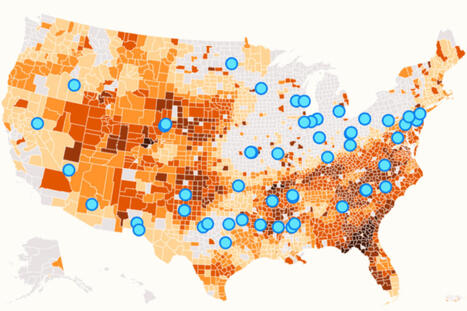
It seems that one of the hottest topics in the industry is Direct-to-Device (D2D) cellular service that can bypass terrestrial cell towers and connect cellphones directly to satellites. I’ve already seen claims being made that D2D technology will solve the rural cellular issue since everybody will have cell coverage. Today’s blog looks at some of these claims.
From 2015 to 2024, average retail electricity prices decreased by 3.5% for every doubling of data center capacity, new research finds. In the era of hyperscalers, the rising unpopularity of data centers has become inextricably linked with the fear of skyrocketing utility prices. A YouGov poll administered last year found that among 1,000 Americans, more than two-thirds expected electricity prices to rise if a data center was built in their area. Earlier this year, Goldman Sachs projected the AI infrastructure buildout to increase electricity costs by 6% between 2026 and 2027, and an additional 3% by 2028. But a recent working paper from the Electric Power Research Institute is complicating the relationship between the AI boom and what it means for Americans’ electric bill.
As the AI revolution accelerates, semiconductors have become the most critical hardware enabling the compute, memory, and connectivity required to strengthen sovereign AI. The United States has made an historic commitment to rebuilding semiconductor manufacturing. New fabrication facilities are under construction, advanced process nodes are returning to domestic soil, and billions of dollars are being being invested across the semiconductor value chain. The next challenge is less visible but equally important.
It’s so hard for big businesses to get AI tools working reliably that whole new organizations of forward-deployed engineers or FDEs — specialists who drop into a company to get its AI systems up and running — are springing up to help them. “AI, paradoxically, increases the demand for professional services,” says Efrat Rapoport, a former Salesforce executive whose new company, June, emerged from stealth Monday morning. “The industry’s answer to AI implementation is, ‘let’s hire more and more and more people’.”
Officials from the Massachusetts Broadband Institute and Community Broadband Networks America — an independently-owned fiber Internet service provider — gathered with dozens of residents at two Southbridge Housing Authority properties to celebrate the expansion of the state's Residential Retrofit Program. The event marked the latest milestone for a program that, more than two years after its launch, has grown from a $22 million pilot project into a $74 million initiative to rewire some of the Commonwealth's oldest affordable housing stock in order to allow residents living there faster and more reliable access to the Internet.
What do surveillance, A.I., and broadband policy have in common? Chris and Sascha connect the dots. In this episode of Unbuffered, Chris is joined again by Sascha Meinrath, Palmer Chair of Telecommunications at Penn State University and Director of X-Lab, for a wide-ranging conversation about privacy, artificial intelligence, and “The Cost of Inaction” in Pennsylvania.
Everything the world’s briefly richest man built is failing at once. On the morning of September 10, 2025, Larry Ellison was the richest man alive. Oracle had reported earnings the night before, and the story inside the numbers was a backlog: hundreds of billions of dollars in contracted future cloud revenue, nearly all of it from artificial intelligence, the largest single piece of it from one customer. The stock rose as much as 43 percent in a day. Ellison, who owns roughly 40 percent of the company he founded in 1977, gained $101 billion overnight — the largest single-day wealth gain ever recorded on the Bloomberg Billionaires Index — and passed Elon Musk, his net worth cresting at $393 billion. He was eighty-one years old, and every bet he had ever placed appeared to pay off on the same morning. The customer was OpenAI. The contract was three hundred billion dollars of computing capacity over roughly five years, sold to a company that has never earned a profit and burns billions in cash every year. The market heard the number and paid Ellison for it as if the money were already in the vault. Ten months later, the ledger reads like a curse working its way through everything the man owns.
Lately I’ve been hearing a lot about data sovereignty. Indian Tribes want data sovereignty. Countries around the world and state and local governments in the U.S. are talking about data sovereignty. Corporations are talking about data sovereignty, even though they use different terms to describe it. The concept behind data sovereignty is simple. It means keeping data internally and not sharing it with the outside world, which today means keeping it away from the AI companies that are training their models on every bit of data they can put their hands on.
New York's data center moratorium reveals as much about what's missing as what it addresses. New York is the first state in the nation to establish a moratorium on data center construction. Governor Kathy Hochul signed the executive order June 14 pausing “hyperscale” data center construction in the state—data centers that use 50 megawatts or more to operate (the equivalent of roughly 40,000 homes).[i] Recent reports suggest at least 28 new datacenters have been proposed, many of which would consume 20 or more megawatts. If all were approved, they would increase electricity demand in the state by at least one-third, at a time when the state’s electricity grid is aging and at capacity. The response by New York speaks to the growing resistance from the public to the new AI industrialization boom. Data centers themselves are not new, and their growth is essential to powering the revolution we’ve seen in AI capabilities. The economic power of AI is an important driver of current economic growth in the US. But the current shift in public mood is due to a set of factors, including increased electricity costs, worry about water usage and increases in greenhouse gas pollution, and an overall public malaise around AI.
In mid-July, the European Commission accepted X's corrective action plan to terminate its breaches of the Digital Services Act (DSA), including the failures on researcher data access under Article 40(12) that accounted for €40 million of the €120 million fine issued in December 2025. In an earlier analysis for Tech Policy Press, Oliver Marsh and LK Seiling unpacked what the December fine decision revealed about the Commission's interpretation of Article 40. That decision identified four failures: an overly restrictive interpretation of researcher eligibility, deficient application review processes, limited quotas and access duration, and contractual prohibitions on independent data collection. X's accepted commitments respond almost point by point: X will revise its screening process so that eligible researchers are not excluded in error, provide access free of charge, ensure timely access "including to the appropriate volumes of data" with significantly reduced application processing times, and update its terms to state explicitly that eligible researchers are not contractually prohibited from scraping publicly available data. X has six months to implement the plan, will be subject to an external independent audit, and remains under enhanced supervision.
|