

Why does Public Media Network still exist with social media? The answer has nothing to do with reach, and everything to do with who owns the infrastructure.


|
Scooped by
Chuck Sherwood, Former Senior Associate, TeleDimensions, Inc
onto Surfing the Broadband Bit Stream April 16, 9:32 PM
|
 Scoop.it!
Why does Public Media Network still exist with social media? The answer has nothing to do with reach, and everything to do with who owns the infrastructure.

 Your new post is loading...
 Your new post is loading...
Your new post is loading...
Scoop.it!

From
www

On Tuesday, Amazon announced it would be acquiring Globalstar, a company that manufactures and operates low-Earth-orbit satellites with the spectrums needed to communicate with devices on the ground. Amazon also says it is partnering with Apple, which has relied on Globalstar to provide off-grid emergency communication features on devices like its iPhone and Apple Watch.
The $11.57 billion deal is Amazon’s latest effort to take on Elon Musk’s Starlink. It comes at a time when satellite internet is becoming critical to the spread of AI tech, but it also adds to concerns about what happens when our orbit fills up with junk. Here’s what to know about the Amazon deal.
Scoop.it!

From
www
In a letter obtained by WIRED, the Energy Information Administration tells two senators that it plans to develop a mandatory assessment of data centers' energy use.
Scoop.it!
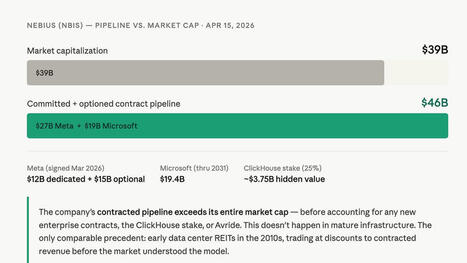
On March 11, I finished a deep analysis of Nebius Group (NBIS). The thesis: NVIDIA’s $2 billion investment was not a capital story — it was a structural validation that most investors were misreading.
I didn’t publish it in time.
The stock was at $112 that day. It’s at $162 today — a 44% move in 35 days. The all-time high, set earlier today, is $166.
I’m not writing this to complain about timing. I’m writing it because the story has changed again — and this time the magnitude of the change is large enough that the original thesis needs to be rebuilt from scratch, not updated with footnotes.
Scoop.it!
From
medium
Thanks to Chandler Vaughan from the Virginia Office of Broadband, I’ve learned that NTIA recently issued guidance outlining how state broadband offices can make changes to their approved Final Proposals for BEAD when tentative awardees decide to withdraw. This guidance provides clarity on the process, ensuring that communities are not left stranded when companies step back from participating.
Key takeaway: States not only have the freedom, but also the responsibility, to select alternative providers to address gaps in coverage caused by sub-awardee withdrawals. This flexibility allows states to maintain momentum and ensure that locations are not left without service.
This process means that, before the final grant agreements are executed, there is likely some negotiation and adjustment happening in many states. States are actively working to fill any gaps and ensure that their BEAD projects proceed as planned.
Scoop.it!
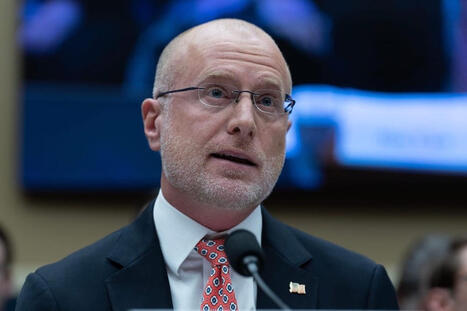
WASHINGTON, April 16, 2026 – A longtime telecom journalist asked federal regulators Wednesday to look into whether Verizon was violating an agreement with contractors. On Thursday morning Federal Communications Commission Chairman Brendan Carr suggested he was concerned.
“If Verizon is not living up to their commitments, then that would be a problem,” Carr posted on X in response to Wireless Estimator editor Craig Lekutis’s story.
In exchange for FCC approval of its $20 billion acquisition of Frontier, Verizon reached a deal with NATE, which represents telecom contractors, to institute a more transparent procurement process and account for inflation in its pricing, among other things.
Scoop.it!

From
prospect
It’s almost impossible in these times to find a specific policy issue on which Democrats and Republicans agree, but there is one: opposition to data centers in their backyards.
This bipartisan concurrence, I hasten to add, is found chiefly in areas where data centers have already been built and begun to operate. Proximity, it appears, breeds contempt.
A Washington Post/Schar School poll released yesterday shows that the share of Virginians saying they’d be “comfortable” if a new data center were built in their community has plummeted to half the level it was at just three years ago.
Scoop.it!
From
x
Scoop.it!

From
techcrunch
Krieger's departure and any forthcoming design tools will be another data point for investors who fear the SaaSpocalypse — that the largest AI labs will come to dominate software businesses, a thesis that has rocked public markets at times this year.
Scoop.it!

A new agreement between San Jose and PG&E is the latest in a string of moves by the California utility, aimed at supporting data centers’ power need.
In sum — what to know:
Power partners – The agreement between the city of San Jose and PG&E is the first of its kind, and introduces 2,000 megawatts of new transmission capacity. Speed and certainty – The partners want to attract data center development and make San Jose a major data center hub by removing uncertainty around grid connection and capacity. Golden State of mind – Utility PG&E is working on 18 new data center projects across the state that are in the final phase of engineering and expected to come online between 2026-2030. In the heart of Silicon Valley, San Jose, California wants more than just tech HQs. It wants the data centers, too. So the city is working with utility PG&E to supercharge its grid, adding about 2,000 megawatts (MW) of transmission capacity via two new high-power lines by 2028, to support new data centers under development. It’s part of San Jose’s bid to become Silicon Valley’s — and the West Coast’s — server center.
Scoop.it!

California initiated its Middle-Mile Broadband Initiative (MMBI) in July 2021 with $3.25 billion in funding authorized by Senate Bill 156. On April 2, Governor Newsom announced that the first portion of the network would be activated and ready to provide wholesale broadband access.
MMBI is an extensive fiber network that stretches across the state, as shown on the map below. What’s not obvious on this map is how the network reaches throughout cities like Los Angeles to reach underserved and low-income neighborhoods.
Scoop.it!
From
www
Globalstar provides satellite connectivity on iPhones, but Amazon and Apple say the $11.6 billion deal won't change anything. For now, it creates a new rival to SpaceX's Starlink Mobile.
Scoop.it!

Damon Lindelof is an Emmy Award-winning writer and producer, best known for co-creating Lost, The Leftovers and Watchmen. He’s among more than 1,000 creators and professionals across the film and TV industry who signed an open letter opposing the Paramount Skydance-Warner Bros. Discovery merger that was released on Monday. The following post from Lindelof’s Instagram feed is reprinted in Pressing Issues with his permission.
When I was asked to sign a letter that openly opposed the sale of Warner Brothers to Paramount Skydance, I felt two things. The first was that yes, absolutely, of course, I opposed it. The second was, oh shit, I’m afraid to say so publicly.
Fear is embarrassing. No one wants to be the guy puking in the boat in Saving Private Ryan. They want to be the ones storming the beach. So why was I afraid?
Some implied retaliation? Being put on some list of rabble-rousers? Getting kicked off the beloved Warner Brothers backlot I have called home for the last 15 years?
I actually sort of know my (potential) new boss, David Ellison. We produced a few things together not too long ago, and I found him to be bright, ambitious and passionate. He loved movies and trusted the people he made them with. But still …
Better not to risk it. Me opposing an inevitable merger would be pointless, and signing a letter that will evaporate into the shitstorm of an unrelenting news cycle would be even more pointless.
But is it?
Pointless?
Scoop.it!
From
www
In July 2024, a voltage fluctuation rippled through Northern Virginia’s “Data Center Alley” and knocked 60 data centers offline simultaneously. Gone in an instant: 1,500 MW of load, roughly equal to a mid-sized city. The grid operator, PJM, scrambled to stabilize frequency. It was a 10-second glimpse of a problem that’s only getting worse.
Electricity demand is surging on both sides of the Atlantic, driven by AI data centers, EV adoption, and the electrification of heating and industry. U.S. winter peak load could climb 21.5% over the next decade. The EU wants electricity to reach 50% of its final energy mix by 2040. But the grid wasn’t built for this, and new infrastructure takes years to permit and construct.
The standard playbook offers two bad options: wait years for new connections, or curtail the very loads (data centers, factories) driving economic growth. A new report from the Schneider Electric Research Institute proposes a third path. The report’s case is simple: smarter buildings can free up grid capacity faster than new infrastructure can.
|
Scoop.it!

From
www
AI is making it easier to design chips and optimize software for different silicon. Some startups envision a revolution in chipmaking.
Scoop.it!

STANFORD, Calif., April 16, 2026 — Artificial intelligence is arriving in American courtrooms before the rules governing it, as state judges experiment with AI tools to manage overwhelming dockets and lawyers face consequences for submitting fabricated citations.
The pressure on American courts was the backdrop Thursday at Stanford Law School's Codex conference, where panelists described judges managing more than 100 cases some mornings and three-quarters of litigants appearing without a lawyer.
Over 60 percent of federal judges have used AI at least once.
Scoop.it!

From
www
WIRED tracked down some of the most prominent figures of last year’s DOGE invasion. Here's where they are now—in government and beyond.
Fourteen months ago, WIRED introduced the world to a cadre of young, inexperienced technologists who were working with Elon Musk’s newly formed, so-called Department of Government Efficiency. These workers, many of them between the ages of 19 and 24, were given the keys to the US government. They were also quickly the subject of controversy, as they laid waste to government agencies with little rhyme or reason. When Musk departed DOGE, many of the people who constituted DOGE’s early strike force dispersed.
But as the dust has settled, it’s clear that DOGE’s efforts have caused lasting damage in both large and small ways—from the more than 300,000 federal workers fired to the destruction of the US Agency for International Development to even just increased wait times for assistance on the Social Security Agency’s phone lines. Yet its members have been given positions of increased responsibility, both inside the government and out, despite the fact that DOGE’s own members described the organization as “chaotic” and the group failed to achieve many of its goals. Musk’s DOGE may no longer exist as it did a year ago,
Scoop.it!

From
www
Broadband infrastructure will determine whether the U.S. leads the AI revolution.
Artificial intelligence may define the next era of global innovation — but its success depends on something foundational.
In a new op-ed in National Review, NCTA President & CEO Cory Gardner writes that America’s ability to lead in AI will ultimately depend on the infrastructure, policies, and innovation ecosystem that support it.
Drawing a parallel to earlier technological change, Gardner notes that just as farmers in the 1930s resisted moving from horse-powered machinery to tractors, “AI is today’s tractor. But unlike the 1930s, when leadership in the technological revolution was determined by who built the flashiest and best-marketed models, winning the AI revolution will be determined by who builds and protects the infrastructure that makes AI possible in the first place.”
Scoop.it!

From
www
The Trump Administration is threatening to withhold funds from states that lawfully regulate AI and broadband. Those threats are likely unlawful.
What's going on?
In 2021, President Biden signed the Infrastructure Investment and Jobs Act (IIJA), which allocated over $42 billion to the new Broadband Equity, Access, and Deployment (BEAD) Program to ensure high-speed Internet access for every American.[1] That money was allocated across 56 states and territories responsible for selecting the providers that will build connectivity to unserved and underserved locations.
After President Trump’s second inauguration, his administration implemented several changes to the BEAD Program. Among them are two new conditions on state funding.
Scoop.it!

Let’s put aside the argument of whether LEO/satellite should “count” as covering a BSL with service in BEAD. BEAD’s goal was and is "universal coverage.” It’s defined as available coverage for each and every BSL in the US. Each and every location in our country should be able to connect to robust internet speeds (100/20), affordably.
But… without actual consumer uptake, we are only presenting the appearance of universal coverage. Its adoption, not availability, that bridges the rural digital divide. BSLs covered by LEO/satellite are a long way from being connected. I’m reminded by carrier claims back in the day that they “covered” a home or business... but coverage only existed with a multi-thousand-dollar investment from the location that needed to be connected. Coverage isn’t connection. Uptake and adoption are connection.
Scoop.it!
Why does Public Media Network still exist with social media? The answer has nothing to do with reach, and everything to do with who owns the infrastructure.
Scoop.it!

The FCC has been directed by Congress to free up 800 MHz of mid-range spectrum that will then be auctioned off to commercial users. One of the important steps to repurpose spectrum is that existing users of spectrum must be relocated to other spectrum bands before the auction winner can use the spectrum.
Two decades ago, Congress formalized some of the spectrum relocation process with the Commercial Spectrum Enhancement Act (CSEA), which created the Spectrum Relocation Fund (SRF). This fund was created to pay for the cost of federal agencies that have to change to using a different spectrum band if the spectrum they had been using is sold in an auction. By statute, any auction of federal spectrum must raise at least 110% of the estimated relocation costs for the federal incumbent, ensuring the move does not cost taxpayers. The SRF fund covers the cost of planning, research and development, and hardware upgrades needed to change to a different spectrum. The process of a federal agency having to relocate its spectrum use is handled by the NTIA.
Scoop.it!

My CBSD Goes to 11: Why Turning Up the Volume Could Silence the CBRS Innovation Band
The Citizens Broadband Radio Service (CBRS) has been hailed as the "innovation band," a landmark three-tiered spectrum sharing framework that allows over 1,000 different operators to coexist seamlessly.
However, a new technical analysis by Valo Analytica, prepared for Spectrum for the Future, warns that proposals to significantly increase allowed power levels could effectively dismantle this ecosystem. Currently, CBRS relies on relatively low power limits that allow many users to share limited spectrum resources efficiently and harmoniously.
The new study, titled Negative Impacts of Higher-Power Operation on the Citizens Broadband Radio Service, explores what happens when megaphones are deployed among the whisperers.
Read the full report here.
Scoop.it!

An important conversation around what happened when federal agents came to Minnesota—and how communities responded.
In this episode of the podcast, Chris Mitchell is joined by David Brauer and Lisa for a candid conversation about what happened when federal agents came to Minnesota and how communities responded.
The episode begins with a timeline of events, from early organizing efforts to a significant escalation, when thousands of federal agents, including ICE and Border Patrol, came to Minnesota. They discuss how rhetoric increased over time, how certain communities were targeted, and how a “multi-jurisdictional” federal presence took shape.
From there, the conversation focuses on what people experienced on the ground.
Scoop.it!

From
www
For too long, businesses on Cape Cod and across Southeastern Massachusetts have faced an uncomfortable choice: build and maintain their own costly server rooms, or ship their critical IT infrastructure hours away to a major metro data center they can rarely visit. OpenCape's Data Center changes that equation entirely.
Scoop.it!
FESTUS, Missouri — Voters in a small Missouri town, unhappy with the city council’s approval of a $6 billion data center, struck back at the polls last week, ousting all four incumbent council members running for reelection.
Tuesday’s election in Festus, Missouri — a city of 12,000 people along the Mississippi River a half-hour south of St. Louis — is the latest example of growing public backlash against cities agreeing to host hyperscale data centers over the objections of residents concerned about their local impacts.
On the same day as the Festus election, voters in Port Washington, Wisconsin, a Milwaukee suburb, where tech giants Oracle and OpenAI are building a $15 billion data center campus, also registered their disapproval by overwhelmingly passing a first-of-a-kind referendum to restrict future projects. At least three other cities across the country will vote on similar measures this year.
|





