New interviews and closely guarded documents shed light on the persistent doubts about the head of OpenAI, Ronan Farrow and Andrew Marantz write.
n the fall of 2023, Ilya Sutskever, OpenAI’s chief scientist, sent secret memos to three fellow-members of the organization’s board of directors. For weeks, they’d been having furtive discussions about whether Sam Altman, OpenAI’s C.E.O., and Greg Brockman, his second-in-command, were fit to run the company. Sutskever had once counted both men as friends. In 2019, he’d officiated Brockman’s wedding, in a ceremony at OpenAI’s offices that included a ring bearer in the form of a robotic hand. But as he grew convinced that the company was nearing its long-term goal—creating an artificial intelligence that could rival or surpass the cognitive capabilities of human beings—his doubts about Altman increased. As Sutskever put it to another board member at the time, “I don’t think Sam is the guy who should have his finger on the button.”
At the behest of his fellow board members, Sutskever worked with like-minded colleagues to compile some seventy pages of Slack messages and H.R. documents, accompanied by explanatory text. The material included images taken with a cellphone, apparently to avoid detection on company devices. He sent the final memos to the other board members as disappearing messages, to insure that no one else would ever see them. “He was terrified,” a board member who received them recalled. The memos, which we reviewed, have not previously been disclosed in full. They allege that Altman misrepresented facts to executives and board members, and deceived them about internal safety protocols. One of the memos, about Altman, begins with a list headed “Sam exhibits a consistent pattern of . . .” The first item is “Lying.”
Roger Entner, of Recon Analytics, published an article in Light Reading that challenges the paradigm of the benefits of convergence. Convergence has most recently come to mean bundling broadband and cellular service.
There is a widespread industry belief that ISPs need to have a cellular product to thrive, and cable companies have added a cellular product in the name of convergence.
Entner says there is only one kind of convergence that makes a real market difference – fiber ISPs with a cellular product do far better than any other kind of convergence.
Further expands American wireless leadership by boosting coverage and connectivity for underserved communities in remote regions, through joint efforts including enhanced satellite capacity.
The Joint Venture (JV) will accelerate American leadership in next-generation direct-to-device (D2D) communications by using satellite-based technologies to address coverage gaps, especially in unserved and underserved communities. This initiative will help America extend its global leadership in wireless communications technology and services by delivering exceptional, resilient connectivity and creating the best and most diverse ecosystem for wireless and satellite products and services
The JV will extend mobile connectivity for wireless customers through joint investment in using satellite-based, direct-to-device (D2D) technologies to supplement coverage gaps
Customers will have a more seamless experience, especially in remote areas where traditional cell networks have limited or no service
Collaborative approach will expand customer choice by bringing together IP and terrestrial spectrum and creating industry specifications to enable a more seamless experience for customers and satellite operators
AT&T, T-Mobile, and Verizon have an agreement in principle to form a new JV which aims to end wireless dead zones in the U.S., including in rural areas, by pooling limited spectrum resources to increase capacity, improve the customer experience, and help satellite providers reach more customers through a unified platform. The JV remains subject to negotiating definitive agreements between the parties and satisfying customary closing conditions.
Collectively, satellite services function as supplementary components to the core wireless services customers depend on. By collaborating on this JV, the partners will be able to enhance convenience for their customers, enable competition and foster innovation and growth within the industry.
Fixating on questions of whether Altman is untrustworthy, or whether Musk is even less so distracts from a far deeper problem with AI.
If it wasn’t already clear, Elon Musk and Sam Altman hate each other.
While the two men were once co-founders of OpenAI, they’re now locked in a vicious feud, playing out in all its theatrics in front of a judge and jury in a California courtroom. Musk is suing, alleging that Altman and OpenAI’s president, Greg Brockman, tricked him into forming and funding the organization as a non-profit before they subsequently restructured it to have a for-profit entity. OpenAI says Musk was well aware of those plans and frames the lawsuit as an attempt to derail a competitor.
I know this story all too well. I’ve been reporting on OpenAI since 2019, embedding within its office for three days shortly after Musk stepped away and Altman formally took up the CEO position. If there’s anything I’ve learned from my years of following this company and the AI industry, it’s that this world breeds bitter rivalries.
It’s not a coincidence that nearly all of OpenAI’s original founders left the company under acrimonious conditions, nor that every tech billionaire has a largely identical AI company. The frenetic AI race is inseparable from the petty, clashing egos of the unfathomably rich, hellbent on dominating one another.
Indeed, if Musk were to win his bid, that could be devastating for OpenAI, especially as it prepares this year for a potential initial public offering. Musk seeks $150bn in damages from the company and one of its top investors, Microsoft. He also seeks to return OpenAI to a non-profit, to remove Altman and Brockman as leaders of the for-profit, and to boot Altman off the non-profit board.
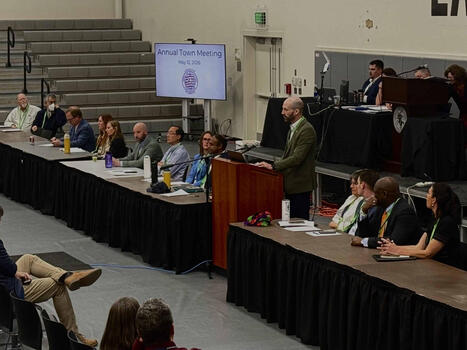
LONGMEADOW, MA — A town-owned fiber network has been a hot topic of debate in Longmeadow since the idea began in 2024, and especially for the months leading up to the Annual Town Meeting.
Now that the meeting has come and gone, the debate has as well.
The Longmeadow High School lobby was filled with chatter from voters before the May 12 meeting began murmuring that Article 7 was “the big one.”
Discussion took place for an hour and the article was shot down in a 374-270 vote.
Article 7 was looking to see if the town would approve the appropriation of $8.6 million for the initial phases of the $27 million fiber project, paid for by a property tax increase of $97 per year. Ben Brown, a member of the original Municipal Fiber Task Force, was chosen as the Select Board’s designated speaker. Brown presented a final look into the benefits of approving the project, how the town got here, why it matters and what the town would have owned after the fact.
Brown said that other companies had filed pole applications but nobody had built anything yet, stating that the town couldn’t wait for “someone else to decide we’re worth their investment, we have to decide for ourselves.”
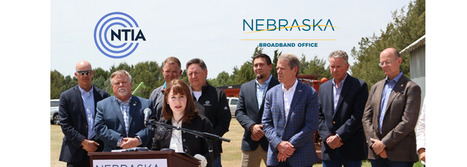
Today in western Nebraska, NTIA Administrator Arielle Roth and Nebraska Governor Jim Pillen commemorated the nation’s first “live” BEAD customer connection. Its made possible by the $42.5B BEAD program and Nebraska’s allotment of ~$405M.
The first customer, located near Ogallala, NE is receiving service levels of 800 Mbps download and 200 Mbps upload, significantly higher than the program’s required 100/20 Mbps. Additionally notable is the fact that Vistabeam’s connection is a full 11 miles from our tower.
Within the Ogallala area, Vistabeam was awarded funding for two tower upgrades to serve 93 BSLs. Service was turned on last week, two months after Vistabeam signed its contract with the state and two days after National Environmental Policy Act (NEPA) approval.
Building Stronger Communities: Massachusetts Community Media. MassAccess video in support of H.91, S.2556 - An Act to modernize funding for community media programming. The video includes a collection of clips from many community media and public access centers across the Commonwealth.
Featured Speakers: David Gauthier: Executive Director of WinCam & (former) President of MassAccess Nancy Albertson: Executive Director of Billerica Access TV Elizabeth Shanahan-Jewett: Executive Director of The Local Seen (serving the towns of Plymouth, Pembroke, Kingston, Duxbury, and the South Shore Region) Karen Henderson: General Manager of Westborough TV
Featuring Footage from the following Centers: WMCT-TV (Marlborough), Focus Springfield, Westborough TV, Westwood Media Center, Milton Access TV, NewTV (Newton), Boston Neighborhood Network, Nantucket Community TV, LexMedia (Lexington), Wilmington Community TV, The Local Seen (Plymouth, Pembroke, Kingston, Duxbury), Lynn Community TV, Northampton Open Media, Minuteman Media (Concord, Carlisle)
On May 1, Nextlink Internet activated what it is calling “the first tower in the nation funded by the federal BEAD program.” The site is located in southern Bienville Parish, LA, bringing service to 104 BEAD locations in the area. It is designed to deliver gigabit internet speeds and higher to homes and businesses across northwest Louisiana via fixed wireless infrastructure.
Here’s a fun fact kids… Rhode Island was the first colony to declare independence from Great Britain. Two months before the Declaration of Independence was signed, Rhode Island passed its "Act of Renunciation."
I recently sat down with Brian Thorn, the Director of Broadband Strategy for the Rhode Island Commerce Corporation. In essence, Thorn leads the statewide broadband office employing a team of 3-plus professionals within the state’s economic development engine.
Thorn has held the Rhode Island broadband director position for four years, operating out of Providence.
Alachua County and Windstream have completed over 80% of a rural broadband rollout, deploying 365 miles of fiber to 3,950 locations since last year.
The $14 million ARPA-funded project targets underserved areas like Island Grove and High Springs, accelerating broadband access by four years to finish by Q3 2026.
Alachua County and Windstream entered into an agreement a year ago to deploy broadband to four rural areas, and officials now say the work is over 80% complete.
Rex Reeves with Kinetic, Windstream’s fiber offering, said 365 miles of fiber optic cable had been deployed in the last 12 months, with 3,950 locations served. He said the rollout is projected to finish in the third quarter of 2026 and around six months ahead of schedule.
The county set aside $14 million from its American Rescue Act Plan (ARPA) funds for broadband assistance in underserved or unserved areas. The agreement with Windstream focused on Island Grove, Earleton/Orange Heights and sections north and south of High Springs.
Gas turbines at xAI's Colossus 2 data center have drawn a lawsuit over the company's use of "mobile" gas turbines as power plants.
Elon Musk’s xAI is running nearly 50 natural gas turbines at its Mississippi data center, power plants that the state is currently not regulating thanks to a loophole.
The power plants are considered “mobile” by the state of Mississippi because they are sitting on flatbed trailers, thus allowing them to dodge air pollution regulations for one year. The NAACP, which has filed a lawsuit on behalf of residents in the area, says the unchecked emissions from the turbines is worsening air quality in an already polluted region. This week, it asked the court for an injunction against xAI.
Facility would require more power than entire state uses and suck up vast amount of water in drought-stricken area.
A plan to create one of the world’s largest datacenters, a gargantuan project spanning an area more than twice the size of Manhattan, has provoked a furious public backlash in Utah amid concerns over its vast energy use and impact upon the state’s stressed water supplies.
The Stratos artificial intelligence datacenter footprint will cover more than 40,000 acres (62 sq miles) over three sites in Box Elder county in north-western Utah. The facility will require about 9GW of power, which is more than the entire state of Utah currently consumes, and suck up a significant amount of water in an area that has been hit by severe drought in recent years.
The Okanogan County Electric Cooperative and the Okanogan County Public Utility District say they’re making steady progress on bringing affordable fiber broadband access to Okanogan County, a highly rural stretch of rugged land in Washington state on the border of Canada.
According to the organizations, the coalition is poised to bring next-generation fiber to as many as 1,366 peppered along the upper Methow Valley this year starting near Chewuch River and ending at Lost River. Many of these areas will be seeing fiber upgrades for the first time ever after years stuck on the wrong side of the digital divide.
According to a presentation at a town hall last month, officials stated that the project will include 98 miles of underground fiber deployment and 88 miles of new aerial fiber deployment. A mainline backbone fiber between Twisp and Winthrop is completed and functional, providing a redundant loop feed of fiber between the two areas, they stated.
From electric vehicles to drones to solar to AI, the Chinese are doing what the U.S. used to - investing and competing. Chinese strategy is also predatory, but we could learn a thing or two from them.
Today, Donald Trump is in China negotiating with Xi Jinping, with the possibility of reordering the global economy. As with most of these kinds of summits, the symbolism and pomp is rich. Trump understands imagery, and he brought with him a group of CEOs. In this picture, where Trump is greeted by Chinese Vice President Han Zheng, you can see Elon Musk and Nvidia CEO Jensen Huang in the background.
These men are both worth over $100 billion, and they project Trump’s view that dominant American firms represent the strength of the nation.
What has happened so far? Rush Doshi, a savvy China analyst, noted there were few promises here and there, but ultimately not very much has yet occurred.
Precision agriculture is no longer optional. Farmers increasingly rely on connected equipment, sensors, automaton, and cloud-based analytics to optimize operations, reduce inputs, and improve yields. This shift is driving a fundamental change in network requirements, with farms now demanding higher upstream capacity, lower latency, greater reliability, and scalable connectivity across large geographic areas.
In this episode of Unbuffered, Chris is joined by Ernesto Falcon, Program Manager of Communications and Broadband Policy at the California Public Utilities Commission for a conversation about competition, mergers, and how to make sure the lowest-income households have access to an Internet connection that allows them to participate in the economy and civic life, as well as access telehealth and educational services on an equitable playing field.
Along the way, they talk about how public advocate offices like the state of California's serve the public interest, and serve also to inform policies that make state infrastructure and affordability programs as impactful as possible. Ernesto shares how recent research (and community partners) have driven new insight and tools to help level the playing field in a marketplace mishapen by promotional pricing schemes by the biggest ISPs. Finally, Chris and Ernesto talk about the Charter Spectrum/Cox merger, and the strong set of comittments the state of California has gotten in exchange for letting the action proceed, including multi-year commitments that should make getting online easier for all households.
One year ago, President Trump declared the Digital Equity Act “unconstitutional” and “racist and illegal” in a post on Truth Social. The next day, the Department of Commerce sent cancellation letters to every grantee.
Trump’s claim is false. The Digital Equity Act is a bipartisan law passed as part of the Infrastructure Investment and Jobs Act of 2021. It funds digital literacy training, device access, and technical support for rural communities, veterans, seniors, incarcerated people, people with disabilities, and communities of color. The president does not get to repeal a law by posting about it.
The National Digital Inclusion Alliance is suing to stop the illegal cancellation. UCC Media Justice is supporting that effort by coordinating an amicus brief written by the Samuelson Law, Technology & Public Policy Clinic at UC Berkeley School of Law, joined by 22 total organizations.
For the first time, both the Strait of Hormuz and the Red Sea are effectively closed to commercial traffic.
Seventeen submarine cables pass through the Red Sea alone, carrying the majority of data traffic between Europe, Asia, and Africa.
U.S. policy protected chips from Beijing but not infrastructure from Tehran.
Billions of dollars in U.S. technology infrastructure, and trillions more in planned investment, now depend on fiber-optic cables running through war zones.
Amazon, Microsoft, and Google spent years building data centers across the Gulf, betting the region would become the world’s next great hub for artificial intelligence. The undersea cables connecting those facilities to Africa, South Asia, and Southeast Asia pass through two narrow passages: the Red Sea and the Strait of Hormuz. Both are now effectively closed to commercial traffic.
The Red Sea and Strait of Hormuz carry all undersea cable traffic to the region’s trillion-dollar tech buildout. Both are now war zones.
The U.S.-Iran conflict has closed the only two routes for data in and out of the region.
For many Americans, data centers represent higher utility bills, noise pollution, tax giveaways, and very few local jobs — all to enrich distant tech giants.
Anew Gallup poll confirms that most Americans hate the prospect of data centers coming to their communities. This revelation has been met with some anger among the tech crowd and its Extremely Online Fans, but the opposition is entirely predictable for a few reasons worth reviewing, even if they are obvious:
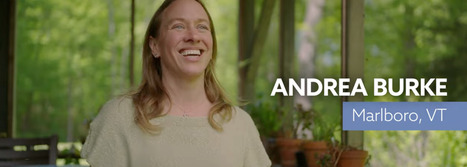
The Burke family in rural Marlboro, Vermont has a new high-speed internet connection. In a short video entitled “Connection Day,” the Vermont Community Broadband Board, shows just how impactful a fiber broadband connection is to a rural home and family. How much broadband access means and the opportunities a reliable connection brings. The short video captures the moment the Burkes are connected by DVFiber.
The Burkes and so many other families are fortunate to be reached and served by one of the state’s nine Communications Union Districts (CUDs). These entities facilitate fiber broadband builds in every corner of the state. DVFiber serves 24 communities in southern Vermont, including Marlboro.
It’s always difficult for ISPs to fully understand how changes in the economy might impact them. Folks in the industry see the usual statistics on unemployment and inflation, but those don’t really tell much about the future as it relates to broadband adoption. I’m not an economist, and this blog is not a prediction, but in the last few weeks, I’ve heard a number of unrelated economic statistics that I find troublesome when taken as a whole.
CHICAGO – Gov. JB Pritzker sent a letter to U.S. Commerce Secretary Howard Lutnick on Tuesday, urging him to approve Illinois’ proposal for federal broadband infrastructure funds.
The $1 billion proposal would connect about 383,000 people, mostly in rural areas, to high-speed internet.
However, Illinois and California lag months behind other states in the approval process – leading to speculation that the funds have been withheld from the two blue states for political punishment or leverage.
The FCC approved EchoStar spectrum sales to AT&T and SpaceX, but requires a $2.4 billion escrow ac | EchoStar won FCC approval for its spectrum transactions with AT&T and SpaceX – and it must establish a $2.4 billion escrow account.
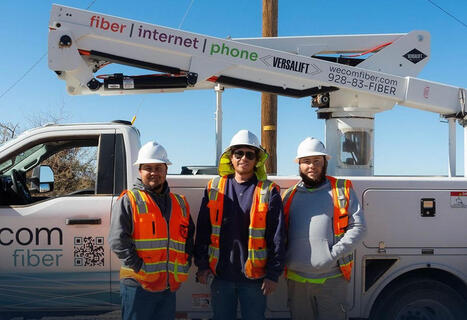
The public-private partnership (PPP) the city struck Arizona-based Wecom Fiber is expected to inject at least $100 million into local economy over five years while saving the city an estimated $18 million in capital expenses.
The fiber network will ultimately pass 30,000 locations within Flagstaff city limits, but also connect 34 municipal facilities. Construction of the network began in April of 2025, and is poised to deliver more than 815 miles of new fiber across Coconino County.
Or that’s at least the conclusion of a new whitepaper by the Fiber Broadband Association, a policy coalition of municipal broadband networks and key fiber industry giants such as Adtran, GFiber, Corning, Calix, and Graybar.
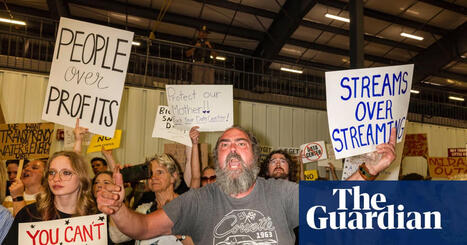
As the “supercharged” construction of new data centers to power artificial intelligence blankets the country, a growing resistance movement to these massive corporate projects amid a lack of public oversight is not far behind.
As organizer Astra Taylor explains, local fights across the country are leveraging this “industry chokepoint” to force important questions, from the distribution of land, water and energy resources to democratic governance over an industry currently driven by a “billionaire Big Tech agenda.”
While AI boosters frame the technology as inevitable, Taylor says, “I think that many people are more skeptical than that. … That’s part of what it means to have democratic governance over AI, to say, 'No, we don't need this technology to take over every facet of our existence.’”
To get content containing either thought or leadership enter:
To get content containing both thought and leadership enter:
To get content containing the expression thought leadership enter:
You can enter several keywords and you can refine them whenever you want. Our suggestion engine uses more signals but entering a few keywords here will rapidly give you great content to curate.


 Your new post is loading...