The DOGE engineer appeared on influencer Nick Shirley's podcast this week to talk corruption and government work—and how they collaborated on Shirley's recent ‘investigation.’
Nick Shirley—the right-wing creator whose YouTube investigation sparked the Trump administration’s immigration crackdown in Minnesota—claims that his most recent video about alleged fraud in California was bolstered by data provided by none other than Edward Coristine, one of the first members of the so-called Department of Government Efficiency (DOGE) known online as “Big Balls.”
Coristine, who joined DOGE at 19 years old with no prior government experience, was staffed across several agencies including the Social Security Administration (SSA) and the Small Business Administration (SBA). Before joining DOGE, Coristine worked at Elon Musk’s Neuralink for several months and founded a startup known for hiring black hat hackers.
In an interview with Coristine published on Shirley’s YouTube channel on Thursday, Shirley claims that Coristine personally pulled data on Medicaid spending for businesses based in California as potential targets. Coristine nodded along, telling Shirley that the government must create more opportunities to crowdsource fraud investigations.
Kudos to The Times for investigating and exposing the use of A.I. to flood major social media platforms with avatars to fool viewers into believing that various pro-Republican avatar comments represent the thoughts of real human beings.
When the public square becomes the marketplace of bots, democracy and free speech suffer a major blow, as bad actors can and do use A.I. avatars to drown out or dilute the speech of the human beings — we the people — who are intended by the Constitution to form and be the agents of speech. This boils down to being a modern version of election campaign fraud.
A year ago today, President Trump abruptly “canceled” the Digital Equity Act (DEA) for being a “woke handout.” He's wrong.
The DEA, created by the Infrastructure Investment and Jobs Act in 2021, directed funding to states, territories, and community organizations to address the Digital Divide and ensure that everyone has internet-enabled devices, reliable internet service, and the skills needed to use broadband to improve their lives. The goal: universal, meaningful connectivity.
The President’s declaration brought to a halt years of considered and considerable work by states, counties, community organizations, national nonprofits, and a multitude of other stakeholders to understand and begin to solve the barriers to universal connectivity. Every state and territory had conducted surveys, held listening sessions, and crafted plans to close the Digital Divide.
HERSHEY, Pa. — Chief Justice John Roberts on Wednesday defended the Supreme Court from what he believes are misconceptions held by the American people that he and his colleagues are “political actors” who are making decisions based on policy, not law.
Speaking at a conference for lawyers and judges in Hershey, Roberts said the Supreme Court is required to make decisions that are not popular and bemoaned that there is not a better understanding among the public of how the court operates.
“I think at a very basic level, people think we’re making policy decisions, [that] we’re saying we think this is what things should be as opposed to this is what the law provides,” Roberts said. “I think they view us as truly political actors, which I don’t think is an accurate understanding of what we do. I would say that’s the main difficulty.”
While he conceded that people have a right to criticize the court and its decisions, he added that there is a tendency to focus too much on politics.
Public Knowledge promotes freedom of expression, an open internet, and access to affordable communications tools and creative works. We work to shape policy.
Inequity is not inevitable. It surfaces through rhetoric from leaders, personnel that mirror the values (or lack thereof) of said leaders, funding structures, policy implementation, and court decisions. In other words, inequity does not appear out of thin air. Inequity begins with an idea from someone’s imagination. It is only through power, resource allocation, and replication that an idea can take shape, gain traction, and impact lives. And it is only through an honest and accurate diagnosis of the problem that we can begin to dismantle the structures, ideas, and systems that perpetuate harm and uphold it, and replace them with systems that allow everyone to thrive.
One year ago today, on May 8, 2025, President Trump announced on Truth Social that he intended to kill the Digital Equity Act. His administration followed through. The Department of Commerce terminated grants under the program, froze the remaining funds out of the $2.75 billion Congress had appropriated, and declared the statute itself unconstitutional. None of that is the president’s call to make. Congress passed the Digital Equity Act in 2021 as part of the bipartisan Infrastructure Investment and Jobs Act. The executive branch cannot repeal a law via a social media post. A lawsuit is now pending, Congress can act, and there is still time to save the program.
President Trump has attempted to strip away Congress’ budgetary control by taking a sledgehammer to worthwhile, bipartisan grant programs that provide essentials like connectivity for the nation’s most vulnerable consumers, including his loudest and proudest supporters.
Plus, NYC has announced $2 million in funding to expand Internet, New Mexico launched a new broadband mapping tool, a bicameral bill could increase participation in the Lifeline program, and more.
“Unprecedented surge in demand driven by the rapid expansion of large-load data centers and broader economy-wide electrification,” is noted by PJM as one of the the three drivers of grid strain, alongside “the accelerated retirement of dispatchable generation due to environmental policy and economics; and significant supply chain and permitting frictions that have extended the time required to bring new resources online.”
David Sirota buckles up for a trip through rural Maine with a Senate candidate that the Democratic establishment doesn’t want — but can't afford to lose.
Just two days after Gov. Janet Mills dropped out of Maine’s U.S. Senate race, David Sirota hopped in a car with Graham Platner — the long-shot candidate who is now the presumptive Democratic nominee — for an unfiltered, on-the-road interview.
In today’s episode of Lever Time, you’ll hear Platner on where he thinks the Democratic Party went wrong, why he thinks the United States went from President Barack Obama to President Donald Trump, how he feels about combat and war, his latest views on gun policy, and, if he wins, what kind of senator he intends to be.
Follow The Lever for investigative reporting on politics, money, and power.
WASHINGTON, May 5, 2026 – It appears Pennsylvania won’t need to change a state labor law in order to access hundreds of millions in federal broadband funding.
NTIA had previously said the state would have to change course.
In yet another bruising blow in the fight to ensure equitable access to high-speed Internet service, an appeals court struck down federal rules this week that aimed to combat digital redlining.
Though the FCC had not exercised its anti-digital discrimination authority in a single instance, the US Court of Appeals for the 8th Circuit ruled that the FCC had exceeded its authority by even having a rule that threatened to impose liability on ISPs for “disparate impact,” instead of relying on instances of “disparate treatment.”
The ruling came despite a mandate from the bipartisan infrastructure law passed during the Biden administration that directed the FCC to develop “rules to facilitate equal access to broadband internet access service” that would prevent “digital discrimination of access based on income level, race, ethnicity, color, religion, or national origin.”
Not adopted until 2023 after a lengthy rulemaking process and public comment period, when the FCC published its final digital discrimination rules it gave the agency the authority to penalize Internet Service Providers (ISPs) whose policies resulted in “disparate impact,” even if the agency couldn’t prove deliberate discriminatory intent.
WASHINGTON, D.C.—(May 5, 2026)—The Fiber Broadband Association (FBA) today announced its latest policy paper, "U.S. Broadband Policy’s North Star: Fiber is the Key to Closing the Digital Divide", offering a forward-looking framework for policymakers and industry leaders to strengthen U.S. competitiveness in a rapidly evolving digital economy.
The broadband industry is shifting from federal investment planning to execution and long-term network planning. The paper highlights the need to prioritize infrastructure that can support emerging technologies, economic expansion, and sustained connectivity demands. It emphasizes fiber broadband as the only technology capable of delivering the scalability, reliability, and performance required for an increasingly AI-driven, data-intensive future.
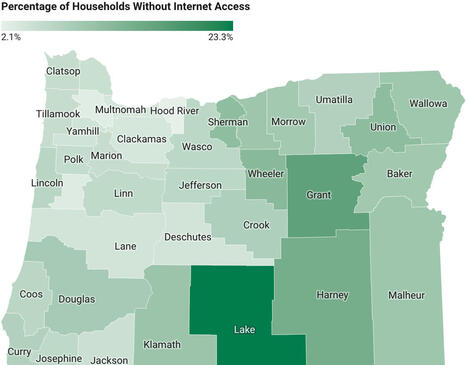
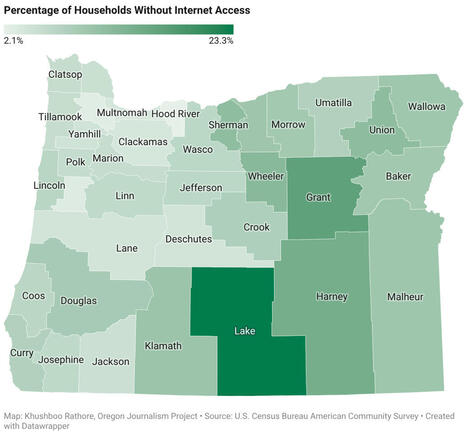
In February, when Oregon lawmakers were reworking the state’s budget in the face of massive looming federal cutbacks, a little-known state agency announced it had received a colossal federal grant—$689 million—to finally bring high-speed internet access to rural parts of the state. In an age of remote work, online shopping, and 24/7 connectivity, nearly 84,000 Oregon households still have no way to access email or social media, let alone do a Google search or chat with an AI assistant.
The most recently available five-year estimate by the U.S. Census Bureau’s American Community Survey shows that about 5% of households in Oregon have no internet access—no satellite internet, no cellular data, no broadband.
Communities like Longmeadow deserve an honest debate about costs, governance, and accountability, not recycled myths designed to spread misinformation, protect the status quo, and discourage local choice.
As more people cut the cord and drop their cable TV subscriptions, public access channels are losing a vital source of revenue. For decades, cable television companies have paid franchise fees to local municipalities as compensation for use of the public right of way, through which the companies route cables and utilities. Those fees have funded local stations focused on public, educational, and governmental access programming.
"As there's migration to digital entertainment and to streaming, there is no local investment — there's no local jobs, there's no local programming," says Michael Max Knobbe, executive director of BronxNet in New York.
We also speak with Joe Barr, executive director of Access Sacramento in California, who says the station is "of the community, by the community, for the community." He adds that as the corporate media continues to consolidate, "it really could be a dire situation for getting a broad spectrum of viewpoints."
Hundreds of millions of dollars are now dedicated to satellite and fiber internet programs around the state that will begin construction in late 2026.
In February, when Oregon lawmakers were reworking the state’s budget in the face of massive looming federal cutbacks, a little-known state agency announced it had received a colossal federal grant — $689 million — to finally bring high-speed internet access to rural parts of the state.
In an age of remote work, online shopping and 24/7 connectivity, nearly 84,000 Oregon households still have no way to access email or social media, let alone do a Google search or chat with an AI assistant.
The most recently available five-year estimate by the U.S. Census Bureau’s American Community Survey shows that about 5% of households in Oregon have no internet access — no satellite internet, no cellular data, no broadband.
The legal battle between Disney and the FCC is heating up. ABC has filed an "extraordinary" legal letter accusing the Trump administration of using the FCC to "violate the First Amendment".
In a major legal escalation, ABC has formally accused the Federal Communications Commission (FCC) of violating the First Amendment. In a letter signed by renowned Supreme Court litigator Paul Clement, the network argues that the Trump administration is weaponizing regulatory power to "chill" political discussion and upend decades of established media law.
The conflict centers on an inquiry into "The View," ABC's long-running daytime talk show. Chairman Brendan Carr has recently questioned whether the program truly qualifies for news exemptions that have protected it from "equal time" requirements since 2002.
I ran across a reference to Moore’s Law the other day. This was named after Gordon Moore, an engineer who later became one of the founders of Intel. In 1965, Moore observed that the number of transistors that could be squeezed into a given area of a circuit board was doubling every two years.
He predicted this trend would last for perhaps another decade, but the microchip industry kept fulfilling his prediction for over fifty years, and the general consensus is that the Moore’s Law prediction died somewhere between 2016 and 2018. Chip density has continued to improve, but at a slower rate, and there is general consensus that we are getting close to reaching the maximum possible density of transistors, limited by the law of physics.
Restricted access to powerful defensive AI tools like Anthropic’s Mythos leaves some companies, central banks, and nations more vulnerable than others.
AI-driven cyberattacks are surging because models can now weaponize software vulnerabilities within hours of their discovery.
A massive global shortage of cybersecurity professionals is compounding the risk of an “AI bugocalypse.”
With the interconnected nature of the global digital economy, leaving smaller institutions and nations vulnerable means that no one is truly safe from the cascading effects of a breach.
Last month, Anthropic said its new artificial intelligence model, Mythos Preview, had discovered thousands of vulnerabilities in “every major operating system and web browser.”
About 40 tech firms and institutions have initial access to Mythos to bolster their systems, but these do not include most central banks and governments, leaving much of the rest of the world vulnerable, and dependent on companies such as Anthropic, OpenAI, and Google to secure their systems.
Fiercely independent journalist Amy Goodman has spent three decades holding the powerful to account, building the Democracy Now! newsroom into an indispensable source for groundbreaking news and reporting on war zones, protests and movements the mainstream media too often ignore. In the new documentary Steal This Story, Please!, filmmakers Carl Deal and Tia Lessin craft a riveting portrait of journalism’s power — and peril — in an era of corporate control and political attacks on the truth.
The film screened in Philadelphia on World Press Freedom Day, and I had the opportunity to interview Goodman and the Oscar-nominated directors for a TV special produced for PhillyCAM, Philadelphia’s community-media center. We discussed free speech, media consolidation and the role of independent media in liberation movements. Goodman, Deal and Lessin touring local screenings of the film, which documents Goodman’s storied career in independent media and follows some of her most impactful reporting.
IRREGULATORS Call for a Halt of ALL FCC Proceedings, Created by Chairman Carr: Hundreds of Billions of Dollars at Stake Nationwide.
NOTE: This is an excerpt from the Verizon NY 2024 Annual Report, published May, 2025. The Verizon NY 2025 Annual Report is due May 21, 2026
Back-Story: Dismantling the State Telecom Utilities Hiding in Plain Sight.
Weren’t we told that there are no telecom utilities, and only a few legacy copper landlines in service — right? We will come back to this excerpt in a moment.
Verizon New York is the largest New York State telecommunications state-based public utility, and it has a $37 billion active network (“Telephone Plant in Service”).
Based on Verizon NY’s network in service and other sources, AT&T’s 21 state-based telecommunications public utilities could be hiding over $235 billion dollars in rate-payer funded networks — but most of it is hidden.
How could the FCC et al. fail to mention that the utilities exist, much less are still massive in each state? Because the information presented by the FCC makes it appear that there are no utilities and it’s only a few old lines. In fact, Chairman Carr quotes AT&T, claiming that only 5% of customers are using the copper legacy wires and that it cost over $6 billion a year.
But, a simple example of the distortions of the information presented by the FCC demonstrates how Carr understates the numbers of lines which creates a false narrative.
In one of the open FCC meetings, Carr miss=quotes AT&T, (though he claims he is talking about ‘one provider’, to not specifically mention AT&T). Carr didn’t read the AT&T fine print which claims that this number of legacy lines supplies only the voice, residential, copper POTS lines; it is not All copper lines such as data lines or business lines.
As we uncovered, AT&T could have over 50 million lines that are business or data lines and they were not counted as a copper access line —
Anthropic and Elon Musk’s SpaceX said on Wednesday that the two entities have signed an agreement for Anthropic to use computing resources from xAI’s data center in Memphis, Tennessee. It’s the latest tie up in an industry that is scrambling to find enough computers to run complex AI software. SpaceX and xAI were previously separate companies, but the two merged earlier this year. The combined entity, also owned by Musk, is called SpaceXAI.
Anthropic executives made the announcement on stage at the company’s annual developer conference in San Francisco. SpaceXAI also put out a blog post sharing more details about the deal, which will see Anthropic draw power from xAI’s Colossus 1 supercomputer.
Antitrust law could threaten to hobble AI labs’ attempts to stop foreign developers from pilfering their technology.
Anthropic, OpenAI and Google all released strikingly similar reports earlier this year of Chinese developers launching distillation attacks — a high-tech maneuver for extracting key information to train other models. Distillation involves a “student” model submitting a large number of prompts to a “teacher” model to figure out what’s going on under the hood.
White House Office of Science and Technology Policy Director Michael Kratsios then published a memo late last month disclosing that the government has evidence of Chinese entities conducting “industrial-scale campaigns to distill U.S. frontier AI systems.” (The Chinese embassy in Washington previously told DFD that the allegations are “groundless.”)
When Anthropic unveiled its new Mythos model in April, it also delivered a stern warning to anyone developing software. The model was so powerful at sniffing out software vulnerabilities, the lab claimed, that it had discovered thousands of high-severity bugs that would need to be fixed before it could be made public.
Security researchers at Mozilla say Anthropic's Mythos has unearthed a wealth of high-severity bugs in Firefox.
Last week, Minnesota’s Department of Employment and Economic Development’s (DEED) Office of Broadband Development (OBD) hosted the Connecting One Minnesota: 2026 Broadband Summit. This in-person event brought together national leaders, internet service providers, federal, state, Tribal, and local government partners, and broadband advocates from across Minnesota.
The morning began with welcome videos from Governor Tim Walz, Senator Amy Klobuchar and Senator Tina Smith, with a keynote address from the Center for Rural Policy & Development’s President and CEO, Julie Tesch. Morning panels provided insights from leading national associations and broadband directors from Minnesota, Wisconsin, and Michigan, who shared how they navigate federal and state programs to meet the unique needs of their states.
A recent survey by Pew Research shows that in 2025, 16% of Americans used a smartphone as their only source of broadband. The percentage has grown a bit over previous surveys. I’ve seen articles in the popular press that tout this, and similar surveys, as proof that young people find cellphones to be equivalent to
home broadband. These articles imply that, as today’s youth become a bigger segment of the population, broadband will wane in popularity.
Anybody who is touting this idea didn’t take a very hard look at the Pew survey results. A deeper look at the survey results shows that the percentage of people relying on a cellphone as the only source of broadband varies by household income.
Advocates for the creation of a new public utility hope their message can be heard above a well-funded campaign against the network buildout.
When Vineeth Hemavathi ran for a vacated seat on Longmeadow’s Select Board in 2023, he spent months on the campaign trail knocking on doors. Though it hadn’t been an issue he had considered previously, the topic he said his neighbors mentioned most during those conversations was the poor quality of internet service.
“In Longmeadow, there are a lot of remote workers, and I just kept hearing over and over again how disruptive it was to their workdays,” he told The Shoestring.
After he was elected to the Select Board, Hemavathi volunteered to represent the body on the town’s Municipal Fiber Task Force, which began meeting that year to explore creating a public utility to bring much faster fiber internet to town. It wasn’t long before he heard from other towns that Longmeadow would likely face some well-funded opposition to the creation of a new public utility.
Longmeadow is only the latest among dozens of municipalities in western Massachusetts building out publicly owned fiber networks, most of which have partnered either with Whip City Fiber, Westfield’s public utility, or Fiberspring, part of the South Hadley Electric Light Department. But while building a municipal fiber network in the region’s more rural towns has faced little opposition, as private internet service providers have little intention of building infrastructure for small customer bases, a shadowy, difficult-to-trace group calling itself Mass Priorities has run apparently well-funded campaigns against municipal broadband in communities like West Springfield and Southwick.
To get content containing either thought or leadership enter:
To get content containing both thought and leadership enter:
To get content containing the expression thought leadership enter:
You can enter several keywords and you can refine them whenever you want. Our suggestion engine uses more signals but entering a few keywords here will rapidly give you great content to curate.





 Your new post is loading...






![[Statement] AAPB Responds to Reports of Dark Money Opposition to Longmeadow Municipal Broadband | by Gigi Sohn | American Association for Public Broadband | Surfing the Broadband Bit Stream | Scoop.it](https://img.scoop.it/yQLC36cf0Rfaht2pZcBAqjl72eJkfbmt4t8yenImKBVvK0kTmF0xjctABnaLJIm9)