California, New York and six other states filed a lawsuit late Wednesday seeking to block television station owner Nexstar’s proposed $6.2 billion takeover of rival company Tegna, arguing the tie-up violates federal antitrust laws.
“When broadcast media is owned by a handful of companies, we get fewer voices, less competition, and communities lose the critical check on power that local journalism delivers,” California Attorney General Rob Bonta said in a news release.
In filing the suit, Bonta and New York Attorney General Letitia James were joined by the attorneys general of Colorado, Illinois, Oregon, North Carolina, Connecticut and Virginia.
Nexstar and Tegna did not respond to requests for comment about the lawsuit.
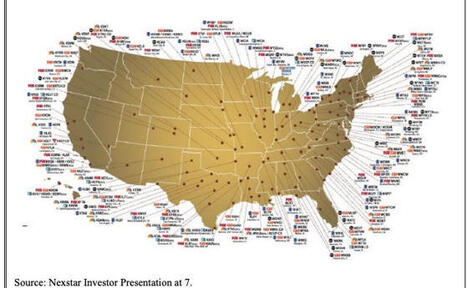
The FCC has approved the sale of Tegna television stations to rival Nexstar Media Group Thursday. The deal would create a company that owns 259 television stations in 44 states.
The Justice Department and the Federal Communications Commission approved the $6.2 billion merger between the companies Nexstar and Tegna. Critics say the process was rushed to please the president. NPR's David Folkenflik reports.
The following are a few topics I found interesting but which are two short to need a full blog.
Acquisitions Changing the Broadband Landscape. We’ve recently seen the closing of a number of major mergers and sales that are changing the broadband landscape.
Artificial intelligence agent instructed engineer to take actions that exposed user and company data internally.
An AI agent instructed an engineer to take actions that exposed a large amount of Meta’s sensitive data to some of its employees, in the latest example of AI causing upheaval in a large tech company.
The leak, which Meta confirmed, happened when an employee asked for guidance on an engineering problem on an internal forum. An AI agent responded with a solution, which the employee implemented – causing a large amount of sensitive user and company data to be exposed to its engineers for two hours.
I've been watching the SpaceX/EchoStar spectrum situation for a while now, and a few things just landed in quick succession that are worth unpacking.
In just a few weeks, we saw two major moves, a question I keep getting asked about AST SpaceMobile, and a comment from someone whose opinion I take seriously.
Let’s walk through what happened, and what it could mean for rural telecom operators.
An investigation by journalists working with Republik magazine may have struck a nerve by suggesting the company has failed in Switzerland.
It was over beers on an autumn evening in Zurich in 2024 that a group of journalists with an independent Swiss research collective began to discuss investigating Palantir, one of the world’s biggest tech companies.
Three years earlier, Palantir had advertised that it was setting up a “European hub” in the Swiss municipality of Altendorf, a sleepy town of roughly 7,000 people on the shores of Lake Zurich.
Press coverage of the move was positive: a Swiss national newspaper said the canton of Schwyz had “pulled off a coup” by landing a US tech company. But the journalists in the collective, WAV, were not so sure. They wondered what Swiss authorities were doing with Palantir.
As cellular IoT deployments grow from thousands to millions, the limits of hardware, not software, come into focus, writes IoT connectivity provider Onomondo. Until connectivity infrastructure evolves to adapt to constrained devices – rather than forcing them into legacy telecom models – cellular IoT will remain stuck in a cycle of complexity, fragmentation, and unrealised potential.
Too many people still think IoT scales like the internet. Like software. Like OS settings and apps on laptops, smartphones, and tablets. In reality, IoT – including cellular IoT – scales like hardware. Basic hardware. Whether you are scaling NB-IoT or LTE-M smart meters, asset trackers, e-scooters, trucks, or vending machines, you are never dealing with an iPad. You are dealing with resource-constrained hardware components, often in the thousands at once, scaling to millions.
Yes, you can tweak firmware over the air, but that is usually limited to patching bugs and security vulnerabilities. The underlying hardware – the ‘thing’ – does not change. Whether it is a smart meter sitting in a basement for 15 years or an asset tracker constantly moving across networks, you cannot reconfigure its network behavior in the same way you would an iPad. This is what creates a scaling constraint in cellular IoT.
State and local officials gathered Friday to mark the start of new broadband construction in Caldwell Parish, part of Louisiana’s wider push to expand high-speed internet to rural communities through state and federal programs.
Through a release provided to Broadband Communities, officials said the work in Caldwell has connected more than 500 homes and businesses so far under the state’s Granting Unserved Municipalities Broadband Opportunities (GUMBO) initiative.
On the same day Facebook changed its name to Meta in 2021, CEO Mark Zuckerberg gave a keynote address to lay out his plans for the metaverse.
The keynote featured a bonkers video of Zuckerberg jumping between various CGI-rendered depictions of the metaverse in virtual reality. He visited a spaceship where the company’s executives were playing poker, toured a tropical mansion with a floating fireplace and met CTO Andrew Bosworth’s Pixar-esque alien pet Oppy.
Yet that vision of the metaverse — an internet consisting of an infinite series of three-dimensional VR spaces — never quite caught on with the public. Meta cut 10 percent of its Reality Labs workforce in January, and the division has seen more than $70 billion cumulative losses since late 2020.
Historical FCC precedent includes cases where station owners lost their broadcast licenses for deliberately skewing news coverage toward favored political candidates.
Ettienne Brandt, who most recently led Frontier's biz services unit, is the new CEO of Astound Broadband, which just struck a deal to combine with GFiber.
A jury has found Elon Musk liable for misleading investors by deliberately driving down Twitter's stock price in the tumultuous months leading up to his 2022 acquisition of the social media company for $44 billion. But it absolved him of some fraud allegations, finding that he did not “scheme” to mislead investors.
The nine-person jury returned the verdict after nearly four days of deliberation, nearly three weeks after the trial began on March 2. They said that while Musk was liable for misleading investors with two tweets — including one said the Twitter deal was "temporarily on hold," he did not do so with a statement he made on a podcast and that he did not intentionally "scheme" to defraud investors.
The jury awarded shareholders between about $3 and $8 per stock per day as damages, which the plaintiffs' lawyers said amounts to about $2.1 billion. Musk's fortune is currently estimated at about $814 billion, much of it tied up in Tesla shares.
IRREGULATORS Call for a Halt to All of the FCC Proceedings Presented By Chairman Brendan Carr to ‘Shut Off The Copper’, Carrier Of Last Resort, Universal Service, As Well As 25+ Other Interlocking Actions.
Every State Should Challenge the Carrier of Last Resort Removal — The Counting of Access Copper Lines Appears to be Manipulated and Deceptive.
Since the beginning of 2025, FCC Chairman Carr has put out a barrage of different actions and new regulations, framed as ‘streamlining’ or removing some burden on the poor telecommunications companies. See:
In the next installment, Part 2, we will address these interlocking proceedings that are part of Delete, Delete, Delete but are directly tied to the shut off of the copper wires and the manipulation of the access line accounting we discuss here.
Roughly three quarters of Brightspeed's ambitious fiber build in South Carolina is completed, the service provider today announced.
Brightspeed says its fiber rollout in South Carolina is approaching a milestone, with about 75 percent of the company’s planned build finished and more than 47,000 homes and businesses already able to get multi‑gig internet, the company announced today.
Construction crews are working in Beaufort, Greenwood, Hampton, Jasper, Laurens, Orangeburg, and Saluda counties, and Brightspeed said the company has made early progress in the town of Ninety-Six, where roughly 20 percent of the community’s fiber work is complete.
Eight Democratic state attorneys general challenge the $6 billion Nexstar-TEGNA merger that would consolidate local TV broadcasting and kill local news. It's about time.
Last September, late night talk show host Jimmy Kimmel was temporarily kicked off the air by Disney/ABC for making a joke about Donald Trump in the wake of the Charlie Kirk assassination. At the time, I described our concentrated communications system as a ‘censorship machine,’ because the fewer channels for speech, the easier it is to control content. Our broadcast systems have become very consolidated, and the political attack on Kimmel showed that.
Two powerful broadcasters, Nexstar and TEGNA, were at the center of the Kimmel saga. Neither is a household name, but at the time, they were seeking to merge in a highly controversial $6.2 billion deal. In order to get favorable treatment from the Trump administration for that combination, they allegedly helped to punish Kimmel.
That said, it seemed to conclude with a reasonable ending - the backlash to Disney/ABC was so significant that Kimmel got his show back. You might think that would be the end of the saga. But it’s not.
Today, in an unusual assertion of state law enforcement against corporate power, eight state attorneys general, led by California AG Rob Bonta sued to block the Nexstar/TEGNA merger.
WASHINGTON, March 19, 2026 – The wireless and aviation industries are still at odds on some parts of the government’s plan to open the upper C-band up to mobile carriers.
CTIA, the major wireless industry group, told the Federal Aviation Administration last week that its proposed operating standards were too conservative in estimating next-generation airplane gear’s tolerance to 5G use in adjacent spectrum, an issue it’s raised before. Existing altimeters, critical instruments that measure a plan’s altitude, will have to be replaced for upper C-band spectrum to be used, and CTIA wanted priority aircraft finished by 2029.
The aviation industry, for its part, sided with the FAA on its safety analysis.
Today’s episode features guest host Michael Upshall (guest editor, Charleston Briefings) who talks with Brewster Kahle, Founder & Director, Internet Archive.
Brewster says that back in the 1980’s he believed that everything would eventually become digital. He dreamed of building a Library of Alexandria where humanity’s knowledge would be freely accessible. In this conversation, he talks with Michael about his work building early search technologies at the MIT Artificial Intelligence Laboratory.
In 1983, he helped create Thinking Machine Corporation, a pioneering supercomputer manufacturer. In 1996, he founded Alexa Internet, a web traffic analysis and ranking company that was eventually acquired by Amazon. He then launched The Internet Archive, which now contains over a trillion archived web pages and works with thousands of libraries around the world to preserve digital content.
Brewster says he believes the internet should be a global, open library that supports learning and that compensates content creators fairly. He also talks about some lawsuits against publishers, controlled digital lending and the importance of open access for the future.
At the "America at 250 Forum," Governors Spencer Cox (R-UT), Wes Moore (D-MD), and Kevin Stitt (R-OK) discussed what governing looks like in polarized times—and why collaboration and local action matter now more than ever.
The American Association for Public Broadband (AAPB) and the Institute for Local Self-Reliance (ILSR) Community Broadband Networks Initiative are continunig the year with another one of their increasingly popular and informative webinars.
Slated for March 19th from 12 to 1:00 pm ET, the livestream event – “High-Density, High Impact: Connecting Apartment Buildings, Public Housing and Multi-Dwelling Units” – will be live on YouTube and feature an eye-opening conversation on Multi-Dwelling Units (MDUs) and the real challenges/opportunities on connecting a significant portion of the population.
The webinar will feature guest appearances by DigitalC Joshua Edmonds, HR&A Advisors Anna Read, and REVInternet Brendan Kelly.
There is an interesting spectrum battle going on between cell carriers and satellite companies. The heart of the contention is spectrum in the Upper Microwave Flexible Use Service (UMFUS) bands, specifically the 24 GHz (GigaHertz), 28 GHz, upper 37 GHz, 39 GHz, 47 GHz, and 50 GHz bands. These frequency bands are generally referred to millimeter wave spectrum.
Satellite companies use some of this spectrum today via a shared arrangement with cellular companies that have purchased some of this spectrum in FCC auctions. Satellite companies are seeking greater use of this spectrum to communicate between satellites and ground stations, which is a growing concern as the number of different satellite providers and the overall number of satellites in the sky increases. Satellite companies want access to more shared spectrum using a process the FCC calls ‘light licensing’, which is a process to register new ground stations with relatively little paperwork.
Something is broken in how communities get the information they need to function, and a new statewide report puts data behind what many of us already know from experience.
The Michigan Media Ecosystem Report, published in November 2025 by The Pivot Fund, spent months talking with Michigan residents about how they find, trust, and use local news and information. The findings are striking: people are consuming news constantly, yet most don’t feel well-informed about what’s happening in their own communities. They’re cobbling together information from Facebook groups, word of mouth, Google searches, and direct calls to city hall, not because they don’t care, but because the systems that were supposed to keep them informed have contracted, consolidated, or disappeared entirely.
This isn’t just a media industry problem. It’s a civic problem.
To get content containing either thought or leadership enter:
To get content containing both thought and leadership enter:
To get content containing the expression thought leadership enter:
You can enter several keywords and you can refine them whenever you want. Our suggestion engine uses more signals but entering a few keywords here will rapidly give you great content to curate.


 Your new post is loading...