Your new post is loading...
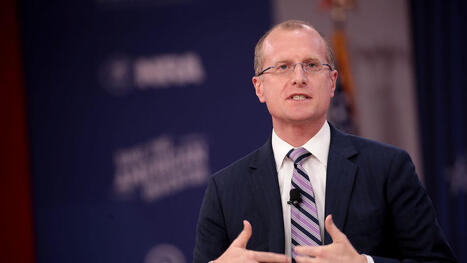
The following is an open letter to FCC Chairman Brendan Carr, by Robert Corn-Revere, who served as Chief Counsel to former FCC Chairman James H. Quello. He is currently Chief Counsel for the Foundation for Individual Rights and Expression. Checks & Balances is a newsletter of the Society for the Rule of Law Institute. Dear Chairman Carr, Pam Bondi’s sudden and ignominious end as Attorney General is an important cautionary lesson about what happens to officials in this administration who over-promise in order to curry favor with the man they see as their boss, but who under-perform because of the limits of their authority. Bondi promised the President she would prosecute his political enemies and failed miserably. The President rewarded her misplaced loyalty by denying her the graceful exit she sought, and instead fired her during a cross-town limo ride to watch a Supreme Court argument. You have recently threatened to revoke the licenses of broadcasters who air what you call “fake news,” which apparently includes any skeptical reporting about the war in Iran—something you know you cannot do legally. My advice? Don’t get into a car with the president anytime soon.
Apple and Google recently announced a multiyear, $20 billion partnership to integrate Google’s Gemini technology into Apple's own AI features. On January 12, 2026, Apple and Google announced a multi-year partnership between the companies, in which Apple will use Google’s Gemini models and cloud technology to power its artificial intelligence features, including an AI-powered Siri. This partnership is partly due to weak remedies handed down in the U.S. v. Google case, where the Department of Justice and a bipartisan group of states proved that Google held an illegal monopoly in the online search market. Judge Amit Mehta imposed several behavioral remedies, but they don’t go far enough to restore competition or meaningfully restrict Google’s anticompetitive practices. These remedies include limits on Google’s ability to form long-term, exclusive contracts. However, rather than preventing Google from entering billion-dollar default agreements, the Court’s Order simply limits these agreements to one-year terms. While this change is meant to encourage partners to reconsider their options each year, it may do little to increase real competition.
- Satellite operators may work peacefully with telecom providers for the time being
- But telecom providers will have to keep an eye on their revenue share
- There was disagreement among satellite executives as to whether physics will remain a major problem for satellite to act as a standalone mobile operator
A panel of satellite experts discussed the excitement (and perhaps some trepidation) in the telecom world from the entrance of direct-to-device (D2D) satellite connectivity. During a recent virtual event, Fierce asked the question on everyone’s mind in telecom: Will D2D be complementary to telecom, or will it pose a competitive threat?
IBM agrees to pay $17 million to resolve US Department of Justice probe over diversity hiring practices, the first settlement under Trump's anti-DEI initiative.
Barbara Johnson has been fighting coal pollution for decades in her mostly Black neighborhood of North St. Louis as an organizer with Metropolitan Congregations United – one of many activist groups campaigning for cleaner air in a city that has some of the country’s dirtiest. She sees environmental progress reversed by Trump's policies supporting data centers. The rollback of Biden's soot standards could prevent Ameren's plant from reducing emissions, threatening St. Louis's air quality amid AI-driven power demands.
"The Telecommunications Act of 1996 is now 30 years old, and there has been a lot of events, hearings and webinars, including a congressional hearing, an FCC series of panels, Public Knowledge, Benton Foundation, TPI, Brookings, Broadband Breakfast, and a few others, all easily findable on the web.
The Act was supposed to open the wired networks to direct competition, that would lower prices and bring in new and innovative services that would be available via a new fiber optic wire to the home and business. And it would be delivered to everyone, equally, as this Act was an update of the original Communications Act of 1934." https://kushnickbruce.medium.com/telecom-act-is-30-500-billion-overcharging-the-digital-divide-and-delete3-by-fcc-chairman-carr-e50d0ab5940f With these words, Bruce Kushnick, a longtime critic of U.S. telecom policy, sums up the flawed magical thinking that made the envisioned future state immediately preceding this regulatory overhaul impossible to attain. As Kushnick describes it: Starting in the 1990’s, a few years before the Telecom Act, America was promised a new shiny fiber optic future. Seven holding companies had been created in 1984 and given control over the existing state telecommunications public utilities, which were based on copper wire.
And in 1992, Vice President Al Gore laid out the ‘Information Superhighway’, a fiber replacement of this existing copper wires. The root cause is negligent policymaking.
St. Joseph, Louisiana has celebrated the opening of a renovated community center that will now serve as a local broadband hub. A renovated community center in a small Tensas Parish town is being positioned as a local hub for broadband-enabled services after a groundbreaking ceremony Thursday marking upgrades to the St. Joseph Community House. Town leaders say the project will add high-speed workspaces and classrooms for data, language and driver’s training, along with space for GED and HiSET tutoring and extracurricular programs tied to area schools.
n 2020, the Federal Communications Commission (FCC) approved the T-Mobile/Sprint merger, reducing the number of wireless carriers in the U.S. to just three. In a new paper titled “Performative competition: The U.S. wireless communication market and the T-Mobile/Sprint merger,” published in the journal International Communication Gazette, several researchers with ties to the Annenberg School for Communication at the University of Pennsylvania examine the evolving political economy of the U.S. wireless communications market through a case study of the merger, arguing that telecom executives and regulators worked to construct a perception of competition to justify the merger’s approval. The researchers, Postdoctoral Fellow Sydney Forde, Visiting Scholar Hendrik Theine, and alumni Pawel Popiel (Ph.D. ‘20) and Christopher Ali (Ph.D. ‘13), call this strategy “performative competition.” Drawing from policy documents and industry data from the Global Media & Internet Concentration Project (GMICP), they show how the FCC justified ongoing consolidation in the U.S. wireless communications market by downplaying antitrust concerns, reframing consumer harms, and emphasizing the speculative promises of new technology. “The wireless industry has long been dominated by just a handful of corporations,” says Forde, postdoctoral fellow at Annenberg’s Media, Inequality, & Change Center. “AT&T and Verizon, alongside smaller competitors Sprint and T-Mobile, have made up a tight oligopoly since the early 2000s,” she says.
From AI-generated images to restricted satellite data, the systems used to verify what’s real online are struggling to keep up. Lego-style propaganda videos alleging war crimes are flooding online feeds, echoing the White House’s own turn toward cryptic teaser clips and meme-native visuals. This is not just content drift. It is a new front in the information war, one where speed, ambiguity, and algorithmic reach matter as much as accuracy. One Iran-linked outlet, Explosive News, can reportedly turn around a two-minute synthetic Lego segment in about 24 hours. The speed is the point. Synthetic media does not need to hold up forever; it only needs to travel before verification catches up. Last month, the White House added to that confusion when it posted two vague “launching soon” videos, then removed them after online investigators and open source researchers began dissecting them.
This report describes important and challenging connectivity gaps that should be a priority as governments and industry develop visions and plans for a “6G” wireless ecosystem. While forms of broadband convergence, based on substitutability and bundling, are increasingly evident in the marketplace, a broader and more ambitious convergence should move to the fore. Convergent connectivity can also refer, as it does here, to the integration of varied wireless communication technologies and networks (mobile, fixed, satellite) to create ubiquitous, seamless, and interoperable networks that allow users to access and transition among the best available connections everywhere they go. This form of convergence bridges the gaps between diverse networks and platforms, enabling real-time communication and data sharing across multiple devices, networks, and locations at all times. Today’s networks fall far short of this goal, subjecting users to rural coverage gaps, urban “not-spots,” weak (or nonexistent) indoor mobile signals, and enormous friction and frustration when smartphones and other devices must manually authenticate to Wi-Fi and other location-based networks as they move around throughout the day. Instead of embracing this challenge, industry and most governmental bodies emphasize visions for mobile 6G that remain siloed and misaligned with some of the most important benefits that convergent connectivity could yield for consumers and the economy. This report explores the current reality, including consumer preferences for frictionless connectivity and the flattening growth rate of mobile network data consumption, both of which indicate that 6G-related policy priorities should nurture a wireless ecosystem anchored on ubiquitous and seamless connectivity.
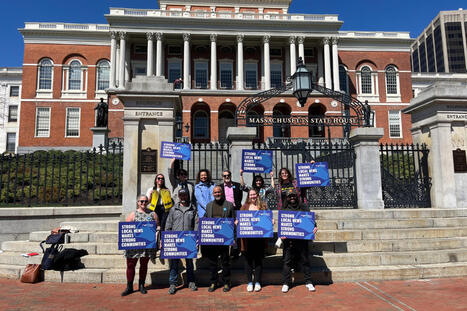
I’ve always thought that good public policy work should start by asking, “Who’s at the table?” This isn’t just a question of who’s consulted down the line, but who’s sitting there from the beginning, talking about a problem, the possible solutions and how to make them happen. This week in Boston, I got to experience a real-life example of this, gathered around a large wooden table in a 200-year-old historic Quaker guest house hidden in the heart of Beacon Hill. As the national field director at Free Press, I joined a dozen local newsroom leaders, journalists and community advocates for a local news lobby day, where we met with lawmakers and urged them to provide more funding and support for community-rooted news and information. This grew out of our broader organizing work to build statewide coalitions that can advocate for local news policies rooted in the needs of communities. As a group, we had spent the past year meeting on Zoom, strategizing on how to advance legislation that would center the needs of local, independent newsrooms that provide vital public services to their communities by doing the daily work of connecting communities to a more equitable and fully-funded media system. We decided that the day before Local News Day would be a good chance to gather in person in Boston and start talking with legislators about investing in the kinds of news and information that keep their constituents safe, informed and engaged in their communities.
There is an interesting technology that is slowly edging into the telecom industry. There are a handful of places that are using hydrogen fuel cell generators instead of the more standard diesel generators for backup power. Everybody who works with a telecom network is aware of the wide use of diesel backup generators that kick in when commercial power fails. Diesel generators are permanently installed for critical hub sites, and telecom companies use portable generators that can be quickly driven to remote powered sites like huts and cabinets. Hydrogen fuel cells offer an alternative to the shortcomings of diesel generators.
The Federal Communications Commission has proposed a major overhaul of satellite spectrum sharing rules, replacing decades-old constraints with a modern, performance-based framework designed to unlock faster, more affordable broadband from space. This decision targets the longstanding limitations imposed on Non-Geostationary Orbit (NGSO) systems—such as low Earth orbit constellations—by rules originally developed in the 1990s to protect Geostationary Orbit (GSO) satellites. The FCC concludes that these legacy constraints now significantly restrict the capacity, speed, and efficiency of satellite broadband services, particularly in rural and underserved areas.
|
A group of Hollywood actors, directors, and producers on Monday published an open letter demanding the proposed merger between Paramount and Warner Bros. Discovery be blocked. In their letter, the Hollywood heavyweights outlined the harms that would come from allowing Paramount—which is owned by David Ellison, son of billionaire Trump donor Larry Ellison—to acquire Warner Bros. Discovery. “This transaction would further consolidate an already concentrated media landscape, reducing competition at a moment when our industries—and the audiences we serve—can least afford it,” the letter states.
Today’s blog takes a deeper dive into the upcoming case at the Supreme Court concerning appeals by AT&T and Verizon over fines levied by the FCC. The original appeals followed an FCC finding that all three major U.S. cellular carriers were liable for violating customer privacy by selling access to customer location data. This data showed every place that a customer visited during the day, something that should make every cell customer uncomfortable. The FCC fined AT&T $50 million, T-Mobile $80 million, and Verizon $47 million, with smaller fines against a few other carriers. The case at the Supreme Court looks specifically at the FCC’s ability to levy fines against the carriers for violating consumer privacy rights.
A conversation with Asad Ramzanali, Director of AI and Technology Policy at the Vanderbilt Policy Accelerator for Political Economy and Regulation. If you read, watch, or listen to financial news, you’ll find there is a boom in discussion over whether the AI boom is a bubble, and what the consequences might be if it bursts. Today’s guest says that if such a crash occurs, it will represent a significant policy opportunity—a potential point of intervention that could lead to meaningful reform of the tech sector.
Meta Platforms must face a lawsuit by the Massachusetts attorney general alleging that as the parent company of Facebook and Instagram, it deliberately designed social media features to addict young users, the state’s top court ruled on Friday. The ruling by the Massachusetts supreme judicial court marked the first time a state high court has considered whether a federal law that generally shields internet companies from lawsuits over content posted by their users would also bar claims that companies like Meta knowingly addicted young users. Writing for the unanimous court, Justice Dalila Argaez Wendlandt said the lawsuit brought by the attorney general, Andrea Campbell, does not seek to hold Meta liable for content created by its users, which section 230 of the Communications Decency Act of 1996 generally shields companies from, but targets the company’s conduct.
British financial regulators are holding urgent talks with the government's cyber security agency and major banks to assess risks posed by the latest artificial intelligence model from Anthropic, the Financial Times reported on Sunday. Bank of England, Financial Conduct Authority and Treasury officials are in talks with the National Cyber Security Centre to examine potential vulnerabilities in critical IT systems highlighted by Anthropic’s latest AI model, the FT said, citing two people briefed on the talks.
WASHINGTON, April 8, 2026 – Winning a grant from the $42.5 billion Broadband Equity, Access, and Deployment program may not be the only path to gaining a competitive edge as the market undergoes major expansions. At a webinar hosted Tuesday by the Fiber Broadband Association, industry experts said the BEAD program is creating opportunities not just for awardees, but also for providers that did not receive funding. “For the non-awardees,” said Jeremiah Sloan, head of product marketing at Vetro, “they essentially have their competitors’ roadmap laid out before them. That’s intelligence and data that they can leverage for better strategic positioning.”
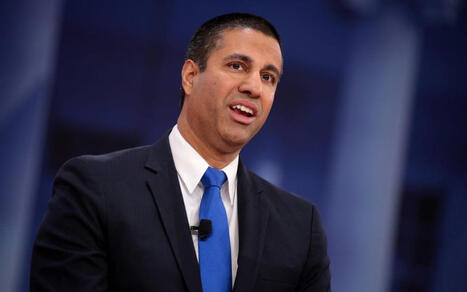
WASHINGTON, April 10, 2026 – Former Federal Communications Commission Chairman Ajit Pai said competition in the wireless industry is helping lower prices for consumers while improving service, arguing the model could guide broader broadband and economic policy. “America’s innovative wireless providers aren’t just stabilizing prices; they’re driving them lower while delivering competitive choice, more data, and better services,” Pai said in the opinion piece on April 8. Writing in the Washington Examiner, Pai pointed to declining wireless costs alongside rising performance.
A deep dive into one of the most successful municipal fiber networks in the country—and what other communities can learn from it. In this episode of Unbuffered, Chris is joined by Roger Timmerman, Executive Director of UTOPIA Fiber, for a deep dive into what it takes to build fast, reliable, and community-focused broadband networks. They begin with a closer look at a recent Ookla report and what it reveals about network performance, unpacking why latency matters more than most people realize and how UTOPIA’s open access, active ethernet model delivers a different kind of Internet experience.
“We could see billions of dollars in benefits for the American economy,” says FCC chairman, Brendan Carr. In sum — what to know: Policy change: The Federal Communications Commission (FCC) is set to discard the power limits on satellite spectrum use. EPFD limits: The current Equivalent Power Flux Density (EPFD) framework which was established in the 1990s is “an enormous regulatory constraint,” that limits operators’ ability to deliver faster speeds. New regime: The commission proposes looser power limits that could potentially produce $2 billion from increased usage and lower broadband costs for customers. The Federal Communications Commission (FCC) is preparing to rewrite a key piece of satellite policy, in a move that could clear a major bottleneck constraining growth of low Earth orbit (LEO) satellite services.
In 2018, Xcel Energy made a pledge no major U.S. utility had made before: 100% carbon-free electricity by 2050, with a commitment to fully exit coal by 2030. The markets rewarded it. ESG funds bought in. The narrative was clean. Today, Xcel is asking Colorado regulators to keep burning coal through 2030 — not as a strategic pivot, but because a single turbine failure at one plant exposed how thin the actual reliability margin was. The same utility that led the clean energy narrative is now the clearest demonstration of what I’m calling reliability debt: the growing gap between the retirement timelines utilities promised investors and regulators, and the timeline the physical grid can actually absorb without reliability risk. This is post one of a series. I’m not short, I’m not long. I’m establishing a public thesis and then checking it against reality over the next twelve months. I’m not a utility analyst. I’m a grid researcher who learned to read balance sheets — because the companies I was already tracking turned out to be publicly traded. The analysis starts with the grid and works backward to the stock.
Not One Pundit, Politician, Advocate or Lawyer Mentioned the Rewriting of History The Telecommunications Act of 1996 is now 30 years old, and there has been a lot of events, hearings and webinars, including a congressional hearing, an FCC series of panels, Public Knowledge, Benton Foundation, TPI, Brookings, Broadband Breakfast, and a few others, all easily findable on the web. The Act was supposed to open the wired networks to direct competition, that would lower prices and bring in new and innovative services that would be available via a new fiber optic wire to the home and business. And it would be delivered to everyone, equally, as this Act was an update of the original Communications Act of 1934. And I just sloughed through a collection of them, even read the testimony for over 11 hours, and if you want to know why there is a digital divide, why America’s communications prices are out of control and every excuse to not build fiber optic infrastructure to the home, or why much of America does not have serious competition, it is because… ANSWER: It appears that every advocate, politician, analyst, lawyer or former FCC congressional staffer, all worked off a rewritten history, which failed to address the basic facts. (Unless we missed it...) Basic Facts: § Virtually every state in America had a plan to replace the original copper wire of the state telecommunication public utility with a fiber optic wire. Though the plans varied by state. § The original copper had been put in before the 1980’s, but it could be decades earlier. For example, copper wires in areas of Brooklyn, NY were laid in the 1920’s, and only got replaced when they had to — almost 90 years later. § Irony of Ironies: It appears that the copper wires in 2026 are part of these original state Bell system utilities that were written off decades ago, and should have been replaced with fiber. — Hold that thought; we’ll come back to this point.
Overview Blue Origin has filed an application with the Federal Communications Commission seeking authorization to deploy and operate Project Sunrise, a massive non-geostationary satellite constellation designed to host data centers in space. The proposal envisions: -
Up to 51,600 satellites -
Sun-synchronous orbits at 500–1,800 km altitude -
Primary reliance on optical inter-satellite links -
Limited use of radio spectrum (Ka-band) for control and reliability functions
|