Your new post is loading...
ROCKFORD, IL — Landfills initially helped bring data center developer Monarch Energy to town. The San Diego-based infrastructure developer was attracted to land south of the Chicago Rockford International Airport in part because of its proximity to two landfills: the Winnebago Landfill just south of Baxter
Minutes after Donald Trump announced that the US and Israeli governments had launched a “major combat operation” against Iran in the early hours of Saturday morning, disinformation about the attack and Tehran’s response flooded X. WIRED has reviewed hundreds of posts on X, some of which have racked up millions of views, that promote misleading claims about the locations and scale of the attack. Elon Musk’s social media platform is a verifiable mess:
United States President Donald Trump’s record-breaking 107-minute State of the Union address referenced artificial intelligence only three times, two of them in passing. - Trump announced a “ratepayer protection pledge” meant to create an obligation for major tech companies to cover the power needs of their new AI data centers.
- He highlighted First Lady Melania Trump’s support for “AI legislation,” a reference to her advocacy for the TAKE IT DOWN Act, a law targeting AI-generated deepfakes and nonconsensual explicit images.
- He made a passing reference to the Presidential AI Challenge, a nationwide competition for K-12 students and educators to use AI tools to solve a community challenge.
Here’s a look at what Trump specifically said about data centers and the context in which it lands, and what he didn’t say about other public concerns around AI.
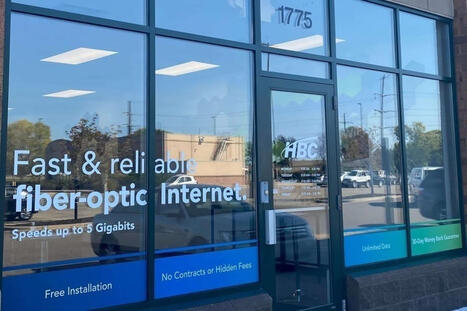
Feb. 26, 2026 – Hiawatha Broadband Communications (HBC) announced plans to bring multi-gig Flight Fiber internet service to southeast Minnesota cities. HBC is expanding multi-gig speeds to provide 2 Gig and 5 Gig options for faster internet for both households and businesses. A variety of construction is already underway in some Minnesota’s cities, including Winona, Red Wing, Lake City, Farmington, Hastings and Empire.
The West Central Tribune reports… The Willmar City Council on Monday, March 2, will consider rescinding the bid award to NC3 for construction of phase one of Willmar Connect and re-awarding the bid to Kramer Service Group. Hometown Fiber has been contracted to manage the network and the ISPs will pay fees to the city to run on the network. Those fees will be used to fund the debt service and interest on the bonds that will be issued to pay for the construction of the network. However, after the awarding of the bid, NC3 notified the city that it no longer possesses the financial and operational capacity necessary to complete phase one of the project as originally proposed and bid, according to the memo in the agenda packet of materials for the March 2 meeting.
Anthropic on Friday hit back after U.S. Secretary of Defense Pete Hegseth directed the Pentagon to designate the artificial intelligence (AI) upstart as a "supply chain risk." "This action follows months of negotiations that reached an impasse over two exceptions we requested to the lawful use of our AI model, Claude: the mass domestic surveillance of Americans and fully autonomous weapons," the company said. "No amount of intimidation or punishment from the Department of War will change our position on mass domestic surveillance or fully autonomous weapons."
Petition calls for the FCC service rules supporting 5G direct-mode technology in the 1.7 GHz and 5.4 GHz spectrum bands for first-responder use.
This is the moment to find a better solution. But the winning coalition must be as broad and as honest as the problem is large.
Alarms raised over Paramount Skydance's bid to acquire Warner Bros. Discovery, sparking fears of media censorship and antitrust violations.
OLYMPIA, Wash. — The National Telecommunications and Information Administration (NTIA) approved Washington’s final Broadband Equity, Access, and Deployment (BEAD) Program proposal, clearing the way for the Washington State Broadband Office (WSBO) to begin awarding $736 million in federal funding and $112 million in state match funding to bring high-speed internet to every part of the state. That combines with other sources for more than a billion in total funding to support broadband expansion. The approval is a significant milestone in Washington’s efforts to close the digital divide and ensure that every resident has access to reliable, high-speed internet. BEAD projects will bring about 166,500 businesses and households online over the next four years in Washington.
Public Knowledge submitted an amicus brief recently opposing Google’s motion for a partial stay of the remedies in the search monopoly case.
WASHINGTON, Feb. 27, 2026 – Major telecom trade groups are urging the Supreme Court to find that the industry’s main federal regulator can’t issue fines for violations of its rules. CTIA, NCTA, and USTelecom submitted a joint filing with the high court Wednesday arguing the Federal Communications Commission’s process for fining companies, as outlined in the Communications Act, was unconstitutional. The high court will hear arguments on the issue in April.
|
Arab princes, Western bankers, Silicon Valley AI guys, and Israeli hawks are all part of one blob. And they just started a war. Plus, the Ticketmaster trial starts... Lots of monopoly news, as usual. The Ticketmaster antitrust trial starts tomorrow, supermarket competition is heating up a few years after the Kroger-Albertsons deal was blocked, and Hollywood’s wealthiest producers back the Paramount takeover of Warner. But the big story is of course the war in the Middle East launched on Saturday morning. And while war often seems distinct from the question of political economy, in this case the two are intrinsically linked. Let’s start with the contours of the conflict itself, which is the second attack on Iran since last June. In that first conflict, Israel killed many people in the regime, and weakened the country significantly. But it was a largely choreographed response, with Iran sending a barrage of rockets repelled by defenses across the Middle East, and then the whole thing ended with a cease fire. Oil prices didn’t much move, and neither did stocks. This time, it could be different.
It’s an interesting time to be an organization that conducts media bias research in the United States. Depending on the results of your research, you may find the Federal Trade Commission (FTC) using it to justify an inquiry directed at another company; or you may find yourself the target of an FTC investigation. The first scenario is reflected in events earlier this month, when FTC Chairman Andrew Ferguson sent a letter to Apple CEO Tim Cook. In his letter, Ferguson noted that recent research from self-described conservative media watchdog organization the Media Research Center indicated that Apple News, the company’s news aggregation app, “systematically promoted news articles from left-wing news outlets and suppressed news articles from more conservative publications.” According to Ferguson, such patterns may put Apple in violation of the FTC Act — if such patterns are inconsistent with Apple’s terms and conditions; are contrary to consumers’ expectations that failure to disclose such ideological favoritism is a “material omission”; or if such practices cause “substantial injury that is neither reasonably avoidable nor outweighed by the countervailing benefits to consumers or competition.” The bottom line, Ferguson contends, is that this pattern in Apple News’ curation may constitute unfair or deceptive practices, and therefore could warrant an FTC investigation.
The Pentagon wants AI that can fight wars — without limits. One of the United States’ leading AI companies says there are lines it won't cross. And this week, that standoff turned into an all-out confrontation. To discuss the implications of the dispute between Anthropic and the Pentagon, including the determination that the company represents a supply chain risk, I spoke to two experts: - Kat Duffy, senior fellow for digital and cyberspace policy at the Council on Foreign Relations, and
- Amos Toh, senior counsel in the Liberty and National Security Program at the Brennan Center for Justice.
-
What follows is a lightly edited transcript of the discussion.
WASHINGTON, Feb 27, 2026 – Disruptions to work from AI are coming, and the United States is not on a path to prevent the worst impacts, according to a panel of MIT professors and researchers. At an event hosted by the Brookings Institution and The Hamilton Project on Tuesday, Daron Acemoglu, David Autor, and Simon Johnson spoke about research paper “Building Pro-Worker AI,” which outlines a conceptual framework for an AI that supports and increases the need for human expertise, instead of creating tools that displace workers. In 2024, Acemoglu and Johnson won a Nobel Prize in Economic Science.
When the powers-that-be at Silicon Ranch first laid eyes on a gorgeous and available 4,500-acre parcel of timberland in northern Baldwin County, they probably believed they’d found an ideal site to build a utility-scale solar farm. The unzoned property is plenty big enough to accommodate the 2,000 acres of solar panels they want to install; it’s adjacent to an existing high-voltage transmission line and has good highway access; and it looks like it’s in the middle of nowhere. Check, check, and check. But it’s not quite that simple. The proposed solar farm, whose explicit purpose is to offset the power needs of Meta’s new data center in Montgomery more than 100 miles away, has gotten locals’ hackles up.
The public access television station has become one of Vermont’s most reliable sources of campaign coverage.
Attorney General Pam Bondi announced federal charges Friday against 30 more people who are accused of civil rights violations in a January protest inside a Minnesota church where a pastor works for Immigration and Customs Enforcement.
BOSTON — The Healey-Driscoll Administration received approval for $18.8 million under the National Telecommunications and Information Administration’s (NTIA) Broadband Equity, Access, and Deployment (BEAD) program. The funding will enable the Massachusetts Technology Collaborative’s (MassTech) Massachusetts Broadband Institute (MBI) to implement high-speed broadband infrastructure to all remaining unserved and underserved locations in the state, including 251 communities, 2,565 homes and businesses, and 1,243 community anchor institutions. The BEAD program expands internet access through a variety of technologies, including fiber optics as well as hybrid fiber-coaxial and low Earth orbit satellite internet. The program builds on the foundation of prior state and federal investments by MBI through the Executive Office of Economic Development that have brought Massachusetts to over 99 percent statewide broadband coverage, including awards made under the state-funded Last Mile Grant programs and the federally funded Gap Networks Program.
Federal agencies have issued a warning that made its way to top officials at the White House.
AI is too powerful and too new to be set free from human oversight. On Tuesday, in a closed-door meeting, Secretary of Defense Pete Hegseth issued a blunt ultimatum to Anthropic CEO Dario Amodei: Strip the ethical guardrails from your AI models by Friday or face the full weight of the state. The terms of the threat were stark. If Anthropic does not allow the Pentagon “all lawful uses” of its Claude models, Hegseth will invoke the Defense Production Act to compel cooperation, he warned—or, even more devastatingly, designate Anthropic as a supply-chain risk. The latter would effectively blacklist Anthropic from doing business with any entity that touches the Department of Defense. Yesterday evening, Amodei gave his answer. He rejected Hegseth’s “best and final offer,” writing, “I believe deeply in the existential importance of using AI to defend the United States and other democracies, and to defeat our autocratic adversaries.” However, he continued, “in a narrow set of cases, we believe AI can undermine, rather than defend, democratic values.” He concluded that the Pentagon’s “threats do not change our position: we cannot in good conscience accede to their request.”
With its twirly cord and landline-like features, the Tin Can is giving kids a crash course in phone etiquette. For example: Talk!
|