Your new post is loading...
A friend of mine, Frederick Pilot, recently asked me an interesting question. Is digital literacy that comes from using a smartphone the same as digital literacy from using a computer? It’s a great question, because the majority of Internet users in the world only have broadband access through a smartphone. In developing nations, 90% of broadband users only have access to a smartphone. In the U.S., 16% of adults only use a smartphone to reach the Internet.
Despite all the hype, overall global nuclear capacity shrunk in 2025 as retirements outstripped additions. Still, the sector could rebound in the coming years. For press releases, policy changes, and promises to build new nuclear power, 2025 was a gangbusters year. For actually adding new reactors to the grid, not so much. In fact, around the world, more gigawatts’ worth of nuclear reactors were retired than turned on this year, according to new data from the consultancy BloombergNEF.
A team of researchers at Epoch AI, a non-profit research institute, are using open-source intelligence to map the growth of America’s datacenters. The team pores over satellite imagery, building permits, and other local legal documents to build a map of the massive computer filled buildings springing up across the United States. They take that data and turn it into an interactive map that lists their costs, power output, and owners. Massive datacenter construction projects are a growing and controversial industry in America. Silicon Valley and the Trump administration are betting the entire American economy on the continued growth of AI, a mission that’ll require spending billions of dollars on datacenters and new energy infrastructure. Epoch AI’s maps act as a central repository of information about the noisy and water hungry buildings growing in our communities.
We’ve been hearing the same mantra for years now: AI will change everything. And yes, some things will change. But what hasn’t changed, and this is what’s really interesting, is the old-school political economy that sustains AI: the way its infrastructure is being built, how it’s being paid for, and the perverse incentives to make it all happen. Because when an industry needs obscene amounts of electricity and capital to grow, what we see is not the future, but the same old old story of financial engineering, environmental factors and a geopolitical regulatory free-for-all. Let’s start with the power source.
NPR health and science correspondents Rob Stein and Katia Riddle chat with host Emily Kwong about what these cuts could mean for the future of science. Science in the United States took some big hits this year. The Trump Administration disrupted federal funding for all kinds of scientific pursuits. Administration officials say those changes were a step towards reinvigorating federal agencies like the National Institutes of Health. But many scientists disagree.
The AI boom has caused as much carbon dioxide to be released into the atmosphere in 2025 as emitted by the whole of New York City, it has been claimed. The global environmental impact of the rapidly spreading technology has been estimated in research published on Wednesday, which also found that AI-related water use now exceeds the entirety of global bottled-water demand. The figures have been compiled by the Dutch academic Alex de Vries-Gao, the founder of Digiconomist, a company that researches the unintended consequences of digital trends. He claimed they were the first attempt to measure the specific effect of artificial intelligence rather than datacentres in general as the use of chatbots such as OpenAI’s ChatGPT and Google’s Gemini soared in 2025. The figures show the estimated greenhouse gas emissions from AI use are also now equivalent to more than 8% of global aviation emissions. His study used technology companies’ own reporting and he called for stricter requirements for them to be more transparent about their climate impact.
“One of the most ‘democratic’ republics in the world is the United States of America, yet nowhere is the power of capital, the power of a handful of multimillionaires over the whole of society, so crude and so openly corrupt as in America. Once capital exists, it dominates the whole of society.” – V.I. Lenin, 1919 Last November, four days after the presidential election, Fox News personality Jimmy Failla said Donald Trump beat Kamala Harris because he had a “secret weapon.” That weapon? The working class, at least according to Failla. In this commentator’s telling, Trump “connected with working-class voters on unprecedented levels…at a time when far too many people feel ignored by Washington elites.” The same narrative was being pushed again on Inauguration Day, with split-screen coverage on right-wing social media contrasting Democratic Party lawmakers in their stuffy-looking suits on one side and everyday Americans in their Carhartt hoodies and blue jeans on the other, eating hot dogs and popcorn as they awaited Trump’s arrival at Capital One Arena. The message was clear: Trump fights the “political establishment” to lift up the masses, those who work for a living and struggle to get by. If we’re being honest, we must admit that Failla, Fox News, and the rest of the far-right echo chamber aren’t telling a complete lie. There’s no denying Trump managed to lock in the support of a substantial number of working-class Americans (mostly but by no means exclusively white ones)—otherwise, there’s no way he could have scored 77 million votes. But to argue that Trump is the workers’ champion, that he’s a warrior battling the powerful and wealthy on behalf of the rest of us? That’s where the story completely falls apart.
When I first entered the industry in the 70s, Bell Labs held an exalted place in the industry that was responsible for inventing and perfecting the technologies we all used. Bell Labs was founded and owned by the giant AT&T monopoly, and was operated with the brilliant concept of hiring the smartest people and letting…
Ever since a spate of mergers in the 1990s, Westlaw and LexisNexis have dominated legal research. And that might be why searching legal cases is so costly, even in the age of AI.
Dec 30, 2025 The Cape Cod Commission is a pre-qualified planning service provider through the Massachusetts Broadband Institute's (MBI) Municipal Digital Equity Planning Program for the 15 towns of Barnstable County. Through this program, the Commission assisted the towns of Bourne, Sandwich, Orleans, Falmouth, and Barnstable in developing municipal digital equity plans, roadmaps for ensuring that all residents have access to the devices, connectivity, and skills needed to participate fully in today's digital society.
The past year has seen a steady drip of news related to quantum, with telcos increasingly thinking about improving the security of their networks. The passing year certainly did its best to live up to its designation by the UN as the international year of quantum science and technology, at least in the world of telecom. Even if commercial quantum computers are still years away, the industry is already grappling with what their arrival will bring. A big concern is shoring up defenses against quantum computing's expected implications for cybersecurity. The technology is broadly expected to crack common encryption algorithms, which are underpinned by mathematical equations that are for all practical purposes impenetrable for classical computers but vulnerable to quantum ones.
The Trump administration brought the sledgehammer down on clean energy — but that still wasn't enough to crush it. Five and a half months. That’s all the time Donald Trump needed to crush the only major climate law the United States ever managed to pass. It was swift work, using a sledgehammer and not a scalpel, and now the energy transition will have to make do with the fragments of the law that remain. The words bleak and dispiriting come to mind. How else to describe the fact that the U.S. entered the year implementing an ambitious if inadequate decarbonization law, and is now exiting 2025 with that law all but repealed? But there were also some reasons to be hopeful about the energy transition this year — if you knew where to look. Let’s start with the numbers.
For the past few years, Light Reading has been exploring the digital divide in our podcast, The Divide, where we talk to guests about why and where digital inequity still exists, and what's being done to get high-speed Internet to everyone, everywhere. While broadband providers and trade associations in the US continue to celebrate the ongoing deployment of broadband infrastructure across the country – and while those builds are indeed in progress (as you'll note if you read our weekly column, The Buildout) – the fact remains that the digital divide persists. That divide comprises three distinct issues: broadband access, affordability and adoption.
|
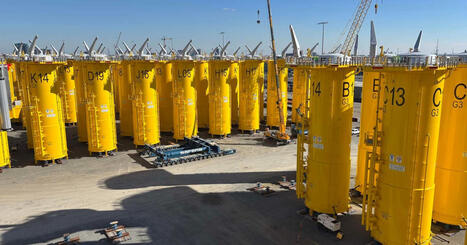
Construction will be paused for 90 days as Trump's "Department of War" and Interior Department coordinate to evaluate supposed "national security" risks. The Interior Department announced Monday it is pausing leases for all five large-scale offshore wind projects under construction in America, citing unspecified issues of national security. Canary Media obtained a copy of a letter notifying one of the affected wind farm developers, providing new details about the move — the Trump administration’s most sweeping attempt yet to halt offshore wind construction.
Accelerated growth continues to define the data center industry, driven by surging demand for operational capacity across the Americas. First highlighted in our 2025 Global Data Center Market Comparison, this trend has only intensified, with no signs of slowing. Most demand in the Americas remains concentrated in the continental United States. Power constraints remain a critical challenge, with utility availability playing a key role in site selection for hyperscalers and large colocation projects. Across many markets in the Americas, utility power queues are swelling, delivery timelines are lengthening, and interconnection requests are rising. These pressures are driven by the rapid expansion of AI, high-performance computing (HPC), neocloud, and GPU-as-a-service data center projects.
What’s happening in 2026 makes even the interstate highway system and the moon landing look small. Across the next three years, the world will pour more than four hundred billion dollars into building the physical backbone of artificial intelligence—data centers, semiconductor plants, and energy systems big enough to power small nations. The scale of construction is unlike anything modern industry has seen. This isn’t another tech bubble. It’s a complete rebuild of digital civilization. Every major government and tech giant now treats AI infrastructure as a matter of national security and long-term competitiveness. The race to expand compute power and secure energy capacity has drawn comparisons to the Cold War space race, except this time, the launchpads are steel-framed data halls rising from fields in Virginia, Texas, and Ohio.
We are about to get a “post-American internet,” because we are entering a post-American era and a post-American world. Some of that is Trump’s doing, and some of that is down to his predecessors. When we think about the American century, we rightly focus on America’s hard power — the invasions, military bases, arms exports, and CIA coups. But it’s America’s soft power that established and maintained true American dominance, the “weaponized interdependence” that Henry Farrell and Abraham Newman describe in their 2023 book The Underground Empire: https://pluralistic.net/2023/10/10/weaponized-interdependence/#the-other-swifties As Farrell and Newman lay out, America established itself as a more than a global power — it is a global platform. If you want to buy things from another country, you use dollars, which you keep in an account at the US Federal Reserve, and which you exchange using the US-dominated SWIFT system. If you want to transmit data across a border, chances were you’re use a fiber link that makes its first landfall on the USA, the global center of the world’s hub-and-spoke telecoms system. No one serious truly believed that these US systems were entirely trustworthy, but there was always an assumption that if the US were to instrumentalize (or, less charitably, weaponize) the dollar, or fiber, that they would do so subtly, selectively, and judiciously. Instead, we got the Snowden revelations that the US was using its position in the center of the world’s fiber web to spy on pretty much every person in the world — lords and peasants, presidents and peons.
As federal AI legislation remains stalled, states like California and Texas are stepping forward with distinct—sometimes conflicting—approaches to AI regulation. In California, policymakers are focused on preventing “irreversible harms” from AI, with strong emphasis on fairness, disinformation, and high-risk use cases. In contrast, Texas has already passed the Responsible AI Governance Act, which codifies AI documentation, transparency, and red-teaming requirements into law by 2026. Together, these approaches highlight a new reality: AI governance is no longer theoretical, and regulation is coming from the ground up.
The Trump scandals can be overwhelming, but as I argue in this piece, his corruption is enabled by media consolidation. We tend to think of antitrust and corruption in separate buckets, but the Jimmy Kimmel scandal shows how concentrated control over information becomes the ground on which corruption thrives. It’s time to break up Big Media, Big Tech, and the Big Money finance system that binds them together.
The real threat to liberal democracy isn’t authoritarianism—it’s nationalist oligarchy. Here’s how American foreign policy should change.
By treating IT and AI as neutral tools, we obscure our ability to see—and resist—power. If just one of the big three tech giants collapses, societal mayhem could follow.
A bill filed late last month would claw back $21 billion allocated to state governments to address the digital divide, marking another moment in the debate over expanding broadband internet access in rural America. A draft version of the bill, sponsored by Republican Senator Joni Ernst of Iowa, would limit the scope of the Broadband Equity, Access, and Deployment (BEAD) program. BEAD, created as part of the 2021 Infrastructure Investment and Jobs Act under the Biden administration, is a $42.45 billion federal grant program aimed at connecting every American to high-speed internet. Of that $42.45 billion, about $21 billion is slotted for so-called nondeployment funds — essentially, anything other than infrastructure to expand internet access. Those other projects could include funding for permitting, telehealth, cybersecurity, preparedness for artificial intelligence, and more. Ernst’s bill would claw back those nondeployment dollars, angering critics and lawmakers across multiple states.
2025 was a transformative year for the submarine cable industry, characterized by unprecedented private investment and AI-driven infrastructure demands. The world's largest hyperscalers remain the largest investors in new submarine cable systems in 2025 as they race to ensure they have the essential infrastructure in place to support their growing networks of data centers and cloud regions. Google Cloud announced in late November its plan to construct TalayLink, a new subsea cable connecting Australia and Thailand. The cable will create a new, diverse route to Thailand via the Indian Ocean, west of the Sunda Strait. Many existing subsea cables currently pass through this area. Google Cloud also announced plans for new connectivity hubs in Mandurah, Western Australia, and southern Thailand.
Light Reading's D2D market coverage this year spotlights progression from testing to launches, and competitive dynamics among global satellite partners. Direct-to-device satellite connectivity shifted from promise to product in 2025, as T-Mobile launched the first commercial D2D messaging service in the US and operators worldwide scrambled to match the capability that suddenly went from a luxury to a critical competitive advantage.
BISMARCK, N.D. – North Dakota Information Technology (NDIT) recently announced that a key federal agency has approved the state’s final Broadband Equity, Access, and Deployment (BEAD) plan—an essential milestone that allows the state to move forward with awarding grants under streamlined, lower-cost rules. According to a press release from North Dakota Public Information Officer Jeremy Fettig, the approval from the National Telecommunications and Information Administration (NTIA) is especially significant for a state already recognized for its strong broadband infrastructure. Decades of strategic investment in high-quality fiber have positioned North Dakota to become the first state in the U.S. where every home and business can access high-speed fiber.
|