Your new post is loading...
The nation's biggest power market has to find a way to prevent data centers from driving up electricity costs. A new report has a solution. Federal regulators are demanding that PJM Interconnection, the country’s biggest power market, find a faster way to connect data centers to the grid without spiking energy costs or threatening reliability. Those regulators and other energy experts increasingly believe that a practice known as flexible interconnection is key to juggling those imperatives — and a recent study offers compelling supporting evidence. Flexible interconnection is simple in principle:
The FCC will soon vote to beef up Wi-Fi in the 6GHz band and a new 'GVP' device category. In a move that's likely being cheered by Apple, Meta and Google, the FCC will soon vote to beef up Wi-Fi in the 6GHz band and a new 'GVP' category that would feature connected wearables, including AR and VR devices.
Local governments and industry trade groups are divided on what the FCC can and should do to reform wireline permitting, according to public filings.
Trump administration policies and AI needs are fueling a growing mismatch between energy supply and demand. That’s a huge problem, but there may be a way out. Almost a year ago, President Donald Trump declared that the United States was experiencing an “energy emergency.” At the time, the U.S. was beating national and world-historical records for oil and gas production, as well as for wind and solar generation. But since then, the threat of an energy emergency really has emerged, in large part thanks to Trump’s own interventions in the power sector. The Trump administration has blocked construction of renewable power sources, rescinded billions of dollars allocated by Congress to expand the grid and clean energy, and helped pass a law that vaporized federal tax credits for wind and solar projects.
Watch the Hearing, download testimony We document that the FCC has claimed it is an independent agency since at least 2001. The Senate Committee on Commerce, Science, and Transportation, convened a hearing on December 17th, 2025. This oversight hearing was triggered over the FCC essentially using the Agency to go after broadcast companies as well as late night comedians, including Jimmy Kimmel. Here are just a few comments made and questions asked of Chairman Brendan Carr.
Last month, Ofcom, the United Kingdom’s telecom regulator, granted Amazon’s Kuiper Systems a license to provide low-Earth-orbit-based (LEO) broadband Internet in the country. The move places Kuiper systems in a rival position with the industry leader, and SpaceX subsidiary, Starlink Services. And while more specialized LEO broadband Internet interests are also emerging—in the public and private sectors—Ofcom’s decision signifies an important shift in consumer LEO Internet providers. The game is shifting, in other words, from a single-player to a multiplayer one. Which is not to say, however, that the game today is evenly matched. As one analyst from Copenhagen-based Strand Consult recently put it in the industry publication Broadband Breakfast, Kuiper now is just “a burger bar, while [Starlink Services] runs an interstellar McDonald’s.” In fact, “burger bar” is being charitable
A Trump takeover of Greenland could open the door to tech moguls’ mineral interests and their utopian aspirations. resident Donald Trump started his second term with his sights set on Greenland. When Trump first proposed buying the Arctic nation during his first administration, it was treated like a joke. But in a phone call last week with Denmark’s prime minister, who controls the autonomous territory’s foreign policy, the president doubled down on his efforts to seize power. In the “aggressive and confrontational” conversation, Trump threatened tariffs if he didn’t get his way. In a news conference earlier this month, he also refused to rule out the use of military force. Now, Denmark is taking him seriously: On Monday, they announced a $2 billion military expansion in the Arctic. Though the island is not for sale, the president emphasized Greenland’s importance to U.S. national security. Left unspoken: A U.S. takeover could weaken the country’s mining laws and ban on private property, aiding Trump donors’ plans to profit from the island’s mineral deposits and build a libertarian techno-city. Trump, who has summarized his own natural resources policy as “drill, baby, drill,” would likely approach the island’s natural resources quite differently from Greenland’s current government, which has opposed large extractive projects.
A leading artificial intelligence expert has rolled back his timeline for AI doom, saying it will take longer than he initially predicted for AI systems to be able to code autonomously and thus speed their own development toward superintelligence. Daniel Kokotajlo, a former employee of OpenAI, sparked an energetic debate in April by releasing AI 2027, a scenario that envisions unchecked AI development leading to the creation of a superintelligence, which – after outfoxing world leaders – destroys humanity. The scenario rapidly won admirers and detractors. The US vice-president, JD Vance, appeared to reference AI 2027 in an interview last May when discussing the US’s artificial intelligence arms race with China. Gary Marcus, an emeritus professor of neuroscience at New York University, called the piece a “work of fiction” and various of its conclusions “pure science fiction mumbo jumbo”.
A former X exec who worked on Elon Musk’s embattled Grok chatbot got a “highly unusual” carveout to keep his company shares while working as the U.S. Patent Office’s “chief AI officer.”
Willmar City Council had planned to announce the broadband plans at Monday's council meeting. Instead, West Central Tribune reports... Consideration for awarding the bid for the Willmar Connect initiative was expected to be on the Willmar City Council agenda on Monday, Jan. 5, but that agenda item was again delayed. When asked why, City Operations Director Kyle Box explained…
As we kick off 2026, NDIA is proud to announce the release of our latest Impact Report, highlighting two years of progress from June 2023 through June 2025. This period brought major shifts in funding, policy, and the broader digital inclusion landscape. Even amid uncertainty and change, NDIA and our national network of community-based organizations, advocates, and practitioners continued advancing digital equity. The Impact Report reflects how the field adapted, stayed resilient, and remained focused on ensuring all people have the access, skills, and support needed to fully participate in our digital world.
In the first episode of the new year, Chris is joined once again by Blair Levin to unpack what 2025 delivered and what 2026 may hold for broadband, media, and technology policy. The two revisit last year’s predictions on tariffs, deportations, BEAD implementation delays, and federal broadband investment, assessing where expectations aligned with reality — and where they didn’t. The discussion closes with reflections on what it will take to rebuild trust, competition, and accountability in an era where policy, power, and technology are more intertwined than ever.
|
On December 16, 2025, the US Government Accountability Office (GAO) issued a legal opinion finding that the National Telecommunication and Information Administration’s (NTIA) June 6, 2025, BEAD Restructuring Policy Notice (policy notice) – guidance that overhauled the $42.5 billion Broadband Equity, Access, and Deployment (BEAD) program – is a “rule” subject to the Congressional Review Act (CRA). Under the CRA, no rule can take effect until it is submitted to Congress and the Comptroller General (the director of GAO). GAO concluded NTIA failed to follow this procedure, meaning the “Benefit of the Bargain” reforms announced in June cannot legally take effect until Congress is formally notified and given a chance to review.
Late yesterday, the NTIA posted summaries on BEAD final proposal approvals for Florida, Kentucky, Maryland, Missouri, and Nevada. This means that 39 states and 3 territories are either in or completed the NIST Ts&Cs process.
Only one notable change from draft to final approved is Maryland’s Fiber-to-HFC mix. Fiber went up from 30.72% to 44.00% and HFC went down from 43.90% to 32.20%. The latest five approved state statistics are below. Final allocation numbers are consistent with originally proposed numbers with exceptions highlighted below where the change was >5% in yellow.
US cable operators notched 39% of US smartphone net ads in Q3. MoffettNathanson believes that cable's mobile performance will improve in 2026.
It feels like we’ve reached that point in the year. You know, the moment when everyone rolls out predictions for what’s coming next. Rather than adding another take centered on AI or BEAD, I wanted to approach 2026 from a slightly different angle. From my perspective, much of today’s narrative around BEAD and AI, while important, misses what’s happening beneath the surface. For rural broadband providers, 2026 won’t be about following the herd. It will be about making deliberate strategic decisions in a market that is prime for consolidation, with rules that are changing faster than many realize. Here’s what you should be thinking about now.
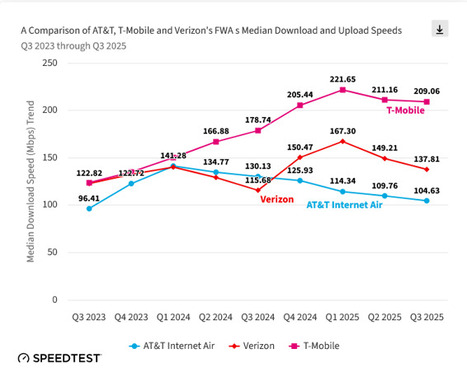
Ookla recently published a report looking at broadband speeds being delivered with FWA cellular broadband offered by AT&T, T-Mobile, and Verizon. The report includes the chart shown below that tracks the median download speeds of each carrier, by quarter, since the third quarter of 2023. There are some interesting stories in the chart: At the…
Congress is moving to avoid another lapse in funding, but a freeze in welfare support to blue states shows what’s missing in the debate.
From flying to online shopping to using social media, everything seems to be getting worse. It’s all — pardon our language here — shittier. According to today’s Lever Time guest, that’s no accident. Cory Doctorow is the author of Enshittification: Why Everything Suddenly Got Worse and What to Do About It. In this episode, Doctorow explains how enshittification works, how it’s infected our online spaces, and what we can do to stop it.
The demise of the coal industry left much of Appalachia in economic tatters, with lost jobs, spoiled water, and depopulated communities across the coalfields of Kentucky, West Virginia, and Virginia. Now, in an ironic twist of the region’s energy history, tech companies and data center developers are eyeing these same rural landscapes with ambitious plans to power the artificial intelligence revolution. From the hollows of Tucker County, West Virginia, to the former strip mines of Wise County, Virginia, proposals for massive data center complexes are sparking both hope and fierce resistance.
At the start of a new year, I thought it would be interesting to take a fresh look at the state of the Internet around the world. The following statistics come from the DataReportal Digital 2026 Global Overview Report. Population. There are 8.25 billion people on the planet, up 69 million over the last year,…
- Marvell inked a $540M deal to buy XConn shortly after acquiring optical interconnect startup Celestial AI
- The company “absolutely” sees optical as a high-growth opportunity, said analyst Jack Gold
- XConn tech could help Marvell scale AI memory bandwidth
Semiconductor company Marvell is sharpening its data center networking arsenal with a deal to buy XConn Technologies for $540 million. XConn, which manufactures compute express link (CXL) and Peripheral Component Interconnect Express (PCIe) switching silicon will allow Marvell to expand its switching portfolio and add “highly experienced engineering talent with deep domain expertise in high-performance switching,” the company said in a press release.
- Fiber rollouts will keep moving, but BEAD revenue won’t come quickly for access vendors
- Operators will focus on experience more than subscriber count and speeds, said Calix
- Cable gear spend will likely pick up after a 2025 slump
2026 is poised to be a busy year for broadband access vendors, but not necessarily due to the Broadband Equity, Access and Deployment (BEAD) program. Although NTIA is finally allowing states to put their BEAD plans in motion, it’ll take a while longer before equipment vendors profit from those projects, said Dell’Oro Group VP Jeff Heynen.
GoNetspeed is bringing state-of-the-art fiber internet connectivity to Newport. Construction is underway on a 100% fiber network that will deliver ultrafast internet to more than 8,200 homes and businesses.
|