SpaceX’s Starlink division confirmed yesterday that it lost contact with a satellite on Sunday and is trying to locate space debris that might have been produced by… whatever happened there.
Starlink said there appeared to be “no new risk” to other space operations and did not use the word “explosion.” But it seems that something caused a Starlink broadband satellite to break apart into at least tens of pieces. LeoLabs, which operates a radar network that can track objects in low Earth orbit, said in an X post that it “detected a fragment creation event involving SpaceX Starlink 34343,” one of the 10,000 or so Starlink satellites in orbit.
One of the Supreme Court’s latest rulings has raised concerns that internet service providers will be let off the hook when it comes to copyright infringement.
Last week, the country’s highest court decided that Cox Communications was not liable for failing to prevent customers from using its internet services for online piracy. Justice Clarence Thomas ruled for the majority that an ISP can only be liable for this kind of activity when it induces customers to do so, or when it offers a service that can only be used in a way that violates copyright.
The decision effectively shields ISPs from legal consequences even if they know customers are using internet services to pirate copyrighted works, or are likely to do so in the future — as long as the companies aren’t actively encouraging people to break the law. In her concurrence, Justice Sonia Sotomayor argued that Thomas was being too easy on ISPs.
The Trump administration recently unveiled a national policy framework for AI, but it misses a critical dynamic in AI governance around responsibility and accountability.
Effective oversight begins with recognizing the effects of AI—its harms and risks—and the causes of those effects—power and competition
Meaningful policy must structure power by focusing on four interlocking principles: accountability, access, agency, and action.
Tom Wheeler and Bill Baer discuss what considerations are missing from the Trump administration's new national AI policy framework.
On March 20, the Trump White House released its National Policy Framework for Artificial Intelligence. It is filled with worthy aspirations such as protecting children, promoting innovation, and ensuring American leadership.
But it sidesteps the most important question in AI governance: Who is in charge of those in charge?
The advertising revenue model for supporting journalism has long been an article of faith for scholars and policymakers alike. This paper challenges that assumption by examining advertising revenue as a share of the newspaper industry’s total revenue from 1880 to the present as part of a larger political economic analysis. By historicizing the complicated relationship between journalism and advertising and arraying its critical historiography, we arrive at implications vital to the industry’s foundations and future.
A whole industry of data brokers buys up vast quantities of electronic information from cell phone apps and web browsers and sells it to advertisers who use that data to target ads. The same industry also sells that data, including bulk cell phone location data, to police departments and federal government agencies in ways that can reveal intimate details about Americans without a warrant.
Now, privacy advocates say that the best chance for Congress to close the well-known loophole around the Fourth Amendment that allows for that sort of governmental snooping is coming up in just a few weeks.
I was looking through the FCC cellular map in Buncombe County, North Carolina, where I live. For those not fully familiar with the FCC broadband maps, the agency publishes two maps: the more familiar one that shows broadband coverage and a second that shows cellular coverage. You can toggle between the two maps at the FCC's map website.
It struck me while looking at the details in the maps that rural cellular coverage is changing, and not in a good way. I started by looking at a small section of the county that is on the outer fringe of where the Asheville outer suburbs turn rural. According to the FCC cellular map, the area I selected has the following cellular coverage:
"CEO said a thing!" journalism involves parroting the claims of a business leader or executive with absolutely no context, correction, or challenge whatsoever, no matter how elaborate the delusion.
This is the 14th installment of The TechEd Revolution.
AI is often described as a tool for answering questions. But in scientific work, answering questions is only part of the challenge. The deeper work lies in how questions are framed, how methods are designed, and how knowledge is produced.
A new class of AI-enabled environments is beginning to reshape that process. This shift is already taking shape in how students and faculty engage in research.
The last major congressional overhaul of our nation’s media and telecom laws was 30 years ago. Was it a good plan, and are we still following it today?
On March 26, I testified before the House Subcommittee on Communications and Technology at a hearing examining the Telecommunications Act of 1996 — 30 years after it became law. The full written testimony covers issues like broadband oversight and affordability, but for Pressing Issues readers, I’ll focus on parts of the testimony tied to a recent and huge news event: the Nexstar-Tegna merger, and how it’s even worse than the Federal Communication Commission’s long-running practice of looking the other way on massive media mergers.
The subcommittee that held this hearing is the same one that oversees the FCC and other agencies that administer laws covering TV, radio, wireless companies and internet providers. I told them that these kinds of hearings about the developments in the law and in the technologies we’ve seen come and go over three decades often look back to laugh at now quaint-sounding tech trends and touchstones.
What I wanted to do in the hearing instead was look forward to what Congress and federal agencies still must do to fulfill the Act’s goals. And to do that, I had to talk about the severe and sometimes shocking departures current FCC Chairman Brendan Carr has made from longstanding Commission practice and precedent, often thumbing his nose at Congress’ laws and the Constitution as he does.
The U.S.-China Economic and Security Review Commission, which Congress created to examine how the bilateral economic relationship affects national security, warned in a report earlier this month that China’s embrace of AI could cement its industrial edge.
The report, “Two Loops: How China’s Open AI Strategy Reinforces Its Industrial Dominance,” finds that Chinese AI labs’ willingness to publish model source code and weights is accelerating innovation and adoption in ways the U.S. isn’t prepared to counter.
Michael Kuiken, vice chair of the USCC, talks to DFD about how China’s open-source approach drives the innovation and adoption of its models, and what that might mean for robotics and industry standards.
This interview below has been condensed and edited for clarity.
With many Americans struggling to afford the basics, consumers and state lawmakers alike are becoming more concerned about how retailers are using algorithms — many of which rely on personal data — to price products.
One online grocery shopper got charged $3.99 for a box of Wheat Thins, while another — buying from the same store at the same time — got charged $4.89.
A consumer watchdog detected this price discrepancy during an investigation last September in Seattle. The grocery app Instacart used an artificial intelligence-powered algorithm that charged customers differently for each item by as much as 23%, Consumer Reports and Groundwork Collaborative found. Instacart has since stopped offering grocery retailers the technology.
SpaceX emerged as a possible bidder to acquire more AWS-3 spectrum, as a warm-up act for the upper C-band auction, in the Federal Communications Commission's upcoming auction, sparking further questions about its intent for Starlink Mobile direct-to-device services.
First reported by Ookla analyst Mike Dano on LinkedIn, the FCC announced late last week the list of 19 companies that have applied to participate in Auction 113, which is due to start on June 2.
Starcloud just raised millions at a $1.1 billion valuation, helping it compete with SpaceX and Google's Project Suncatcher
Key questions around the economic viability of such plans remain
Starcloud just crossed a huge milestone, raising $170 million in funding at a $1.1 billion valuation. While $1 billion isn’t exactly a huge sum in the data center world, it is certainly a lot for a startup – and one looking to deploy data centers in space at that.
Starcloud’s monster valuation is reflective of growing enthusiasm around the potential for a new kind of data center: the kind in orbit. The theory goes that space-based data centers can sidestep key terrestrial constraints tied to the availability of land and – more importantly – power. After all, what is the sun if not a massive source of energy? And the company is just one of several big names looking to the stars.
Here are the names you need to know in this space:
Commercial data centers have become critical infrastructure, supporting everything from financial transactions to government services. And critical infrastructure is often targeted in war.
WASHINGTON, April 1, 2026 – With the Broadband Equity Access and Deployment Program (BEAD) on the cusp of finally getting off the ground, states' attempts at AI regulation may be yet another barrier to implementation.
The administration’s actions have now halted regulation in at least two states.
Members of Louisiana state legislature withdrew their bipartisan AI regulatory bills after several legislators heard that administration officials opposed them and threatened to withhold BEAD funding, according to several legislators and reporting by NOLA.
Hyperscale data centers have policy experts, residents and environmentalists concerned about water usage and extreme energy consumption in the Great Lakes region.
Sure, the sheer size of the hyperscale centers draws attention. An individual hyperscale data center often requires over 100 times more power to operate than a traditional data center, churning through as much as a million gallons of water per day. Still, a single data center, even a hyperscale behemoth, isn’t the issue that most concerns water experts focused on the long-term health of the Great Lakes region, home to the largest surface freshwater system on the planet and 90% of the U.S. supply of fresh water.
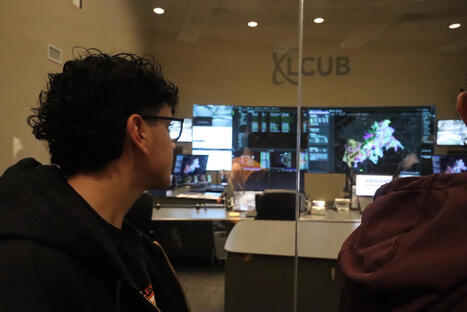
Lenoir City, Tennessee officials say they’re making steady progress on their goal to deliver affordable fiber well beyond the Southern city of 12,998.
Under the collaborative umbrella of the Lenoir City Utilities Board (LCUB) and Tennessee Valley Authority (TVA), officials say they’re leveraging century-old experience in rural electrification to help bridge the digital divide across Knox and Loudon counties.
Former FCC official Carol Mattey joins the podcast to discuss the outcome of states' revised BEAD plans, plus why she's not optimistic about USF reform.
The skies are quickly filling with communications satellites. Following is a short list of the many ventures that have or will soon be launching large numbers of broadband satellites.
Starlink now has over 10,000 operational satellites in orbit, with the ultimate announced goal of reaching 42,000 satellites. The company is not sitting still and will be introducing its new V3 satellites sometime this year, that promises to provide 10 times the download and 24 times the upload capacity of the current V2 satellites. That should mean a big boost in the capacity of the Starlink constellation and faster speeds. Starlink is likely to maintain a major advantage over competitors through its use of the reusable Starship rocket.
The Australian government has accused big tech firms like Meta, TikTok and Google of disobeying the landmark ban on under-16s using social media, after the country’s online safety office warned many children had accounts.
A survey of 900 Australian parents found around a third (31%) said their children still had one or more social media accounts after the ban, compared to 49% before the laws.
Of the total number of under 16s who had accounts on Instagram, Snapchat and TikTok before the ban, 70% had maintained access, the survey found.
Entry barriers have dropped but infrastructure costs are still a major hurdle for new satellite players, said Hughes VP Patrick Markus
Countries pursuing sovereign GEO and LEO strategies face especially steep costs
It’s too early to predict SpaceX’s Starlink Mobile will reshape the communications landscape, Markus said
Despite a flood of new and aspiring players for satellite communications, cost remains a critical barrier for new entrants, said Patrick Markus, VP and general manager of Hughes Networks’ defense and government solutions division.
The barrier to entry for space is “much lower” than it was a decade ago, but the satellite business is “still fundamentally an expensive endeavor,” he told Fierce at SatShow 2026. “It comes with its own headaches and maintenance tale.”
Vox reports... "The Supreme Court tossed out a billion-dollar verdict against an internet service provider (ISP) on Wednesday, in a closely watched case that could have severely damaged many Americans’ access to the internet if it had gone the other way.
Wednesday’s decision in Cox Communications v. Sony Music Entertainment is part of a broader pattern. It is one of a handful of recent Supreme Court cases that threatened to break the internet — or, at least, to fundamentally harm its ability to function as it has for decades. In each case, the justices took a cautious and libertarian approach. And they’ve often done so by lopsided margins. All nine justices joined the result in Cox, although Justices Sonia Sotomayor and Ketanji Brown Jackson criticized some of the nuances of Justice Clarence Thomas’s majority opinion.
Some members of the Court have said explicitly that this wary approach stems from a fear that they do not understand the internet well enough to oversee it."
To get content containing either thought or leadership enter:
To get content containing both thought and leadership enter:
To get content containing the expression thought leadership enter:
You can enter several keywords and you can refine them whenever you want. Our suggestion engine uses more signals but entering a few keywords here will rapidly give you great content to curate.





 Your new post is loading...