


Company CEO Jeff Bezos says he hopes to soon deploy an armada of mini-drones able to drop small packages at your doorstep.
Via eft - Logistics & Supply Chain Business Intelligence

 Your new post is loading...
 Scoop.it! Company CEO Jeff Bezos says he hopes to soon deploy an armada of mini-drones able to drop small packages at your doorstep. Via eft - Logistics & Supply Chain Business Intelligence 
Scoop.it!

In the northern hemisphere, Fall / Autumn has begun. With that comes the harvest and in particular, apples! However, we are not going to talk about the fruit but about the technology company, Apple. Via Ricard Lloria
Scoop.it!

Our previous post began exploring the seven key traits to look for in a SCM partner. It included the first four. Here are the last three attributes you want a SCM software partner to have ... Via Ricard Lloria
Scoop.it!

The logistics industry needs a more diverse workforce, but it suffers from poor perceptions about career opportunities. Melanie Hall shares her experiences as woman in the sector Via eft - Logistics & Supply Chain Business Intelligence

eft - Logistics & Supply Chain Business Intelligence 's curator insight,
October 28, 2013 7:13 AM
This topic will be discussed by the CEO's of Damco and DHL Freight, plus VP Europe APL Logistics at the 11th European 3PL Summit next month www.3plsummit.com/eu
Scoop.it!

The 2013 Red Cross disaster report takes a close look at how technology can help with humanitarian activities. When there is a natural catastrophe, access to information is as important as to food and drink. NGOs are taking to geo-spatial mobile technology to collect data in real time in relation to people affected or about to be. You can warn a whole population in a hurry if it has smartphones.
Via Robin Landis
Scoop.it!
Subject Matter Experts Apply Now!Deadline for Submissions: October 31, 2013 Conference: March 17-20, 2014 The Supply Chain & Transportation USA Conference Program is looking for Subject Matter Experts...
Scoop.it!

A rite of passage for new Sloan MBA students provides lessons in systems thinking. Via Supply Chain Council
Scoop.it!
Transportation & Logistics providers - join us at Supply Chain & Transportation USA 2014. The ONLY event where supplier/shippers and cargo owners from all ve...
Supply Chain & Transportation USA's insight:
Attracting over 30,000 buyers from 22+ vertical markets and 800 suppliers with state-of-the-art solutions, Supply Chain & Transportation USA, co-located with MODEX 2014 and Georgia Logistics Summit, provides a unique opportunity for supply chain executives and logistics providers to unite under one roof. Exhibit with us! March 17-20 | Georgia World Convention Center | Atlanta, GA
Scoop.it!

Ninety percent of manufacturers agree that the environment is becoming more important, but 40 percent of consumers think manufacturers are not doing enough in terms of environmentally friendly manufacturing procedures or products, according to a study by Underwriters Laboratories (UL). Via Acquisti & Sostenibilità not-for-profit
Scoop.it!

(Watch the introduction video on the right.) Want a fast accurate diagram and map of your supply chain? How about automatic alerts for earthquakes, strikes, and floods? This project brings together two concepts: Automatically draw a flow diagram and a map of a company’s supply chain based on data stored in its corporate databases, andSuperimpose visual displays of alerts and other critical information on top of these images. Examples of the kinds of critical information to be displayed includes: Locations of your plants, suppliers, customers, and major transportation lanesAlerts of Natural Disasters, Strikes and Protests, Infrastructure Failure, etc.Heat Maps (frequency diagrams) of hurricanes, floods, earthquakes, etc.Inventory Deployment ($ and Days of Supply) across the networkCapacity Constraints (bottlenecks) in the networkRisk Pathways (most vulnerable segments) across the networkCost Accumulation across the networkCycle Time Accumulation across the network, andMarket Share Impacts of major eventsLater – Carbon Use Across the NetworkLater – Water Use Across the Network Until now, transportation and network analysts have needed to spend weeks collecting scattered information about suppliers, freight lanes, customers, and products in order to create a network flow diagram. And then it becomes out of date a few months later. Via Ricard Lloria
Scoop.it!

When brand-name companies distance themselves from their products' design and supply-chain management, they take a step backwards from corporate responsibility. They can lose competitive design advances including environmental efficiencies; as well as assurance of regulatory compliance, IP security; and visibility to supply-chain quality and worker conditions. Via ECO-Buy
Scoop.it!
From the manufacturing process onwards, adopting lean sigma systems spreads operational excellence throughout a company's supply chain, according to Roy Shurling of Lectra Via Supply Chain Council
Scoop.it!

Gartner’s sixth annual study focused on the intersection of supply-chain management processes and technologies. Among the most notable trends, says Klappich, is the continuing adoption of cloud technology, or software as a service.
|
Scoop.it!

Gartner, Inc. has released the fifth annual Healthcare Supply Chain Top 25 ranking. Via Cathy Roberson
Scoop.it!

Warehouses and DC networks adapt to changing supply chain trends; U.S. FTZ activity continues to grow; Trendset malfeasance raises red flag for shippers. Via LogisticsMatter, Supply Chain Council
Scoop.it!

Floods, earthquakes, typhoons, pandemics, and other natural and manmade disasters show how precarious the global IT supply chains can be. Via Ricard Lloria
Scoop.it!

Are you supply chain management professionals who are looking for inspiring ideas to improve the operations of your supply chain? This article will show you 10 amazing SCM books that provide information you can really use. Via Supply Chain Council
Scoop.it!
Supply Chain & Transportation USA's insight:
Register today for the inaugural Supply Chain & Transportation USA [SCT] expo, taking place March 17-20, 2014 at Georgia World Convention Center in Atlanta, Georgia. Co-located with MODEX 2014 and our education partner, the Georgia Logistics Summit, SCT will bring together the entire Supply Chain under one roof. One Investment. One Location. 30,000+ Supply Chain Professionals. Visit www.supplychainusaexpo.com for more information and to register.
Scoop.it!

It’s not enough to have a great product to be successful. Companies also need an effective supply chain to be competitive. Via Ricard Lloria
Scoop.it!

Trend towards developing a green supply chain is popular but most companies are wondering how this can be achieved and where to start. Businesses have been concentrating on improving supply chain visibility, refining efficiency and minimizing cost. Via Cinatis, Supply Chain Council
Scoop.it!
Supply Chain & Transportation USA's insight:
Be a Supply Chain Superhero
Scoop.it!

Companies are overlooking the danger of cyber attacks to their supply chains that could result in lost income and increased operating expenses. Via Supply Chain Council
Scoop.it!

New global standard for hospital supply chain process Via Cathy Roberson
Scoop.it!
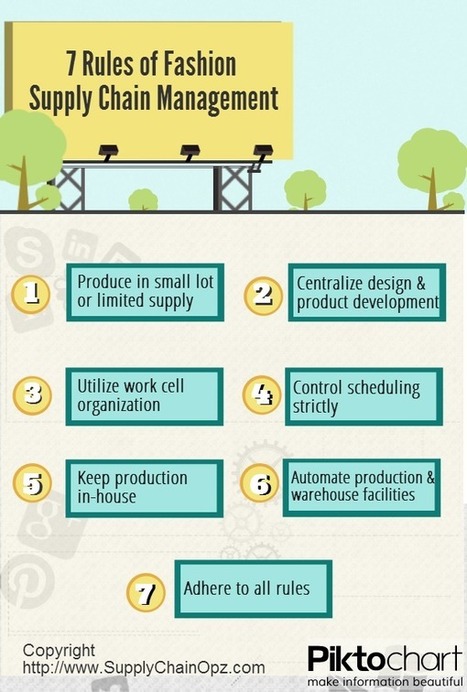
Fashion industry is one of the most primitive form of supply chain management and its practices have been extended, adopted and become best practices that we use today. This article will show you the development of fashion industry and how one company manages to bring operations into the next level. Via Supply Chain Council
Supply Chain & Transportation USA's insight:
In lieu of Fashion Week(s)
Scoop.it!

American Airlines Cargo signs the International Air Transport Association Multilateral Electronic Air Waybill agreement
|






I think this technology may actually become very useful in the developing world. Using drones to say deliver small payloads of exepensive pharmaceuticals to rural communities with bad or non-existent transport infrastructure for example
How practical will it be to have legions of drones flying about, delivering stuff? in one way of course it's 'so what' - we're already beset with delivery channels and vans, so it's just another one. In another way it feels like unnecessary, potentially disastrous - with the potential for huge fails, injuries, etc. The technology is of course there to make such drone in the millions. But what about coordinating and ensuring delivery? That's not just a complex problem, it's a complex problem with almost infinite nonlinear and dynamic variables. The IT to make this work, if it's more than just a stunt, almost requires AI just on its own.
Or perhaps this is just the first chapter in 'drononomics' - and we will soon be seeing an upscaling of nonhuman physcial economics such as we've never imagined.