Here we argues that the modern obsession with organizational alignment is actually a symptom of structural failure rather than a viable leadership strategy. We contends that when executives prioritize manufactured consensus through meetings and retreats, they are attempting to use psychological fixes to solve governance problems. This reliance on collective agreement creates a "consensus tax" that balloons decision latency and slows down operations by replacing individual authority with endless negotiation. True alignment should be an invisible byproduct of a well-designed operating model featuring clear decision rights and accountability. Ultimately, we suggests that leaders must stop treating alignment as a goal and instead focus on architecting a structure where execution happens automatically. To read more visit https://kamyarshah.com/alignment-is-a-lagging-indicator-not-a-solution/
This vidoe examines how a 90-day strategy consulting engagement functions as a practical operating system rather than a mere theoretical exercise. It emphasizes that meaningful strategy requires making explicit tradeoffs, reducing the number of active priorities, and establishing clear decision rights to eliminate leadership bottlenecks. It outlines a three-phase evolution where businesses move from auditing friction to installing a weekly execution cadence supported by a small set of trusted metrics. Ultimately, the goal of such an engagement is to replace organizational drift with a durable, action-oriented framework that changes how leaders behave on a daily basis. By focusing on irreversible momentum and measurable outcomes, the author argues that true strategic success is found in operational discipline rather than polished presentations. To read more visit https://kamyarshah.com/inside-a-90-day-strategy-consulting-engagement-what-actually-changes/
The founder is always the last person to recognize an operational problem. Everyone else identified it months earlier.
The VP who stopped escalating. The ops manager began making decisions unilaterally. The senior hire who resigned at 90 days cited culture in the exit interview.
That was not a culture problem. That was an organization with no decision architecture. The cost accumulates long before the founder sees the damage.
A competitive strategy guide covering cost leadership, differentiation, and focus, reframed around what each approach demands from the organization behind it.
Census 2023, age 0 to 1, 49 jurisdictions: 129.4 separations per 100 average beginning-of-quarter jobs, 16.9 jobs destroyed per 100 BDS denominator jobs.
Strategy consulting vs business consulting differs in scope. One shapes long-term direction, the other fixes operational problems across finance and HR.
Here we argues that the modern obsession with organizational alignment is actually a symptom of structural failure rather than a viable leadership strategy. We contends that when executives prioritize manufactured consensus through meetings and retreats, they are attempting to use psychological fixes to solve governance problems. This reliance on collective agreement creates a "consensus tax" that balloons decision latency and slows down operations by replacing individual authority with endless negotiation. True alignment should be an invisible byproduct of a well-designed operating model featuring clear decision rights and accountability. Ultimately, we suggests that leaders must stop treating alignment as a goal and instead focus on architecting a structure where execution happens automatically. To read more visit https://kamyarshah.com/alignment-is-a-lagging-indicator-not-a-solution/
The founder's priorities are obvious. The founder feels the urgency.
Nobody else got the memo.
Not because the team is incompetent. Because the mechanism for translating a decision into action does not exist. Every priority lives in one person's head and travels by hallway conversation.
That is not leadership. That is a bottleneck wearing a title.
The companies that scale past the founder are the ones that replace the founder's memory with a system.
To get content containing either thought or leadership enter:
To get content containing both thought and leadership enter:
To get content containing the expression thought leadership enter:
You can enter several keywords and you can refine them whenever you want. Our suggestion engine uses more signals but entering a few keywords here will rapidly give you great content to curate.


 Your new post is loading...










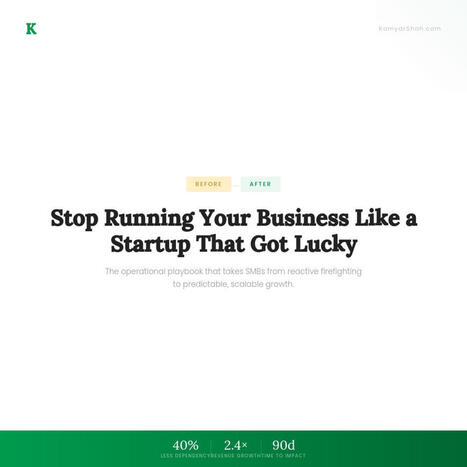





https://youtu.be/2R0VtS3QWRg?si=QcnwhDib6DZ-_T7m