The debates around STEM v STEAM are plentiful - many STEM advocates disconnect STEM content from meaningful and engaging contexts; seemingly forgetting about active and inquiry focussed pedagogies that can only operate well in a rich integrated ecosystem. We advocate for STEM+ and the "+" is essential.
We're on the edge of a new frontier in art and creativity — and it's not human. Blaise Agüera y Arcas, principal scientist at Google, works with deep neural networks for machine perception and distributed learning. In this captivating demo, he shows how neural nets trained to recognize images can be run in reverse, to generate them. The results: spectacular, hallucinatory collages (and poems!) that defy categorization. "Perception and creativity are very intimately connected," Agüera y Arcas says. "Any creature, any being that is able to do perceptual acts is also able to create."
The Microsoft study also found that young girls were in dire need of people to look up to – the very people who could kick start that interest in STEM. Although 53 percent of girls in the UK believe there are encouraging role models, but 62 percent said they would like to see more encouragement coming from female professionals working as coders, developers and lab scientists.
Microsoft also found that girls’ attitudes towards STEM differ depending on where they live in the world. Girls in Russia start to become interested at the age of 10, a year earlier than girls in the UK. Further comparisons between the two countries revealed that 43 percent of girls in the UK would consider a career in STEM, compared to 54 percent in Ireland and 50 percent in Russia.
Design thinking is a methodology for creative problem solving. You can use it to inform your own teaching practice, or you can teach it to your students as a framework for real-world projects. The set of resources on this page offer experiences and lessons you can run with your students.
This gives educators interested in teaching design thinking a first taste of challenges they might run.
The Foil Challenge is appropriate for elementary schools students. Redesign the School Lunch Experience can be for middle and high school students.
The Mindset and Process powerpoint outlines how we explain the design thinking process and the its underpinning mindsets. The red text in the Facilitators Guide offer a script for how we explain design thinking to first-time designers.
As the research on how people learn evolves, so should instructional methods for STEM undergraduate programs within colleges and universities. That's the premise of a set of case studies compiled in a publicly available report published by the Association of American Universities and the Research Corporation for Science Advancement.
The case studies profile current and past efforts to transform teaching and learning in STEM fields from the traditional lecture format and are meant to serve as a resource for department chairs and deans who are considering large-scale efforts of their own.
The case studies, written by insiders, examine programs within five institutions:
The "Science Education Initiative" at the University of Colorado Boulder and the University of British Columbia (UBC); The "Freshman Research Initiative" at the University of Texas at Austin; A program to innovate within the physics and biology programs at Cornell University; and The "Instilling Quantitative and Integrative Reasoning" (INQUIRE) program at Lyman Briggs College within Michigan State University.
We've then got two main sections that represent the two major fields in mathematics today - Pure Mathematics (an appreciation of the language of numbers itself) and Applied Mathematics (how that language can be used to solve real-world problems).
You can mess around with and download a high-res, zoomable version here, and print it on a throw pillow here, because we all need something to look at on the couch when Taboo is getting a little too weird.
To fully appreciate Walliman's Map of Mathematics, you should definitely watch the video below to get the proper walkthrough.
In this tutorial, we’re going to help you create a few simple arduino projects that are perfect for beginners. These basic projects will help you understand how to set up the Arduino software and then connect the components to perform a specific action.
If you’re completely brand new to Arduino, make sure you download our free ebook below. This guide was created for the absolute beginner and will help you to understand the Arduino board along with its parts and components.
One in five Victorian Year 10 students will be expected to have “excellent” critical and creative thinking skills by 2025.
The Herald Sun reported the benchmark is a 25 per cent increase on last year, and is part of a push to teach children hi-tech skills, including robotics, precision manufacturing and biotechnology.
Education Minister James Merlino told the publication students needed to cope in a “changing, global economy”.
“Many of the jobs our kids will have in the future do not even exist right now,” he said.
Mathematical genius is misunderstood. The term “genius” evokes feelings of envy. It paints a picture of a pre-determined minority of people who have truly mastered a discipline. A chosen few.
Yet there is nothing pre-determined about it. Mathematical genius resides within every one of us. Most people just don’t know it yet. That’s because genius is fragile. If you don’t embraced genius and tend to with care, it will slip away, leaving behind just a subdued vision of the mathematicians we could have become.
If you take even a cursory look through the annals of mathematics, you’ll see the fragile and often fickle nature of genius. Many of the legends of the field — whose talents and achievements are beyond dispute — could so easily have been forgotten by history. Their stories should act as a warning sign to educators today.
This paper is designed to inform schools, families and communities about the potential of personalized learning. This report describes why personalized learning matters and shows what personalized learning looks like in schools for teachers and for students.
Through case studies, this paper illustrates what personalized learning looks like in practice, provides examples of teachers personalizing learning in their schools and districts, and shares student perspectives on how new instructional designs are meeting their unique needs. Education leaders, parents, teachers, students and communities can use this report to begin conversations around what modern learning environments look like and how schools can best prepare students for postsecondary success.
Synchronized programmable drones are entertaining for sure, and you can see them providing a wow factor like fireworks. They’re easier to control, allow for more elaborate effects, and are reusable. But the technology offers far more practical, and potentially life-saving, applications.
Bring obsolete objects and unused gear back to life for a chance to win great prizes in the element14 Upcycle it Design Challenge with Intel® Edison.
We invite all engineers, DIY hobbyists and tinkerers to upcycle an obsolete item, computer, piece of electronic equipment or appliance and make a cool new electronics project built around the Intel® Edison Kit for Arduino.
The Upcycle it Design Challenge will choose 15 official challengers to receive a Challenger Kit for FREE.
For a chance to become a Challenger, submit your project idea using the enrollment form by March 3rd, 2017, and our Judges will select their favourite 15. The Challenger Kit comprises of the Intel® Edison Kit for Arduino, Intel® Edison Breakout Board, Arduino Protoshield R3, the Grove Starter Kit for Arduino, an AC/DC power supply and a USB cable.
Anyone completing a project by the 9th June deadline and posting at least 10 times on the Community detailing their project build will be in the running to win some awesome prizes, including a Keithley DMM7510 Digital Multimeter worth almost $4,000.
The official Challengers must build their project in accordance with the challenge's terms and conditions. All projects must include the Intel® Edison.
Long before Sir Isaac Newton, Pierre de Fermat, Gottfried Leibniz or the rest of the crew credited with the development of calculus, an astronomer and mathematician named Jyesthadeva put ink to palm leaves to record the mathematics of his teachers and possibly some of his own.
In a small town in southern India in the 1500s, Jyesthadeva penned concepts important to developing a calculus system, and he did so in complete proofs that demonstrated infinite series expansions of trigonometric functions and gave precise approximations for complex calculations. “Calculus and everything derived from it depends to some extent on these concepts of infinitesimals and infinite series,” says Kim Plofker, author of Mathematics in India. By way of comparison, it wasn’t until the 1660s in Europe that a Westerner named James Gregory was able to independently do the same proof.
Outside of the classroom, I run a large research group of undergraduates in a variety of STEM and education disciplines. When I look at the students who are, or have been, part of this group over the last decade, the thing I am most proud of is the community that these young researchers have built. Typically about 80 percent of our group is female, and it is made clear from everyone’s first day in the lab that we will not tolerate discrimination. Male or female, gay or straight, transgender or cisgender, black or white — when students join this lab, the group commits to supporting them and assisting one another with research projects. These young researchers work collaboratively on research that has an impact beyond a grade or a class ranking.
Simply saying that discrimination isn’t allowed isn’t enough. Rather, this is a chance for faculty members to lead by example and to make sure that our students can identify and speak up against such bias and discrimination. When, as has happened with seemingly increasing frequency these past few years, sexual harassment in STEM academe is in the news, it’s important that we discuss it, not ignore it. We must have difficult yet respectful conversations about our differences. We also must question assumptions and simplifications we make — when we say that a program is for women in STEM, are we equally welcoming to both trans- and cis-women?
A way to support female undergraduates in STEM is to teach all undergraduates that there is no single model for what STEM success looks like. There are multiple paths in these fields, and even the most successful-looking scholars and executives have faced some roadblocks and stumbles along the way. As we work to make STEM more welcoming and encouraging for women today, I hope that part of that is sharing honest stories of what life as a woman in STEM can be, and not just the highlights. Let’s create an environment where we see each student, regardless of gender, as a unique individual, and where we teach them all to appreciate and acknowledge the differences of others.
However, ground-breaking research by Microsoft has revealed that most girls’ positive views may change within just a few years. The technology company asked 11,500 women between the ages of 11 and 30 in 12 countries across Europe about their attitudes to STEM. The unique insight found that: Most girls become interested in STEM at the age of 11-and-a-half but this starts to wane by the age of 15.
Girls cited a lack of female role models in STEM as a key reason they didn’t follow a career in the sector Young women are not getting enough practical, hands-on experience with STEM subjects Just 42% said they would consider a STEM-related career in the future 60% admitted they would feel more confident pursuing a career in STEM fields if they knew men and women were equally employed in those professions
Five years ago, universities like MIT and Stanford first opened up free online courses to the public. Today, more than 700 schools around the world have created thousands of free online courses. Here are 250 Ivy League courses you can take online right now for free
Some of the most popular courses have been those focused on technology — topics like programming, computer science, data science, and artificial intelligence.
I’ve compiled this list of over 370 such free online courses that you can start this month. For this, I leveraged Class Central’s database of over 7,000 courses. I’ve also included each course’s average rating.
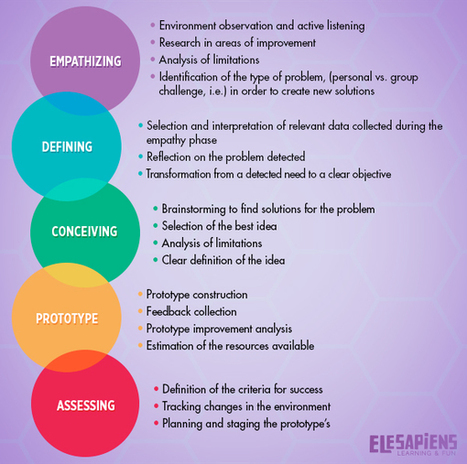
The application of this methodology is possible in any field of knowledge because it develops empathy, creative thinking and critical thinking, as well as collaborative skills, social skills and entrepreneurship.
Over the last five years, the new curricula of the European, North American and Latin American countries have been adding skills relating to engineering, technology, innovation and entrepreneurship in Science."
Learning standards or performance expectations Science curricula not only entail knowing about surrounding phenomena, but also involve applying such knowledge to build prototypes and solve problems in a society. The Design Thinking process will adhere to these standards and correlate to all the learning disciplines represented by the STEM [“acronym”]: Science, Technology, Engineering and Mathematics. Furthermore, it enables further growth in students, such as developing emotional intelligence, and increasing motivation when solving real-world problems, exercising linguistics expression, activating creative thinking and increasing entrepreneurial skills among students.
The video shows that there's a gaping "chasm of ignorance" that physicists need to fill in before we can truly understand how the Universe works. This includes things like dark matter and energy, which work in theory, but so far have never been directly observed or explained.
The bottom line in all of this is that, the more we learn, the more we realise how much we have left to discover, and that's one of the things we love the most about science.
So, for anyone who's ever hurt their brain by trying to think about what the Universe is expanding into, or what exactly space-time is made of, this is for you. Because when the history of physics is broken down into a palatable 8 minutes, it suddenly doesn't seem so scary after all.
Now, check out the video below, and go and use your newly minted expertise to impress some dinner table conversationalists.
While a few decades back you would’ve needed an entire room to fit in a computer, technology has come such a long way you can literally pack a PC right in a tiny mint box – and this is precisely what this crafty recreational inventor has done with his Raspberry Pi.
Developer Matt Wagner has managed to cram an almost entirely self-contained computer setup inside an Altoids mint box. While the resourceful inventor initially came up with the idea around 2012 when Raspberry Pi first launched, he had to wait a couple of years until the company eventually released the ultra compact Pi Zero.
Message from Ms Irina Bokova, Director-General of UNESCO
This International Day of Women and Girls in Science is an opportunity for all to take a stand for girls and women in science.
Girls continue to face stereotypes and social and cultural restrictions, limiting access to education and funding for research, preventing them from scientific careers and reaching their full potential. Women remain a minority in science research and decision-making. This throws a shadow over all efforts to reach the 2030 Agenda for Sustainable Development and the Paris Agreement on Climate Change – both of which highlight the key roles of gender equality and science.
At the same time, girls and women shoulder the heaviest burdens of poverty and inequality – they stand on the frontlines of climate change, including the disasters resulting from natural hazards. Girls and women in rural and disadvantaged areas are hit hardest.
Meaningful progress must start with the rights and dignity of women, by nurturing their ingenuity and innovation.
10:45am. Year 9 woodwork technology class. Students are building chairs and have been told to cut and join pieces of wood to form a right-angled triangle. With little time to explore it further, the teacher tells their students exactly how to cut the wood to achieve the desired angles. Fast forward only a few weeks and the same students are in class, but this time it’s maths. The time-old sigh of bored students echoes around the room: “why are we learning this anyway, we’re never going to use it”. You guessed it, they were learning about how to calculate the angles of a triangle.
Our secondary education system, designed largely in and for the industrial era, is in desperate need of revision if it is to remain effective in preparing students for their adult lives. One opportunity is to combine the isolated study of science, maths and technology (like woodwork – though all the cool kids are now running “maker spaces” instead) into a single, integrated “STEM” subject. Doing so will provide context to students, making learning relevant and engaging, whilst likely save time. Most importantly it creates a natural setting for students to hone their problem solving and logical reasoning skills, critical to their success in a rapidly changing world.
The rise of automation is destined to replace some worker employment, and it could increasingly cause friction with efforts to create new jobs, a hallmark of the Donald Trump administration. Many…
Brian is a grade 7/8 teacher on a mission to expose as many kids as he can to coding and computer science. In this passionate talk, he makes a case for the importance of exposing youth to the principles of coding and computational thinking to prepare them for a rapidly changing future.
Brian is a grade 7/8 teacher and Microsoft Innovative Educator Expert who develops web applications to support 21st century learning practices and pedagogies. His latest project, edmettle, is a tool to support and develop student feedback to improve learning. Brian speaks professionally on the topics of 21st century education, assessment and evaluation and has given two TEDx talks on education reform.
He has a Bachelor of Science in Computer Information Systems and is currently completing his Masters of Professional Education in Math & Computational Strategies.
Someone always asks the math teacher, "Am I going to use calculus in real life?" And for most of us, says Arthur Benjamin, the answer is no. He offers a bold proposal on how to make math education relevant in the digital age.
Normal crystals, likes diamond, are an atomic lattice that repeats in space, but physicists recently suggested making materials that repeat in time. Last year, UC Berkeley's Norman Yao sketched out the phases surroundin
The Tesla Foundation has partnered with key educators, aviators, roboticist, scientist, and engineers to offer K-12 and College level courses in Unmanned Aerial Systems for education and workforce development. The transition from the “Information Age” to the “Autonomous Age” is here and we are on the forefront of the largest migration of education and labor since the transition from “Farm to Factory” which occurred at the turn of the 20th century.
To get content containing either thought or leadership enter:
To get content containing both thought and leadership enter:
To get content containing the expression thought leadership enter:
You can enter several keywords and you can refine them whenever you want. Our suggestion engine uses more signals but entering a few keywords here will rapidly give you great content to curate.


 Your new post is loading...