 Your new post is loading...

|
Scooped by
Sepp Hasslberger
September 10, 2015 5:03 PM
|
New close-up images of Pluto from NASA’s New Horizons spacecraft reveal a bewildering variety of surface features that have scientists reeling because of their range and complexity.
“Pluto is showing us a diversity of landforms and complexity of processes that rival anything we’ve seen in the solar system,” said New Horizons Principal Investigator Alan Stern, of the Southwest Research Institute (SwRI), Boulder, Colorado. “If an artist had painted this Pluto before our flyby, I probably would have called it over the top — but that’s what is actually there.”
|
|
Scooped by
Sepp Hasslberger
September 3, 2015 1:54 PM
|
A team of researchers from the University of California in Santa Barbara has figured out how to deflect asteroids and stop them from spinning—using lasers. Yes!
They used basalt to simulate an asteroid (basalt and known asteroids have similar composition) and directed a laser at the small rock until it was white hot.
As the laser eroded material from the rock, in a process called laser ablation, the rock sample’s mass changed and in effect produced a “rocket engine” where the asteroid uses itself as a propellant—in space, this could alter the asteroid’s trajectory.
|
|
Scooped by
Sepp Hasslberger
August 18, 2015 4:04 PM
|
The US Air Force's top secret X-37B space plane has been caught on camera surveying the same region of the ground every two days at a much lower orbit and inclination than expected.
Like a shuttle, X-37B is blasted into orbit by a rocket. However, it lands using a runway like a normal aircraft. The X-37B is too small to carry people onboard, but does have a cargo bay similar to that of a pickup truck, which is just large enough to carry a small satellite
According to X-37B manufacturer Boeing, the space plane operates in low-earth orbit, between 110 (177km) and 500 miles (800km) above earth.
By comparison, the International Space Station orbits at about 220 miles (350km).
|
|
Scooped by
Sepp Hasslberger
August 9, 2015 7:09 PM
|
A new study overturns longstanding scientific ideas regarding how energy is distributed within muscles for powering movement.
Scientists are reporting the first clear evidence that muscle cells distribute energy primarily by the rapid conduction of electrical charges through a vast, interconnected network of mitochondria -- the cell's "powerhouse" -- in a way that resembles the wire grid that distributes power throughout a city.
The study offers an unprecedented, detailed look at the distribution system that rapidly provides energy throughout the cell where it is needed for muscle contraction.
|
|
Scooped by
Sepp Hasslberger
August 6, 2015 7:15 PM
|
Unlike any other life on Earth, these extraordinary bacteria use energy in its purest form – they eat and breathe electrons – and they are everywhere.
Nealson is particularly excited that Rowe has found so many types of electric bacteria, all very different to one another, and none of them anything like Shewanella or Geobacter.
“This is huge. What it means is that there’s a whole part of the microbial world that we don’t know about.”
|
|
Scooped by
Sepp Hasslberger
August 4, 2015 1:31 PM
|
An incredible, reprocessed picture of Jupiter's moon Europa shows the mysterious natural satellite's amazing colors as they have never been seen before.
"Hidden beneath Europa's icy surface is perhaps the most promising place in our solar system beyond Earth to look for present-day environments that are suitable for life," NASA officials wrote in a statement.
"The Galileo mission found strong evidence that a subsurface ocean of salty water is in contact with a rocky seafloor. The cycling of material between the ocean and ice shell could potentially provide sources of chemical energy that could sustain simple life forms."
|
|
Scooped by
Sepp Hasslberger
August 1, 2015 12:07 PM
|
The comet lander Philae may be uncommunicative at the moment, but the pictures and measurements it took after it touched down on the comet in November have shown scientists that the comet is covered with coarse material, rather than dust, and is harder than expected.
As it landed, Philae bounced and ended up in shadow, where its batteries soon ran out. But it still gathered unprecedented data, some of which the DLR German Aerospace Center said "amazed" scientists.
A report on its findings will be published on Friday in a special edition of the journal Science.
"The experiments conducted on site have led to new and, at times, unexpected insights into the nature of the comet," Ekkehard Kuehrt, a planetary researcher at the DLR, said in a statement.
For example, pictures taken by Philae as it came in to land showed the surface of the comet was covered with coarse debris, rocks and pebbles, measuring up to five meters across, rather than the dusty deposits expected.
According to the DLR, Philae's systems found a total of 16 organic molecular species, including four never before encountered in comets.
|
|
Scooped by
Sepp Hasslberger
July 26, 2015 1:31 PM
|
Physicists bust a 350-year-old conundrum in a report that proposes a transfer of energy through a sound pulse causes clocks to synchronise
A pair of Portuguese scientists hypothesised that these pulses might move from clock to clock, perturbing the swing of the pendulums and eventually causing them to synchronise.
They developed a complex mathematical model before conducting experiments with a pair of clocks attached to a rail fixed to a wall. The theoretical predictions and simulation matched, they found.
“We could verify that the energy transfer is through a sound pulse,” said co-author Luis Melo, from Lisbon University’s physics department. This not only solves “an old, fundamental problem,” it also boosts understanding of other types of oscillator, he said.
|
|
Scooped by
Sepp Hasslberger
July 20, 2015 3:39 PM
|
|
|
Scooped by
Sepp Hasslberger
July 15, 2015 4:16 PM
|
Unless humans slow the destruction of Earth's declining supply of plant life, civilization like it is now may become completely unsustainable, according to a paper published recently by University of Georgia researchers in the Proceedings of the National Academy of Sciences.
"As the planet becomes less hospitable and more people depend on fewer available energy options, their standard of living and very survival will become increasingly vulnerable to fluctuations, such as droughts, disease epidemics and social unrest," Schramski said.
"I'm not an ardent environmentalist; my training and my scientific work are rooted in thermodynamics," Schramski said. "These laws are absolute and incontrovertible; we have a limited amount of biomass energy available on the planet, and once it's exhausted, there is absolutely nothing to replace it."
Read more at: http://phys.org/news/2015-07-destruction-earth-life-humans-jeopardy.html#jCp
|
|
Scooped by
Sepp Hasslberger
July 14, 2015 5:51 PM
|
“At some point during the modern age of public relations, it occurred to governments and corporations that they could fabricate any sort of knowledge. For example, they could pretend to follow the scientific method, pretend to take all the right steps in proper sequence, and then attach the seals and certifications of approval, without ever doing actual science.
Take the case of SARS, the epidemic that never was, in 2003. When the World Health Organization (WHO) decided there was an outbreak of a new disease, a closed circle of 10 WHO labs collaborated to find the virus that was causing SARS. This, on the basis of zero evidence that SARS was a new disease or that it was the result of a virus. The labs announced the discovery of a so-called coronavirus.
Subsequently, no other independent researchers replicated this finding with convincing evidence. And at the height of the “outbreak,” a WHO researcher in Canada (Frank Plummer) would confess to reporters that he was puzzled by the extremely rare appearance of the coronavirus in SARS patients—which was tantamount to an admission that he had no idea what singular factor or multiple factors were making patients ill.
|
|
Scooped by
Sepp Hasslberger
July 12, 2015 12:14 PM
|
A new model of the Sun's solar cycle is producing unprecedentedly accurate predictions of irregularities within the Sun's 11-year heartbeat. The model draws on dynamo effects in two layers of the Sun, one close to the surface and one deep within its convection zone.
Predictions from the model suggest that solar activity will fall by 60 per cent during the 2030s to conditions last seen during the 'mini ice age' that began in 1645.
|
|
Scooped by
Sepp Hasslberger
July 6, 2015 12:36 PM
|
The closer we get to Ceres, the more perplexing the dwarf planet grows. NASA's Dawn spacecraft has found several more bright spots as well as a pyramid-like peak jutting out of the frigid world's surface.
That bright spot resolved into two bright spots as the spacecraft got closer, and new images show that the dimmer companion is actually not one, but at least eight smaller spots.
What are those shiny areas? It's still unclear, Russell said. It's possible they are salt or water ice, though scientists can't say for sure.
"We should get the answer when we pass over the bright spot again," Russell said. "We do see the contour of the ground, and it seems that it is not a hill but possibly a dip in the surface that is bright, but we need to complete the survey orbits in order to accurately obtain the topography of the area."
Read more at: http://phys.org/news/2015-07-dwarf-planet-ceres-big-scientists.html#jCp
|
|
|
Scooped by
Sepp Hasslberger
September 7, 2015 3:27 PM
|
Earth’s depths are a hellish place. More than 5,000 kilometers belowground, the iron-rich core scorches at temperatures comparable to the sun’s surface and crushes at pressures akin to the weight of 20 blue whales balanced on a postage stamp.
|
|
Scooped by
Sepp Hasslberger
August 29, 2015 2:34 PM
|
Over the last few years, a growing chorus of insider critics have been exposing serious flaws in the ways that scientific research is funded and published, leading some to go so far as to say, "Science is broken." The dysfunctions they describe include:
- Deliberate, unconscious, and systemic fraud
- Irreproducibility of results and lack of incentive to attempt replication
- Misuse of statistics, such as "P-hacking" - the mining of research data to extract a post-hoc "hypothesis" for publication
- Severe flaws in the system of peer review, its propensity to enforce existing paradigms, to be hostile to anything that challenges the views of the reviewers whose careers are invested in those views.
- Difficulty in obtaining funding for creative and unorthodox research hypotheses ...
The system encourages the endless elaboration of existing theories about which there is consensus, but if one of these is wrong, there are nearly insuperable barriers to it ever being overturned.
|
|
Scooped by
Sepp Hasslberger
August 14, 2015 11:45 AM
|
The research team operating out of Pohang University of Science and Technology, reported a tunable band gap in black phosphorus (BP), effectively modifying the semiconducting material into a unique state of matter with anisotropic dispersion. This research outcome potentially allows for great flexibility in the design and optimization of electronic and optoelectronic devices like solar panels and telecommunication lasers.
Birth of a Revolution...
Phosphorus is the fifteenth element in the periodic table and lends its name to an entire class of compounds. Indeed it could be considered an archetype of chemistry itself.
Black phosphorus is the stable form of white phosphorus and gets its name from its distinctive color. Like graphene, BP is a semiconductor and also cheap to mass produce.
The one big difference between the two is BP's natural band gap, allowing the material to switch its electrical current on and off.
|
|
Scooped by
Sepp Hasslberger
August 8, 2015 1:48 PM
|
There is a very common illustration of a ball pulling a flat sheet out of shape to represent Einstein's curvature of space but that concept is not really accurate.
We do not live in a two-dimensional world of sheets of flat space-time and gravity isn't just a bending, but a twisting curvature. Imagine the ball rotating and thus distorting that matrix of space-time to create a kind of space-time vortex, and you'd have a good analogy.
We should really think of a 3-dimensional matrix of potential particles filling space. That matrix seeks to arrange itself in orthogonal patterns, but it can also be twisted out of shape by a rotating mass sitting in that spatial matrix. The distortion would be a twist in the space matrix.
Gravitation is a consequence of spin-induced curvature (actually a twisting out of shape) of the space-time matrix...
|
|
Scooped by
Sepp Hasslberger
August 6, 2015 5:40 PM
|
A team of physicists has published a paper detailing how it developed the first ever maser to work at room temperature with the help of a home-baked crystal and a laser bought on eBay.
Masers (Microwave Amplification by Stimulated Emission of Radiation) have a similar functionality to lasers but work by emitting concentrated microwave beams instead of light.
Although the process was first used 60 years ago it is considered notoriously inconvenient, functioning at low power only in high magnetic fields, a vacuum or at temperatures close to absolute zero (the ruby crystals used to amplify the microwaves have to be kept at low temperatures)...

|
Suggested by
Troy Oakes
August 3, 2015 8:57 AM
|
Have you ever wondered what the International Space Station (ISS) looks like inside?
Samantha Cristoforetti, the Italian astronaut, was in space for 199 days and 16 hours until she came back to Earth last month. This makes her the record holder for the longest single space flight by a woman, as well as the longest uninterrupted space flight of a European astronaut.
But before Cristoforetti left the ISS, she took 15 photographs of the inside of each module...
The photos have now been stitched together, giving us a highly detailed interactive tour; you can see it in full screen here. Apart from the Russian modules of the ISS, you can see every part of the Space Station in detail.
|
|
Scooped by
Sepp Hasslberger
July 31, 2015 5:04 PM
|
Continuing the theme that 20th century physics is all-knowing, all-seeing, and all-describing, when scientists saw their gravity equations could not describe the speed of stars on the edge of galaxies, instead of looking at their own equations they did what they always do: change the facts.
They invented something invisible and impossible to detect because it must be really really hard to detect if the physicists can find it. Heaven forbid their equations are wrong! In fact, one of the more famous “physics evangelists” Michio Kaku says there is a Nobel Prize waiting for the answer to dark energy. That is the interest of course: the Nobel Prize. They don’t care if Dark Energy or Dark Matter is real or not.
So basically, physicists invented a magical thing they called “dark” and say it is the reason stars are going faster than their equations predict.
|
|
Scooped by
Sepp Hasslberger
July 23, 2015 7:17 PM
|
NASA's Kepler mission has confirmed the first near-Earth-size planet in the “habitable zone” around a sun-like star. This discovery and the introduction of 11 other new small habitable zone candidate planets mark another milestone in the journey to finding another “Earth.”
|
|
Scooped by
Sepp Hasslberger
July 18, 2015 6:08 PM
|
"Buckyball" molecules appear to be commonplace across the universe, and may even be sources of organic molecules that are key to the origin and evolution of life, a new study suggests.
|
|
Scooped by
Sepp Hasslberger
July 15, 2015 3:32 PM
|
Now that I have a reasonable-resolution global color view of Pluto, I can drop it into one of my trademark scale image montages, to show you how it fits in with the rest of the similar-sized worlds in the solar system: the major moons and the biggest asteroids.
These are the not-planets. Their non-planetary status is a handicap because these are the worlds that we need to get Earthlings excited about exploring.
Titan's strange hydrology -- Enceladus' geysers -- the subsurface oceans of Europa and Ganymede -- the dynamic surfaces of Triton and Pluto. And beyond all the worlds pictured here, there are hundreds of Kuiper belt objects that I would include on this montage if we had ever visited them up close. But we haven't yet.
So much undiscovered country yet to explore -- but they're all worlds that much of the public is not familiar with.
...please go out and show your friends and family how cool these worlds are, and how much worth exploring. Help people learn their names, and help them understand how fascinating and mysterious they are.
|
|
Scooped by
Sepp Hasslberger
July 13, 2015 5:47 PM
|
It is paradoxical and ironic that peer review, a process at the heart of science, is based on faith not evidence.
There is evidence on peer review, but few scientists and scientific editors seem to know of it – and what it shows is that the process has little if any benefit and lots of flaws.
Peer review is supposed to be the quality assurance system for science, weeding out the scientifically unreliable and reassuring readers of journals that they can trust what they are reading. In reality, however, it is ineffective, largely a lottery, anti-innovatory, slow, expensive, wasteful of scientific time, inefficient, easily abused, prone to bias, unable to detect fraud and irrelevant.
|
|
Scooped by
Sepp Hasslberger
July 9, 2015 5:04 PM
|
Earlier this week, there was a mishap — or, as the Captain would say, there was a “failure to communicate” — with New Horizons: the spaceprobe dispatched to explore the dwarf planet, Pluto. As of now, all systems are up and running once again, and the little probe that could remains on course for its rendezvous with the Plutonian system.
It is expected to come within 7,750 miles (12,500 kilometers) of Pluto on July 14th; the event will mark the very first time that the enigmatic minor planet and its equally fascinating moons are studied up close and personal, before the probe ventures into the icy unknown—deep within the Kuiper Belt.
In the days since the minor glitch, new images have trickled out, the latest batch is the most detailed yet...
|


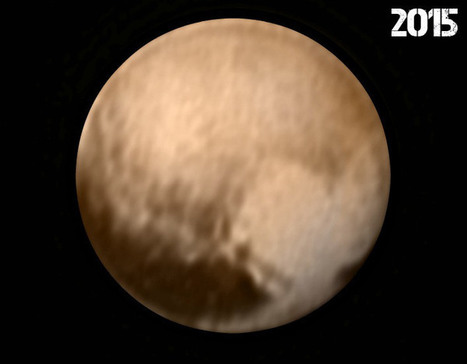





It took a while to download those images, but it was worth waiting. I wonder if those astronomists who voted to demote Pluto from planet status to "dwarf planet" are biting their tongues yet...