WATCH THE FULL EP1 HERE: http://www.youtube.com/watch?v=XahbqLdCVhE An amazing 13 episode animated TV series, iPhone game, music album! A Unicorn Black produ...
Your new post is loading...
Deanna Metz's curator insight,
March 1, 2016 8:05 PM
This is an incredibly powerful and remarkably well-done video by the Economist (see related article here) that is reminiscent of a TED-ED lesson on the importance and value of population pyramids. This video goes nicely with this article from the World Bank entitled "The End of the Population Pyramid" which highlights the demographic changes that will be reshaping global demographics in the next 50-100 years. Tag: population, declining population, demographic transition model, video, APHG.
Damon Recagno's curator insight,
October 12, 2017 11:52 AM
Here is a quick introduction to the shifting population demographics and why there is a Declining Natural Growth Rate.
This video is a good way of introducing the topic of Cities and Countries Methods for Tackling a Declining Natural Growth Rate because it provides insight on why many locations around the world are currently experiencing a declining natural growth rate.
Teresa Morante Arona's comment,
October 13, 2017 9:35 PM
Gret Video, but why do you think there is such a diverse shift in population demographics?
Peter Phillips's curator insight,
November 6, 2014 11:43 AM
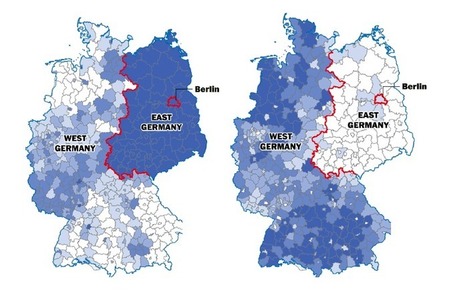
50 years of communist rule still affect opportunities in Germany today, as these maps show. What they don't show is the social mirror that each provides to the other and the rich discussions about social policy that result. Reunification has been an expensive exercise for Germany, however one that it is committed to.
Jacob Conklin's curator insight,
February 12, 2015 6:20 PM
The Soviet Union collapsed in 1991, but its influence is still present in today's Germany. History plays a key role in the shaping of political boundaries and that history is clearly evident in Germany. The line where the Berlin wall once stood still divides the country economically. The western part of Germany is far more economically affluent than the east. The USSR may be gone, but its influence still remains.
BrianCaldwell7's curator insight,
April 5, 2016 8:14 AM
These two maps (unemployment on the left and disposable income on the right) are but two examples in this article that highlights the lingering distinctions between the two parts of Germany that were reunited 25 years ago. The social geographies imposed by the Iron Curtain and the Berlin Wall are still being felt from this relic border and will for years to come. Tags: Germany, industry, labor, economic, historical, political, borders. |
Kortney Renee Honstein's curator insight,
November 6, 2014 11:59 PM
As the United States we love to make things our own. Create things to make ourselves stand out and seem different. We like to branch out. As in making choices to change things out in our menus at restaurants. Just like France doesn't allow that because it is their restaurant. This is an idea of fold culture because it shows that the United States likes the freedom to do whatever we please. And other places like the strict ground rules they have set to keep what they love to themselves so others don't ruin it.
Dean Haakenson's comment,
November 7, 2014 9:02 AM
Interesting Article--and it makes a lot of sense when thinking of the value of the individual in the US.
Elizabeth Sheppard's comment,
October 3, 2014 3:07 AM
Its interesting to see the different cultural traditions that are set at different stages in a persons life as the beginning into adulthood for most. I don't think I would want to be a male in the Brazilian Amazon, or the island of Vanuatu where you literally put your life on the line to prove your ready for adulthood. It shows the differences and what is considered important or the role the person plays in society. I think the mention of the sweet 16 for American girls was a pretty weak presentation. America is a melting pot and represents so much more than that.
Jacob Crowell's curator insight,
October 27, 2014 11:59 AM
These traditions reflect the cultural geographies they take place within. In the Brazilian Amazon, the locals use the bullet ants native to the area to use in their Bullet Ant Initation. On North Baffin Island, where Inuits must be able to navigate and hunt in the wilderness of the artic, their coming of age involves a hunting journey that begins with them opening up the lines of communication between men and animals a relationship that the survival of the community hinges on. In the Amish tradition, they send their youth out into the world to witness the perils of modern society as a way to provide them with the choice of Amish Living. In Central and South America, girls have a Quinceanera where they girls solidifies their commitment to her family and faith two very important ideals of that culture. These coming of age traditions reflect the cultural differences between places throughout the world.
Lydia Tsao's curator insight,
March 24, 2015 1:34 AM
I think this article could also fit into the view of culture of gender. The fact that there are separate celebrations in Jewish culture represent the divide between men and women. The Satere-Mawe tradition of wearing bullet ant gloves in order for boys to demonstrate their "manliness" is actually quite sexist. It demonstrates how men must behave in "manly" ways and not cry in order to be viewed as a "true" man. This creates a mentality in boys from a very young age that they must not be "feminine," and that they must be more headstrong than girls to be viewed as a man. The same goes for the Vanuatu tradition. Young boys have to go to the extreme (jump from tall towers with a simply a rope around their legs to keep them from dying) to prove their manhood. Of course these traditions are an important part of their culture, and I have no right to criticize, but I am simply providing an alternative analysis of these traditions. |