Your new post is loading...

|
Scooped by
Giuseppe Mauriello
January 29, 2012 5:40 PM
|
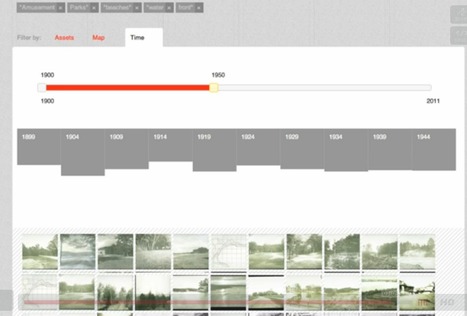
Thinking about the sheer volume of information — stories, images, videos, data — available from The New York Times can evoke a simultaneous glee and terror. It is simply impossible for readers to see them all. The task for beta620, the Times experimental projects group, launched Deep Dive that uses the Times’ massive cache of metadata from stories to go, as the name suggests, deeper into a news event by pulling together related articles. So Deep Dive would provides readers a collection of stories relating to a topic, based on whatever person, place, event or topic of their choosing. What’s interesting about Deep Dive? At least three things: 1) Deep Dive relies on the extensive tagging system the Times uses for all its stories and makes the Times Topics pages possible. As part of the editing flow tags are applied to stories by editors or producers, with suggestions provided by an internal algorithm. Deep Dive looks for connections among topics. 2) Deep Dive’ unique interfact, where the related articles flow into the same frame as the main story when selected. You need never leave the page; jumping backwards or forwards in articles all happens in the same space. That’s a departure from the pageview-driven way most news sites are designed. But Deep Dive’s UI matches its underlying thesis: that individual articles are really pieces of a larger story, told in pieces over time and across bylines and datelines. 3) More interesting, Deep Dive will also allows users to save their “dives,” which would be constantly updated with new articles. What Deep Dives promises is an alert more directly based around a specific developing story. But beyond those elements, the real promise of Deep Dive, though, is that it continues to show the Times’ flexibility in providing different ways for different kinds of readers to access its content... read full article http://j.mp/x2SoPf
visit also http://beta620.nytimes.com/projects/deep-dive/
and read here: http://beta620.nytimes.com/projects/deep-dive/exploring-stories-with-deep-dive/
Curated by Giuseppe Mauriello
|
|
Scooped by
Giuseppe Mauriello
January 23, 2012 12:27 PM
|
Excerpted from article intro written by Lee Odden: "A big part of what I do as an Internet Marketer centers around being able to consume large amounts of information or better, the right information, synthesizing it and using insights to help others make sense of the challenges and opportunities they face with marketing on the web. Simply finding and sharing news ala basic ”curation” is a cheap commodity. Value comes from identifying bigger picture patterns and synthesizing that information into practical business advice. I like what Christian Adams said in a G+ thread, “When you have information overload across multiple channels you start to pick up on common threads and trending topics”. This is the essence of curation that creates value and there’s no substitute for human filtering. As a professional, it’s essential for you to filter signal from a mass of noise to grow expertise in your core discipline as well as others. The question is, where do you get the information to stay current? How do you filter out the noise? While some people still use RSS via Google Reader, usage of the traditional RSS feed has been displaced by Twitter lists, Google+ circles and more so what Shel Holtz called “curated collections” like what you can find at SmartBrief and PR Daily newsletters. Other curated news services mentioned include paper.li, Percolate, news.me, Pulse, FlipBoard. Here are a few of the things that I do to stay current: 1. Read social feeds & email... 2. Meet with my right hand marketer... 3. Meet with our group of Account Managers..." [read full article http://j.mp/wm4Ufm] Curated by Giuseppe Mauriello
|
|
Scooped by
Giuseppe Mauriello
January 23, 2012 1:53 PM
|
With today’s technology, it’s easier now than at any point in the history of the world to create content. But that doesn’t mean the best content is getting to the right audience. That’s why editors and publishers need better tools to help them separate the wheat from the chaff. Historically, as Cory Doctorow pointed out in an article he wrote for The Guardian, there have been three steps in the publishing paradigm: identifying stories (curating); writing them; and connecting those stories to the right audience. While most technological advances have focused on making steps 2 and 3 easier, the first step (identifying stories) has gotten exponentially harder. It’s become a numbers game. Writers send out more and more pitches because they’re competing with more and more pitches from other writers. Ultimately, this model is unsustainable. The simplest way to cut down on low-quality pitches is by imposing a $2 to $3 charge to put some “tension” on submissions and that will decrease spam. The other way to make life easier for editors is through technology. Cloud computing has drastically decreased the cost of creating powerful curation tools that empower editors to curate and edit. [read full article http://j.mp/y7T4d0]
Curated by Giuseppe Mauriello
|
|
Scooped by
Giuseppe Mauriello
January 20, 2012 4:06 AM
|
Excerpted from article: "Today we are excited to introduce our Topical Browser, a new content discovery experience, powered by the collective curation efforts of the Paper.li community. Now, for the first time, we are combining our publisher’s editorial skills with Paper.li's unique content analysis engine to provide a new transparency to content discovery: a curated, filtered, noiseless experience that we call the Paper.li Topical Browser. The Paper.li Topical Browser opens the door for anyone to discover and explore content spanning more than 20,000 curated topics, ranging from mainstream to niche. It provides a great way for you to discover more of the outstanding Paper.li publishers who are truly passionate about these topics..." [read full article http://j.mp/zQmHS0]
Curated by Giuseppe Mauriello
|
|
Scooped by
Giuseppe Mauriello
January 15, 2012 8:07 AM
|
Launched in December 2011, Juxtapost is here to help you remember all the amazing things you see while you browse the web. With all its infinite options, managing what you find has become a massive undertaking. Juxtapost provides members with easy-to-use tools to “bookmark” the photos into categorized PostBoards (collection of posts) they can easily maintain, even if their collection spirals to hundreds of websites. The discovery aspect of Juxtapost is just as simple. Members browse the streams of other members to see what they’re posting and have the option to comment, share or re-post items to their PostBoards. The power of social discovery becomes readily apparent when you begin to follow people/friends with your similar style or tastes, it’s like browsing the web all your friends. There are lots of social discovery websites available, but Juxtapost stands out from the crowd for offering a few unique tools to help streamline the process. 1) Easy Facebook Sign-Ups
2) Intelligent Automatic Descriptions
Juxtapost automatically attempts to fill a description to save them the hassle by evaluating the content on the page and choosing an appropriate description for the image.
3) Private PostBoards
Nearly all social discovery websites force you to make your finds public, Juxtapost gives you the option. Set your PostBoards private so that you can plan a surprise event or keep some discoveries personal. (it is no possible with Pinterest)
4) Automatic Color-Index
Juxtapost indexes the color palette of the image so that it can organize searches by color.
5) Exportable
Juxtapost gives members the ability to export all posted data to an Excel spreadsheet. It makes sense to take your collection with you and use as you see fit. [Curated by Giuseppe Mauriello] Try out it here: http://www.juxtapost.com/
|
|
Scooped by
Giuseppe Mauriello
January 16, 2012 10:41 AM
|
Excerpted from the article: "Beepl is a questions and answers service, which launches today. Co-founder is convinced that Beepl can take on the the so-called Q&A field better than Quora. But how? Unlike Quora where the questions come first and can thus make the service look quite chaotic, it’s Beepl’s aim to first find the experts in a subject who can answer the questions. It does this by applying its semantic engine to users’ interests as surfaced through various social media profiles, such as their Facebook likes, LinkedIn skills and recent tweets, along with their explicit activity on Beepl itself. To continue the inevitable comparison to Quora, Beepl is more like social media rather than a wiki-type resource. Why? Because the experts it surfaces are always changing and improving, so the answers can be ever more relevant..." [read full article http://j.mp/xWAuAT and/or check out official website: http://www.beepl.com] Curated by Giuseppe Mauriello
|
|
Scooped by
Giuseppe Mauriello
January 8, 2012 5:53 AM
|
Below are some of the expected trends this year about Content Marketing. - Crowdsourcing for Content Creation: It became a valid business model to tap into people's willingness to create content for free or for low pay in return for online exposure. Now, companies of all sizes are eager to try such crowdsourcing to generate content. - Content Curation, Aggregation and Syndication: Content curation also will be hot in 2012, but content aggregation and online syndication are losing some heat with the release of the Google Panda Farmer algorithm changes last year. Unlike aggregation and syndication that simply republish links or content, human beings select what they consider the best content in their areas of expertise, share links to the original content and add their own commentary. It's such added value, along with convenience, that is giving content curation momentum. - Brands as Media: More companies are beginning to understand that social media sites and tools aren't the place for their usual marketing pitches. Instead, companies realize they need to think like publishers, not marketers, to connect their brands with online audiences. - Content Marketing Integration: Silo marketing is out in 2012, and complete marketing integration is in. There has never been a more pivotal year for companies to take off their blinders and fully mesh all aspects of their marketing--online and offline, traditional and social. Curated by Giuseppe Mauriello [read full article http://j.mp/zpZ5k4]
The volume of information on the Web is overwhelming. Social media has revolutionized the way information is published and shared. Social media has also become a foundation of information discovery and consumption. Tools that Use the Social Graph to Filter Content: - Social Networks... - Search Engines... - Discovery Engines... It is increasingly easier to publish information and increasingly difficult to consume it. This lies behind a tendency to rely on the “social graph” to filter information on the user’s behalf. Information consumption is largely limited by who we “follow” online. Effectively, we give them our vote of confidence and subscribe to their information published.We are experiencing a huge wave of tools providing social media discovery. However, relying on social media for information consumption has a series of limitations. 1. Dependence on social creates tunnel vision... 2. It is hard to follow the “right” people... 3. The user’s perspective is not challenged, instead it is reinforced... 4. Professional and personal content tend to be mixed... 5. Lists, Circles and Subscriptions aren’t reducing the noise... [Originally scooped and curated by Jan Gordon - further editing by Giuseppe Mauriello] Read the full article here: http://bit.ly/yKZdG6
Via janlgordon
|
|
Scooped by
Giuseppe Mauriello
January 7, 2012 1:57 AM
|
If you’re a blogger, journalist, student, teacher, or other kind of writer that does a lot of research on the Web, you’ll love Shelfster. Shelfster is an application that simplifies the process of research and writing, by allowing you to quickly capture text and image clippings from webpages or documents. The content can be organized, viewed and edited using titles, tags, annotations and project categories, and is stored directly in an online account, enabling you to access your data wherever there is an internet connection and a capable device. Features:
- Organizes all kinds of information for whatever project you are working on.
- Tools for browsers, iPhone, iPad, Mac and PC.
- Export to Word, Google Docs and popular eBook formats.
- Publish to WordPress, Facebook and Twitter. [Curated by Giuseppe Mauriello] check out more http://shelfster.com
|
|
Scooped by
Giuseppe Mauriello
January 4, 2012 12:43 AM
|
Storify, the Twitter and multi-media curation service that's taken the indie and mainstream media worlds by storm, finally added the ability to post comments on stories tonight with the experimental addition of independent commenting platform Livefyre. Storify hasn't announced the feature yet, but Livefyre has. In order to opt-in to comments on your Storify, users must click the settings button near their logged-in avatars in the top right of the page. Then a link to the Labs page will appear on the left side, which today contains nothing more than a check-box to turn on Livefyre. [curated by Giuseppe Mauriello] read full article http://j.mp/y70DVU
|
|
Scooped by
Giuseppe Mauriello
January 2, 2012 4:06 AM
|
[curated by Giuseppe Mauriello] Excerpted from article: There’s plenty of evidence that business is adopting content curation, but the practice hasn’t been around long enough for organizations to innovate more targeted, results-focused uses. Business takes many of its lessons from how everyone else makes use of social tools. To start applying content curation, communicators need to pay attention to how others are using the crop of curation tools that have found acceptance online. Curating news that the media isn’t covering can lead to media coverage. And, by extension, it can improve and expand on stories the media are covering. The process would look something like this: - Identify opportunity: Any company news is a potential curated collection. Think about a product launch, or financial events. - Select curators: Since anybody can curate, the criteria for selecting curators should begin with their familiarity with the topic. The key to a solid curation effort is the selection of the best, most relevant and representative posts. - Monitor conversation: With the curator in place, it’s time to develop key words and set up a monitoring plan. - Select and comment on the best content: The heart of curation is, of course, curating. Curators need to cull through the many items peole have posted in order to find the right posts to create an accurate overview of the news. Moreover, adding context is one more curation chore. When appropriate, adding commentary improves the value of the collection. - Announce and promote the collection: The time to make the announcement is just after the collection gets rolling, populated with enough content to make it interesting but with still more to come. Companies are increasingly focused on content marketing. Curating company news fits nicely into the content marketing bucket, where it can both fill a gap in mainstream media reporting and serve as an impetus to getting that coverage. [read full interesting article http://qik.im/KTK]
|
|
Scooped by
Giuseppe Mauriello
December 27, 2011 9:50 AM
|
I excerpted this interesting part from this article intro: "A magazine editor now has little problem finding information on a range of topics. It is likely that you will have subscribed to email newsletters, RSS feeds, Facebook groups and pages, YouTube channels and various other sources of news and information both in your field and on journalistic or management topics.
There tend to be two fears driving journalists’ information consumption: the fear that you will miss out on something because you’re not following the right sources; and the fear that you’ll miss out on something because you’re following too many sources.
This leads to two broad approaches: people who follow everything of any interest (‘follow, then filter’); and people who are very strict about the number of sources of information they follow (‘filter, then follow’). As an editor you are in the business of variety: you need to be exposed to a range of different pieces of information, and cannot afford to be caught out. A good strategy for managing your information feeds then, is to follow a wide variety of sources, but to add filters to ensure you don’t miss all the best stuff..." Curated by Giuseppe Mauriello [read full article http://j.mp/s08dSk]
|
|
Scooped by
Giuseppe Mauriello
December 21, 2011 1:24 AM
|
This is an interesting article by Byron White, Founder of ideaLaunch. I excerpted from it: We’ve all heard the expression Content is King. After all, content is the fuel behind the social media revolution currently sweeping the Web. Close examination of the art world, however, offers a solid case that curation, not content, may in fact be the ruler online. When it comes to content marketing, developing a content strategy for your company starts by curating your existing content assets, along with researching the assets of the competition. Through the content curation process, you learn how much content you need, how frequently you need to publish it and which channels of distribution (social especially) are required to capture organic market share. The skill and savvy of a Content Strategist is equally as important as your Director of Marketing these days. Getting the right content to the right prospects at the right time is the key to content marketing success. Who will win the content curation war of the web? The race to transform to high-quality publishing is officially on. It’s time to gather ideas, develop stories and publish quality content that keeps readers (and customers) coming back for more. But in the end, it’s not content that’s king. Instead, it’s the impact that the content has on us long after we pass it by. Great content is hard to create, curate, optimize and distribute. But when it all comes to together, it is THE catalyst that makes your business better. And better than that. Curated by Giuseppe Mauriello [read full article http://j.mp/sPZqzu]
|
|
|
Scooped by
Giuseppe Mauriello
January 24, 2012 5:15 AM
|
All of us have areas of interest and expertise that we wish to continue developing. We want to know everything that is going on in relation to that topic. More importantly, we want to be sure we are not missing anything important. What differentiates successful professionals is their ability to take action before competitors so as to mitigate a risk or act upon an opportunity. This post explores 7 roadblocks that difficult content curation. 1. Shooting Stars: The widespread adoption of real-time platforms has led to a huge increase of content publication. Identifying strategically important information has become much like spotting a shooting star. 2. Popularity Icebergs: The massive utilization of popularity to deliver information is making content curation difficult for users with highly personalized information needs. The information that is not considered popular remains under the sea of information and is very hard to find. 3. Assumption Bubbles: Algorithms are gaining importance to filter Web content and tackle information overload. The resulting bubbles are difficult to escape and limit the discovery of unexpected information. 4. Expert Gatekeepers: Relying on experts is a good way to obtain relevant information with a reduced level of effort. However, those experts can easily become gatekeepers if they are not able to deliver information that is relevant to the dynamic interests and information needs of each user. 5. Circles of Trust: It is easy to forget that critical information might come from outside those circles of trust. 6. Bingo Cards: To build expertise, users are required to know everything that’s going on in relation to a specific topic. Users can feel overloaded because they decide to deal with more content than they can curate. 7. Distraction Mazes... Conclusion: Finding timely and relevant information on an ongoing basis about a specific subject is very challenging. Most users are finding it extremely difficult not to be distracted by information that is not relevant to their information needs. [read full interesting article http://j.mp/ynuhT5] Curated by Giuseppe Mauriello
|
|
Rescooped by
Giuseppe Mauriello
from Content curation trends
January 23, 2012 5:10 PM
|
Excerpted from the article: "The concept of curating news is not new. One can look to the supply-chain process of a news organization to see that several roles (editor, managing editor, etc.) have curation as a core competency; that is, the organizing of information filed by reporters into a deliverable packages for readers. But with the push of social media and advancements in communications technology, the curator has become a journalist by proxy. They are not on the front lines, covering a particular beat or industry, or filing a story themselves, but they are responding to a reader need. With a torrent of content emanating from innumerable sources. Curators help navigate readers through the vast ocean of content, and while doing so, create a following based on several factors: trust, taste and tools. Unlike a reporter who is immersed in a particular industry or beat, a curator (as me) often has a day job. Some are in the media industry and have access to their publication’s news sources; others are obsessed with the news and want to provide their network, community or followers with what they think is important. But the common thread between curators is that they are viewed as trustworthy sources of information.
Curators should have more freedoms than traditional reporters in a couple senses, in that part of the appeal of good curation is that it carries the person’s footprint. Opinion isn’t really a bad thing, and in fact gives the content shape in this context.” Read full article http://j.mp/w3YA65 [Curated by Guillaume Decugis - further editing by Giuseppe Mauriello]
Via axelletess
|
|
Scooped by
Giuseppe Mauriello
January 21, 2012 9:43 AM
|
It’s easy to be overwhelmed by the amount of content we’re bombarded with on a daily basis. You can always save links in a text document, and keep images and other files in folders, but your OS file system wasn’t built for bookmarking. Hopper lets you save content such as texts, images and links by copying and pasting it (using Ctrl + V), or just by dragging it into the webpage. You can also drag-and-drop files from your desktop. That will let you get the content back whenever you need it later on. Any device that can access the Internet will let you get it back again, right as if it were on your HD or ZIP drive. Hopper has got the great plus of working without registration. Accounts can be created if you want to organize your data and have it tidied up. Check out it here: http://www.gethopper.com/ and/or read also this article on The Next Web http://j.mp/xW6SED [Curated by Giuseppe Mauriello]
|
|
Rescooped by
Giuseppe Mauriello
from Content Curation World
January 18, 2012 10:51 AM
|
Curation can be done well, and it can be done poorly. Generally, when it’s done well, someone with a unique slant on a topic selects content of particular value and spends time putting that content in perspective. It feels insightful, and valuable. At its most basic, it’s when you find a hidden gem of interesting content on a specific topic for a certain person, and you send it to them, with a note. Ryan Skinner gives his six key recommendations: 1) As narrow as possible: If you’re one guy with one hour a week, you can’t curate a good newsletter about cloud technology. The less resources you have at your disposal, the narrower should be your topic, your focus and your audience. 2) More than a link: This is the era of frictionless sharing, goddammit. Friction is a demonstration of care. Anyone can send a link. If you’re going to curate and share, add something. Some insight. Commentary. But no more than necessary. 3) Slap asses: If you’re going to curate someone’s content, you owe it to yourself and to them to be open about it. Preferably, it’s someone you follow and share comments with. And be sure to give them credit. 4) Give away the reins: To whatever extent possible, allow the people you’re curating for, to influence contents in the future. The likes of Reddit have made this idea their raison d’etre. There’s a reason for that. 5) Keep it 50/50: For every time you curate one story, you should create and publish another. That means your email newsletter would be 50% own content and 50% others’ content. 6) If you doubt, don’t: We’re all overloaded with content. If you have even a moment’s doubt about sharing a piece of content, don’t do it. Better to wait for the right one than more or less spam someone.
Read the full article: http://www.velocitypartners.co.uk/2012/01/18/get-to-terms-with-content-curation-pros-and-cons-and-6-principles/ [Originally scooped and curated by Robin Good - further editing by Giuseppe Mauriello]
Via Robin Good
|
|
Rescooped by
Giuseppe Mauriello
from Content Curation World
January 17, 2012 10:07 AM
|
From the official page: "extraMUROS is an open-source HTML5 infrastructure built on public APIs that aims to fundamentally change the way people discover, curate and share digital collections of books, images, sounds, video and other media. extraMUROS is a unique collaboration between the metaLAB (at) Harvard, Frances Loeb Library, the Harvard Library Lab and a network of journalists, designers and developers." From the official video: "extraMUROS is a groundbreaking project that aims to shape the Digital Library of America into a multimedia library without walls through an open-source HTML5 platform built on public APIs. Extramuros strives to fundamentally transform how people: a) Discover b) Curate c) Share digital collections. Extramuros is made up of four key features:
1) Shared Access Interconnectedness between libraries, museums, and national archives and repositories (Flickr, YouTube, Internet Archive, tec.) of all kinds. 2) Visual Discovery
Ability to explore content collections in completely new ways driven by innovative visualization approaches. 3) Curation A collaborative curation system open to anyone to bring together collections, exhibitions or galleries combining text, images, audio and video. 4) Multi-Channeling Accessibility online and on iPads and other mobile devices." Robin Good writes: This looks like a very promising project, which brings together and pioners some really innovative approaches in search and discovery of content. As can be seen in the video, a Chrome extension has already been developed, helping active curator to easily collect content in a variety of formats and from very different kind of sources, into browsable collections. Inspiring. 8/10
Find out more: http://extramuros.zeega.org/
(Transcription and curated by Robin Good)
Via Robin Good
|
|
Rescooped by
Giuseppe Mauriello
from Content Curation World
January 12, 2012 5:09 PM
|
"Jon Miller of News Corp may have predicted 2012 will see the "channelisation" of the web, but he really means a renewed focus on curation..." "Channelisation implies that media corporations such as News Corp will be the ones controlling the playlist of content, but 2012 will see the role of such organisations fall back to providing content for others to turn into a wealth of different “channels” where the barrier to entry essentially falls to zero." Key highlights curated from the article: Curation of niche interest: channelisation "...opening up of video on demand services from all these channels will allow much smaller organisations to provide cross-channel curation. If the channels who provide the content are still showing their ads before, during and after each show, then curators could start channels focusing on more specific interests and smaller niches than a broadcast channel could do – there will be channels dedicated to crime shows, medical shows, shows with appearances from certain actors, and more. A user will just have to think of a single genre or idea that they want to watch in a show, and there will be a “channel” or that." The curator
"More interesting than the drive to smaller and smaller niches, which could, at least in part, be algorithmically generated – will be the focus on the curator. If a user trusts the taste of a journalist, presenter, blogger or other figure – they may be more interested to watch the content that user picks than the content programmed for any particular channel. ...These curators could add to the content by providing commentary from their own knowledge of the content – offering a place where consumers could find a new love." Social Curation
"...Equally, groups of curators could join together to offer more regular programming than the one-off playlists of individuals, basically creating “channels” without any of the budget and monetary constraints of a real channel. They would not have to pay for licensing as the content owners will bundle ads with the in-stream content, and so people will curate out of love and interest rather than having to focus on budgetary constraints." Read the full article here: http://www.techfruit.com/2012/01/12/channelisation-curation/ (Curated by Robin Good)
Via Robin Good
|
|
Scooped by
Giuseppe Mauriello
January 12, 2012 6:39 AM
|
Slidestaxx enables you to gather social media from various sources and produce a beautiful slideshow you can post on your blog, website or directly on slidestaxx. No matter if you use videos, pictures, bookmarks or product information. Slidestaxx brings it all seamlessly together. Slidestaxx allows for a wide variety of media sources - from YouTube to Flickr. Share your stacks on social networks like Facebook or Twitter. Publish them on your blog using the embed code. These slidestacks can be created absolutely for free. Users are allowed to mix media from all the sites they want together, and combine it to build up something new. And registration to the site is also free. Check out it here: http://www.slidestaxx.com/ [Curated by Giuseppe Mauriello]
|
|
Rescooped by
Giuseppe Mauriello
from Content Curation World
January 5, 2012 8:50 AM
|
Dr. Rachna Jain has a short, valuable article on content curation and its benefits up on his blog. She is good in highlighting the fact that there is more than one approach to curation, a superficial-one geared to just shoot out more content while having an easier life at it, and another one geared to provide a true service to a specific tribe's interest.
Dr. Rachna also shares simple and good advice at the end of his article, on what are the key ingredients that are critical to those who want to develop greater authority and reputation by becoming effective trusted filters for those who follow them.
Key highlights from the article: >> "...you can gain some measure of influence and leadership over a community, simply by being a very strong filter of information specific to that community." >> "While curation seems to have initially begun as a way of rapidly creating new content, it also represents another way to build influence." >> "By curating content, you are subtly allying yourself with the original content producer. By reintroducing content in a new form or as part of a new conversation, you are directing where attention and focus goes. And, when you can direct attention and focus, you clearly have influence...." >> "your goal is to create content that begs to be shared. [How?] a) Make it interesting [editorially]. b) Have an opinion. c) Use graphs, images, infographics to make your point. d) Make your content captivating to your target market. e) Highlight what they absolutely must know and f) Give them guidance on what is not that important." Read full article: http://profitablepopularity.com/blog/content-curation-for-influence
(Curated by Robin Good)
Via Robin Good
|
|
Scooped by
Giuseppe Mauriello
January 6, 2012 3:16 PM
|
Content Curation tools are the next-generation digital content platforms having evolved from content aggregation (gathering links, like Google News) and social bookmarking tools (like Delicious and Digg). Most of these tools have been aimed at individual and/or consumer use to help manage and sort through the vast spaces of Web content. The next-generation tools, like Curata (a HiveFire company) and Curation Station, are focused on B-to-B marketing with a value proposition focused on their ability to drive awareness by improving organic search, and provide organizations with an opportunity to build thought leadership. The key to this evolution is being the “curator.” The curator is an editor who sorts through the content to find the information relevant to a company and/or its audience. Curators are not content creators. And this is where I think the challenge lies in using these tools for thought leadership. Curation tools have the potential to deliver the following results: - Reduce the time needed to collect research and/or develop the issue set
- Provide a real-time broad perspective on pain points
- Combine multiple content formats and platforms (tweets, video, etc.)
- Provide leverage for staff
- Be a ready-made vehicle for content testing and distributing. Keep in mind, content curation tools are enablers. They are not the answer. To realize the potential value outlined above, and, as the research points out, satisfy the need for “original content,” it will still require a resource investment such as a person and the time to do it. Curated by Giuseppe Mauriello [read full article http://j.mp/zv9vVr]
|
|
Scooped by
Giuseppe Mauriello
January 2, 2012 8:00 AM
|
Subpug is a new comfortable feeds reader for following websites, blogs, or news sources you know about. Subscribe to multiple websites and feeds for free, and read them in one place with social comments and filters. iPad compatible. The site gives you the chance to read the themes which interest you in a reading friendly design with no visual clutter. Another of the interesting things about this web service is that there are different categories that group together many of the main sources for that kind of information, or you can build your own/import your Google Reader OPML. The set up process takes all of three seconds and you’re ready to read, mainly because there’s no sign up or log in of any kind. Curated by Giuseppe Mauriello [check out official website http://subpug.com/]
|
|
Scooped by
Giuseppe Mauriello
January 1, 2012 10:09 AM
|
[Curated by Giuseppe Mauriello] I excerpted some interesting pieces from this article by David Weinberger. He wrote: "The rise of the digital is changing just about everything about curation, mainly for the better but not entirely. Collections themselves used to be physical assemblages of works. Now, not only are the works unassembled, the collection consists of metadata about the works. The metadata includes not only where the object exists (usually a clickable address), but also information designed to help the user evaluate whether it's worth the click. You know you have to include the standard reference works, but for most of the works there's no right answer and probably no uniform agreement among the curators themselves. Now every curator can have her own digital collection even if other curators disagree. Digital curation often only brings an item to our attention and reduces the number of clicks to get to it. The items outside the collection are still available on the Web and may show up at the top of a search results page or on someone else's curated list. The cost is in discovering the item; once discovered, items generally are only one click away. Finally, curation protects us from works that are a waste of time, works that would mislead us or works that are objectionable. In a digital world, we have lots of other ways of accomplishing these goals: We use recommendation systems of various sorts, and a wide variety of evaluative tools have emerged to help us decide what is helpful and what is misleading. Curation is thus changing at its core. It's curating metadata, not primary materials. Multiple curations can exist in the same space. We are losing the sense that there is a right curation for almost anything, and are also losing our sense of mastery of topics. And collections often are not as safe as they once were. Because of its strengths, curation will be with us forever. Indeed, as the welter of content continues to increase, we'll have more of it than ever. In some areas—medical information, legal text—it will retain its old virtue of providing a reliable, authoritative source. In most areas, though, it has already been transformed, simultaneously transforming our idea of what constitutes a topic, what constitutes expertise, what constitutes authority and what constitutes a collection." [read full article http://j.mp/uA5gJC]
|
|
Rescooped by
Giuseppe Mauriello
from Content Curation World
December 26, 2011 5:21 AM
|
Curated from the original article by Robin Good: "Managing information overload requires tools that deliver “awareness” of topics and filter out irrelevant information will become indispensable. The challenge is do to so without loosing the ability to make unexpected discoveries. Content discovery engines provide several advantages over other tools. These are: 1) Follow topics, not people: ...Content discovery engines help manage information overload because they are focused on topics, rather than people. 2) Go directly to the Source and avoid distractions: ...Social networks and publishing platforms are not a good place for information professionals to be productive. Such platforms want users to stay on their sites as long as possible. 3) Monitor one channel instead of twenty-five: The focus on specific topics that characterizes discovery engines allows users to stay informed in one single place.
4) Discover the unexpected: A discovery engine allows users to learn what they don’t know about a topic and observe events that, for them, are unexpected.
5) Benefit from others’ curation efforts: Most content discovery engines engage users in the curation process. This can accelerate the identification of the most valuable content before having to read it. Insights can be gained on whether a piece of content is worth consuming based on a number of user-generated indicators such as tags, comments, ratings, summaries and so on.
[Read full article http://j.mp/sYWbi4]
Via Robin Good
|