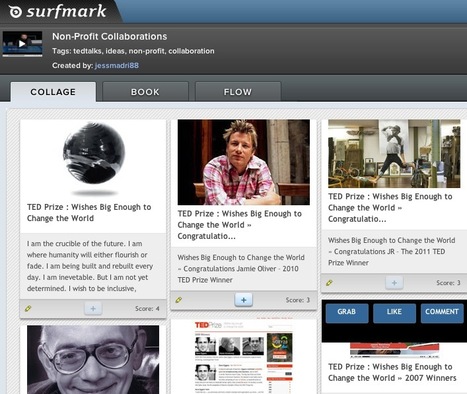
Robin Good: Surfmark is a new content curation service introducing some innovative and forward-looking features.
Surfmark in fact provides not only standard capabilities to easily capture, collect and organize content from any web page, but it adds intelligently alternative display formats to allow the exploration of such collections in multiple ways.
Another key innovative feature of Surfmark is its ability to generate bibliographies and summaries of content collections.
Surfmark allows social collaborative curation, history of all edits made, and the ability to share publicly or keep a collection private.
Collections can be downloaded in PDF or text formats and all pages saved in a collection are fully preserved with all the formatting and links intact so that you can refer back to exactly what you saw.
TwitChimp.com is a web application that leverages the Twitter API to provide curated lists of Twitter users. The application is still in a beta testing period but is open to any who would like to try it in this early stage of development.
The purpose of TwitChimp.com is to enable any Twitter user to create and curate directories of Twitter users.
Curated lists are important because they can help reduce the signal to noise ratio in Twitter.
Here are some features:
- An ability to easily create and curate feature-filled lists of twitter accounts on any topic you desire. - Summation of top concepts/words and hashtags in tweets for an entire list, and a hotlinking of those words to Twitter searches. - Generation of statistics for lists and users in lists. - An ability to discover lists by category. - Search tools enabling lists to be found by keywords in the list or by bios of users. - User profile pages with stats, bios and links. - An ability to embed lists on any site on the Internet..."
Giuseppe Mauriello: I selected this article written almost two years ago by Nicole Nicolay. It is still applicable and full of highlights. The author analyzed the new situation by introducing informative tips. Below I have excerpted few gems from it:
"...***THE REAL ISSUE
Broadcasting what you think may be relevant information again and again, without pre-screening the source and considering the context is a waste of your time.
Most importantly, it begins with content.
...The tools and strategies for sharing good content with your sphere can be learned. But, creating and sharing good content takes skill.
***SO, WHAT'S NEXT?
1) Identify your role in obtaining good, relevant content.
...Are you a content creator a content curator? Or perhaps you’re both.
A content creator is someone who identifies the “needs” within their audience and seeks to help by creating original and highly relevant content.
...
A content curator is someone who sifts through the Web to find and deliver the most relevant content for their intended audience. Sort of a Hunter-Gatherer 2.0!
...
But a thoughtful content curator is more than just a broadcaster of good info. It’s someone who understands their brand and their audience well enough to identify the relevancy of the content, as well as the best context for sharing.
2)Recognize the sources that deliver consistently rockin’ content.
...
You need to recognize both local and national sites that can assist your content delivery efforts. And if you ROCK a niche, be sure to recognize those sites as well.
3) Organize your sources in a dashboard or reader format for easy access...
***YOUR CHALLENGE
1) Balance the type of content you share.
...The content you share represents you, and your brand. So be sure to really check out what you share with your network.
...Your goal should be to find and share content that REALLY helps your audience…or is REALLY interesting.
...
Your consumers don’t gain anything from a constant stream of commentless Foursquare checkins…and the same could be said about listing tweets that are not framed in a social context. If it doesn’t add value or create conversation….don’t share it!
2) Moderate your frequency level and improve your quality of life.
...
The feeling is important…you need to be motivated to deliver consistency with social media. That being said, I’m far more concerned with delivering better quality content than quantity. And so should you if your strategy is to become your network’s trusted advisor.
...
And in order to do that, you need to listen, share, and respond. I see a lot of sharing out there….but far less listening and responding. Social media is about creating opportunities to engage with others. So rather than auto-posting 20 articles a day….try scheduling 3-5 REALLY GOOD shares!!!.."
Hello Susana,
thank you so much for the appreciation!
About your question, you must consider the following points:
- the topic of your choice;
- the quantity/quality of your selected articles that you want to curate;
- but above all, the articles must be "the best of" for your readers.
About publishing...There are daily periods and other weekly, But I don't like to post every article that I found some my keywords about my topic.
I agree, I also don't like to publish everything I find.
The thing about doing it weekly is that it also allows me to read them carefully and gather ideas on what to say about them while posting.
Yet I think I had some more engagement from other people while doing daily posts, so I was just wondering whether I should do this differently :)
Giuseppe Mauriello: Kaleidoscope is a fashion inspiration and shopping app. It combines the viral browsing of sites like Pinterest, the fashion inspiration of street style and the power shopping of sites like Shopstyle. It’s the place to browse, share and shop inspirational pictures.
From Mashable: " A curated feed of street-style images for your iPhone or Android phone.
Human curators help you shop products similar to those featured in the feed.
There’s a few things that make Kaleidoscope a standout. For one, its high-quality feed of street-style images. Instead of depending on user-generated content for fashion inspiration, Kaleidoscope displays thumbnails of photographs pulled from lookbook.nu or produced on its own.
Kaleidoscope also brings quality curation to another key part of its service: product recommendations. The app uses ShopStyle‘s API to locate products that match the clothes in each photograph, and internal staff filter through the options to offer users the best fit.
We also like the app’s integration with third-party networks. It’s easy to share looks straight to Facebook, Twitter and Pinterest...."
This is an excerpt from the article by Steven Rosenbaum and published by Forbes.
"It used to be that company communication was all top down.
Today, things are changing fast – as the tools and networks for communication are broken wide open.
Within the world of corporate communication, there are new school of thought that say there are the thinkers who are looking to turn this big noisy mess into value for their brands and corporate parents.
Ben Edwards the VP Digital Strategy and Development for IBM explains: "“I think there are some emerging roles, potential roles for you know, coms professionals to think about. One of them I think a lot about is this notion of curation.”
At IBM, the voice of the company is increasingly coming from the intranet, known internally as W3. W3 has been leading a transformation from professional to user-generated content within IBM.
The IBM vision is to embrace, rather than ignore the growing voice and knowledge of their community. “One of the measures that we like to talk about is called ‘Professionally Produced Content versus Employee Published Content’.
“We think we have a role in bringing the external perspective into the employee base” says Edwards. That makes IBM a curator as much as a communicator.
Anybody can be a curator – it’s about finding content and surfacing it. Look for multipliers that are often cited by curators, contribute to websites that have wide reach and reverberate content and explore content partnerships.
“The people who can separate the art from the junk will be highly valuable.”
2) Data mine and time:
Use data to inform your timing.
“Offer up the best of the best at the right time to increase viewability and sharability.”
3) Keep stories alive:
Think about the algorithms behind tools like Facebook that can drive traffic back to your website...
“Think about the math behind everything you do.”
4) Roll in the deep:
Use search insights to discover unmet needs and mix up the length of your content for different audiences.
New York-based fashion and shopping website SparkRebel launched its beta website recently.
SparkRebel borrows heavily on the similarly themed social site Pinterest.
SparkRebel is a one-stop site for the chic and devilishly stylish where they can “spark” anything that inspires them like products, blogs, pictures and various other content from the web.
With more than 3,000 brands on the site and thousands of items on the site, SparkRebel is looking to give its members a new retail avenue, as users on the site can share their organized collections with others and purchase new items from the Web.
On SparkRebel, members add inspiration, but they also discover and share it. When you find a spark you love, hover over the photo and click the “respark” button. This allows you to save and re-post the spark to your own collection and share it with the community.
"The clever tool Storify, which lets you build a story out of social media posts on Twitter and your own editorial, has added a search function to its site.
This should help to surface This should help to surface older Storify bundles that have been put together on various topics.
Storify announced the addition using its own tool on the blog."
"Following in the footsteps of Storify, a new free, open-source online timeline tool is innovating storytelling on the web.
The interactive tool allows users to generate timelines on the web by curating content from Twitter, YouTube, Flickr, Vimeo, Google Maps and SoundCloud.
Timeline is an open-source, JavaScript and HTML/HTML 5 based tool that creates elegant timelines.
While Timeline is similar to Storify in that it allows users to aggregate media on the web, it differs in its operation. With Storify, users can drag and drop content into a post. With Timeline, users can either embed the code onto their website using JSON, or — if they don’t want to mess with any coding — they can fill in a ready-made Timeline template on Google Docs."
In his recent business trip to Australia, Edelman’s Steve Rubel discussed his thoughts on the future of the media with Yvonne Adele at Social Media Club Melbourne.
Here are some highlights from this article:
*** Content surplus as a bankable trend:
In an era of self-publication (for brands as well as individuals) and increased noise we’re all faced with the problem of too much content and not enough time. For media companies, scaling this information and providing value through quality curation is a great opportunity to solve this problem for the consumer.
Steve’s top tips for being a quality curator:
- Be knowledgeable and well read on your subject matter of choice; - Save materials for later reading – it’s all an opportunity to be well informed and provide value to others; - Focus on depth, not breadth. As Steve said, he knows a lot about a few things, and little about most things.
***People want to connect with the human element of a brand and those that work for the organisation.
***Journalists and media are now community managers. They have to see their role not only as a reporter/journalist/presenter – but as a brand ambassador who is able to acquire consumers and an build an audience through these channels.
***Steve’s top three emerging trends for media?
1) Building business models that incorporate curation; 2) Increased data mining and analytics about real-time engagement with media content; 3) The increased importance of facebook’s open graph.
Giuseppe Mauriello: This is a brand new site that is INVITE ONLY right now. The site is set up similar to Pinterest and it is all about deals, freebies and coupons! Each board is different, so you can follow multiple boards and users just like you do on Pinterest.
From the article:
"How is this different from Pinterest? Pinterest is a virtual bulletin board with a collection of pictures and websites that offers you the ability to connect with others all over the world based on your likes and dislikes.
Pinterest offers a plethora of finding, however, this Reclip.It only focuses on money savings, discounts, freebies, samples, etc., that you can find all in one place.
You connect through Facebook or Twitter or e-mail and you follow folders that have items in it you like. That simple.
Just as in Pinterest you too can add clips, websites, etc.
You can see what your friends are clipping (provided you are linked up) and you can save and like deals.
If you love great food deals, deals on visiting or traveling to new places, discounted Health & Beauty, and so forth, you never know what you are going to find so you follow different folders in Reclip.It and you simply open the folder and see what it has to offer."
Read original review by Pittsburgh Frugal Mom Blog here: http://j.mp/GL5iFw
"Yummly aggregates hundreds of thousands of recipes from around the web and allows you to filter results by type of food, course, and ingredient and break down recipes by diet, allergy, nutrition, price, cuisine, time, taste, and sources.
You can also edit and save any recipe with ingredient substitutions and adjustments based on your preferences; Yummly will recalculate the recipe to reflect the new ingredient amounts.
So if you wanted to cut a recipe down to one portion, Yummly will recalculate the ingredients you need for a smaller version of a dish.
And Yummly calculates the nutritional value for each recipe, showing you the breakdown of calories, fats, proteins, and carbohydrates.
Users can also import and add their favorite recipes from other websites and save them in their Yummly recipe box."
"What if we started gathering the best #longreads for every destination in the world?
It’s a big job, so we might as well start now. Today we’re announcing the launch of Travelreads, a new channel curated by Longreads and presented by Virgin Atlantic to help you find and share the best stories about the best places in the world.
and you can find our curated picks on Twitter and Facebook. Share your favorite stories by tagging them #travelreads, and tell us where you want to go next..."
"In today’s media-saturated world, consumers are bombarded by content in multiple channels throughout the day. Technology has spawned a profusion of publishing platforms, while it has enabled any individual to become an active publisher or aggregator.
Unlike the past, consumers today can no longer rely on a few trusted editorial sources to filter the noise and deliver the most important news and information.
Instead, consumers must make sense of the vast amount of information that reaches them daily and constantly make decisions about what to take seriously and what to ignore.
Increasingly, they are turning to Social Curation -- the recommendations of others in their social networks -- to identify the most relevant and valuable content.
Perhaps more interesting than the specific social channels is the emergence of socially integrated communications.
Communications in the socially driven world has two significant implications for publishers and marketers:
1. Content will be judged less on its own terms and more by who recommends it and how it has arrived
2. Since recommendations vastly outperform media for driving content consumption, some of the attention (and dollars) that marketers traditionally dedicated to media must be refocused on driving adoption and recommendation in the social milieu.
A social recommendation is a form of personal endorsement, establishing a credible, trusted relationship with your audience is essential. While there are no tricks or shortcuts, there are best practices.
1) Be Honest...
2) Engage...
3) Provide Value...
4) Make things easy...
Engaging social curation can positively increase the reach, relevancy and credibility of your brand. But social engagement is a multichannel dialogue that requires vigilance and timely responses to user comments and questions.
Robin Good: NotesCloud is a new curation service which allows you to collect, organize, and share any type of content you have into beautiful magazine-like layouts.
“Imagine a tool that is always at hand when you stumble upon or dream up something interesting,”
NotesCloud uses the metaphor of a multi-section notebook to organize snippets and notes. People can create their own hierarchies of notebooks, sections, and pages as they curate their topics.
Unlike Pinterest or Evernote, NotesCloud’s structured storage metaphor encourages some organization, so it’s not just a “shoebox” full of random clippings."
(Source: Venturebeat)
Notescloud is equipped with a set of browser-based clipping tools for Chrome, Safari, and Firefox, that make it possible to easily grab and save any content you’re looking at online with just two clicks.
The content curated and organized with NotesCloud can be accessed from tablets and smartphones as well as desktop browsers.
"..."We need to rethink every facet of the journalism model," said Richard Gingras, VP of News at Google.
The news audience is evolving faster than news providers. By now, 75% of traffic is going to stories. A minority of visitors ever see a site's front-page curated presentation of the news.
But the problems go deeper than just presentation. News is a commodity now. It spreads virally across many media through new tellings and retellings. The Web is finally real-time.
News organizations no longer get to control the story. They have to do more than inform to stay relevant. News sites have to be useful.
THE SOLUTIONS:
To be useful, news sites need to be information tools, not just sources. Journalists are the people with the time and skills to gather all the needed information into one place and filter out the rest.
But the value of information is not just in the knowledge of it; it's in what you can do with it.
News isn't just about information. It's also storytelling. Anyone can publish text, photos or even video to the Web now. But technology enables new, compelling storytelling techniques that could shine in the hands of dedicated news organizations..."
Giuseppe Mauriello: Vilize is a new italian-based free web application created to improve the research phase of creative professionals: from the collection of inspiration to the creation of moodboards in the same environment.
SAVE THE DATE: Official Release 16th April 2012.
This platform is for users:
1) Creative Professionals: visual research & moodboarding; 2) Students: discover, track & work in team; 3) Bloggers: share to a collective visual platform.
"Here are some features:
- Collections & moodboards are ready for all devices. You can download them in high-resolution PDF and share them via Mail, Facebook, Twitter & Google+.
- Drag & Drop is the way you save, upload and collect the materials. Drag & Drop to design your moodboard.
- Save time preparing the inspiration for your team project: give your partners the ability to add and remove materials to your collections.
- Vilize's database is designed for the world of inspiration & creativity. We care that our files contain all the useful information like author, source, project description.
- Choose the order between the newest and highest rated files. Rate each file you see with one click and decide for its position.
- Choose the visualization mode you prefer: HD image or thumbnails.
- Vilize is the first platform that gives you a selection of streaming channels. Track the online-status of your favorite channels directly on your console.
- Follow the user that are publishing material you love. Get informed by the notification system about user published files, ratings, collections & moodboards.
- Share your discoveries on social platforms and with people you follow on Vilize. Comment each profile, image, video, collection or moodboard."
Zeeik has created a new way to reuse online videos to make and share video-only-consisted information, video Wikipedia; after disassembling videos by scenes or targeted parts, users can reassemble them to create a meaningful video group, a zeeik.
On Zeeik.com, collected YouTube videos are packed and maintained in a video collection called a “zeeik.”
Users are encouraged to collaborate on zeeiks and can partake in any or all of the following steps: request a zeeik, contribute and review videos in the zeeik, or edit and publish the zeeik.
Users can also share their zeeiks with friends, making Zeeik.com a social website.
Presently, only YouTube videos are available to include in a zeeik, but that won’t always be the case.
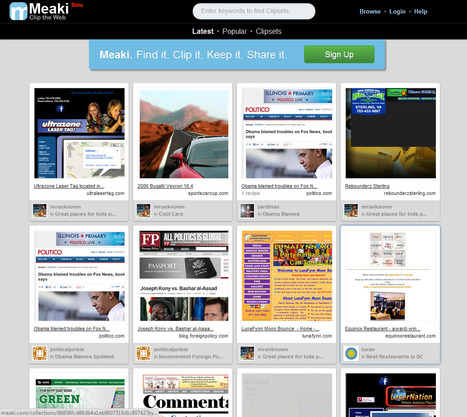
Meaki makes it easy for anyone to clip web pages they visit into a visually engaging collection called a Clipset. You can share your Clipsets with the world or keep them private.
You can discover new things as you browse Clipsets created by other people. You can be inspired by the Clipsets created by people who share your interests. And you can save time finding things on the web by finding a Clipset instead.
It’s really easy to use Clip-it button and create Clipsets around themes. You can add to Clipsets anytime you find a page.
Robin Good: PageOne Curator is a new plugin software for WordPress which allows anyone to easily integrate images, video, news and other content coming from other sources.
PageOne Curator provides funciotnalities to easily tap into selected RSS feeds and to search directly the major content and multimedia search engines out there.
Pulling in content is as simple as clicking a button, or if you want to have full control over what you excerpt as simple as as selecting and copying and pasting what you need.
The new software is in beta and is accessible for now by invitations only.
This is a cross-post from Altimeter Group Researcher Jaimy Szymanski. I excerpted from the article:
"Curation is taking over the digital content scene. With related applications and platforms multiplying, the act of collecting and sharing content has become second nature for most of us.
When talking data it’s far simpler to look at all the content out there and curate, rather than analyze the gaps and create new, original content to fill them.
This brings up some unnerving questions as well: - With curation on the rise, what effect will this have on the creation of new, interesting, valuable and thought-provoking content online? - When (if at all) will curated content be accepted as unique content? - What happens when curators far outnumber creators?
But, upon taking a closer look behind the why of curation, the researcher found potential value pulling some data from Trendstream.
***Motivations Behind Content Curation and Sharing:
1) Motivations behind curation are positive: to share a good experience, to help consumer pick out good product and to encourage company improvement.
2) Millennials share content focused on “self.” As generations get older, secondary motivation shifts to a bigger picture though, to helping consumers. Add to that the fact that many have grown up recognizing technology as a platform for both utility and self-expression or promotion.
3) Fostering expertise is among lowest motivations. I predict that curated content will increasingly be more accepted as “original” content over time, as long as it contains some unique insight or alteration.
***Where Curation Opportunities Lie:
Curation will prove to be a very positive trend for marketers who are looking to affect their audience via way of content marketing.
It’s quite possible that content curators will also begin to be recognized as influencers in their respective industries, and organizations will treat them as such.
I’ll end with a few final thoughts:
1) The amount of content curated will rise and fall in cycles, as shared content depends on original content creation to survive. 2) Organizations will weave curation into their content strategies, at the very least to ensure sharing of their content is as simple as possible for consumers. 3) Application development – both web-based and mobile – will continue to support the curation trend."
Upworthy is a new project from MoveOn.org’s Eli Pariser ("The Filter Bubble"), The Onion‘s Peter Koechley and Facebook’s Chris Hughes.
In a post on his Filter Bubble blog, Eli Pariser said:
"In the Darwinian environment of the hyper-relevant news feed, content about issues like homelessness or climate change can’t compete with goofy viral videos, celebrity news and kittens.
The public sphere falls out of view. And that matters, because while we can lose sight of our common problems, they don’t lose sight of us.
Every day, we’ll be searching the Internet for the best online content that’s highly shareable and clickable and actually important. Hopefully, we can help bring attention and focus to stuff that really matters in a viral format that can reach millions.
Upworthy is using strong visuals along with arch, but serious, curation to find the sweet spot between things that are both “awesome” and “meaningful.”
"To stand out from the masses and to reach their audience, professionals and companies must focus on relevant content to be able to engage efficiently.
Social media influencers have become new channels of information and new web publishers or content curators.
Knowing that their leadership is largely dependent on the quality and value of how they engage, they deserve special attention.
The content that they disseminate via the web and social media must meet specific criteria and respect the “5 W rule”: Who, What, When, Where, Why.
1) WHO is target for the message?
Build on the relevant and personalized message...
2) WHAT is the value of the message?
Give priority to rich content and quality of experience...
3) WHEN should the message be distributed?
Adapt the message for different contexts...
4)WHERE should the content be disseminated?
Vary the content sources to benefit from all formats...
5) WHY choose one tool over another?
Select appropriate tools according to their needs..."
Today Wild Apricot launched Apricot Jam -- a new online resource offering a curated collection of fresh posts and articles on relevant topics for associations, non-profits and membership organizations.
Filtering information for non-profits and membership organizations:
“While there is a lot of great information out there,” Buterin admits, “we recognized that the staff and volunteers of small associations, clubs and not-for-profits are short on time and resources. To save these volunteers and staff time and prevent information overload, we’ll do the searching and filtering of online information so they don’t have to.”
As Professor Barry Schwartz pointed out in a 2005 TED talk, “The Paradox of Choice,” the overabundance of options often leads to disappointment.
Wantful, a new online startup, might have had these ideas in mind when it launched its site in 2011. The site asks a gift-giver to answer a series of questions about the intended recipient.
Next, it generates a list of 10 possible gifts that is bound, printed and sent to the gift recipent as a high quality catalogue. When the catalogue arrives, the recipient simply chooses which of the 10 items she prefers.
To get content containing either thought or leadership enter:
To get content containing both thought and leadership enter:
To get content containing the expression thought leadership enter:
You can enter several keywords and you can refine them whenever you want. Our suggestion engine uses more signals but entering a few keywords here will rapidly give you great content to curate.


 Your new post is loading...