Master Curator Robin Good interviews Futurist Ross Dawson. Here is an excerpt from article:
"Robin asked him:
a) what he suggests to people who want to "make sense of the world", when bombarded by such large amounts of information. How do you make sense of how things are?
b) What is "curation"?
c) Is there any difference between personal, serendipitous social sharing and content curation?
d) What is the key discriminator between the two?
Ross Dawson answers:
a) One of the best ways to make sense of the world is scenario planning or scenarios, where you build a number of worlds for what might happen and that's relevant to you and to use these as filters...
As you look at that and see new things, that's an enormously valuable filter around what is interesting, what is useful, what I need to pay attention to, and what I don't...
b) Curation is selecting what is relevant, selecting what is interesting... ...and this is now becoming almost overwhelming in terms of how many people are doing that.
Ultimately, [the goal is to reach a point] where I can wake up in the morning and I can say I know I have seen the most interesting and relevant things for me.
We're a long way away from that.
c) Sometimes, they can overlap, but [a curator] is usually [someone] saying, "I'm in a particular area. I am the expert. I know what there is. I'm doing that for people who are interested that topic, people I want to demonstrate my expertise too."
d) There's three, perhaps, [types of] intent.
1) One is to contribute to others, to give.
2) Another is to develop your own expertise. I think that's one of the ways to be able to search for and share things actually does make you know more, and I think that's very valid.
3) [The third one, which] is equally valid, though perhaps a little too overdone at the moment, is just people curating so that people look at them..."
During the past six months there have been some major changes in the way audiences consume information. These changes are happening simultaneously on two fronts, one in the form of content curation and the other in content shifting.
While content curation is nothing new, the rise in the use of mobile devices is changing when, where, and how we read internet content.
Content shifting:
Mobile devices are allowing people to break free from the computer desk and shift both the physical environment and the time in which they read or consume content.
This content shifting can be as simple as using tools like Evernote’s Clearly on a web browser.
Apps such as Pocket and Instapaper allow us to save articles discovered on a desktop computer to read later on any internet-connected device.
Sifting through the glut of information:
Many social media platforms have taken on the role of content curators, developing algorithms in an attempt to help us weed out the information we don’t want and present us with the information we do. This has been evidenced through a variety of changes in the Facebook Timeline, the #Discover tab on Twitter, and social search results in Google.
The latest wave of content shifting applications also curate and reformat articles to gear them toward our personal interests, fundamentally changing the reading experience as they do so. Programs such as Flipboard and Zite gather content from RSS feeds, Twitter, and Facebook streams and present it in a mobile-friendly magazine format.
Tips to optimize for content shifting and content curation:
1. Incorporate calls to action directly into the text...
2. Optimize for mobile...
3. Capitalize on compelling images...
4. Write strong headlines, lead paragraphs, and meta descriptions...
5. Maximize social media sharing...
6. Publish and promote quality content...
Each element and tip is analyzed with more information. Read full article here: http://j.mp/LmZpjT
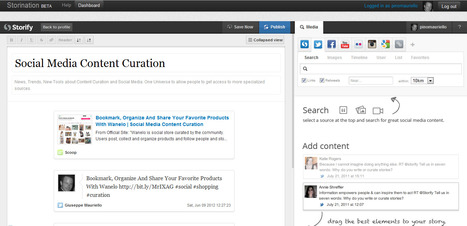
Giuseppe Mauriello: Private beta Storination is content curation tool that provides the first community-oriented platform based on the Storify publishing tool allowing journalists or any user to collate a group of Storify stories around a topic and allows others to add to the storyboard.
Yesterday I received an invitation code as beta tester. I attached a screenshot about my dashboard: I am testing and editing it with my tweets and some sources from this my topic on Scoop.it.
From official website:
"Storination lets you create online communities called a Nation. It's a space where you and other people add into a storyboard social stories. Customize your Nation like a blog by uploading a logo, and a large cover. Now, you can publish a Storify story by collecting photos, video, tweets, embedding URL... or If you prefer, just import social stories directly from Storify to your Nation.
A storyboard is an online set of Storify stories curated by you. After opening your Nation, Storination allows you to compile into a storyboard your stories and other people's stories created in Storify. It's very easy to organize your storyboard by adding or removing stories. With the 'favorite story' feature you highlight stories easily..."
"Wanelo is social store curated by the community. Users post, collect and organize products and follow people and stores they like. Wanelo comes from the words WAnt, NEed and LOve.
How to use Wanelo - post your product finds from any online store. - browse others' finds and save them. saving is like voting a product up - more saves means higher placement on the homepage. - if people like your taste, they will follow you. more followers + more saves = more visibility for you."
From review on TechCrunch:
"The eCommerce world is starting to warm up to the future of online shopping: Social curation. Call it the “Pinterest-effect” — People are embracing the idea that bookmarking and social sharing slowly are replacing search with regards to product discovery.
Wanelo is a site that allows users to bookmark and share their favorite products via a grid layout and high-res imagery.
The startup allows you to follow your Facebook friends in addition to top site users — resulting in a more personalized product feed than that of just celebrity selections. To post an item to Wanelo enter a product URL, tag the item with categories, and add price and other details. Users can browse through Wanelo items by popularity, recency, or by people and stores that they follow.
Site founder Deena Varshavskaya says:
“Pinterest is a great product and it solves the curation problem for images,” Varshavskaya tells me, ”It contains products as well, but that’s not their focus, so users don’t go to Pinterest to shop. They go there to collect things like recipes. Wanelo has nothing but products and users know that, so they come to Wanelo to shop. Users on Wanelo have much more purchase intent”
"The new Web service uses the links and photos you share on Twitter or Facebook to populate a Web page.
For an individual journalist, RebelMouse can build a website that harnesses all your social media curation work into a Web product.
For a news organization, RebelMouse could also be a tool for aggregation projects. One page could represent all the content your news staff is tweeting. Another one could pull in content from a hashtag for a crowdsourcing project.
Visually, RebelMouse looks a lot like Pinterest. Functionally, it is in the same product space as Storify, but different in key ways:
- More permanence;
- More automation;
- No embedding, yet.
Pricing is extremely affordable — free for basic usage, and if you want to use the site at a custom domain name (instead of rebelmouse.com/username) it’s $3 a month for an individual or $3 a week for a company."
"Both consumers and marketers are faced with an ever more fractured media landscape in which informative and engaging content can be hard to find.
In a March 2012 poll of more than 400 US marketers and agencies, Curata found that 95% had curated content in some way over the past six months by sharing a link, blog post or other content type with a potential customer.
The survey also found that 85% of respondents viewed the main objective of content creation as establishing thought leadership.
Time constraints are emerging as the biggest difficulty marketers face in content curation. Three-quarters of respondents did not have enough time to devote to the process.
Social media has emerged as the platform of choice for sharing content; but it’s not enough to simply share content. Curation must be performed on a regular basis, and with quality content, in order to interest consumers and keep them engaged."
"One interesting trend I've been watching over the last year or so is the intersection of social and personalization as a way to discover new videos. And, of course, how it helps users to discover new music videos.
The latest entrant into the social music video discovery category is Rockify, which just launched its public-facing portal for music videos, Rockify.TV, in public beta.
Rockify.TV is kind of like Pandora for music videos, but with social hooks to help users find interesting content based on their own musical preferences, and those of friends.
The big difference comes in how Rockify displays videos to users — like the way MTV used to do it. Once signed in, users get a stream of music videos, based on trending music, personal favorites, and personalized suggestions. The site serves up a continuous stream of content, meaning that users never have to stop and search for the next video they want to watch — that is, unless they want to.
The startup has rolled out a web app that can be accessed from HTML5-ready browser — meaning that users with iPads and other mobile devices can access it...."
"Project Décor is the web's leading home decorating community site, where users are empowered to discover their home design style, collaborate with friends and family, and shop for everything for the home in one place."
From review on GigaOM:
"Project Decor, a social home decorating platform, said Wednesday that it will open its site for an invite-only beta launch on June 18.
Like Pinterest, the image-centric site lets users express their sense of design by collecting pictures of products and sharing them with friends. But instead of “pinning” products, users “tear” them and instead of displaying them on “pin boards,” users arrange them in “rooms.”
On the platform, members can design their own virtual rooms, as well as share them with friends and follow other users and professional designers. The company said it will also offer customers a way to purchase products they see.
Project Decor thinks it can differentiate itself by deploying an elite crew of more than 40 top designers to consult with users, as well as offering an easier path from curation to commerce."
Excerpted from the article by Nicholas Herold on Darwin Ecosystem Blog:
"There are a lot of great pieces on the techniques and tools of content curation, and almost all of them include some version of do’s and don’ts.
This is the way I think about content curation: If you were a museum curator, you would be thinking about 1. Your audience; 2. Your theme; 3. Find pieces that would work in that context; 4. Acquire the pieces; 5. Plan the space for the exhibit; 6. Advertise, and 7. Install.
Obviously there are major differences between curation in a museum and on the Internet.
The most important difference is the time scale: events on the Internet are new every picosecond.
In almost every other important respect, the role of the museum curator is the same as that of a content curator on the Internet. The 7 steps above are all the same, except the context is a bit different: you still need to plan how you’re going to exhibit what you’ve acquired.
Curation is a tool to get people who are interested in your field to come to you and regard you as a trusted source.
First, the Do’s:
1. Do pay attention to your subject: Keep on top of your topic.
2. Do give credit to others where you get stuff from: in a world where SEO credit comes from others, it makes sense to scratch their backs, and give them a reason to scratch yours.
3. Do find interesting content to share.
4. Do share the content in context: It’s not enough to post the relevant content, you have to say why you think this is important.
Now for the Don’ts:
1. Don’t appropriate—curate. This means that you should not take someone else’s work. It’s okay to quote small portions of text or visuals, but grabbing the content and resposting it as you own is appropriating, in other words, stealing.
2. Don’t forget your audience. A while back I tweeted something that was a bit controversial and unrelated to my topic and lost about a third of my followers.
3. Don’t pitch your product by pretending it’s the content you’re curating. If someone feels you are only interested in selling, you will lose followers.
"When ITV News launched a new website two months ago the site started presenting news in a way that was radically different from before.
They came up with a “digital native” news format that includes tweets and other social media content from the broadcaster’s correspondents, experts and eye witnesses.
Jason Mills, editor of web development for ITV News, told Journalism.co.uk:
"The thinking behind the site is that it’s about news now. News is a live process, news continuously comes in and stories develop the whole time. So what we are trying to do is to tell that news in real time.
People now are used to consuming content in a stream, from Twitter to Facebook timelines, and we wanted to take that concept and adapt it to all news.
We have a small number of curators to the site and they are curating content, the vast majority of which comes from our correspondents, our producers in the field, and the news desks.
The curators are then using things like Twitter to add to the telling of that story as well.
Twitter is a fantastic way of adding value to existing stories. What are people saying out there, what is the community saying, what are experts saying out there?..."
A great example is this story of the death of Robin Gibb of the Bee Gees, which combines tweets from singers Gary Barlow and Lenny Kravitz, TV footage and a written statement from the former Bee Gees manager. It appears more like a curated Storify than a traditional copy-only news story.
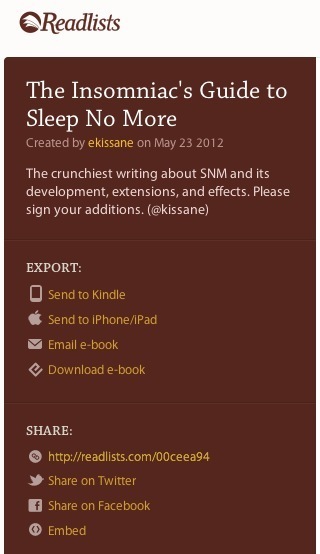
Robin Good: Readlists is a simple web app which allows you to easily create curated lists of web resources, articles and links and bundle them to a downloadable eBook.
"A Readlist is a group of web pages—articles, recipes, course materials, anything—bundled into an e-book you can send to your Kindle, iPad, or iPhone."
To create a "Readlist" you simply click on the Create a Readlist button and add one url at a time. The system gently grabs metadata info like title and author and elegatly lays it out in an ebook formatted reading index ready to be published.
Giuseppe Mauriello: Learnist is a new site (still in beta) that aims to be like Pinterest but for sharing learning resources.
On Learnist you can create pinboards of materials organized around a topic.
You can pin images, videos, and text to your boards by using the Learnist bookmarklet, by manually entering the URL of a resource, or by uploading materials to your boards.
From article by Mashable:
"Grockit's latest product re-configures online content such as YouTube videos, Wikipedia entries and ebooks into ordered lesson plans.
Unlike Pinterest, however, creators suggest a path in which to consume each content component. Users can check off each component as they go or “re-add” it to one of their own learnings.
Grockit founder Farbood Nivi argues that expert curation helps avoid the misinformation, hacked-together how-to articles and other useless content one must weed through in a typical Google search. It also provides a clear learning path and eventually, he hopes, will include some form of assessment..."
"It looks like Flipboard; aggregates and posts content like Reddit; and presents news visually, like Newsmap. And it's from Intel. Intel iQ is a social-publishing platform and the tech giant's latest content-marketing experiment.
IQ resembles a digital magazine but is curated by Intel employees. A story gets to the iQ front page when a certain number of people recommend it. The goal is to "connect with a younger audience and tell them the bigger story of who we are as a brand," said Editor-in-Chief Bryan Rhoads. "Many of them don't know, so we need to tell them the story of Intel that is beyond PCs and beyond processors."
Mr. Rhoads will sometimes place staff-written or important stories on the page, but most articles will appear democratically and make it on their own merits.
On page, each story box appears with a photo and a tag: "IQ Original" for staff-written and freelance-commissioned articles, "iQ Network" for content written by partner companies such as Discovery or Vice, or "Via" for pieces from an outside source. The last tag is followed by the name of the publication, for instance, "via Mashable."
Bryan Rhoads, editor in chief of Intel iQ Each story box grows visually as social media -- clicks, shares, freshness, relevancy and other data from around the web -- is added."
Giuseppe Mauriello: Watchlater is a good way to manage your online video queue. It caches online video for later viewing.
You can use the app to bookmark video from a variety of sites, either using your iPad’s Safari browser or from any desktop computer using a bookmarklet.
From Official Website:
"Cache your videos
No internet on the airplane, subway or train? How often did you complain about videos not loading while traveling? We fix this. Watchlater offers a novel caching function, which allows you to download videos from selected video hosts. This way, you can always access your videos. Online or not.
Our caching service costs only $1.29 for 150 download minutes. Btw, your first 60 minutes are free!
One single place for all your videos
Watchlater keeps your queue organized and in one place. Access your videos over any iOS device or the watchlater web interface.
Many ways to fill your queue
Watchlater comes with a powerful bookmarklet which detects videos from over 40 platforms (including blip.tv, TED talks, and Vimeo), even if videos are embedded on other sites. You can also post URLs into your queue via email. On top of that, connect with your Twitter, Facebook or Google Reader profiles to automatically add videos from these streams to your queue."
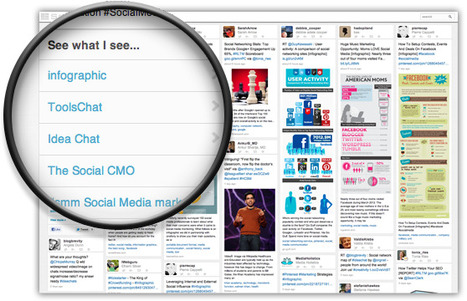
Robin Good: SeeSaw is a new web app which allows you to easily monitor social media news streams on any topic and in real-time.
You can pick and select which news stories to find by using hashtags, or specific search keywords. Once Seesaw starts visualizing the live social stream on that topic you can begin to save, pull together into collections and/or share them on your social media channels.
Each search you make can be saved and labelled and reloaded and updated in real-time with one click.
Very useful for monitoring specific topics and finding relevant stories to collect, share or post.
This is article by Oliver Starr, chief evangelist for Pearltrees, and posted on GigaOM.
Excerpted from article:
"In 2010, “curation” popped up on tech blogs and VCs’ radars. Since then, people have been asking whether curation is a legitimate trend, a new market to be exploited, or just the latest buzzword.
It is now clear that social curation is not a bubble. The more I watch the development of social curation and the more I learn about the what, how and why of it, the more convinced I become that what we’re seeing is going to grow well beyond a simple market.
People have always had the desire to create, share what we’ve created and see what others have created. The emergence of the Web democratized access to content created by others in a way not seen since the invention of the printing press.
Humans also love to collect things — from tiny stamps to shiny cars. And what do we do with these things once we have them? We play with our collections. We organize, shape and prune them, and we display our collections for the benefit of others and the occasional bragging right. “Curation” is simply a stiff sounding word for an innate human activity — collecting, organizing and sharing — that people are now engaging in online.
In my opinion, online curation isn’t going to be a winner takes all game. There are too many ways that people collect, too many different things that people collect and too many different types of collectors for this to happen..."
In my humble opinion, Mr Starr view maybe quite limiting, especially if your interest is not just for personal expression and social sharing, but involves a mission of creating meaning and understanding out of a multitude of resources, ideas and concepts.
Collecting things you like has nothing to do with trying to make sense of a topic or issue.
Both activities involve collecting, but while one is done for personal pleasure (later to be shared with other like-minded people) the second one is done with an "audience" (a tribe) in mind, and with the goal of making sense of a certain topic for them.
Hello Robin,
I agree with your analysis, but at the same time I believe that Mr. Starr wanted in his article providing a general overview of the social curation, and in my personal opinion it is a different concept from what we think about how to make content curation :-)
Thanks for the comment, and I repeat that I agree with your point of view.
Robin Good: Mendeley is a cross-platform research tool, which can help you tap into a vast online library of over 30 academic paper databases, while helping you "curate" your own library of references, bibliographies and reference documents.
From the official site: Mendeley is a free reference manager and academic social network that can help you organize your research, collaborate with others online, and discover the latest research available.
Key features:
-> Generate citations and bibliographies in Microsoft Word, OpenOffice, and LaTeX.
-> Open PDFs and capture your thoughts through sticky notes and highlights.
-> Import and organize PDFs from your computer, EndNote™, Papers or Zotero.
-> Collaborate with colleagues and securely share your papers, notes and annotations.
I used to be in Awe in Syracuse University Libraries (5) the amount of information available at your finger tips. The Internet and software tools make the World at our fingertips
Giuseppe Mauriello: This is my “scoop” article for today. I found this article written by Suw Charman-Anderson in November of 2006 from her first professional blog “Strange Attractor”, now permanently moved to charman-anderson.com.
Suw is journalist, social technologist consultant and writer, one of the UK’s social media pioneers. She writes for Forbes, The Guardian, amongst others. In 2009, she founded of “Ada Lovelace Day”, an international celebration of the achievements of women in technology, science, engineering.
Returning to her article, it is highly relevant today. At the beginning of the article, the author describes the scenario of the digital industry at the time, then come out few interesting and great points about the need of content curation and the importance of the role of the curator. Here are some gems:
“We already have more movies available than any one person can watch; more videos on YouTube; more blogs… more everything. It’s not like we’re starting from a point of scarcity here. And the flood of stuff is going to turn into a rampaging torrent as more people get online and more people get excited by their ability to participate and create.
In the past, the media acted as gatekeepers. They were the ones that went to the movie previews… They were the ones who got the advance copy of the game… They were the arbiters of taste, the people in the know, the ones with the connections needed to get at culture before us plebs got at it.
But we don’t need gatekeepers anymore. We don’t need people who stand between us and our stuff, deciding what to tell us about and what to ignore. We don’t need arbiters of taste.
We do, however, still need help. There’s just too much stuff around for us to know what’s out there, to keep up with what’s good, what works for us, what is worth investigation. What we need are curators.
We need people who can gather together the things that are of interest to us, things that fit with our tastes or challenge us in interesting ways, things that enrich our lives and help us enjoy our time rather than waste it on searching.
Curators already exist. Some are people: Bloggers who sift through tonnes of stuff in order to highlight what they like, and who, if you have the same taste as them, can be invaluable to discovering new things to like. But curation of the web has barely started. Much of what you could call curation that exists today is flawed: too many noisy opinions and not enough capacity to understand what I as an individual want…”
I selected this article by Vadim Lavrusik, journalist program manager at Facebook, posted on Mashable.
I excerpted some interesting points from this long article:
"Disclaimer: A robot did not write this. Neither did an algorithm. As has been done for centuries, a human curated the information and produced this content. But that doesn’t mean that technology didn’t help.
While it’s become easier for journalists to find information, discover sources through the web, and use tools like Storify to curate content, the process still relies on having the bodies to scour for this information. And that’s the challenge.
In the newspaper industry, there were more than 13,000 newsroom jobs lost between 2006 and 2010, according to Pew’s State of the News Media report. At the same time, the amount of information available has grown at an astronomical rate. These two things are at odds.
Media must build tools that help a journalist do what it once took five journalists to do. They must innovate the news-gathering process.
***The History: Publishing and Innovation
Before the web, it was difficult to produce, distribute, and access information. Publishers thrived since they had a printing press to produce information at scale.
Today, the social web is the new public square. Anyone is able to produce and publish information at the click of a button.
To stay competitive, publishers adapted to producing content for the web by integrating their newsrooms.
Media organizations like the one you’re reading as well as others adapted distribution based on where audiences were spending more time: social and mobile.
But with all this focus on innovating the distribution process, innovation in news gathering, largely, took a backseat. Distribution isn’t necessarily the challenge. News gathering at scale is.
***The Opportunities: Distributed Reporting and Investing in Technology
Crowdsourcing and distributed reporting are two great tools news organizations can use to scale and are part of the solution. This means media organizations should think of themselves not only as producers of content but also as platforms for content. One example is CNN. It began bridging the gap between the producer and the citizenry through iReport...
A great example of this is The Guardian, which deployed its community to help dig through 458,832 expense documents belonging to Members of Parliament...
But even as we look at ways to innovate the reporting process, newsrooms must also re-prioritize skill sets and equip themselves with hacker journalists. There are already journalists who write scripts to make their reporting more efficient, but journalists with such skills are hard to come by.
Journalists should no longer think of themselves as “newspaper reporters” or a journalist of any specific medium. Instead they should consider themselves multimedia producers equipped to tell a story on multiple platforms. They should also have knowledge of how stories are being consumed. More than anything, a truly “integrated newsroom” will have journalists who build tools that enable them to do reporting at scale and innovate the storytelling process.
***The Solution: Becoming Builders
If content is king and distribution is queen, where does that leave the news-gathering process?
We need a new approach to how news organizations refocus their innovation on building technology that will equip journalists to do better, smarter, and more efficient reporting...."
I have a journalism degree, although I am not in that field right now, I have seen a tremendous change with video reporting and writing now happening on internet news sites. One reporter must know how to do both. It has changed dramatically, and the internet news sites are winning, over print.
Today Clipboard, that allows users to save parts of Web pages, is no longer in private beta.
From review on The Next Web:
"Clipboard was founded by Gary Flake, who previously founded Microsoft’s Live Labs, Yahoo Research.
Flake sees Clipboard as a service closer to Dropbox, then he does Pinterest. While Pinterest is more for vanity sharing, his company is all about capturing the important parts of the web for your own purposes, whether you want to keep your clips private or share them with others.
Along with coming out of beta, the site has launched its own feature called “boards”, which Flake tells me was the original concept for the site. Users can now put together all of the things that they clip into a Pinterest-style board and share them publicly or just with specific people.
By using Clipboard, you can not only share links, you can share the actual context of what interested you in the first place, with the code from the page completely intact. So if you wanted to clip an IMDB page, all of the links to the actor pages would remain. This beats the current Pinterest experience of simply grabbing an image..."
Clipboard is a fantastic tool. One of my favorite for now. I don't see the point of Pinterest.
With Clipboard we grab all what we want. Almost perfect.
"The content curation website Bundlr has just announced a new version of its service which allows for embedding of content from a wide range of sources.
By partnering with Embedly the site now supports over 200 sources of content, including Storify, Pinterest and Amazon, for users to add to their bundles.
Embedly is the service that the new version of Twitter uses to embed photographs and articles in your Twitter stream and is used by a host of other sites such as Reddit and Bitly and comes as a WordPress plugin.
While Bundlr was originally seen as an alternative to sites like Storify, which can be used to create stories from curated links and content, Bundlr's focus is now on creating a top-level resource for curated content around a story or topic."
Giuseppe Mauriello: Squirro creates a living collection of content that’s updated continuously and automatically in a simple, elegant digest that can be shared with colleagues and friends. More specific than search and broader than feeds, Squirro scans multiple sources to find the most relevant information on topics of interest and includes tools to clip, save and share.
After my request two months ago, I received an invite two weeks ago and I am checking it: http://imm.io/qVbz
From official website:
"Squirro is your personal digital research assistant. Squirro curates the most relevant content from multiple sources and delivers it in a living collection you can really harvest and share. Squirro filters out the noise to give you the content that matters most.
Squirro is your personal digital research assistant:
He delivers the info you want, when you need it. Squirro is an expert in content curation: Just give him a few keywords and he’ll filter out the noise to deliver just what you’re looking for – news, documents and even people.
- Any topic, from the general to the obscure. - Any purpose, work or play.
Squirro is broader than feeds and more specific than search:
Squirro is gathering content from a wide variety of sources and delivering it in simple and elegant digest that’s updated continuously and automatically. And the more you use Squirro, the smarter he gets, able to sense what you’ll want next. The result is a living collection of information that matches your interests exactly..."
Looks like a nice idea ... However, signing up for the beta with an email address is fine. Then they want you to spam your contacts before you even get a chance to see how it works.
Then an email follow up which states the following "The more of your friends sign up, the higher you jump in the waiting list queue"
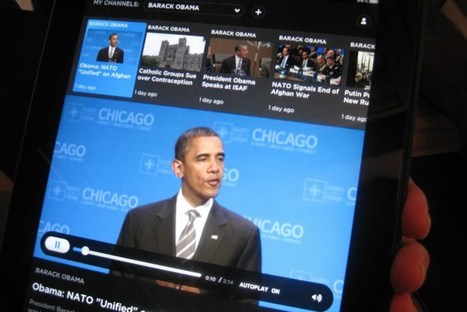
"While video lovers have gotten more and more social services that serve up interesting clips from friends, it’s still not easy to construct a more comprehensive look at video news by topic. That’s the gap that New York state startup Newslook is trying to fill with a new iPad app that allows users to construct channels of their favorite news subjects on the fly.
Newslook is now getting even more into the consumer video space with its first iPad app. The app, which will debut at the paidContent 2012 conference Wednesday, allows users to build their own channel using video from more than 50 sources including the AP, Reuters, Bloomberg, National Geographic and others.
Newslook takes in hundreds of videos each day from its sources and applies a bunch of metadata to a smaller number of clips, putting them into various taxonomies that can be searched. Users who look for Barack Obama or The Hunger Games can pull up a stream of professional videos that are tied to the topic and can create an instant channel based on that topic.
Newslook adds more than 150 new videos a day that have been hand selected and tagged with metadata. In addition to search, there’s also tabs for finding top videos and clips that are trending and featured. Users who view one video can also see a list of relevant metadata terms to construct a similar channel. And they can share their videos on Facebook, with Twitter and Pinterest support coming later..."
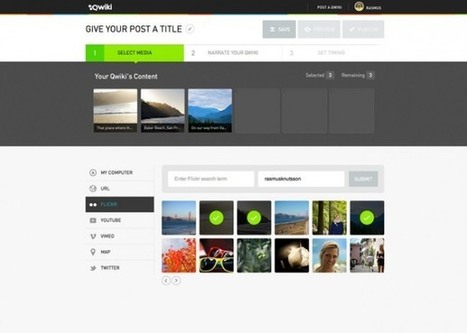
"Qwiki, the start-up known for creating automated multimedia presentations, is launching a new media format that allows publishers, bloggers, web personalities and others to create 60-second video stories that are embedded with other videos, images, maps and links.
It’s like an interactive video slideshow that lets users click on other content throughout a narrated story, so they can choose how deep they want to experience the content.
The service goes into private testing today with some early users and is expected to open to the public in a couple of weeks.
Users can put together a Qwiki by arranging images, videos and maps and other content into six frames. Each frame can be further edited with a caption and embedded with more images, Tweets, maps and links taken from sources such as YouTube, Flickr, Google Maps and other sources including their personal content.
When the media content is laid down, a user records a 60-second narration for the story with the option of appearing in a small window throughout the Qwiki. The creator decides when to advance each frame.
Imbruce, Founder and CEO, said:
"there are many more features to be added that could make Qwiki even more attractive to its creators and users.
Right now, creators can only tell a 60-second story. But with the ability to add more content, it could really be the starting point for a bigger story. I think over time, Qwiki might be better served by allowing people the option to make videos a little longer.
New online tools, such as Pinterest, are already showing us that self-expression and curation are now very popular. I think it’s logical that a simple tool for mixing video, images and online content could also attract an audience..."
Giuseppe Mauriello: StyleSaint allows you to create, curate and collect the things you worship as Editor-in-Chief of your own StyleBooks.
StyleBooks are the quickest and most amazing way to show your style to the world. Creating a StyleBook is as easy as one-click publishing, or you can customize your own with our stylish drag-and-drop StyleBook creator.
From the article by TechCrunch:
"As we covered earlier today, the fashion vertical in tech has exploded.
One of the most unique premises I’ve seen thus far is StyleSaint, a startup which at first glance seems like a Pinterest for fashion, but with a unique real-life twist.
To use StyleSaint in its current form, log in with Facebook or Twitter and create an account, once logged on, you can choose from over 55K “tear sheet” images from which to create your own Stylebook, once you’ve got more than ten tear sheets loaded, you can hit the “Create Stylebooks” link in the top right and StyleSaint will automatically import, then publish, the last ten sheets you’ve torn. Alternatively you can drag-and-drop the tears to create a custom stylebook. Click on “Create” to publish to the site.
In addition the resulting books are Facebookable, tweetable and embeddable, the embeddable stylebooks function as an overlay on embedded sites, preventing traffic re-direction.
The most compelling thing about StyleSaint is that co-founders Brian Garrett and Allison Beal eventually want to use the collective data from the style booking activity to come up with its own line of clothing. “StyleSaint is the only company editorializing the phenomenon of image discovery and curation and combining it with a manufacturing, vertical eTailer ecommerce model,”...."
To get content containing either thought or leadership enter:
To get content containing both thought and leadership enter:
To get content containing the expression thought leadership enter:
You can enter several keywords and you can refine them whenever you want. Our suggestion engine uses more signals but entering a few keywords here will rapidly give you great content to curate.


 Your new post is loading...