Your new post is loading...

|
Scooped by
Gust MEES
October 5, 2012 9:54 AM
|
|
|
Scooped by
Gust MEES
September 18, 2012 10:20 AM
|
Two Romanian Nationals Plead Guilty to Hacking into and Stealing Payment Card Data from Hundreds of Point of Sale Systems Two hackers who took part in a hacking scheme that involved more than 146,000 compromised cards leading to more than $10 million in losses, pleaded guilty today in a New Hampshire court. One agreed to spend seven years behind bars, while the other agreed to spend 21-months locked up. Read more: http://www.securityweek.com/point-sale-hacker-gets-seven-years-prison
|
|
Scooped by
Gust MEES
September 11, 2012 6:38 AM
|
|
|
Scooped by
Gust MEES
September 5, 2012 6:12 AM
|
|
|
Scooped by
Gust MEES
July 30, 2012 10:43 AM
|
The WLAN network at Black Hat was accessed by 3,155 attendees with a maximum of 904 simultaneous clients, detected and quickly contained a total of 1,561 severe independent security events. These events included more than 280 rouge APs – with some rogue APs attempting to impersonate the official event network. Other wireless attacks that were detected included Block ACK DoS attacks, Power Save DoS attacks, Deauth Broadcast, AP Spoofing and “Hotspotter” attacks. The network also detected some malicious fragmentation-based attacks from the wired side, which were all contained very quickly. Read more, a MUST: http://www.net-security.org/secworld.php?id=13339
|
|
Scooped by
Gust MEES
July 28, 2012 6:45 AM
|
|
|
Scooped by
Gust MEES
July 23, 2012 5:33 PM
|
|
|
Scooped by
Gust MEES
July 21, 2012 10:10 AM
|
|
|
Scooped by
Gust MEES
July 19, 2012 11:20 AM
|
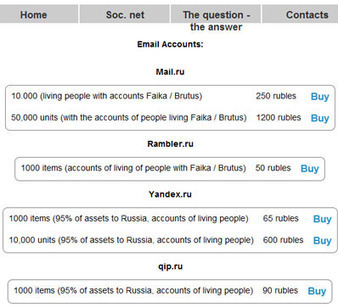
The recently unearthed website of a service specializing in selling access to compromised email and social networking accounts of Russian and Ukrainian users offers a fascinating glimpse into just how much one such account is worth to spammers. Wannabe spammers and social engineers can choose to buy accounts by the service, and should be ready to pay 190 rubles ($5.9) for 100 compromised Vkontakte accounts belonging mostly to Russian users, or 180 rubles ($5.6) for the same number belonging to mostly Ukrainian users. Facebook accounts are somewhat cheaper - 500 for 200 rubles ($6.2), and the same number of compromised Twitter account can be had for 250 rubles ($7.7). Read more to find out how others are earning money with your stolen data, you should: http://www.net-security.org/secworld.php?id=13275
|
|
Scooped by
Gust MEES
July 17, 2012 12:55 PM
|
A Seattle hacking triumvirate has received a collective quarter-century behind bars.
With a combination of wardriving and malware implantation, they made off with $3m plundered from company acco... The three men, Joshuah Allen Witt, 35, John Earl Griffin, 36, and Brad Eugene Lowe, 39, have all now been given stiff prison terms. Lowe picked up the lightest sentence, ===> with six-and-a-half years, whilst Witt and Griffin were sent down for nearly eight years each. There are two lessons to be learned here. The first lesson is to make sure you get your WiFi security right - at work and at home. We've written up some simple guidelines before to help you do the right thing. To summarise, here are three things which do not provide WiFi security. Two of them provide a touch of safety against inadvertent connections, but none of these protect you against wardrivers: - WEP encryption. The security system in WEP (Wired Equivalent Privacy) is flawed and can easily and automatically be cracked. A wardriver will bypass WEP in 60 seconds - and that includes the time taken to park outside your office and boot up his laptop. Use WPA instead. - MAC address filtering. MAC (Media Access Control) addresses aren't secret. WiFi networks broadcast the MAC addresses of all currently-connected devices, so a wardriver already has a list of addresses he can use. - SSID hiding. The SSID (Service Set identifier) is your network name. Hiding it merely means your network doesn't openly advertise itself for use. But it isn't a secret - the SSID appears in other network traffic anyway, so the wardriver knows what it is. The second lesson is to be doubly vigilant after a physical break-in. Don't just look for what's missing, but what might have been left behind. Read more, a MUST for WiFi protection: http://nakedsecurity.sophos.com/2012/07/16/seattle-cybercrime-trio-sentenced-for-3m-hacking-spree-via-wifi-and-malware/
|
|
Scooped by
Gust MEES
July 17, 2012 9:04 AM
|
The Grum botnet is the world’s third largest botnet, producing some 17% of the total spam that floods email boxes daily. Researchers at malware intelligence firm FireEye are reporting that Dutch authorities have pulled the plug on two secondary servers used by the Grum botnet. The removal of the servers shines light on how quickly some law enforcement agencies work, given that proof of their existence is just over a week old. Read more: http://www.securityweek.com/dutch-police-takedown-ccs-used-grum-botnet
|
|
Scooped by
Gust MEES
July 16, 2012 9:24 AM
|
|
|
Scooped by
Gust MEES
July 13, 2012 10:34 AM
|
|
|
|
Scooped by
Gust MEES
September 21, 2012 1:02 PM
|
18/09/2012
The EU faces massive proliferation of cyber-crime yet police are often unable to trace the criminals as they are both quick and anonymous, Troels Oerting, the head of the new European Cybercrime Centre, told MEPs at a hearing in Brussels this week, adding that “there is no absolute security, it is a myth”. He believes the solution is to improve legal norms and public awareness, and to make sure that activities illegal in the “offline world” are also illegal in the online one. Some EU countries, however, are unable to cope with the high number of cases and don’t have the budget to investigate the cyber-crimes, especially when they are cross-border. "I hate to say it, but when we invite [people] to meetings about Europol investigations, half of the most critical countries don't come. They haven't got the money for travelling," Oerting admitted. Read more: http://www.securitydefenceagenda.org/Contentnavigation/Library/Libraryoverview/tabid/1299/articleType/ArticleView/articleId/3237/categoryId/64/EU-lags-behind-in-cybercrime.aspx?utm_source=dlvr.it&utm_medium=twitter
|
|
Scooped by
Gust MEES
September 11, 2012 7:51 AM
|
|
|
Scooped by
Gust MEES
September 5, 2012 8:12 AM
|
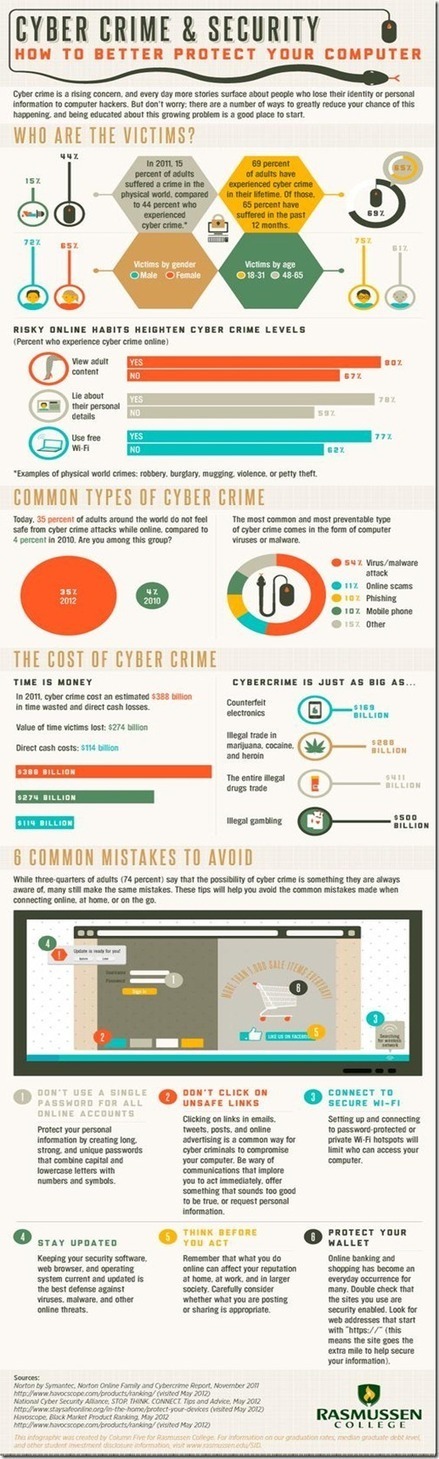
The Norton Cybercrime Report is out for 2012! Cybercrime continues to have far-reaching effects and is increasingly a problem on mobile devices and in our social networks (where we seem to be less vigilant). After surveying more than 13,000 consumers in 24 countries, the researchers found that the numbers of online adults increased by 20 percent from last year, and that cybercrime impacted just under ½ of them in the previous 12 months. The total direct consumer cost was calculated to be $110 billion, slightly down from last year’s $114 billion (USD), with the average cost per victim down approximately 20 percent. The reason the overall cost remains so high is that the pool of victimized online adults grew more rapidly - in other words, less money, but from more victims. The nature of the crimes is shifting towards the social networks we love and the mobile devices we use constantly. Consumers seem to have figured out the basics of protecting themselves on their desktop and laptop computers and report using basic security measures and caution to stay safe. It would seem they’ve really gotten the message about things like being careful what you click on and deleting suspicious emails without opening them. Programs, like the October Cyber Security Awareness Month and the NCSA’s “Stop.Think.Connect.” campaign, are likely having a positive impact on consumer behavior! Read more: http://community.norton.com/t5/Ask-Marian/Cybercrime-is-a-Global-Problem-Increasingly-Social-and-Mobile/ba-p/796538
|
|
Scooped by
Gust MEES
August 7, 2012 3:10 PM
|
Ukrainian authorities have taken down Demonoid.com, one of the world's largest BitTorrent tracker sites. Torrents allow users to download music, video and other internet content by downloading small bits of files from others' computers at the same time. The shutdown is the latest news in a campaign against file-sharing sites. It follows the US's closure of Megaupload, and several European ISPs (internet service providers) being ordered to block access to The Pirate Bay. Read more: http://www.bbc.com/news/technology-19166779#?utm_source=twitterfeed&utm_medium=twitter
|
|
Scooped by
Gust MEES
July 28, 2012 9:27 AM
|
|
|
Scooped by
Gust MEES
July 25, 2012 4:59 AM
|
|
|
Scooped by
Gust MEES
July 23, 2012 12:25 PM
|
|
|
Scooped by
Gust MEES
July 19, 2012 5:29 PM
|
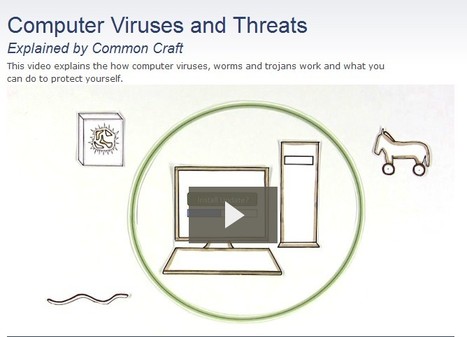
What it teaches
This video explains computer viruses by comparing them to human viruses and focuses on the role of prevention in being protected. Major points include:
- A basic look at computer viruses as computer programs that can spread like a disease and can be prevented by anti-virus software. - An introduction to worms, how they cause damage in networks and can be prevented by software updates. - An introduction to trojans, how they trick people into downloading a virus and how awareness is important for prevention. Check for more videos here: http://www.commoncraft.com/video/computer-viruses-and-threats
|
|
Scooped by
Gust MEES
July 19, 2012 4:06 AM
|
|
|
Scooped by
Gust MEES
July 17, 2012 12:03 PM
|
Internet giant teams up with politicians and academics to host two-day summit in bid to disrupt illegal activity on the internet... The internet giant has launched a campaign against the secrecy and impunity of drug cartels, organ harvesters, cyber-criminals, violent radicals and traffickers in arms and people. It has assembled victims, law enforcers, politicians, academics and technology experts to devise strategies in a two-day summit in Los Angeles, starting Tuesday, called Illicit Networks: Forces in Opposition. Read more: http://www.guardian.co.uk/technology/2012/jul/17/google-tech-knowhow-internet-crime?CMP=twt_fd
|
|
Scooped by
Gust MEES
July 17, 2012 6:49 AM
|
|
|
Scooped by
Gust MEES
July 13, 2012 12:16 PM
|
|