 Your new post is loading...

|
Scooped by
Gust MEES
December 21, 2017 12:11 PM
|
Un plugin WordPress vérolé a ouvert les portes de plus de 300 000 sites !
L'un des intérêts de WordPress est qu'il suffit de télécharger des plugins pour ajouter rapidement des fonctionnalités à son site. Une simplicité apparente qui peut aussi être source de vulnérabilités.
C'est ce qui s'est passé pour les utilisateurs d'un plugin ajoutant un captcha. L'entreprise qui le maintenait a vendu ce produit à une autre société, qui y a discrètement ajouté une porte dérobée. Plus de 300 000 sites utilisent cet outil et sont donc concernés par cette brèche, estime The Hacker News.
Le plugin, ainsi que quelques autres publiés par le même auteur et présentant la même porte dérobée, ont été supprimés de la boutique d'éléments de WordPress.
Learn more / En savoir plus / Mehr erfahren: https://www.scoop.it/t/securite-pc-et-internet/?&tag=WordPress
|
|
Scooped by
Gust MEES
December 20, 2017 3:34 PM
|
|
|
Scooped by
Gust MEES
December 19, 2017 11:34 AM
|
Mit der Messenger-App Signal und dem auch von Whatsapp eingesetzten Signal-Protokoll ist Moxie Marlinspike ein großer Coup gelungen. Den will er nun mit einer Bitcoin-Alternative wiederholen. Noch vor einem Jahr waren Cryptowährungen wie Bitcoin die große Hoffnung für Liebhaber des anonymen Bezahlens online. Spätestens seitdem der Bitcoin-Kurs aber immer neue Rekorde bricht, arbeiten immer mehr Entwickler an möglichenAlternativen.
|
|
Scooped by
Gust MEES
December 15, 2017 3:28 PM
|
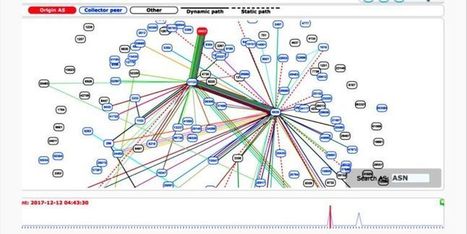
Traffic sent to and from Google, Facebook, Apple, and Microsoft was briefly routed through a previously unknown Russian Internet provider Wednesday under circumstances researchers said was suspicious and intentional.
Russian-controlled telecom hijacks financial services’ Internet traffic.
The unexplained incident involving the Internet's Border Gateway Protocol is the latest to raise troubling questions about the trust and reliability of communications sent over the global network. BGP routes large-scale amounts of traffic among Internet backbones, ISPs, and other large networks. But despite the sensitivity and amount of data it controls, BGP's security is often based on trust and word of mouth. Wednesday's event comes eight months after large chunks of network traffic belonging to MasterCard, Visa, and more than two dozen other financial services were briefly routed through a Russian government-controlled telecom, also under suspicious circumstances.
Learn more / En savoir plus / Mehr erfahren: https://www.scoop.it/t/securite-pc-et-internet/?&tag=BGP
|
|
Scooped by
Gust MEES
December 15, 2017 1:50 PM
|
This website is a resource to educate the public about the main elements of the General Data Protection Regulation (GDPR)
After four years of preparation and debate the GDPR was finally approved by the EU Parliament on 14 April 2016. It will enter in force 20 days after its publication in the EU Official Journal and will be directly application in all members states two years after this date. Enforcement date: 25 May 2018 - at which time those organizations in non-compliance will face heavy fines.
The EU General Data Protection Regulation (GDPR) replaces the Data Protection Directive 95/46/EC and was designed to harmonize data privacy laws across Europe, to protect and empower all EU citizens data privacy and to reshape the way organizations across the region approach data privacy. The key articles of the GDPR, as well as information on its business impact, can be found throughout this site.
Learn more / En savoir plus / Mehr erfahren: https://www.scoop.it/t/luxembourg-europe/?&tag=LIST https://www.scoop.it/t/luxembourg-europe/?&tag=CNPD https://www.scoop.it/t/luxembourg-europe/?tag=Digital+L%C3%ABtzebuerg https://www.scoop.it/t/luxembourg-europe/?&tag=GDPR
|
|
Scooped by
Gust MEES
December 15, 2017 1:28 PM
|
Webseitenbesucher für Crypto-Mining missbraucht
Der Boom um Kryptowährungen hält weiter an. Um an der zunehmenden Wertsteigerung teilzuhaben, missbrauchen manche Webseitenbetreiber sogar die Rechenleistung ihrer Nutzer für das Mining.
Die Anzahl der Webseiten mit Coinhive-Skript ist besonders in den letzten Monaten geradezu sprunghaft angestiegen.
(Quelle: Sophos )
Blockchain-basierte Währungen wie Bitcoin werden immer beliebter. Mehr und mehr Menschen wollen am enormen Wertanstieg der Digitaldevisen mitverdienen; und das auch mit teilweise fragwürdigen Mitteln. Relativ neu ist etwa das Ausnutzen der Rechenleistung von Webseiten-Besuchern zum Mining, also zum Generieren von Kryptowährungen.
Wie die Experten von Sophos beschreiben, ist dazu lediglich eine in JavaScript geschriebene Anwendung des Anbieters Coinhive notwendig. Ist diese in die Webseite integriert, wird das Tool beim Aufruf der Seite automatisch heruntergeladen. Und schon beginnt der Computer im Hintergrund die Kryptowährung Monero zu schürfen.
Learn more / En savoir plus / Mehr erfahren: https://www.scoop.it/t/securite-pc-et-internet/?&tag=crypto-currency
|
|
Scooped by
Gust MEES
December 8, 2017 8:18 PM
|
"Highly professional" hackers made off with around 4,700 Bitcoin from a leading mining service, a Bitcoin exchange has said.
The value of Bitcoin is currently extremely volatile, but at the time of writing, the amount stolen was worth approximately $80m.
The hacked service was NiceHash, a Slovenia-based mining exchange.
It said it was working hard to recover the Bitcoin for its users, adding: "Someone really wanted to bring us down."
The attack happened early on Wednesday, said NiceHash's chief executive Marko Kobal. Attackers accessed the company's systems at 01:18 CET (00:18 GMT). By 03:37 the hackers, whom the company believes were based outside the European Union, had begun stealing Bitcoin.
The theft comes as the price of Bitcoin continues to surge, dumbfounding experts and stoking concerns of a bubble.
High-stakes attacks like this are not uncommon, with several large breaches and thefts hitting Bitcoin and other related services over the past year.
NiceHash is a mining service, a company that pairs up people with spare computing power with those willing to pay to use it to mine for new Bitcoin. Learn more / En savoir plus / Mehr erfahren: https://www.scoop.it/t/securite-pc-et-internet/?&tag=crypto-currency
|
|
Scooped by
Gust MEES
December 6, 2017 9:31 PM
|
A new massive IoT (Internet of Things) botnet dubbed Satori has emerged, which security researchers fear, can launch crippling attacks at any time. The botnet has reportedly already infected over 280,000 IP addresses in just 12 hours, enslaving hundreds of thousands of home routers by exploiting a recently discovered zero-day vulnerability.
Satori, which reportedly means "awakening" in Japanese, is actually the infamous Mirai botnet's successor. Since Mirai's authors made the botnet's source code public last year, cybercriminals have been pushing out new variants of Mirai. Learn more / En savoir plus / Mehr erfahren: http://www.scoop.it/t/securite-pc-et-internet/?&tag=Botnet http://www.scoop.it/t/securite-pc-et-internet/?&tag=Botnet&tag=Mirai+Botnet
|
|
Scooped by
Gust MEES
December 4, 2017 12:57 PM
|
|
|
Scooped by
Gust MEES
December 4, 2017 2:42 AM
|
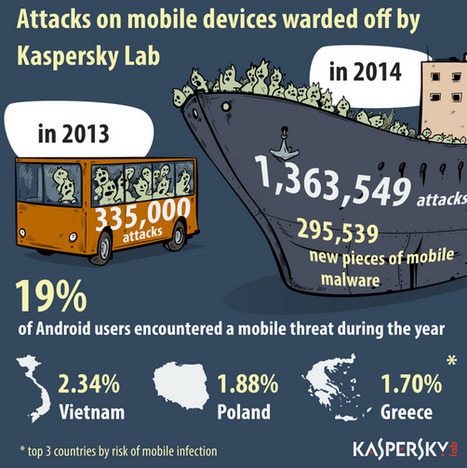
68 Prozent mehr mobile Cyberangriffe seit September 2014
Kaspersky-Studie zur mobilen Bedrohungslage für Deutschland zeigt auch signifikante Steigerung (77,8 Prozent) bei Angriffen auf mobil genutzte Finanzdaten
Moskau/lngolstadt, 30. November 2017 - Das Internet erleichtert den Alltag und Cyberkriminellen möglicherweise den Zugang zum Geldbeutel vieler Smartphone-Nutzer. So sehen die Experten von Kaspersky Lab seit September 2014 bis August 2017 einen Anstieg mobiler Cyberattacken gegen deutsche Nutzer um mehr als 68 Prozent. Zugleich haben immer mehr Schädlinge auf Smartphone und Co. verfügbare Finanzdaten im Visier – mit einem Zuwachs an Attacken durch mobile Banking-Trojaner gegen deutsche Nutzer um 77,8 Prozent (auch seit September 2014 bis August 2017). Die erstmals für Deutschland von Kaspersky Lab durchgeführte Studie ,Mobile Schadprogramme in Deutschland – Panikmache oder echte Gefahr?‘ [1] zeigt: Betrugsversuche über das mobile Web sind auch in Deutschland akut. Learn more / En savoir plus / Mehr erfahren: https://www.scoop.it/t/securite-pc-et-internet/?&tag=Mobile-Security https://gustmeesde.wordpress.com/2014/12/13/mobile-security-smartphones-sind-auch-mini-computer/
|
|
Scooped by
Gust MEES
December 1, 2017 9:25 AM
|
Phishing, Trojans, Ransomware and Viruses: Hardly a day goes by without hacker attacks against companies or private individuals. This huge LUCY Infographic shows the explosion of internet crime State of Cyber Crime 2018 – Numbers in detail In the United States by Internet crime caused damage in 2001:17.8 million USD. In the United …
|
|
Scooped by
Gust MEES
November 28, 2017 7:46 PM
|
Would more Nazis and terrorists on social media make our internet more free?
FCC Chairman Ajit Pai, speaking Tuesday at a panel on the “future of internet freedom,” asked and answered this question in staunchly libertarian terms, calling out YouTube, Facebook and Twitter’s purported double standards against conservatives and identifying them as the “actual threat” to the open internet. Pai’s critics say net neutrality repeal will lay the groundwork for ISPs to fragment and meter out the internet, but, speaking on a panel hosted by libertarian think tank, R Street Institute, Pai said Silicon Valley—wicked, liberal, Silicon Valley—already does this by promoting some viewpoints while suppressing others.
His first target: Twitter. Twitter openly supports net neutrality, which Pai argued is hypocritical because they differentiate between users based on their viewpoints. Learn more / En savoir plus / Mehr erfahren: https://www.scoop.it/t/securite-pc-et-internet/?&tag=net+neutrality
|
|
Scooped by
Gust MEES
November 27, 2017 11:16 AM
|
Eine DDoS-Attacke hat die Kryptowähungs-Börse Bitfinex lahmgelegt. Das bestätigten die Betreiber auf Twitter. Der Angriff sei während Wartungsarbeiten an der Infrastruktur gestartet worden.
Während Wartungsarbeiten an der Infrastruktur legten Hacker die Kryptowährungs-Börse Bitfinex mit einer DDoS-Attacke lahm. Wie die Betreiber auf Twitter mitteilen, ist der Angriff noch in vollem Gange.
Damit erleidet die Tauschbörse einen weiteren schweren Schlag. Erst vor wenigen Tagen hatte die von den Bitfinex-Machern entwickelte Kryptowährung Tether durch einen Cyber-Angriff 31 Millionen US-Dollar verloren. Es bleibt abzuwarten, wie lange die Nutzer der Plattform noch ihr Vertrauen schenken.
Learn more / En savoir plus / Mehr erfahren: https://www.scoop.it/t/securite-pc-et-internet/?&tag=Bitfinex https://www.scoop.it/t/securite-pc-et-internet/?&tag=crypto-currency
|
|
|
Scooped by
Gust MEES
December 21, 2017 10:18 AM
|
Sicherheitsforscher haben weltweit 14 Millionen Angriffe pro Stunde auf WordPress-Webseiten registriert. Die Angreifer wollen sich Zugang zu den Seiten verschaffen.
Derzeit erschüttert eine Angriffswelle gegen WordPress-Webseiten das Internet. Sicherheitsforscher von Wordfence haben dokumentiert, dass unbekannte Angreifer pro Stunde 190.000 Seiten via Brute Force attackieren. Als Spitzenwert haben sie stündlich 14 Millionen Angriffe beobachtet.
Dabei probieren sie im großen Stil Kombinationen von Nutzernamen und Passwörtern aus, um Admin-Zugriff auf Webseiten zu bekommen. Dabei sollen sie zum Teil organisiert vorgehen und versuchen, die möglichen Zugangsdaten von der URL und dem Inhalt der Webseite abzuleiten.
Malware schürft Kryptowährung
Ziel der Angriffe ist es Wordfence zufolge, auf gekaperten Seiten Software zum Schürfen der Kryptowährung Monero zu installieren oder diese als Ausgangspunkt für weitere Brute-Force-Attacken zu missbrauchen. Mittlerweile sollen die Angreifer dabei Monero im Wert von 100.000 US-Dollar geschürft haben.
Learn more / En savoir plus / Mehr erfahren: https://www.scoop.it/t/securite-pc-et-internet/?&tag=crypto-currency
|
|
Scooped by
Gust MEES
December 20, 2017 9:41 AM
|
An Amazon Web Services (AWS) S3 cloud storage bucket containing information from data analytics firm Alteryx has been found publicly exposed, comprising the personal information of 123 million US households.
The S3 bucked, located at the subdomain "alteryxdownload", was found by Californian cybersecurity firm UpGuard, with its Cyber Risk Team discovering the leak on October 6, 2017.
According to UpGuard, exposed within the repository were datasets belonging to Alteryx partners, consumer credit reporting agency Experian, and the US Census Bureau.
Full datasets for both Experian's ConsumerView marketing database and the 2010 US Census were available. Learn more / En savoir plus / Mehr erfahren: https://www.scoop.it/t/securite-pc-et-internet/?&tag=Alteryx https://www.scoop.it/t/securite-pc-et-internet/?&tag=DATA-BREACHES
|
|
Scooped by
Gust MEES
December 16, 2017 6:28 PM
|
|
|
Scooped by
Gust MEES
December 15, 2017 3:10 PM
|
BGP-HIJACKING:
Traffic von Google, Facebook & Co. über Russland umgeleitet
Mit Hilfe einer falschen BGP-Konfiguration hat ein bisher unbekannter russischer Internetprovider für einen kurzen Zeitraum den Internetverkehr großer Unternehmen über russische Server umgeleitet. So könnten terabyteweise Daten abgeschöpft worden sein.
Eine fehlerhafte Konfiguration in Zusammenhang mit dem Border Gateway Protocol (BGP) soll zwei Monitoring-Diensten zufolge dazu geführt haben, dass Datenverkehr von Facebook, Google, Apple und Microsoft über Russland umgeleitet wurden. Auch russische Seiten wie Mail.ru und Vkontakte sollen betroffen gewesen sein. Ars Technica hatte über den Vorfall berichtet.
Learn more / En savoir plus / Mehr erfahren: https://www.scoop.it/t/securite-pc-et-internet
|
|
Scooped by
Gust MEES
December 15, 2017 1:34 PM
|
What would you like with your latte? Cocoa? Cinnamon? Sprinkle of cryptocurrency mining piggybacking off your free Wi-Fi?
Recent visitors to a Buenos Aires Starbucks didn’t actually have a choice: instead, a 10-second delay was foisted on them when they connected to the coffee shop’s “free” Wi-Fi, as their laptops’ power secretly went to mine cryptocoins (of which the Starbucks customers received nary one slim dime, of course).
The mining was noticed by Stensul CEO Noah Dinkin, who took to Twitter on 2 December to ask Starbucks if it was aware of what was going on. He included a screenshot of the code.
Dinkin said in his tweet that the code was mining bitcoins, but it was actually CoinHive code, which offers a JavaScript miner for generating a cryptocurrency called Monero that’s an alternative to Bitcoin. Learn more / En savoir plus / Mehr erfahren: https://www.scoop.it/t/securite-pc-et-internet/?&tag=crypto-currency
|
|
Scooped by
Gust MEES
December 12, 2017 12:27 PM
|
Insbesondere durch Social Engineering sammeln Cyberkriminelle Informationen, mit deren Hilfe sie Unternehmen ausspähen können, Schadsoftware platzieren oder gleich direkt wie zum Beispiel bei Ransomware Attacken oder durch fälschlicherweise initiierte Geldüberweisungen Unternehmen massiv schädigen. Wir stellen in unseren Analysen immer mehr fest, dass für diverse Angriffsszenarien auch Trackinginformationen herangezogen werden.
Unter folgendem Link können Sie Ihren Browser testen, ob er genügend Schutz gegen unerwünschtes Tracking bietet.
https://datenschutz-agentur.de/ist-ihr-browser-sicher-vor-trackingtechnologien/
Sollte hier aufgezeigt werden, dass Sie identifizierbar sind, sollten Sie geeignete Schutzmaßnahmen gegen das Browser-Tracking ergreifen. Learn more / En savoir plus / Mehr erfahren: https://www.scoop.it/t/securite-pc-et-internet/?&tag=tracking
|
|
Scooped by
Gust MEES
December 7, 2017 4:06 AM
|
According to security researchers, a new IoT botnet has quietly hijacked more than 100,000 routers, readying them for paralysing distributed denial-of-service attacks against websites.
The botnet, which some researchers have dubbed “Satori” (a name given to supernatural mind-reading monsters in Japanese folklore), has increased its activity in recent days – propagating very quickly via a zero-day remote code execution vulnerability in Huawei Home Gateway or Huawei’s Echolife Home Gateway devices, and an already documented vulnerability in Realtek routers.
The exploitation of vulnerabilities allows the botnet to infect routers even when they have been secured with strong passwords.
Through the attack, an army of hundreds of thousands of routers are thought to have been commandeered into the botnet. Some commentators have even suggested that over 280,000 IP addresses have been compromised by the attack in just 12 hours.
Like the Reaper IoT botnet before it, Satori is built on the foundations of the notorious Mirai botnet which knocked major websites offline last year, and whose source code was released onto the internet. Learn more / En savoir plus / Mehr erfahren: https://www.scoop.it/t/securite-pc-et-internet/?&tag=Satori+botnet https://www.scoop.it/t/securite-pc-et-internet/?&tag=Botnet https://www.scoop.it/t/securite-pc-et-internet/?&tag=Botnet&tag=Mirai+Botnet
|
|
Scooped by
Gust MEES
December 5, 2017 8:27 PM
|
Personal data belonging to over 31 million customers of a popular virtual keyboard app has leaked online, after the app's developer failed to secure the database's server.
The server is owned by Eitan Fitusi, co-founder of AI.type, a customizable and personalizable on-screen keyboard, which boasts more than 40 million users across the world.
But the server wasn't protected with a password, allowing anyone to access the company's database of user records, totaling more than 577 gigabytes of sensitive data.
The database appears to only contain records on the app's Android users.
The discovery was found by security researchers at the Kromtech Security Center, which posted details of the exposure alongside ZDNet. The data was only secured after several attempts to contact Fitusi, who acknowledged the security lapse this weekend. The server has since been secured, but Fitusi did not respond when we asked for comment.
ZDNet obtained a portion of the database to verify. Learn more / En savoir plus / Mehr erfahren: https://www.scoop.it/t/securite-pc-et-internet/?&tag=Mobile-Security https://gustmeesde.wordpress.com/2014/12/13/mobile-security-smartphones-sind-auch-mini-computer/
|
|
Scooped by
Gust MEES
December 4, 2017 3:05 AM
|
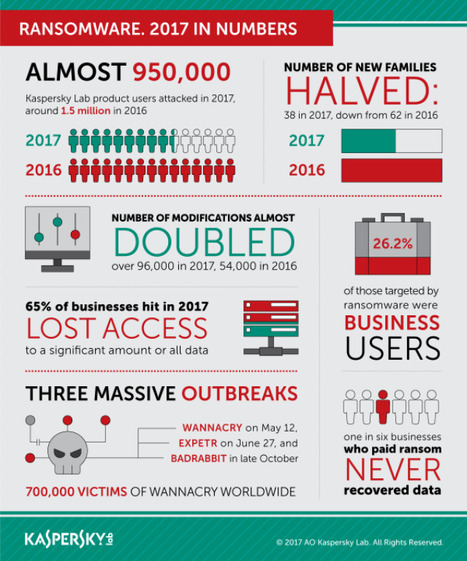
Ransomware 2017 in numbers | #CyberSecurity #Infographic #Awareness
|
|
Scooped by
Gust MEES
December 1, 2017 6:57 PM
|
A study of 90 cryptocurrency mobile applications available on Google Play found that 90 percent of them contain security vulnerabilities or privacy risks.
Web security company High-Tech Bridge conducted the research, using dynamic, static, and interactive testing to search mobile apps for weaknesses, including the top ten mobile flaws listed by the Open Web Application Security Project (OWASP).
“We took the most popular cryptocurrency mobile applications from Google Play from the ‘Finance' category and tested them for security flaws and design weaknesses that can endanger the user, his or her data stored on the device or send/received via the network, or the mobile device itself,” High-Tech Bridge reported in a Nov. 29 blog post.
Learn more / En savoir plus / Mehr erfahren: https://www.scoop.it/t/securite-pc-et-internet/?&tag=crypto-currency
|
|
Scooped by
Gust MEES
November 29, 2017 11:05 AM
|
Zu einem Projekt des US-Geheimdiensts mit dem Codenamen "Red Disk" lagen ungeschützt über 100 Gigabyte an Daten auf einem nicht gelisteten AWS-Server. Es war nicht mal ein Passwort zum Download notwendig.
Und das nächste Datenleck: Chris Vickery der Firma UpGuard fand Ende September über 100 Gigabyte an Daten zu einem Projekt der NSA auf einem AWS-Server (Amazon Web Services) – ungeschützt und ohne Passwort. Dabei handelt es sich um den neuesten Fund in einer Reihe von ungeschützten Daten in der Cloud. UpGuard hatte bereits Daten von Accenture, Verizon, registrierter Wähler in den USA und eine Terabyte große Sammlung von Überwachungsdaten des US-Militärs auf AWS-Servern gefunden.
Kein Passwort benötigt
Bei den Daten handelt es sich laut Aussagen von UpGuard um Eigentum der NSA und der US-Armee, genauer gesagt um ein Projekt mit dem Codenamen "Red Disk". Die Dateien befanden sich zwar auf einem nicht gelisteten Server, waren aber nicht mit einem Passwort geschützt. Jeder, der über den Link verfügte, konnte die Dateien also abrufen. Der größte Fund dabei war eine virtuelle Festplatte, die laut UpGuard die Geheimhaltungsstufe "NOFORN" beinhaltet, also nicht einmal an Verbündete der USA weitergegeben darf.
UpGuard vermutet, dass die virtuelle Festplatte zur Weitergabe von klassifizierten Informationen dient. Ein Zugriff auf die Daten der Fesplatte ist jedoch nicht ohne eine Verbindung zum System des Pentagon möglich. Learn more / En savoir plus / Mehr erfahren: https://gustmees.wordpress.com/2012/11/05/naivety-in-the-digital-age/ https://www.scoop.it/t/securite-pc-et-internet/?&tag=Naivety
|
|
Scooped by
Gust MEES
November 27, 2017 2:35 PM
|
The average home now has around three connected computers and four smart mobile devices. Hardly surprising, considering that 86 per cent of us check the Internet several times a day or more, and that’s outside of work. Chatting, shopping, banking, playing games, listening to music, booking travel and managing our increasingly connected homes. The risk of cyberattack can be the furthest thing from our mind. Every year, Kaspersky Lab’s experts look at the main cyberthreats facing connected businesses over the coming 12 months, based on the trends seen during the year. For 2018, we decided to extract some top predictions that also have big implications for everyday connected life. So what could the hackers be after in 2018? Learn more / En savoir plus / Mehr erfahren: https://www.scoop.it/t/securite-pc-et-internet
|












![State of Cyber Attacks 2018 – A big Overview about Cybercrime [Infographic] - LUCY Phishing, Social Hacking and Security Awareness | #CyberSecurity | ICT Security-Sécurité PC et Internet | Scoop.it](https://img.scoop.it/dH0qjTsuLei_pVSG-kbkczl72eJkfbmt4t8yenImKBVvK0kTmF0xjctABnaLJIm9)




![Stolen California Voter Database Held for Bitcoin Ransom [Updated] | #CyberSecurity #DataBreaches #Ransomware #CryptoCurrency | ICT Security-Sécurité PC et Internet | Scoop.it](https://img.scoop.it/mgyGVgXn_QV_Fs7Qo01leTl72eJkfbmt4t8yenImKBVvK0kTmF0xjctABnaLJIm9)











Un plugin WordPress vérolé a ouvert les portes de plus de 300 000 sites !
L'un des intérêts de WordPress est qu'il suffit de télécharger des plugins pour ajouter rapidement des fonctionnalités à son site. Une simplicité apparente qui peut aussi être source de vulnérabilités.
C'est ce qui s'est passé pour les utilisateurs d'un plugin ajoutant un captcha. L'entreprise qui le maintenait a vendu ce produit à une autre société, qui y a discrètement ajouté une porte dérobée. Plus de 300 000 sites utilisent cet outil et sont donc concernés par cette brèche, estime The Hacker News.
Le plugin, ainsi que quelques autres publiés par le même auteur et présentant la même porte dérobée, ont été supprimés de la boutique d'éléments de WordPress.
Learn more / En savoir plus / Mehr erfahren:
https://www.scoop.it/t/securite-pc-et-internet/?&tag=WordPress