From black holes to the physics of footballs...good stuff from the Net to use in your class, brought to you courtesy of the Rondebosch Boys' High School Library (If you would like to receive a weekly newsletter of the latest items in this Scoop just mail me at library@rondebosch.com)
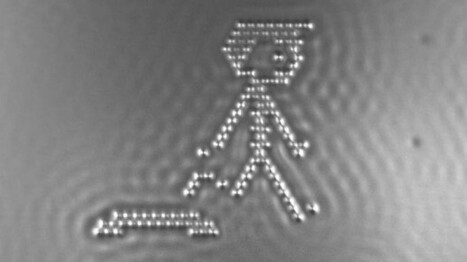
What you’re watching above isn’t your ordinary film. No this film – A Boy And His Atom – holds the Guinness World Record for being the World’s Smallest Stop-Motion Film. It’s literally a movie made with atoms, created by IBM nanophysicists who have “used a scanning tunneling microscope to move thousands of carbon monoxide molecules, all in the pursuit of making a movie so small it can be seen only when you magnify it 100 million times.” If you’re wondering what that means exactly, then I’d encourage you to watch the behind-the-scenes documentary below. It takes you right onto the set — or, rather into the laboratories — where IBM scientists reveal how they move 5,000 molecules around, creating a story frame by frame. As you watch the documentary, you’ll realize how far nanotechnology has come since Richard Feynman laid the conceptual foundations for the field in 1959.
This video might be useful for teaching forces, energy and so forth. If nothing else it will certainly get your student's attention! I wonder if any of these guys are in hospital yet?!?
Speaking at the American Physical Society last month, Matthew Bierbaum, a Cornell grad student, presented a talk called “Collective Motion at Heavy Metal Concerts,” where he made the case that physics is everywhere, even in a mosh pit at a heavy metal show. Along with three other Cornell researchers, Bierbaum has analyzed and modeled the collective motions of moshers in various YouTube concert videos (like the one below) and discovered that “dancers collide with each other randomly and at a distribution of speeds that resembles particles in a two-dimensional gas,” writes Lauren Wolfe in Chemical & Engineering News.
There are natural poisons that lurk in bacteria, plants, and fungi pretty much everywhere, and they're there for good reasons (according to the organisms that produce them) - but what is it about their chemical make up that makes them so poisonous? How do their toxins attack the human body with such deadly efficiency? Discover the answers to these and other questions as Hank talks about some of the most deadly natural substances in the world.
What would happen if a hair dryer with continuous power was turned on and put in an airtight 1x1x1 meter box?
—Dry Paratroopa
A typical hair dryer draws 1875 watts of power.
All 1875 watts have to go somewhere. No matter what happens inside the box, if there’s 1875 watts of power being used, eventually there will be 1875 watts of heat flowing out.
This is true of any device that uses power, which is a handy thing to know. For example, people worry about leaving disconnected chargers plugged into the wall for fear that they’re draining power. Are they right? You can use heat flow to come up with simple rule of thumb: If an unused charger isn’t warm to the touch, it’s using less than a penny of electricity a day. For a small smartphone charger, if it’s not warm to the touch, it’s using less than a penny a year.
This is true of almost any powered device (though not necessarily those plugged into a second device. If a charger is connected to something, like a smartphone or laptop, power can be flowing from the wall through the charger into the device.)
But back to the box.
Heat will flow from the hair dryer out into the box. If we assume the dryer is indestructible, the interior of the box will keep getting hotter until the outer surface reaches about 60°C (140°F). At that temperature, the box will be losing heat to the outside as fast as the hair dryer is adding it inside, and the system will be in equilibrium.
The equilibrium temperature will be a bit cooler if there’s a breeze, or if the box is sitting on a wet or metallic surface that conducts away heat quickly.
If the box is made of metal, 60°C is hot enough to burn your hand if you touch it for more than five seconds. If it’s wood, you can probably touch it for a while, but there’s a danger that parts of the box in contact with the mouth of the hair dryer will catch fire.
The inside of a box will be like an oven. The temperature it reaches will depend on the thickness of the box wall; the thicker and more insulating the wall, the higher the temperature. It wouldn’t take a very thick box to create temperatures high enough to burn out the hair dryer.
But let’s assume an indestructible hair dryer. And if we have something as cool as an indestructible hair dryer, it seems like a shame to limit it.
Am I right to be afraid of pressure cookers? What's the worst thing that can happen if you misuse a pressure cooker in an ordinary kitchen?
—Delphine Lourtau
The worst thing?
Pressure cookers are dangerous.
They can explode, in a sense, but not as violently as you might fear (or hope). The pressure inside a consumer cooker doesn’t go above about two atmospheres—about the pressure inside a can of soda. Those levels can be dangerous, but they’re generally not high enough to cause the metal to violently rupture.
So what makes a pressure cooker dangerous?
Imagine a world where Pepsi is scalding hot. Now imagine that someone shakes up a can of Pepsi and sets it in front of you.
That’s the real threat from a pressure cooker: If the seal fails (or the lid is opened too early), it can spray scalding stew in all directions.
But it’s not really an explosion.
The blast couldn’t even fling the lid very far. If you mounted a rifle-style barrel on a pressure cooker, even in ideal circumstances it wouldn’t be able to fire the lid much faster than you could throw it. Any potato cannon (especially this one) could do better.
Of course, the question wasn’t about whether a pressure cooker is likely to explode. It was about what the worst thing that could happen was.
Randall Munroe applies his scientific mind to weird and wonderful...and sometimes outrageous questions in his What If? column from Xkcd. I think these would be great to print out and put on a classroom wall. Physics is always more fun if you make it crazy or big:)
In 1812, four men at Cambridge University met for breakfast. What began as an impassioned meal grew into a new scientific revolution, in which these men -- who called themselves “natural philosophers” until they later coined “scientist” -- introduced four major principles into scientific inquiry. Historian and philosopher Laura Snyder tells their intriguing story.
The astronauts aboard the International Space Station work every day on all kinds of experiments, from working with robots to preparing for spacewalks. But when they get a break, they often field questions from school children and adults about life in space.
Commander Chris Hadfield recently videotaped himself demonstrating a simple experiment inspired by a common question: If an astronaut cries in space, do their tears fall?
OCW is a critical resource for providing global educational opportunity. At MIT, OCW provides content and infrastructure to support MITx courses. Around the world, OCW helps educators improve online and offline educational offerings, and millions of learners worldwide depend on OCW for timely access to a broad range of educational materials.
Access of our resources has never been higher
Last year, the OCW site received record traffic, 22 million visits to 2,150 courses, including 3.4 million visits to the OCW Scholar courses and 640,000 visits to our Highlights for High School site. Our videos on YouTube have been viewed more than 12.6 million times and downloaded from the iTunesU site more and 9.9 million times. Our courses have been downloaded locally more than 2.2 million times.
We're making OCW even more useful
A challenge in sharing materials from 2,150 courses openly is helping our visitors find the course that meets their needs and we hope that with the new site redesign, you've noticed an improvement. Our new course finder helps visitors zero in on the topic that interests them most. We've also made it simpler for those familiar with the MIT course numbering system to find a course by number and also by department.
Like many positive terms, the phrase “big bang” originated as a pejorative. Fred Hoyle coined the term in 1949 as a way of deflating the concept of an expanding universe. It stuck, even after Edwin Hubble showed that 13.7 billion years ago, all of the matter in our massive universe was indeed compacted into “one superdense ball.” Astronomers have also figured out that the volume of the big bang was only 120 decibels, about the loudness of your average rock show (though how there might have been sound without an atmosphere escapes me). There is some irony in Hoyle’s dig: the “big bang” wasn’t particularly big, and wasn’t much of a bang, but it happened.
We learn all this and more in the video above from The Open University, and all within a minute, as the title of the series, 60 Second Adventures in Astronomy, promises. These amusing animations are very much like other OU series we’ve featured in the past: 60 Second Adventures in Economics; 60-Second Adventures in Economics: and 60 Second Adventures in Thought.
Taylor Wilson was 14 when he built a nuclear fusion reactor in his parents' garage. Now 19, he returns to the TED stage to present a new take on an old topic: fission. Wilson, who has won backing to create a company to realize his vision, explains why he's so excited about his innovative design for small modular fission reactors -- and why it could be the next big step in solving the global energy crisis.
At 14, Taylor Wilson became the youngest person to achieve fusion -- with a reactor born in his garage. Now he wants to save our seaports from nuclear terror.
When we drive, we get into a glass bubble, lock the doors and press the accelerator, relying on our eyes to guide us -- even though we can only see the few cars ahead of and behind us. But what if cars could share data with each other about their position and velocity, and use predictive models to calculate the safest routes for everyone on the road? Jennifer Healey imagines a world without accidents. (Filmed at TED@Intel.)
A research scientist at Intel, Jennifer Healey develops the mobile internet devices of the future
Have you always wanted to own a hovercraft but can't afford one? Richard Ambrose and Jonny Phillips might have the answer. Learn how you can build your own using plywood and a leafblower—and ride on air in no time!
What if you somehow managed to make a stereo travel at twice the speed of sound, would it sound backwards to someone who was just casually sitting somewhere as it flies by?
—Tim Currie
Yes.
Technically, anyway. It would be pretty hard to hear.
The basic idea is pretty straightforward. The stereo is going faster than its own sound, so it will reach you first, followed by the sound it emitted one second ago, followed by the sound it emitted two seconds ago, and so forth.
The problem is that the stereo is moving at Mach 2, which means that two seconds ago, it was over a kilometer away. It’s hard to hear music from that distance, particularly when your ears were just hit by (a) a sonic boom, and (b) pieces of a rapidly disintegrating stereo.
Wind speeds of Mach 2 would messily disassemble most consumer electronics. The force of the wind on the body of the stereo is roughly comparable to that of a dozen people standing on it:
An ordinary stereo wouldn’t make it, but one with some kind of ruggedized high-strength casing might be able to survive.
If we put together a durable, heavy-duty stereo and launch it on a ballistic trajectory, it will only be traveling at supersonic speeds for the first 150 meters or so. This means that the target will hear a maximum of about a third of a second of reversed music.
This phenomenon is actually confirmed in the 2008 paper Reproduction of Virtual Sound Sources Moving at Supersonic Speeds in Wave Field Synthesis, which says that the sound wave field “contains a component carrying a time-reversed version of the source’s input signal”.
If you have kids, you’re going to get the inevitable question: Where did the universe come from? And you’re likely going to take a long pause before trying to present the science of the big bang. Before you head down that path, know this: CERN physicist Tom Whyntie has created a new TED-ED video that explains, in three animated minutes, how the universe began, why it’s expanding, and other basic phenomena that concern cosmologists and particle physicists. Phew. By the time you’re done, you might be eagerly awaiting a where-do-babies-come-from video. That’s hopefully somewhere in TED-ED’s media pipeline too.
They can be as huge as a new constitution or as tiny as a medical microchip. In this special report, TIME explores innovations that are changing the way we work, live, pray and play
Wear Your Doctor
Monitoring patients usually requires visits to the doctor, invasive tests and bulky, expensive devices. But what if getting a checkup were as simple as slapping on a Band-Aid?
Such is the potential of bioelectronics, an emerging field whose leaders are developing small, wearable, wi-fi-enabled sensors that can detect all kinds of vital information — heart rate, body temperature, hydration levels — and relay them to your doctor or your smartphone in real time. Once patients have the big data about their bodies, the thinking goes, they can be proactive about their health, cut care costs and foster better relationships with their doctors. “We want to change the world,” proclaims David Icke, CEO of bioelectronics firm MC10, which is leading the health-sensor charge.
If you love innovation and "Big-picture" thinking you will definitely want to check out this article on how our world is changing-from growing a burger to fixing traffic jams and more. Lots of brain food...
The guidelines, known as the Next Generation Science Standards, are the first broad national recommendations for science instruction since 1996. They were developed by a consortium of 26 state governments and several groups representing scientists and teachers.
The focus would be helping students become more intelligent science consumers by learning how scientific work is done: how ideas are developed and tested, what counts as strong or weak evidence, and how insights from many disciplines fit together into a coherent picture of the world.
Leaders of the effort said that teachers may well wind up covering fewer subjects, but digging more deeply into the ones they do cover. In some cases, traditional classes like biology and chemistry may disappear entirely from high schools, replaced by courses that use a case-study method to teach science in a more holistic way.
Popular science educator Michael from Vsauce returns to the web to discuss gravity and the Sun. As a thought experiment, he asks the interesting hypothetical, “What if the sun disappeared?“
It’s not going to happen, but interestingly enough, if it did, we wouldn’t be aware that anything was wrong for a good eight minutes, as it takes that long for light to travel the millions of miles from the Sun to the Earth.
Your smartphone may feel like a friend -- but a true friend would give you a smile once in a while. At TED2013, Keller Rinaudo demos Romo, the smartphone-powered mini robot who can motor along with you on a walk, slide you a cup of coffee across the table, and react to you with programmable expressions.
To get content containing either thought or leadership enter:
To get content containing both thought and leadership enter:
To get content containing the expression thought leadership enter:
You can enter several keywords and you can refine them whenever you want. Our suggestion engine uses more signals but entering a few keywords here will rapidly give you great content to curate.


 Your new post is loading...