Your new post is loading...

|
Scooped by
Peter Mellow
May 22, 2012 1:01 AM
|
Rubrics for Assessment Information, Cooperative Learning, Research Process/Report, PowerPoint/Podcast, Oral Presentation, Web Page and Portfolio, Math, Art, Science, Video and Multimedia Project , Creating Rubrics, Writing, Rubrics for Primary Grades...

|
Scooped by
Kim Flintoff
May 6, 2012 11:33 PM
|
Abstract: The hurried pace of the modern classroom does not permit formative feedback on writing assignments at the frequency or quality recommended by the research literature. One solution for increasing individual feedback to students is to incorporate some form of computer-generated assessment. This study explores the use of automated assessment of student writing in a content-specific context (history) on both traditional and non-traditional tasks. Four classrooms of middle school history students completed two projects, one culminating in an essay and one culminating in a digital documentary. From the total set of completed projects, approximately 70 essays and 70 digital documentary scripts were then scored by human raters and by an automated evaluation system. The student essays were used to test the comparison of human and computer-generated feedback in the context of history education, and the digital documentary scripts were used to test feedback given on a non-traditional task. The results were encouraging with very high correlation and reliability factors within and across both sets of documents, suggesting the possibility of new forms of formative assessment of student writing for content-area instruction in a variety of emerging formats.
|
|
Scooped by
Kim Flintoff
May 3, 2012 4:23 AM
|
Among the problems on college campuses today are that students study for exams and faculty encourage them to do so... Yes, our mantra of "studying for exams" has created and nourished a monster—but it's not too late to kill it.
|
|
Scooped by
Kim Flintoff
April 24, 2012 4:47 AM
|
It is with pleasure we introduce Curtin Learning and Teaching’s newly formed Learning Futures Team. The new area, Led by Associate Professor David Gibson, has been created using a combination of existing and new functions.
The area is responsible for strategic projects and the integration of learning futures for the University.
There are four key areas in the Learning Futures team:
• Innovation Studio • Partnerships and Pathways • UniReady • Insight Centre - Learning Analytics
|
|
Scooped by
Kim Flintoff
April 24, 2012 2:33 AM
|
Presentation with Bob Rubyini (UofM) to the Academic Technology Advisory Committee (ATAC) at the University of Minnesota in request of an investigation of solut...
|
|
Scooped by
Kim Flintoff
April 18, 2012 11:37 AM
|
In past classes, I've usually offered my students some opportunity to assess themselves, whether it was against a rubric, or a self designed criteria. It's shocking how many students struggle with this idea.

|
Rescooped by
Learning Futures
from Rubrics Cube
April 16, 2012 10:59 PM
|
This site is designed to answer the question being asked: What does a high quality online course look like? It is ourhope that instructors and instructional designers will use this site to learn more about the Rubric for Online Instruction, and be able to view examples of exemplary courses that instructors have done in implementing the different components of the rubric.
Via Kim Flintoff
|
|
Rescooped by
Learning Futures
from Rubrics Cube
April 16, 2012 10:58 PM
|
Links to various web sites that show examples of different rubrics.
Via Kim Flintoff
|
|
Rescooped by
Learning Futures
from Rubrics Cube
April 16, 2012 10:57 PM
|
|
|
Rescooped by
Learning Futures
from Rubrics Cube
April 16, 2012 10:56 PM
|
Steps in Rubric Development Determine learning outcomes Keep it short and simple (Include 4 - 15 items; use brief statements or phrases) Each rubric item should focus on a different skill Focus on how students develop and express their learning Evaluate only measureable criteria Ideally, the entire rubric should fit on one sheet of paper Reevaluate the rubric (Did it work? Was it sufficiently detailed?)
Via Kim Flintoff
|
|
Rescooped by
Learning Futures
from Rubrics Cube
April 16, 2012 10:54 PM
|
Site for preparing for NCA Reaccreditation visit in 2012...
Via Kim Flintoff
|
|
Rescooped by
Learning Futures
from Rubrics Cube
April 16, 2012 10:53 PM
|
Institutional Research, Assessment and Planning provides Fresno State current and historical student data...
Via Kim Flintoff
|
|
Rescooped by
Learning Futures
from Rubrics Cube
April 16, 2012 10:52 PM
|
Rubrics and similar assessment instruments are included in the following categories: Undergraduate Research - student learning ad development outcomes,presentations, and research manuscripts.Student Organizations - organization effectiveness and adviser as teacher.Reflection - content analysis forms for a course and a workshop. Feedback and suggestions for change in the rubrics are welcome. This is an invitation to share rubrics for the use of others in higher education. Send Word documents or PDFs to Dorothy I. Mitstifer at dmitstifer@kon.org
Via Kim Flintoff
|
|
|
Scooped by
Kim Flintoff
May 14, 2012 9:38 PM
|
ProctorU -Online Proctoring
http://www.proctoru.com/ ProctorU allows you to take your exam online from anywhere using a webcam and a high speed internet connection.
|
|
Scooped by
Kim Flintoff
May 4, 2012 7:36 AM
|
|
|
Scooped by
Learning Futures
April 26, 2012 11:04 PM
|
Software Secure enables learners to take exams using patented and secure online testing solutions in traditional and distance learning environments.
|
|
Scooped by
Kim Flintoff
April 24, 2012 2:35 AM
|
If you've never taught a course online, chances are you've never considered how you might adjust your tests and assignments to suit the electronic medium. At most, you've probably shuddered at the thought of having to devise what you assume would be a dumbed-down, self-grading, multiple-choice, Web-based quiz. If that weren't bad enough, you probably also imagined the students being fed the answers by a friend, the two of them side by side at the computer. It all seemed so degrading, so futile. Cheer up: In my years of online teaching, I've never given a quiz or a test online, much less a multiple-choice one.
|
|
Scooped by
Kim Flintoff
April 24, 2012 2:24 AM
|
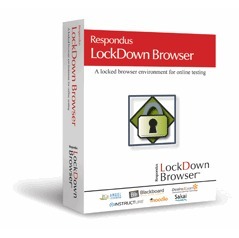
Respondus LockDown Browser™ is a custom browser that locks down the testing environment within Blackboard, ANGEL, Desire2Learn, Instructure, Moodle, and Sakai. When students use Respondus LockDown Browser they are unable to print, copy, go to another URL, or access other applications. When an assessment is started, students are locked into it until they submit it for grading. (Supports Windows and Mac OS X 10.3.9+.)
|
|
Scooped by
Kim Flintoff
April 18, 2012 11:10 AM
|
Plagiarism Advice has been providing resources, training, advice and guidance to the education sector since 2002 to help address growing concerns about plagiarism.
|
|
Rescooped by
Learning Futures
from Rubrics Cube
April 16, 2012 10:59 PM
|
Advice from Experienced TAs Grading Labs Grading Essays Rubrics (Grading Templates) 1) Advice from Experienced TAs: Marking takes longer (Grading and Rubric resources now available on the TA Support website:
Via Kim Flintoff
|
|
Rescooped by
Learning Futures
from Rubrics Cube
April 16, 2012 10:58 PM
|
A collection of links to rubric repositories in the university sector.
Via Kim Flintoff
|
|
Rescooped by
Learning Futures
from Rubrics Cube
April 16, 2012 10:57 PM
|
In education jargon, the word rubric means "an assessment tool for communicating expectations of quality" or "a standard of performance for a defined population".[1] The term Rubric originally referred to instructions (often written in red) for conducting religious services, but in the mid 1990s was given this new meaning by the education community.
Via Kim Flintoff
|
|
Rescooped by
Learning Futures
from Rubrics Cube
April 16, 2012 10:55 PM
|
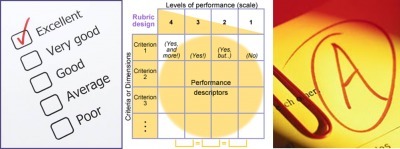
A Workshop by Kenneth Ronkowitz Rubrics provide a powerful tool for grading and assessment that can also serve as a transparent and inspiring guide to learning. Rubrics have been used to increase transparency and accountability across K-12 and higher education, and in corporate and government settings. Rubrics are a printed set of scoring guidelines (criteria) for evaluating work (a performance or a product) and for giving feedback. Generally, they are put in the form of a chart with an x and y axis of performance criteria and a evaluative range or scale. There are a number of ways to categorize rubrics. One simple distinction is the holistic versus analytic rubric. A holistic rubric has one global, holistic rating for a behavior. This differs from an analytic rubric which has separate, holistic ratings of specified characteristics of a behavior.
Via Kim Flintoff
|
|
Rescooped by
Learning Futures
from Rubrics Cube
April 16, 2012 10:54 PM
|
One of new features offered by Service Pack 6 for the Blackboard LearnTM platform that has caused the most buzz is Interactive Rubrics.
Via Kim Flintoff
|
|
Rescooped by
Learning Futures
from Rubrics Cube
April 16, 2012 10:53 PM
|
These pages are based on the work of Bonnie B. Mullinix (see related TLT Group Flashlight Rubric pages) Rubrics are a powerful tool for supporting learning by guiding learners activities and increasing their understanding of their own learning process. The following links down or out to support and supplemental materials that will help you to more deeply explore rubrics and their use as an effective assessment tool.
Via Kim Flintoff
|