


Sans en avoir conscience, les utilisateurs de drone peuvent endommager le patrimoine et se retrouver devant les tribunaux. Qu'il y est dégâts ou non d'ailleurs. Explications.


 Your new post is loading...
 Scoop.it! Sans en avoir conscience, les utilisateurs de drone peuvent endommager le patrimoine et se retrouver devant les tribunaux. Qu'il y est dégâts ou non d'ailleurs. Explications. 
No comment yet.
Sign up to comment
Scoop.it!

From
io9

Futurists and science fiction authors often give us overly grim visions of the future, especially when it comes to the Singularity and the risks of artificial superintelligence. Scifi novelist David Brin talked to us about why these dire predictions are often simplistic and unreasonable. Via FastTFriend, Jean-Pierre Blanger, juandoming
Scoop.it!

In September we wrote an article on the upcoming Kickstarter launch of a 3D printer that promised to print in a range of materials including wood, conductive materials, ceramic, plastics, and various foods. Many of our readers were very curious about the 3D printer, and now you can all get the chance to test it …
Scoop.it!

When it comes to the future of computing, there is one major known and a principal unknown. The known, with almost guaranteed certainty, is that the next era of computing will be wearables. The unknown, with commensurate guaranteed uncertainty, is what these wearables will be and where on your body they will live. Apple and Samsung, for example, are betting on the wrist; Google, the face. A slew of tech companies believe clothing will simply become electronic. Yet there’s a whole new segment of start-ups that believe all of the above are destined for failure and that we humans will become the actual computers, or at least the place where the technology will reside. Their enthusiasm is on an emerging class of wearable computers that adhere to the skin like temporary tattoos, or attach to the body like an old-fashioned Band-Aid. Continue reading the main storyRelated CoverageGadgetwise: Fashion and Functionality Meet in Smart JewelryOCT. 8, 2014Disruptions: Can the Apple Watch Woo Traditional Watch Fans?SEPT. 12, 2014Disruptions: ‘The Innovators’ by Walter Isaacson: How Women Shaped TechnologyOCT. 1, 2014Disruptions: Big iPhone 6 Bulges in All the Wrong PlacesSEPT. 24, 2014Disruptions: Science Fiction Writers Take a Rosier ViewSEPT. 17, 2014 Many of these technologies don’t look anything like today’s gadgets. Instead, they are stretchable, bendable and incredibly thin. They can also be given unique designs, to stand out like a bold tattoo, or to blend in to the color of your skin. Photo
MC10 attachable computers. Credit John A. Rogers/The University of Illinois at Urbana-Champaign While these wearables raise novel privacy concerns, their advocates say there are numerous benefits. Attachable computers will be less expensive to make, provide greater accuracy because sensors will be closer to a person’s body (or even inside us) and offer the most utility, as something people won’t forget to wear. MC10, a company based in Cambridge, Mass., is testing attachable computers that look like small rectangular stickers, about the size of a piece of gum, and can include wireless antennas, temperature and heart-rate sensors and a tiny battery. “Our devices are not like wearables that are used today, where people wear them for a little bit and then throw them into a drawer,” said Scott Pomerantz, the chief executive of MC10. “Ours are always on you. We have the smallest, most flexible, stretchable, wearable computer, and you can collect all sorts of biometric data tied to your motion.” MC10 recently teamed up with John A. Rogers, a professor of materials science and engineering at the University of Illinois at Urbana-Champaign, who has been working for nearly a decade to perfect flexible devices that can be worn on the skin or implanted internally. How would these gadgets work? Imagine being able to slap a few Band-Aid-size sensors to your body when you go for a run, then seeing a micro-level reading of your exercise on your phone. Maybe you want to figure out which deodorant would be best for you. This would be done with a sticker that tracks your sweat level, then emails you a few brand recommendations. Or if you want to monitor your baby’s breathing, you would stick a little sensor on the baby’s chest that will alert you to any problems. Photo
MC10 attachable computers. “We’ll eventually see a more intimate integration of electronics and biological systems,” Mr. Rogers said in a phone interview. “Without that kind of intimate physical contact, it’s going to be difficult, or maybe even impossible, to extract meaningful data.” Continue reading the main storyContinue reading the main story The health applications are enormous. Over the past year, Mr. Rogers and his team of scientists have been working with patients with Parkinson’s disease to monitor their motions, dermatologists to treat skin diseases, and beauty companies like L’Oréal to develop digital stickers that track skin hydration. Wearable-computer advocates are also giddy about the infinite style possibilities. “It turns out that the mechanics of these devices are 100 percent compatible with kids’ standard temporary tattoos,” Mr. Rogers said. Meaning, they can be made to look like tattoos, with each segment containing different sensors. Anke Loh, the chairwoman of the fashion department at the School of the Art Institute of Chicago, has been experimenting with making the attachable computers look like body art. “You see these patches and you really want to put them on your skin, even without knowing what the function is,” Ms. Loh said, noting that most wearable computers today are clunky and ugly. “There’s a lot of potential to combine fashion and technology.” On a more futuristic front, scientists at the University of Tokyo have been working on an “e-skin,” which, as you may have guessed, is an electronic skin that sits on top of real skin. It looks like a flexible and stretchable sheet of plastic wrap, yet contains lots of health-related sensors. In another iteration of e-skin, scientists are working to add a layer of LEDs, turning it into a functional screen that sits on the body. Digital skins offer numerous applications, not only in monitoring a user’s health, but also as a visual user interface. They can be used on lifelike prosthetics and even replace smartphones one day. (Imagine your forearm as a touch-screen display.) But don’t throw aside your smartwatch or say goodbye to Google Glass just yet. It will be a while before our wearable future becomes known. Via Philippe Marchal, dbtmobile
Scoop.it!

“ Google’s Chromecast is the most popular “connected device” – or so infers a new report from app analytics firm App Annie, which analyzed the top apps associated with connected devices across both iTunes and Google Play in the U.S.”
Scoop.it!

An intrepid 16-year-old web developer hacked his Android Wear to run Windows 95. Ah, to be young and very good at undertaking whimsical hacking projects. Via Club de TeleMatique
Scoop.it!

Scoop.it!

Suite à un conflit de copyright, Withings rebaptise son objet connecté Pulse Ox afin de mesurer l'activité physique de ses utilisateurs au quotidien, à l'aide d'une application mobile. Via Made In Ecommerce
Scoop.it!

NFC, QR Codes, iBeacon, RI: tout savoir sur les technologies sans contact. Depuis la sortie de l'iPhone 6 et de son système de paiement Apple Pay, on parle beaucoup de "NFC". NFC, Communication en champ proche, QR Codes,... Via JP Fourcade
Scoop.it!

GE Healthcare is releasing a new high-performance ultrasound system targeted at OB/GYN applications. The Voluson E10 features the eM6C, the world's first c Via Jean-Francois Talbot
Scoop.it!

Sources: PDF of Study, Technology Review Via Emmanuel Capitaine , dbtmobile

ChemaCepeda's curator insight,
September 24, 2014 3:40 AM
El teléfono móvil como dispositivo 'wearable' para medir nuestros hábitos e interacciones
Scoop.it!

Google X, the research division of tech giant Google, has just announced that it has acquired Lift Labs, a company working on devices for people suffering from neurodegenerative diseases such as Pa... Via THE OFFICIAL ANDREASCY

THE OFFICIAL ANDREASCY's curator insight,
September 11, 2014 1:57 AM
The research division of tech giant Google has just announced that it has acquired Lift Labs, a company working on devices for people suffering diseases such as Parkinson’s.
Scoop.it!

Computer Vision Google has explained their new award-wining image detection system that can identify multiple objects in a scene, even if they're partly obscured. The key is a neural network... Via Spaceweaver
|
Scoop.it!

ABob''s curator insight,
October 11, 2014 8:16 AM
Hélène, 39 ans, bibliothécaire et aveugle, raconte ici l'importance d'internet dans son quotidien. Par exemple, l'i-phone et la plage braille (photo ci-dessus) lui permettent d'aller sur facebook, sur twitter, d'organiser ses voyages, de trouver des recettes de cuisine, de jouer à des jeux et de gagner en autonomie pour des gestes quotidiens (en faisant ses courses en ligne notamment).
Scoop.it!
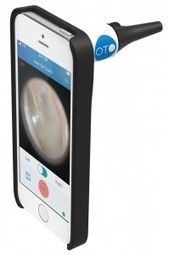
OTO est un otoscope qui se fixe directement sur le smartphone de l’utilisateur. Le système comprend un étui pour iPhone et un embout à placer au niveau de l’objectif de l’appareil photo du smartphone pour réaliser l’examen otologique. Une fois le dispositif installé, l’utilisateur doit placer le petit embout au niveau du canal de l’oreille et prendre une photo. OTO capture des images haute résolution et produit une vue de l’intérieur amplifiée de l’oreille et du tympan. Les images capturées sont enregistrées dans le cloud sécurisé de CellScope et accessibles via l’app dédiée. A partir du site web CellScope, l’utilisateur peut transmettre les données enregistrées à un médecin traitant. Les otites sont courantes chez les jeunes enfants. Ainsi, OTO apporte une solution concrète aux parents pour réaliser un examen de l’oreille et envoyer les données au pédiatre pour détecter si l’enfant à une infection. CellScope est une start-up basée à San Francisco dont la principale mission est de développer des outils de diagnostics médicaux connectés pour aider les patients à obtenir des réponses rapides et fiables. OTO est le premier produit développé par CellScope. Déjà utilisé par les professionnels de Santé aux Etats Unis, OTO devrait également être commercialisé auprès du grand public d’ici la fin de l’année 2014. OTO de CellScope est un otoscope qui se fixe directement sur le smartphone de l’utilisateur. Le système comprend un étui pour iPhone et un embout à placer au niveau de l’objectif de l’appareil photo du smartphone pour réaliser l’examen otologique. Via Philippe Loizon, Lionel Reichardt / le Pharmageek, dbtmobile
Scoop.it!

Des scientifiques se méfient des progrès de l'intelligence artificielle. Représentent-ils un danger pour l'homme ? Sommes-nous trop enclins à les intégrer à notre quotidien ? Via fduport
Scoop.it!

European researchers suggest using creative quantum robots to accelerate machine learning (credit: SINC) Quantum computing should be applied to robots, Via Apmel
Scoop.it!

Arduino may be known for revolutionizing open source hardware platforms, but this week it enters the 3D printer market with the small and affordable Materia... Via F. Thunus
Scoop.it!

A Connecticut library has acquired two fully-automated, walking, talking robots to provide independent assistance to its patrons. The robots, set to begin their duties at the Westport, Conn., library Oct. 11, will teach computer programming skills, the Wall Street Journal reports . Via Jean-Philippe BOCQUENET
Scoop.it!

«Le lycéen d’aujourd’hui est hyper-connecté […] Et on voudrait continuer à faire comme si tout cela n’existait pas… Isoler un lycéen de ce siècle, se contenter de lui demander de restituer des connaissances, sur une table carrée avec un stylo bille et une feuille de papier — voir l’image en tête de ce billet —, est un crime contre l’éducation. Imaginer et déployer des arsenaux techniques sophistiqués pour mettre en œuvre ce qui ressemble à une sorte de castration sociale des candidats [en situation d'examen] est un crime contre la raison.» Via Jean-Claude Domenjoz, Manuel Pinto

Jean-Claude Domenjoz's curator insight,
October 2, 2014 2:04 AM
À lire, cet intéressant billet de Michel Guillou !
Scoop.it!


Jacqueline Valladon's curator insight,
September 28, 2014 6:37 AM
Médiafiche de l'académie de Créteil janvier 2014
Sommaire du dossier
Un apprentissage nomade Un accès aux ressources facilité : des ressources directement intégrées dans l’appareil mobile Un complément de ressources, dans un premier temps caché Une individualisation du cours Un environnement d’apprentissage facilité Une synthèse de cours évolutive
Exemples d'utilisation du QR code en pédagogie
Scoop.it!

Games played on mobile devices allow teachers to leverage all the information on the internet along with the lived experiences of people in real life.
|






