


Via callooh


 Your new post is loading...
 Scoop.it! 
No comment yet.
Sign up to comment
Scoop.it!

Grâce au Telesar V, il est désormais possible de toucher ou regarder quelque chose en étant physiquement à des kilomètres. Via Jean-Philippe BOCQUENET
Scoop.it!
Scoop.it!

Creative Commons Licence Via Jean Anning, juandoming
Scoop.it!

Despite the grand announcements, the CAD world evolves at a slow pace with few real advancements each year. This is why when I looked into MoI (Moment of Inspiration) the first time, I wasn't really expecting much. After a short while I noticed that the system created by Michael Gibson was not just another modeling system. With surprise I saw some new ideas and a strong effort to rethink the modeling problem with a fresh approach. In particular I appreciate a system that is easy to use and that manages to hide the complexity of the underlying mathematical model. I thought it would be interesting to get a first hand look into Michael's innovative ideas and vision. Here is the interview. Via Laurent Brixius
Scoop.it!

The Smithsonian will use 3D printing to replicate artwork and artifacts, as well as archive its 137 million-piece collection. Via Henrik Safegaard - Cloneartist
Scoop.it!
Bruno Uzzan, CEO de Total Immersion, le spécialiste français de la réalité augmentée, nous donne sa vision du marché
Scoop.it!

Certaines vidéos prospectives préfigurent les interfaces utilisateurs d'un futur proche, en donnant la part belle aux applications de réalité augmentée et à l'usage massif d'interactions tactiles et gestuelles.
Scoop.it!

Les défis de la réalité augmentée dans les prochaines générations d'interfaces utilisateur | http://t.co/6qQ1j2Ra | ergonomie | Scoop.it (Les défis de la réalité augmentée dans les prochaines générations d'interfaces...
Scoop.it!

Un des sujets les plus traités dernièrement sur ce site concerne les liens de plus en plus étroits entre nouvelles technologies et commerce traditionnel. Une des raisons provient de la multitude...
Scoop.it!

Yes, Corning has a product to sell in this ad, and yes, it’s geared toward the affluent private-school demographic. But even knowing this, it’s still fun to watch this video. The focus on this second installment the company produced is learning — imagining the possibilities of augmented reality on school field trips and a community work table made of interactive glass where students collaborate on online projects alongside the teacher. Via Andrea Zeitz
Scoop.it!

Although the technology is still emerging, it certainly has the opportunity to change the way consumers shop. Brands and marketers are beginning to see the potential of mobile bar codes and are using them in their marketing strategies. Rimma Kats suggests “By simply scanning the mobile bar code, consumers can instantly access an unlimited amount of data on the brand and product of interest – from product information and reviews to special offers – but further integration with a brand or retailer’s existing loyalty, CRM or couponing implementations will also help to drive consumer uptake.” Via Lee Schlenker
Scoop.it!
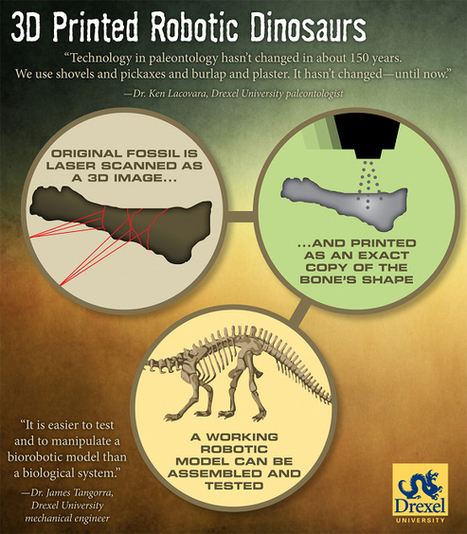
Dino-loving boffins in the US have embarked on their very own Jurassic Park-esque experiment to bring the actions of Earth's favourite prehistoric lizards to life. Via Sakis Koukouvis
|
Scoop.it!

A guide on how to use QR codes beyond just opening URLs. It outlines a practical example: Creating a QR code that opens the Skype app. Via callooh
Scoop.it!

Kansas City StarAutomaton at US museum linkd to Scorsese's 'Hugo'The Korea HeraldPHILADELPHIA (AP) ― The Franklin Institute's automaton can't help you find a good sushi place, direct you out of a traffic jam or check your bank balance.
Scoop.it!

At the CeBIT fair in Hanover, Karlsruhe Institute of Technology and the FZI Research Center for Information Technology will present innovations for our everyday life in the future. Via Paulo Furtado
Scoop.it!

A huge 3D printer can print architectural objects using ordinary sand and an inorganic binder. Wow - Think about it. Make a 3d house on your computer, with stairs, rooms and all the other who is in a complete house, get it printed and move in.
It sounds like a fantasy but it's for real. Imagine how cool that could be, or in some cases how terrible depending on who was the mastermind behind the design ;-) @safegaard Via Henrik Safegaard - Cloneartist
Scoop.it!

Les interfaces à reconnaissance de mouvements ont été popularisées par Nintendo et sa console de jeux de salon, la Wii, qui a été présentée au grand public en 2006. Microsoft est allé encore plus loin en lançant une interface à reconnaissance de mouvement sans contrôleur, appelée Kinect. Des applications nombreuses ont été trouvées dans l’univers de la santé, pour la rééducation notamment, mais les utilisations dans le monde de l’éducation sont encore timides. Quelles peuvent en être les applications, notamment dans l’apprentissage d’un geste ? Via Audrey Bardon
Scoop.it!

Les humains contre les machines L’homme n’est pas seul dans les mondes virtuels. Il partage ces univers avec des intelligences artificielles. Celles-ci peuvent aller du simple “assistant” qui vous salue lorsque vous entrez dans un magasin virtuel au monstre qui cherche à vous éliminer dans World of Warcraft. Toujours est-il que certains chercheurs considèrent la Réalité virtuelle (RV) comme le terrain rêvé pour développer l’intelligence artificielle. Dans le “jeu du restaurant” deux joueurs miment le comportement d’un client commandant un repas et de la serveuse qui s’occupe de lui. Un jeu peu passionnant a priori, mais qui a pour but d’apprendre au programme à élaborer ses propres comportements et répliques en s’inspirant des actes de milliers de joueurs : “Lorsque des animateurs veulent créer un mouvement humain convaincant, ils vont le chercher directement à la source et utilisent la “motion capture“. Ensuite, ils mélangent, superposent ou assemblent ces animations capturées pour en créer de nouvelles. Pourquoi croyons-nous qu’il faudrait procéder différemment pour créer les comportements des intelligences artificielles ? Peut-être obtiendrons-nous des résultats plus crédibles en commençant avec un matériel source, puis en mélangeant, superposant ou assemblant les comportements à l’aide de programmes”, explique son concepteur, Jeff Orkin, du MIT.
Scoop.it!
Petite vidéo de présentation démontrant les possibilités de la réalité augmentée pour l'appel d'offres du Musée du Jouet.
Scoop.it!

Sony utilise la réalité augmentée pour plonger le spectateur au cœur de l'action ! Sensations garanties !
Scoop.it!

Depuis plusieurs années, Metaio développe son moteur de réalité augmentée.
Scoop.it!

intensiKey 1.1 adds new features, updated sets, and more video format support Las Vegas (PRWEB) February 25, 2012 intensiKey™ 1.1 adds new features in the form of preconfigured camera movements and studio...
Scoop.it!
Video courtesy of the Association of Science-Technology Centers (ASTC), representing the science center and museum field worldwide. To learn more, visit www.... Via Dr. Susan Bainbridge
Scoop.it!

3-D printing makes prototyping ideas much easier, meaning more inventors creating more new technologies. It also means a revolution in the way consumer goods are created and shipped. Engineers are also working to change our habit of single-material manufacturing, where each part much be produced separately and then fitted together at a later stage. Professor of computing at Cornell University, Hod Lipson says: "We are making materials within materials, and embedding and weaving multiple materials into complex patterns." Via Jean-Philippe BOCQUENET
|





