
Publications scientifiques
609 views |
+0 today


 Your new post is loading... Your new post is loading...
 Scoop.it!
![[INP-CIRIMAT] Preparation and Characterization of Single-Step Sodium Nitrate-Calcium Chloride Crosslinked Polyvinyl Alcohol-Alginate Sheets for Quorum Quenching Application in Membrane Bioreactors ... | Publications scientifiques | Scoop.it](https://img.scoop.it/o6LG_kpFc9Ku2B1BA-ZOiTl72eJkfbmt4t8yenImKBVvK0kTmF0xjctABnaLJIm9)
Quorum Quenching (QQ) is a proven anti-biofouling strategy in Membrane Bioreactors (MBRs). This study presents a novel approach for preparing and characterizing Poly (vinyl alcohol) (PVA) and Alginate (ALG) sheets for biofouling mitigation in MBRs. A significant challenge is posed in achieving QQ sheet preparation without using boric acid (H3BO3), a toxic crosslinker, and in a single-step crosslinking process. In this context, novel PVA-ALG sheets were prepared using sodium nitrate (NaNO3) and calcium chloride (CaCl2) in a single crosslinking step. Another new type of porous sheets was also prepared using a primary crosslinking solution composed of H3BO3, NaNO3, and CaCl2. The structural, mechanical, and textural properties of newly prepared sheets were compared to those of sheets crosslinked using the conventional primary crosslinking solution containing H3BO3 and CaCl2. Additionally, degradation of the QS signal molecule C8-HSL was investigated using all types of sheets entrapped with the QQ bacteria Rhodococcus sp. BH4. Differences in the composition of the crosslinking solutions among the various sheet types led to variations in their structural properties, characterized by increased crosslinking density and macro-void formation. Mesopores dominate in all PVA-ALG sheets, while their specific surface areas range from 45 m2/g to 77 m2/g, and tensile strength between 0.1 MPa and 0.3 MPa. New sheets crosslinked with NaNO3 and CaCl2 display the highest tensile strength and specific surface area. Furthermore, QQ sheets crosslinked with NaNO3 and CaCl2 demonstrated a superior C8-HSL degradation capacity compared to those prepared using the conventional crosslinking method involving boric acid. Graphical Abstract 
Scoop.it!

The Allis shad (Alosa alosa L.) is a diadromous fish distributed along the coastal areas from Germany to Portugal. After approximately five years at sea, adults migrate upstream for hundreds of kilometres to reach spawning grounds in the middle and upper sections of river catchments, where they reproduce. Photoperiod is a key environmental factor, known to influence fish reproduction in temperate regions. This study examines the influence of photoperiod on the nocturnal spawning of Allis shad in the Loire River catchment (France). Results reveal a consistent spawning dynamic across the locations where it occurs in the study area, with activity beginning 1 h and 45 min before the start of dark night, peaking at 2 h after the start of dark night, and ending at 6 h after the start of dark night, with a total activity duration of 7 h and 45 min. However, variations in spawning dynamics were observed throughout the spawning season, with significant differences between long and short nights. Specifically, spawning dynamic was shorter and more intense during short nights, while it was longer and more moderate during long nights. These findings highlight the role of photoperiod in regulating the spawning dynamics of Allis shad.
Scoop.it!
![[INP-CRBE-LGC] Holocene glacier evolution in the Pyrenees based on 36Cl cosmic-ray exposure dating (Troumouse Cirque, Pyrenees National Park) | Mediterranean Geoscience Reviews | Publications scientifiques | Scoop.it](https://img.scoop.it/r_zkXijXKtmiiU5_2MA_7Dl72eJkfbmt4t8yenImKBVvK0kTmF0xjctABnaLJIm9)
While the Late Glacial evolution of Pyrenean glaciers is rather well-known, Holocene glacier behavior is much less constrained, except for the Little Ice Age period. In this study, we attempt to bridge this knowledge gap by dating four moraines in the Western-Central Pyrenees using in situ chlorine-36 cosmic-ray exposure dating of moraine boulders. Ages of 11.2 ± 1.5 ka, 7.8 ± 1.1 ka, 3.0 ± 0.6 ka and 972 ± 208 yr were obtained, constituting the most robust directly dated Holocene glacier chronology in the Pyrenees. The moraine age of 7.8 ± 1.1 ka (n = 5) is a novel finding as no evidence for significant contemporary glacial advance exists at any other site in the Pyrenees or in the Alps/elsewhere in Europe. We tentatively link this moraine to the 8.2 ka cold event. We propose a paleoclimatic interpretation of this Holocene glacial evolution, in conjunction with the radiocarbon ages from nearby peat bog cores. Further, we hypothesize on the role of Mid-Holocene warm periods on the melting of permafrost within rock glacier complexes and how they translate into peat bog deposits in the vicinity of the moraines. Finally, based on archeological evidence (construction and ceramic remains) collected in the center of Troumouse Cirque, the possible influence of its glacier variability on first human settlements in the region is discussed.
Scoop.it!
![[INP-CRBE] The small size of a myrmecophyte and its associated ant colony facilitate ambushing by large Ectatomma tuberculatum workers | The Science of Nature | Publications scientifiques | Scoop.it](https://img.scoop.it/9_3pjBBecC1PQioHEfJB_jl72eJkfbmt4t8yenImKBVvK0kTmF0xjctABnaLJIm9)
Cecropia obtusa is a Neotropical myrmecophyte (i.e., plant sheltering ant colonies in hollow structures in exchange for protection against different enemies) that, in French Guiana, is associated with the dolichoderine ants Azteca alfari or A. ovaticeps that nest in this tree’s internodes and are provided food, mostly food bodies called Müllerian bodies. We show that the workers of the ectatommine ant Ectatomma tuberculatum are able to select small C. obtusa individuals (i.e., they were never noted on trees more than 3 m tall) to ambush the Azteca workers exiting the entrance holes to the internodes on these trees. Their presence is more frequent diurnally when the Azteca must leave their nest to harvest Müllerian bodies, whose production requires sunlight, than at night. We witnessed 36 E. tuberculatum foragers ambushing Azteca workers, then seizing and stinging them. Exceptionally, they captured three Azteca workers successively. In all cases, they retrieved them by carrying them between their mandibles. These results confirm that E. tuberculatum foragers, which nest at the base of different tree species, are well adapted to ambushing insect prey, including social insects exiting their nests.
Scoop.it!
![[INP-CRBE] Phylogenomics of the critically endangered Harttiella (Siluriformes, Loricariidae) based on complete mitochondrial genomes | Ichthyological Research | Publications scientifiques | Scoop.it](https://img.scoop.it/GSlu0moWac2cdISZCT1TZTl72eJkfbmt4t8yenImKBVvK0kTmF0xjctABnaLJIm9)
The genus Harttiella, belonging to the armoured catfish family Loricariidae subfamily Loricariinae (Siluriformes), comprises species with narrow geographical ranges, predominantly endemic to river basins in French Guiana and Suriname. Despite recent taxonomic advancements, including the description of new species, Harttiella faces conservation challenges due to its rarity, limited dispersal capacities, and habitat fragmentation. To elucidate the evolutionary history and aid in conservation efforts, we sequenced complete mitochondrial genomes for all known Harttiella species. Our analysis revealed distinctive molecular features, including unique stop codon usage and positioning, potentially serving as molecular synapomorphies for the genus. Phylogenetic reconstructions supported previous findings and highlighted the complex evolutionary relationships within the genus. Furthermore, our study provides foundational genomic resources for developing targeted environmental DNA approaches to monitor and conserve Harttiella populations effectively. These findings contribute to a comprehensive understanding of Harttiella evolution and inform conservation strategies aimed at preserving this unique group of freshwater fish.
Scoop.it!
![[INP-CRBE] Microbial photosynthesis mitigates carbon loss from northern peatlands under warming | Nature Climate Change | Publications scientifiques | Scoop.it](https://img.scoop.it/fvVBYpN5HIZHG0B_KgMmLjl72eJkfbmt4t8yenImKBVvK0kTmF0xjctABnaLJIm9)
The future of the northern peatland carbon (C) sink is uncertain as the effects of warming on microbial metabolisms are unclear. While increased microbial CO2 emissions are expected under warming, the response of microbial photosynthesis remains unknown, complicating predictions of net microbial effects on peatland carbon emissions. Here, using a continental-scale experimental study, we show that warming amplifies microbial photosynthesis by 3.4 mgC m−2 h−1 per 1 °C increase. By 2100, this increase translates to a gain of 51.1 Tg of carbon per year from the northern peatland area under the pessimistic SSP 5-8.5 climatic change scenario, offsetting ~14% of projected heterotrophic CO2 emissions in northern peatlands. By linking field and microcosm experiments, we further show that enhanced microbial photosynthesis accelerates peatland CO2 uptake as photosynthetic microbial-C subsidies stimulate nutrient mineralization. These results underscore the importance of photosynthetic microbes for mitigating carbon emissions and supporting long-term carbon storage in peatlands. The authors use experimental and modelling approaches to understand the response of microbial photosynthesis to peatland warming. They show that warming amplifies microbial photosynthesis, which could offset rising CO2 emissions from northern peatlands by 6.0–13.7% in 2100 (SSP 2-4.5–SSP 5-8.5).
Toulouse INP's insight:
Lire l'article du CRBE | 21/03/2025 Retombées similaires : - Cdurable! - 20/03/2025 | Lire l'article en français - EurekAlert! - 20/03/2025 | Lire l'article en français
Scoop.it!
![[INP-LRSV] The Marchantia polymorpha pangenome reveals ancient mechanisms of plant adaptation to the environment | Nature Genetics | Publications scientifiques | Scoop.it](https://img.scoop.it/iCtlFd2EfAT3TMVwG0JocTl72eJkfbmt4t8yenImKBVvK0kTmF0xjctABnaLJIm9)
Plant adaptation to terrestrial life started 450 million years ago and has played a major role in the evolution of life on Earth. The genetic mechanisms allowing this adaptation to a diversity of terrestrial constraints have been mostly studied by focusing on flowering plants. Here, we gathered a collection of 133 accessions of the model bryophyte Marchantia polymorpha and studied its intraspecific diversity using selection signature analyses, a genome–environment association study and a pangenome. We identified adaptive features, such as peroxidases or nucleotide-binding and leucine-rich repeats (NLRs), also observed in flowering plants, likely inherited from the first land plants. The M. polymorpha pangenome also harbors lineage-specific accessory genes absent from seed plants. We conclude that different land plant lineages still share many elements from the genetic toolkit evolved by their most recent common ancestor to adapt to the terrestrial habitat, refined by lineage-specific polymorphisms and gene family evolution. Pangenome analyses of 133 wild accessions of the model bryophyte Marchantia polymorpha identify adaptive features and provide insights into the mechanisms of plant adaptation to the terrestrial environment.
Scoop.it!

Biphasic macroporous Hydroxyapatite/β-Tricalcium Phosphate (HA/β-TCP) scaffolds (BCPs) are widely used for bone repair. However, the high-temperature HA and β-TCP phases exhibit limited bioactivity (low solubility of HA, restricted surface area, low ion release). Strategies were developed to coat such BCPs with biomimetic apatite to enhance bioactivity. However, this can be associated with poor adhesion, and metastable solutions may prove difficult to handle at the industrial scale. Alternative strategies are thus desirable to generate a highly bioactive surface on commercial BCPs. In this work, we developed an innovative “coating from” approach for BCP surface remodeling via hydrothermal treatment under supercritical CO2, used as a reversible pH modifier and with industrial scalability. Based on a set of complementary tools including FEG-SEM, solid state NMR and ion exchange tests, we demonstrate the remodeling of macroporous BCP surface with the occurrence of dissolution–reprecipitation phenomena involving biomimetic CaP phases. The newly precipitated compounds are identified as bone-like nanocrystalline apatite and octacalcium phosphate (OCP), both known for their high bioactivity character, favoring bone healing. We also explored the effects of key process parameters, and showed the possibility to dope the remodeled BCPs with antibacterial Cu2+ ions to convey additional functionality to the scaffolds, which was confirmed by in vitro tests. This new process could enhance the bioactivity of commercial BCP scaffolds via a simple and biocompatible approach.
Toulouse INP's insight:
Laboratories and associated researchers : - Centre Inter-Universitaire de Recherche et d’Ingénierie des Matériaux - Laboratoire de Génie Chimique - CNRS
- Clémentine Aubry - Séverine Camy - Sophie Cazalbou - Christophe Drouet
Scoop.it!
![[INP-LGP] A New Algorithm to Solve the Extended-Oxley Analytical Model of Orthogonal Metal Cutting in Python | Publications scientifiques | Scoop.it](https://img.scoop.it/MNPJ0GsTixgLuaseUxegkDl72eJkfbmt4t8yenImKBVvK0kTmF0xjctABnaLJIm9)
This paper presents a new implementation method of the Extended-Oxley analytical model, previously proposed by Lalwani in 2009, for orthogonal cutting of metals with a Johnson–Cook thermo-elastoplastic flow law. The present work aims to improve the implementation of this analytical model in order to propose a unified solution that overcomes the main shortcomings of the original model: the non-uniqueness of the solution, the low accuracy of the obtained solution, and the relatively long computational time for a purely analytical approach. In the proposed implementation, the determination of the optimal set of model parameters is based on an optimization method using the Python LMFIT library with which we have developed a dual Levenberg–Marquardt optimization algorithm. In this paper, the performance and efficiency of the developed model are presented by comparing our results for a 1045 steel with the simulation results obtained in the original paper proposed by Lalwani. The comparison shows a considerable gain in terms of computational speed (more than 2000 times faster than the original model), uniqueness of the obtained solution, and accuracy of the obtained numerical solution (almost zero force imbalance).
Toulouse INP's insight:
Laboratories and associated researchers : - INP Enit - LGP
- Raymond Houé Ngouna - Olivier Pantalé
Scoop.it!

From
www

Ceramic coatings have a long history in the orthopaedic field, with plasma sprayed coatings of hydroxyapatite as leading standard in the manufacturing process; however, these coatings can contain secondary phases resulting from the decomposition of hydroxyapatite at high temperatures, which limit the lifetime of implants and their osseointegration. This work aims to produce coatings that can maximize bone osseointegration of metallic implants. In order to preserve the raw characteristics of hydroxyapatite powders that are thermally unstable, coatings were deposited by cold spray onto Ti6Al4V alloy substrates. In contrast with other thermal spray technologies, this process presents the advantage of spraying particles through a supersonic gas jet at a low temperature. On top of hydroxyapatite, carbonated nanocrystalline apatite was synthesized and sprayed. This biomimetic apatite is similar to bone minerals due to the presence of carbonates and its poor crystallinity. FTIR and XRD analyses proved that the biomimetic characteristics and the non-stoichiometric of the apatite were preserved in the cold spray coatings. The cold spray process did not affect the chemistry of the raw material. The adhesion of the coatings as well as their thicknesses were evaluated, showing values comparable to conventional process. Cold spraying appears as a promising method to preserve the characteristics of calcium phosphate ceramics and to produce coatings that offer potentially improved osseointegration.
Toulouse INP's insight:
Laboratories and associated researchers : - INP ENIT - INP-ENSIACET - CIRIMAT - Laboratoire Génie de Production - CNRS
- Joël Alexis - Yannick Balcaen - Ghislaine Bertrand - Ambra Paterlini
Scoop.it!
![[INP-LRSV] Overexpression of EgrIAA20 from Eucalyptus grandis, a Non-Canonical Aux/IAA Gene, Specifically Decouples Lignification of the Different Cell-Types in Arabidopsis Secondary Xylem | Publications scientifiques | Scoop.it](https://img.scoop.it/CwbyJ0mTMXkjkroweXlL8Tl72eJkfbmt4t8yenImKBVvK0kTmF0xjctABnaLJIm9)
From
www
Wood (secondary xylem) formation is regulated by auxin, which plays a pivotal role as an integrator of developmental and environmental cues. However, our current knowledge of auxin-signaling during wood formation is incomplete. Our previous genome-wide analysis of Aux/IAAs in Eucalyptus grandis showed the presence of the non-canonical paralog member EgrIAA20 that is preferentially expressed in cambium. We analyzed its cellular localization using a GFP fusion protein and its transcriptional activity using transactivation assays, and demonstrated its nuclear localization and strong auxin response repressor activity. In addition, we functionally tested the role of EgrIAA20 by constitutive overexpression in Arabidopsis to investigate for phenotypic changes in secondary xylem formation. Transgenic Arabidopsis plants overexpressing EgrIAA20 were smaller and displayed impaired development of secondary fibers, but not of other wood cell types. The inhibition in fiber development specifically affected their cell wall lignification. We performed yeast-two-hybrid assays to identify EgrIAA20 protein partners during wood formation in Eucalyptus, and identified EgrIAA9A, whose ortholog PtoIAA9 in poplar is also known to be involved in wood formation. Altogether, we showed that EgrIAA20 is an important auxin signaling component specifically involved in controlling the lignification of wood fibers.
Toulouse INP's insight:
Laboratories and associated researchers : - INP-ENSAT - LRSV - CNRS
- Hua Cassan-Wang - Jacqueline Grima-Pettenati - Mingjun Liu - Fabien Mounet - Hong Yu - Zhangsheng Zhu
Scoop.it!
![[INP-LCA-LGC] Bio-Refinery of Oilseeds: Oil Extraction, Secondary Metabolites Separation towards Protein Meal Valorisation—A Review | Publications scientifiques | Scoop.it](https://img.scoop.it/p8LEtB5snz4kM01ob2Btujl72eJkfbmt4t8yenImKBVvK0kTmF0xjctABnaLJIm9)
Edible oil extraction is a large and well-developed sector based on solvent assisted extraction using volatile organic compounds such as hexane. The extraction of oil from oilseeds generates large volumes of oilseed by-products rich in proteins, fibres, minerals and secondary metabolites that can be valued. This work reviews the current status and the bio-macro-composition of oilseeds, namely soybean, rapeseed, sunflower and flaxseed, and the refining process, comprising the extraction of oil, the valorisation and separation of valuable secondary metabolites such as phenolic compounds, and the removal of anti-nutritional factors such as glucosinolates, while retaining the protein in the oilseed meal. It also provides an overview of alternative solvents and some of the unconventional processes used as a replacement to the conventional extraction of edible oil, as well as the solvents used for the extraction of secondary metabolites and anti-nutritional factors. These biologically active compounds, including oils, are primordial raw materials for several industries such as food, pharmaceutical or cosmetics.
Toulouse INP's insight:
Laboratories and associated researchers : - INP-ENSIACET - LCA - LGC - INRAE - CNRS
- Philippe Evon - Ivonne Rodriguez-Donis - Vincent Gerbaud - Mohamad Nehmeh - Sophie Thiebaud-Roux
|
Scoop.it!
![[INP-LGC-LAPLACE] Life cycle assessment of an isolated hybrid micro-grid with hydrogen production and storage | Environmental Science and Pollution Research | Springer Nature Link | Publications scientifiques | Scoop.it](https://img.scoop.it/xrT-kQnDcWtUNJ6sP_zkbjl72eJkfbmt4t8yenImKBVvK0kTmF0xjctABnaLJIm9)
The world’s rapid advancements have increased energy demand, necessitating both traditional and alternative sources. Non-renewable energy sources contribute to greenhouse gas emissions, prompting urgency to address climate change. The study explores the implementation of a hybrid energy microgrid system for a mountain shelter “refuge” in southern France, aiming to reduce environmental impact. The system uses photovoltaics, electrolysers, and batteries, focuses on hydrogen production and storage, as well as renewable electric power generation. The study compares the environmental impacts of the hybrid system and conventional energy systems, focusing on the impact of photovoltaic module production both globally and locally in France. The study highlights the importance of renewable energy sources in reducing environmental impact. A study using SimaPro and the ecoinvent database found that PV arrays account for 97% of environmental impacts, while other components contribute to 3%. Locally manufactured microgrids in France reduced environmental impact by 39% compared to standard systems. The PV system and electrolyser in a mountain shelter showed favourable environmental and economic outcomes. The study emphasizes the importance of local manufacturing locations and electricity mix for PV module manufacturers.
Scoop.it!
![[INP-CIRIMAT-LGC] Computational Fluid Dynamics Simulation of Chromia Volatilization and Gas-Phase Evolution during Oxidation of Chromia-Forming Alloy: Cross-Linked Influence of Local Gas Velocity a... | Publications scientifiques | Scoop.it](https://img.scoop.it/t3vVsvn0C-TaTgh_Fb-CbDl72eJkfbmt4t8yenImKBVvK0kTmF0xjctABnaLJIm9)
An experimentally validated and self-standing CFD (computational fluid dynamics) model was used to analyze chromia volatilization under high-velocity conditions close to industrial applications range, in wet air and pure O2 environment at 800 and 900 ℃. A rig of complex geometry with several lined-up samples was designed. The simulations revealed the combined and non-trivial influences of gas-phase enrichment from upstream samples, local gas velocity and ratio between sample surface and corresponding free volume for gas flow. The CFD results also validated the often-used analytical approach for single sample planar geometries. For more complex situations, the CFD route is necessary.
Scoop.it!
![[INP-CRBE-LRSV] Comparative study of axenisation protocols for aquatic plants | Plant Cell, Tissue and Organ Culture (PCTOC) | Publications scientifiques | Scoop.it](https://img.scoop.it/8zTt670n8yP-dvzgF26B6jl72eJkfbmt4t8yenImKBVvK0kTmF0xjctABnaLJIm9)
Obtaining in vitro plant cultures free of parasites or pathogens, namely axenic cultures is a major challenge both in the field of scientific research and in agronomy or biotechnology. For aquatic macrophytes, plants free from contamination are required for aquaculture or aquariums, and necessary to prevent microbial growth in medium containing dissolved organic carbon. Then, various protocols have been elaborated to facilitate the production of different qualities of plant cultures from “clean” to sterile. The performance of various calcium hypochlorite axenisation protocols in aquatic plants was evaluated. Through trials with variations in hypochlorite concentration and exposure time, it became possible to draw up a response table for three first species (Ceratophyllum demersum, Lemna minor and Myriophyllum spicatum). Additional results on other species were used to define the response of different species to axenisation, so that each species could be oriented towards a particular technique. A trial with successive axenisation steps was thus successfully tested on the two branchy but resilient species (C. demersum and M. spicatum). The effectiveness of protocol variations (e.g. addition of sucrose and use of rinsing breaks during hypochlorite exposures) were also evaluated. This resulted in recommendations that we propose, primarily the banning of sugars during the early stages of axenisation, contrary to previous recommendations in literature protocols.
Scoop.it!
![[INP-CRBE] From past to a precarious future: climate change threatens protected Mexican tarantulas | Journal of Insect Conservation | Publications scientifiques | Scoop.it](https://img.scoop.it/zHBFM-5qHmLmp2h5HMEdiTl72eJkfbmt4t8yenImKBVvK0kTmF0xjctABnaLJIm9)
Abstract Climate change has an impact on the distribution of numerous species around the world, which for many signifies an increase in the risk of extinction. Human activities, especially the pet trade, often have a negative impact on tarantula spiders. Many species of Mexican tarantulas are considered endangered, such as those that belong to the Tliltocatl complex. Using two datasets containing individuals determined anatomically and/or genetically to be Tliltocatl vagans (Ausserer 1875), we developed distribution models using the MaxEnt algorithm considering past, present, and future climate scenarios. Past scenarios range from the last interglacial period through to the middle Holocene period and future scenarios consider the RCP 4.5 and the RCP 8.5. Our current distribution model of T. vagans covers the known distribution of the genus Tliltocatl. During the last interglaciation (LIG) period, the modelled distribution of this genus was extensive in Central and South America, before being markedly restricted during the last glaciation event. The current distribution is also more concentrated in southern Mexico compared to the initial distribution during the LIG. Future modelled distributions based on the increased temperature scenarios show a drastic decrease in suitable areas, with potential extinction risks in the western part of their current distribution. Given the current context of increasing human activity in the southern regions of Mexico and the future effects of climate change, there is great cause for concern for the conservation of Mexican tarantulas, particularly if no measures are taken to ensure their survival. Implication for insect conservation This work provides important new information showing the high risk of disappearance of Mexican tarantulas’ areas of occupancy in the near future due to climate change. The identification and protection of refuge areas for Mexican tarantulas is essential for their conservation.
Scoop.it!
![[INP-CIRIMAT] Effect of Phosphorus on Intermediate Temperature Embrittlement of High Silicon Spheroidal Graphite Cast Irons | Metallurgical and Materials Transactions A | Publications scientifiques | Scoop.it](https://img.scoop.it/-khMM5g8W5nyJrko-dl3Gjl72eJkfbmt4t8yenImKBVvK0kTmF0xjctABnaLJIm9)
Ferritic spheroidal graphite cast irons can be susceptible to intermediate temperature embrittlement between 350 °C and 500 °C. It has been reported that the corresponding loss of ductility increases with the sulfur and magnesium content of the alloy but can be eliminated if the phosphorus content is adapted to ensure a sufficiently low ratio of magnesium to phosphorus contents. Using a low-sulfur, low-phosphorus and high-silicon alloy, previous work clarified the role of magnesium and suggested that small MgO precipitates, developing at grain boundaries due to diffusion of oxygen from the atmosphere during tensile tests, contributed to the generation of brittleness. The present work aimed to clarify how the addition of phosphorus could effect this process and make spheroidal graphite cast irons immune to brittleness at intermediate temperatures. The findings suggest that Mg–P precipitates appeared at high temperature during the cooling process after casting, and that they catch excess magnesium at grain boundaries. During mechanical testing, these Mg–P precipitates tighten the oxygen that penetrates along the grain boundaries to form large Mg–P–O precipitates that are not detrimental to ductility, while preventing the massive formation of small Mg–O precipitates.
Scoop.it!
![[INP-CRBE] Pioneering DNA metabarcoding analysis of the African wolf (Canis lupaster) diet | Mammalian Biology | Publications scientifiques | Scoop.it](https://img.scoop.it/macEoUk-cNhk73OB1c-yqjl72eJkfbmt4t8yenImKBVvK0kTmF0xjctABnaLJIm9)
Diet plays a pivotal role in the biology of apex predators, shaping their ecological niche, population dynamics, distribution, and adaptability to global changes. The African wolf (Canis lupaster), a large canid endemic to Africa, was recently delineated as a distinct species, taxonomically phagocytizing what was formerly considered the African golden jackal. In this study, we characterised for the first time through DNA metabarcoding the omnivorous diet of the African wolf based on faecal samples collected in northern Algeria. Our results highlighted PCR false negatives in COI (arthropods), while 12S (vertebrates) and trnl (plants) were, respectively, prone to host DNA over-representation and lower taxonomic resolution. Despite these limitations, DNA metabarcoding detected a broader range of consumed items than the morphological analysis applied to the faecal samples, and revealed two vertebrate species, one order of arthropods, and 11 plant families not previously described as part of the African wolf’s diet. The African wolf exhibited an overall reliance on vertebrates and plants with both wild and domestic origins, suggesting yet unobserved cooperative hunting of large prey (wild boar) and regular feeding on livestock carcasses in anthropized areas. Our results indicate that the species employs an opportunistic foraging strategy, with a seasonal shift driven by the abundant consumption of a cultivated fruit (Ficus carica) in summer. Because reliance on farming activities might exacerbate conflicts with humans, there is a need for better knowledge on the foraging strategies of the African wolf, to which further improved, multigene DNA metabarcoding can contribute.
Scoop.it!
![[INP-CRBE] 98% des microplastiques dans l'eau potable échappent à la détection sanitaire 💧 | Publications scientifiques | Scoop.it](https://img.scoop.it/5k7yuR08lCekm1kLsInyZjl72eJkfbmt4t8yenImKBVvK0kTmF0xjctABnaLJIm9)
Une étude menée par des chercheurs du CNRS et de l'Université de Toulouse révèle que la majorit
Scoop.it!
![[INP-Ensiacet] Investigation of near-wall particle statistics in CFD-DEM simulations of dense fluidised beds and derivation of an Eulerian particle dynamic wall boundary condition | Journal of Flui... | Publications scientifiques | Scoop.it](https://img.scoop.it/Bw2dPvEpC253dyDqlqp-3jl72eJkfbmt4t8yenImKBVvK0kTmF0xjctABnaLJIm9)
Investigation of near-wall particle statistics in CFD-DEM simulations of dense fluidised beds and derivation of an Eulerian particle dynamic wall boundary condition - Volume 982
Scoop.it!

Production of hydrogen from a renewable source that is water requires the development of sustainable catalytic processes. This implies, among others, developing efficient catalytic materials from abundant and low-cost resources and investigating their performance, especially in the oxidation of water as this half-r
Toulouse INP's insight:
Laboratories and associated researchers : - LCC - Cirimat - CNRS
- Catherine Amiens - Jérome Esvan - Karine Philippot - Francois Robert - Quyen T. Nguyen
Scoop.it!
![[INP-LRSV] Class III Peroxidases PRX01, PRX44, and PRX73 Control Root Hair Growth in Arabidopsis thaliana | HTML | Publications scientifiques | Scoop.it](https://img.scoop.it/t9xVDfT-mDGmFU0PDVRG7jl72eJkfbmt4t8yenImKBVvK0kTmF0xjctABnaLJIm9)
From
www
Root hair cells are important sensors of soil conditions. They grow towards and absorb water-soluble nutrients. This fast and oscillatory growth is mediated by continuous remodeling of the cell wall. Root hair cell walls contain polysaccharides and hydroxyproline-rich glycoproteins, including extensins (EXTs). Class-III peroxidases (PRXs) are secreted into the apoplastic space and are thought to trigger either cell wall loosening or polymerization of cell wall components, such as Tyr-mediated assembly of EXT networks (EXT-PRXs). The precise role of these EXT-PRXs is unknown. Using genetic, biochemical, and modeling approaches, we identified and characterized three root-hair-specific putative EXT-PRXs, PRX01, PRX44, and PRX73. prx01,44,73 triple mutation and PRX44 and PRX73 overexpression had opposite effects on root hair growth, peroxidase activity, and ROS production, with a clear impact on cell wall thickness. We use an EXT fluorescent reporter with contrasting levels of cell wall insolubilization in prx01,44,73 and PRX44-overexpressing background plants. In this study, we propose that PRX01, PRX44, and PRX73 control EXT-mediated cell wall properties during polar expansion of root hair cells.
Toulouse INP's insight:
Laboratories and associated researchers : - INP-Ensat - LRSV - CNRS
- Christophe Dunand - Philippe Ranocha
Scoop.it!
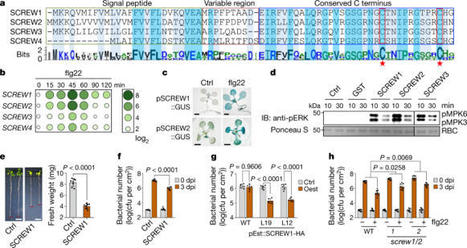
Stomata exert considerable effects on global carbon and water cycles by mediating gas exchange and water vapour1,2. Stomatal closure prevents water loss in response to dehydration and limits pathogen entry3,4. However, prolonged stomatal closure reduces photosynthesis and transpiration and creates aqueous apoplasts that promote colonization by pathogens. How plants dynamically regulate stomatal reopening in a changing climate is unclear. Here we show that the secreted peptides SMALL PHYTOCYTOKINES REGULATING DEFENSE AND WATER LOSS (SCREWs) and the cognate receptor kinase PLANT SCREW UNRESPONSIVE RECEPTOR (NUT) counter-regulate phytohormone abscisic acid (ABA)- and microbe-associated molecular pattern (MAMP)-induced stomatal closure. SCREWs sensed by NUT function as immunomodulatory phytocytokines and recruit SOMATIC EMBRYOGENESIS RECEPTOR-LIKE KINASE (SERK) co-receptors to relay immune signalling. SCREWs trigger the NUT-dependent phosphorylation of ABA INSENSITIVE 1 (ABI1) and ABI2, which leads to an increase in the activity of ABI phosphatases towards OPEN STOMATA 1 (OST1)—a key kinase that mediates ABA- and MAMP-induced stomatal closure5,6—and a reduction in the activity of S-type anion channels. After induction by dehydration and pathogen infection, SCREW–NUT signalling promotes apoplastic water loss and disrupts microorganism-rich aqueous habitats to limit pathogen colonization. The SCREW–NUT system is widely distributed across land plants, which suggests that it has an important role in preventing uncontrolled stomatal closure caused by abiotic and biotic stresses to optimize plant fitness. A plant endogenous peptide-receptor signaling pathway termed SCREW–NUT is described; it counteracts microbe-associated molecular pattern (MAMP)- and abscisic acid-induced stomatal closure to regulate the reopening of stomata after biotic and abiotic stresses.
Toulouse INP's insight:
Laboratories and associated researchers : - INP-PURPAN - Unité de Recherche Physiologie, Pathologie et Génétique Végétales (PPGV)
- Olivier Rodrigues
Scoop.it!
![[INP-LRSV] Editorial for Special Issue: Research on Plant Cell Wall Biology | Publications scientifiques | Scoop.it](https://img.scoop.it/sv_PWe2KMIR2c_uTai97oTl72eJkfbmt4t8yenImKBVvK0kTmF0xjctABnaLJIm9)
Plant cells are surrounded by extracellular matrixes [...]
Toulouse INP's insight:
Laboratories and associated researchers : - INP-ENSAT - LRSV - CNRS
- Christophe Dunand - Elisabeth Jamet
|





