Your new post is loading...
Address by the President of the Republic of South Africa, Jacob Zuma, to the Extraordinary Session of the National Assembly of the Republic of Angola
20 August 2009
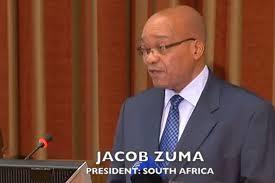
Photo of: President Jacob Zuma
His Excellency Mr P Kassoma, Prime Minister of the Republic of Angola,
Honourable Speaker of the National Assembly,
Honourable Ministers,
Honourable Members of Parliament,
Members of the Diplomatic Corps,
Ladies and Gentlemen,
Honourable Speaker, please allow me to express our sincere gratitude for this honour to address this Extraordinary Session of the National Assembly.
This honour, as well as the warmth with which we have been received, underscores the deep historical ties that exist between our two countries.
Let me also use this opportunity to thank His Excellency President Eduardo dos Santos for his gracious invitation to us to visit this great country.
It had been our wish after the Presidential inauguration in May to undertake the first State visit to this wonderful country which we regard as our second home.
Honourable members, to us, this is not just a State visit to cement ties. It is an emotional homecoming.
Angola was our home away from home during very difficult moments in the history of our country and our struggle.
We would like to express our gratitude for the solidarity and comradeship that was extended by Angolans to the ANC and the people of South Africa during the struggle for our liberation.
Angola evokes deep-seated emotions from many of our cadres, who spent many years of their lives in this country, and whose lives were shaped by experiences shared with the Angolan people.
Our visit invokes pain and sadness about many of our cadres who lie buried here in Angola, who died in combat or through natural causes.
It is a reminder to us of the certainty we always had, that with MPLA comrades and with FAPLA forces on our side, we had brothers and sisters who were prepared to die with us in the trenches for the liberation of our country. This is not a friendship or comradeship we take lightly.
Earlier this morning we laid a wreath at the grave of the late President and Angolan icon, Dr Antonio Agostinho Neto, a gallant fighter and giant of the struggle for the liberation of the people of Angola and Southern Africa.
This solemn act reminded us of the very deep friendship and comradeship that existed between the late ANC President, Oliver Tambo and the late Comrade President Dr Neto.
They both dedicated their lives to freedom, justice and a better life for the people of their two countries and the region.
Through the leadership of the late His Excellency Dr Neto and His Excellency President Eduardo dos Santos, Angola unfailingly and courageously supported us through the years of our struggle.
We remember that Mkhonto Wesizwe cadres were free to walk around the streets of Luanda armed, manning roadblocks as if they were Angolans. This was their home.
We will tomorrow travel to our erstwhile camps in Quibaxe. The visit is bound to revive both the painful memories of life in exile as well as remind us of the support and hospitality that we enjoyed from the Angolan people, which made it all bearable.
The people and leadership of Angola suffered immensely through destabilisation, but they never sacrificed comradeship and principle.
We thank you for your
resolve, dedication, commitment and comradeship.
The South African democratic victory in 1994 was a victory of the Angolan people. Our success is your success because you contributed so immensely to our freedom. That we shall never forget.
Honourable Members,
We have indeed traversed long and difficult roads as a people.
Not so long ago, Angola was embroiled in a long devastating civil war, a war that left untold suffering in its path.
Last year in March, I had the privilege, as President of the African National Congress, to participate in the commemoration of the 20th Anniversary of the battle of Cuito Cuanavale.
That historic battle has left psychological scars in the minds of ordinary people who reside in that village.
At the same time it presented a crucial victory to the peoples of South Africa and Angola to finally defeat the apartheid regime. Needless to say, many of our brothers and sisters have paid the ultimate price in defeating the oppressors.
We salute their courageous acts and we confirm that they shall not be forgotten.
Honourable Speaker,
The victory at Cuito Cuanavale spelled the end of foreign aggression and culminated with the signing of the Peace Accords for Southern Africa by the then apartheid South Africa, Angola and Cuba.
As the former President of Cuba, Comrade Fidel Castro has said, I quote,” the history of Africa will be written as before and after Cuito Cuanavale”.
The battle of Cuito Cuanavale further gave rise to a new political landscape in the Southern African region. It accelerated the liberation of Namibia and indeed finally securing our freedom in South Africa.
Honourable Members of Parliament,
Let me also use this opportunity to extend my sincere appreciation to the peoples of Russia and Cuba for their undivided support during those difficult times.
Based on the rich historical bond that our two countries share, it is of paramount importance that we enhance our bilateral relations.
It is only proper that the two countries should work together to turn the ties forged in struggle into mutually beneficial relationships for sustainable growth and economic development.
We are accompanied on this visit by 11 Ministers and more than 150 businesspeople.
This is the biggest business delegation that has ever been taken on a State visit by a President since the ushering in of democracy in 1994.
The size of the business delegation demonstrates the seriousness with which we take economic relations with Angola.
On the government to government side, we are on course to sign a number of agreements later today.
We have concluded discussions on a high level consultation mechanism.
It will provide political and strategic leadership and guidance to the bilateral partnership between the two countries.
The consultation mechanism will help us to consolidate and strengthen friendship and solidarity between the peoples of the two countries in various areas.
These include trade and industry, mining and energy, defence and security, immigration, tourism, communication, science and technology, banking, transportation, agriculture, fishing and others.
One other notable existing agreement is the Exemption of Visa for diplomatic and official passport holders which is being fully implemented.
Concerning the economic ties between the two countries, a number of South African companies are involved in Angola in a variety of sectors including construction, mining, housing, retail, food and beverages, hotels and leisure, banking and medical services.
The South Africa-Angola Chamber of Commerce promote the economic ties between the two countries.
Honour Speaker and Members of Parliament ,
Angola is an important player in the Southern African region.
There is thus a need for us to forge a common position on regional, continental and international issues that will benefit our countries and the continent at large.
In the regional context, we recall the committed role played by His Excellency, President Eduardo dos Santos, as Chair of the Organ on Peace and Security of SADC.
The Organ has been seized with various crucial matters such as the situation in Zimbabwe, Madagascar and others, based on the view that peace must prevail in Africa.
This august body will also recall that SADC has set out clear timeframes for regional economic integration.
It is our belief that the establishment of a Free Trade Area in the region will greatly enhance our ability to trade with one another and ensure the strengthening of the region as a whole.
Honourable members, the Organisation of African Unity and the African Union were founded on the principle of promoting unity.
Whatever we do, we should be guided by the noble cause of uniting the African people, and to help to take them out of the poverty trap.
We should not do anything that will disturb this unity that the founders of the AU worked for.
Within Southern Africa, we should play an active role in efforts aimed at strengthening the Southern African Development Community.
Our two countries also share the interest in ensuring peace and stability in the continent.
As the current Chair of SADC, we will continue to support the Inclusive Government in Zimbabwe and render whatever assistance our capacity allows.
We urge countries of the developed North to join the continent in assisting the people of Zimbabwe to lift themselves out of the socio-economic difficulties they face.
We will also play our role in supporting the SADC-appointed Facilitator in Madagascar, former President Joaquim Chissano and his team. A sustainable solution needs to be found to resolve the impasse in that country.
In addition, we cannot rest as Africans until solutions have been found to conflicts in the Sudan and other parts of the continent.
We applaud the role of Angola in peace efforts in the Central and Southern African regions, and the concerted support to the Democratic Republic of Congo, Cote d’Ivoire, Sao Tome and Principe and others.
Yes, we do have many challenges ahead of us.
However, I am convinced that through the commitment which my brother, His Excellency the President of the Republic of Angola has displayed to the region, our two countries, in cooperating closely, can certainly move forward.
Honourable Speaker, our two countries must put emphasis on strengthening partnership and coordination in dealing with issues such as the reform of Multilateral institutions such as the United Nations security council, the G8 and multilateral international financial institutions.
A transformed UN system will be more efficient and more accountable to all its member states.
It is our belief that the Security Council should also be enlarged to better reflect and portray contemporary global political realities, and especially the reality of an Africa steadfastly claiming its position in this Community of Nations.
Honourable speaker,
It is also of paramount importance that Angola and South Africa join hands in multinational forums such as the World Trade Organisation (WTO), and the World Economic Forum.
We would then be able to voice our concerns with the current developments such as unbalanced trade between the rich countries of the North and developing countries of the South.
The collapse of talks last year in Geneva, Switzerland mainly over the issue of agricultural subsidy cuts for developed nations and agreement on tariff reduction is a demonstration by countries of the North that they are reluctant to promote fairness in trade in agricultural products.
This places our continent at a distinct disadvantage. Unless we, the developing countries of the South, commit ourselves in a united and resolute manner to oppose this structured inequality, we will not make progress.
Our two countries will need to harmonise their positions when participating in these fora.
Your Excellency,
Honourable Members of Parliament,
Our two countries should also continue to play an important role in the Non-Aligned Movement.
This great movement continues to serve as a platform to forge relations and unity among us as countries of the South and improved relations as a unit with countries of the North.
In forums such as Non-Aligned Movement, we should speak with one voice in order to deal with contemporary issues such as the global economic recession and climate change, as they impact on developing countries severely.
Honourable members of Parliament,
We must also note that our continent is one of the regions least responsible for climate change, but sadly, it is affected most by results of global warming.
We need to lay a firm foundation for a better policy and encourage countries that still need to adhere to the Kyoto Protocol to reconsider their policies on climate change in order to save our planet.
Honourable Members of Parliament,
Together, we can make our two countries prosperous and strong actors in the regional and international arena.
Honourable Members of Parliament, on behalf of the South African Government, allow me to reiterate my gratitude to you and the people of the Republic of Angola for giving us this opportunity to address this august House.
I would also like to extend my best wishes to you and through you, to all the people of the Republic of Angola in this historic journey towards economic and social development.
This is a great new beginning for our two countries. We must now take our relations to greater heights, to reflect the deep historical bonds between the two nations.
Angola will always be our second home, as a large part of our history of freedom was lived in this great country, shaped by the wonderful Angolan people. We are one people, and should always remain so.
Meus amigos ;
Meus camaradas
Permitem – me dizer o sequinte:
O nosso pais è o vosso pais
e o vosso pais è o nosso pais .
Nós somos um só povo, uma so familia.
Sento-me em casa.
Muito obrigado.
Print Email
Address by His Excellency, Jacob Zuma, the President of the Republic of South Africa, at the 57th Session of the International Statistical Institute (ISI); Durban
16 August 2009
Photo of: President Jacob Zuma
Hon Premier of KwaZulu-Natal, Dr Zweli Mkhize;
Hon Minister of the National Planning Commission,
Mr Trevor Manuel;
The Mayor of eThekwini Mr Obed Mlaba;
Statistician-General Pali Lehohla;
The President of the ISI Denise Lievesley;
Chairperson of Statistics Council,
Mr Howard Gabriels;
President of South African Statistics Association,
(SASA) Dr Khangelani Zuma,
Distinguished delegates,
Ladies and gentlemen,
I am honoured to interact with members of one of the oldest scientific organisations in the world.
We appreciate the fact that you have come to our shores.
Ladies and gentlemen, the country is mourning the passing on of Professor Thamsanqa Khambule, an outstanding mathematician and accomplished steward of Stats SA.
We extend our condolences to his family and to Stats SA and entire fraternity.
His contribution to the development of mathematics as a discipline in disadvantaged communities will be eternally appreciated.
Let me reiterate that we are truly pleased to host more than 2 500 elected members from more than 130 countries.
We do not take for granted the fact that in 2003 you decided to bring your biennial sitting to sub-Saharan Africa for the first time in the institute’s 124-year history.
This indicates your commitment to African and world statistical progress and to supporting much-needed development in the world.
It is wonderful to see that this commitment is finding expression in that, for the first time, one-quarter of all delegates are from Africa.
The discussions around Africa’s developmental agenda must provide a new direction in debates regarding statistical capacity-building on the African continent.
Esteemed delegates,
You are assembled here because you seek solutions to the challenges that affect the world today.
These include the global economic crisis, food insecurity, poverty, climate change and many others.
The solutions can be found through cooperation, global dialogue and, importantly, coordinated action, which is what this conference is about.
There are issues that affect people’s daily lives that need to be measured.
These issues include broad demographic patterns, features of urbanisation and the implications for water, sanitation, energy, transport and so on.
The world economic meltdown, which began in developed economies, also dictates that statisticians search for solutions which will benefit all nations.
The economic crisis poses serious dangers to the development of low income countries, particularly in Africa.
Demand for African exports has dropped, investment flows have declined, the cost of borrowing has increased, and remittances from Africans abroad are expected to decrease.
Unless decisive action is taken, the crisis may set back recent economic and social progress on the continent, including progress towards the Millennium Development Goals.
Several African countries, including South Africa, have undertaken measures to minimise the impact of the crisis.
These include fiscal stimulus packages, revising expenditure, targeting assistance to key sectors, and strengthening financial regulation.
South Africa supports a global response to the crisis to restore stability. A sustainable, longer term response needs to be pursued through the United Nations, IMF, World Bank and other multilateral institutions.
In our view, the capacity of the multilateral financial institutions to respond to the crisis has been inadequate.
We have therefore called for a significant increase in resources for these institutions, and an increase in the representation of developing countries.
The increase in resources will enable these institutions to provide better forecasting, planning, monitoring and evaluation.
This will no doubt include efficient statistical data gathering and analysis to assist recovery, especially in the developing world.
Through professionals such as yourselves, we can ensure that the world never again finds itself with problems it should have foreseen.
The need for macro-economic and social information is more important than ever before.
These include details of economic growth, price stability, demographics, population dynamics, poverty employment and job creation.
Esteemed delegates,
The importance of statistics for development is a continental priority.
During the 12th Summit of African Heads of State and Government, member states were called upon to sign and ratify the African Charter on Statistics.
The Charter provides a regulatory framework for statistical development on the African continent.
Developing countries rely on statisticians to provide trends and information that will guide planning for socio-economic development.
The African Charter emphasises evidence-based decision making to guide the African Union in accelerating integration and to implement development programmes that combat poverty.
The AU notes that to meet the continental development challenges, member states require a robust statistical data system which provides reliable, comprehensive and harmonized statistical information on the continent.
At a regional level, the Southern African Development community (SADC) statistics programme aims to ensure the harmonization of statistics among member states as well as the coordination of regional statistics on many matters.
These include foreign trade, population, commodity prices, gender, agriculture, education, employment and development programmes.
The SADC Human Development Indicators show that the region is characterised by medium human development levels and falling levels of human progress, with poverty constraining the quality of life.
Reliable information is therefore needed to enable us to implement strategies towards achieving the ideals of the New Partnership for Africa’s Development and the Millennium Development goals.
These include investing in African human capital, which embrace capacity building and reversing the so-called “Brain Drain”.
The overarching Millennium Development goal, as most of us know, is halving poverty by 2014 and we need accurate facts.
We all know that your field is fraught with controversy and intellectual wars. Everyone has their own view of what the figures should show on any topic be it education, crime or health.
South Africans will tell you about ongoing quarrels over crime statistics, infant or mother mortality rates and other contentious issues.
Governments and politicians rely heavily on official statistics to make informed decisions.
On the other hand, opposition parties and various pressure groups and non-governmental organisations normally use the statistics to attack governments.
This makes the work of statisticians very difficult as their output will always be questioned.
A solution should be possible. Improved communication and cooperation between the various role-players will help to build confidence in both statistics and policy-making.
In our view, there is nothing that stops statisticians in academia and other areas from working with government statisticians to advance methods of collection, compilation and interpretation of statistics.
This would be done for the good of the country concerned.
In this way, official statistics would not be questioned by pressure groups in a manner that challenges their credibility and hampers their use.
Another point to ponder is the fact that information in the world is moving at a very fast pace.
Questions continue to be asked about whether statisticians can measure up to the pace at which demand for information manifests itself.
Ladies and gentlemen,
You are meeting during Women’s Month in our country.
Last week we commemorated an important milestone in our history. On the 9th of August 1956, about 20 000 women marched to the seat of government, the Union Buildings in Tshwane, Pretoria.
They marched in protest against the then hated system of pass laws.
As a country we continue to work tirelessly to improve the status of women in our society.
This conference reminds us of an area we must still work on much more vociferously, that of promoting mathematics and statistics among girl children in schools from a very early age.
It is important therefore to make the subject attractive to the youth.
The manner in which you, as statisticians, illuminate and communicate the complex subject of statistics should be simplified.
This would help us all to interest young people in studying this subject and related ones such as mathematics, geography, economics, science and technology. We therefore urge you not to frighten children!
We are pleased that ISI 2009 will serve as a springboard for leaving a lasting legacy of statistical development on the African continent.
It is thus significant that more than 300 promising young delegates from the statistical community in developing countries have been funded to attend ISI 2009.
We also commend your contribution through the work of the International Association for Statistics Education in organising the ISIbalo International Statistical Literacy Competition.
This will help to promote and increase the interest of the youth in statistics education.
We are already encouraged by the fact that more than 7 000 South African pupils from 126 schools, comprising of primary and secondary schools, sat for the first phase of the ISLP competition in July 2008.
It was equally significant to see more than 2 000 young people from 17 high schools from six countries, Botswana, Lesotho, Malawi, Mozambique, Zambia and Swaziland, in the SADC region participate in this competition.
Such developments will boost the new interest in statistical development by African countries.
You have quite an intensive programme ahead of you. You will generate mountains of information, as 1600 papers will be presented on more than 300 themes.
Your areas of focus are very crucial at this time in the world - from Statistics in Finance; to Statistical issues relating to climate change; Biostatistics in Health; Sport Statistics and Statistics in Africa.
It is not surprising that you will be running 60 different sessions a day, in order to cover all these very important issues.
We are confident that this conference will respond positively to the needs of the peoples of the world.
It will make a significant contribution to the fight against poverty and hunger, and the ongoing struggle for peace, stability and development.
At this juncture, I should perhaps take the liberty to remind you that this city is one of the proud hosts of the 2010 FIFA World Cup tournament.
Your host province, KwaZulu-Natal, is the first in South Africa to launch a provincial 2010 FIFA soccer tournament website, which will be most useful to you for information on provincial attractions.
We look forward to welcoming you back in the country next year to enjoy one of the best soccer World Cup tournaments the world has ever seen.
Esteemed delegates,
It is my pleasure and honour to declare the 57th Session of the ISI open.
Let me also take this opportunity to wish Ireland well as it takes over the baton as host for 58Th Session to be held in Dublin.
I wish you successful deliberations.
I thank you.
Print Email
ddress by President JG Zuma at the Progressive Women’s Movement dinner Sandton Convention Centre
14 August 2009
Photo of: President Jacob Zuma
Progressive Women’s Movement of South Africa Convener, Ms Baleka Mbete,
Co convener PWMSA, Minister Noluthando Mayende-Sibiya,
Chairperson of the IEC, Dr Brigalia Bam
The Public Protector, Advocate Mushwana
United Nations Resident Coordinator- Dr Anyangwe,
Provincial Conveners Present,
1956 Veterans,
Ministers, Deputy Ministers, Premiers, MECs
Good evening to you all.
It is an honour to address you tonight as we gather here to celebrate the role of women in our country and the world.
I am proud to be surrounded by so many women achievers, women who have helped spearhead the transformation of our society and further the role of women’s rights.
Women have played a prominent role in the struggle for equal rights for all. Certainly the history of our country is littered with examples that illustrate women’s resilience and struggle.
In 1912 Indian women led the first mass passive resistance campaign, encouraging Black and Indian miners in Newcastle to strike against starvation wages.
In 1913 Black and Coloured women in the Free State protested against having to carry passes, unlike their White counterparts.
In 1918 Charlotte Maxeke started the Bantu Women’s League, the first formal women’s organization, to fight against pass laws. In the 1930s and 1940s women participated in many demonstrations and passive resistance campaigns.
By 1943 membership of the ANC was open to women and by 1948 the ANC Women’s League was started with Ida Mtwana as the first president.
Women of all races and classes joined the Defiance Campaign en masse in the 1950s united by their common struggles not only as women, but as mothers, daughters, workers and sisters of the revolution.
Their struggles culminated in the march of 9 August 1956.
Led by Sophie de Bruyn, Helen Joseph, Lilian Ngoyi and Rahima Moosa 20 000 women converged on the Union Buildings, defying the convention that their role was merely that of homemaker.
The actions of those women continue to inspire and guide us today.
Fifteen years since the advent of democracy, government has made significant strides to ensure the emancipation of women as stated in our Freedom Charter and as demanded by the women of 1956.
The establishment of a democratic South Africa gave birth to a new era which advocates for equal participation of women in political and social issues.
This is in line with the SADC Protocol on Gender and Development, which calls on SADC Member States to embark upon national campaigns on the 50/50 representation of women.
Globally this call is for the 50/50 quota in all political and decision making structures and also at the implementation level.
It is not merely about numbers of women but it is a platform from which women can influence meaningful change, and make a difference to the lives of all.
The AU Gender Policy which was adopted by AU Ministers of Gender in 2008 December in the Kingdom of Lesotho, emphasizes the creation of an enabling and stable environment for women and gender-sensitive budgets.
It has been consistently demonstrated globally that the under-representation of women in politics and decision making positions, has an adverse effect on national development as a whole.
We should be seeing progressive increases as opposed to regression in terms of representation, particularly at the political level to influence meaningful change.
I am proud that we have five women premiers. Women occupy important positions in all Cabinet clusters. This includes women in portfolios such as correctional services; defence; home affairs; energy international relations and co-operation; mining; public enterprises; science and technology.
Women also occupy significant positions in the Economics cluster.
Our Parliament is ranked high internationally with regard to women’s representation. Our country competes favourably in the list of top 20 most powerful business women across Africa and the world.
All these achievements tell us that women have proven their worth in many fields that contribute towards the growth and development of our country.
However, women empowerment and gender parity is not only about numbers. It is about ensuring that women make a meaningful contribution in society wherever they are deployed, and that the space is opened up for them to make a difference.
It is in this light I salute the Progressive Women’s Movement. It stands out because it is a movement committed to fundamental social change in the lives of women.
This refers to overcoming the triple oppression that many women in our country still suffer from. The burden of patriarchy, the exploitation of women as workers and finally as black women needs to be eliminated. Until this happens in the lives of all women in our country we cannot consider our country free. The role of the Progressive Women’s Movement is vital to achieving these goals.
The Movement is a powerful instrument that must be utilised strategically to advance the cause of gender equality, in commemoration of the women of 1956 and in acknowledgement of the challenges still facing women.
From 6 to 8 August 2006, women representing a broad spectrum of sectors and organizations launched the Progressive Women’s Movement in Bloemfontein.
The August Bloemfontein gathering had been preceded many years earlier by the African National Congress’s 1987 Women''s Section National Conference and the 1989 Malibongwe Amsterdam Conference.
Both conferences emphasised the need for the formation of an umbrella National Women''s Organisation against apartheid.
This new and timely movement was premised on the historic understanding that, firstly, radical social transformation would require people-driven leadership which draws inspiration from the grassroots.
Secondly it was driven by that social and economic transformation would not be possible without the real participation of women.
This gathering and its resolutions was a result of the recognition that without a women’s movement, women’s rights could not be consolidated and strengthened.
The best tribute we can pay to Women of 1956 is to defend the gains made and change the lives of those who are to yet taste this freedom in real terms.
The majority of these women are black, poor, rural and working class women existing on the periphery of society.
It is also significant that in its inaugural August 2006 gathering the PWM advocated for the “encouragement and promotion of the role of women in all spheres of the society and the protection of fundamental human rights and women’s rights in particular”.
In pursuing these objectives the conference directed decision making structures to equalise access to opportunities, whilst focusing on economic and social transformation as well as governance, monitoring and international relations.
In pursuit of these and other objectives the 52nd Congress of the African National Congress endorsed the principle of 50/50 representation in all decision making structures.
It resolved that this should be done whilst also further exploring the form and content of whatever institutional mechanisms to be put in place in pursuit of women’s emancipation.
In pursuit of this strategic objective, we appointed 14 women into Ministerial positions, 11 as Deputy Minister and 5 women Premiers. This cannot be enough, but we are getting somewhere.
We took this process a step further by establishing a Ministry for Women, Children and People with Disabilities.
This Ministry has to ensure the participation of these three sectors in all aspects of life. However, gender issues are cross-cutting in nature and cannot be addressed solely by government alone or one Ministry.
The new Ministry will monitor other government departments to ensure the mainstreaming of gender, children’s rights, and disability considerations into all programmes of government and other sectors.
This will help government to respond to issues of these targeted groups in an integrated and coherent manner.
This gala dinner aims to bring to the fore the issue of “Training for Women’s Entrepreneurships” that will seek to unleash the untapped women entrepreneurial skills amongst those women who are already engaged in some form of business.
The collaborative work between the Women’s Ministry and Progressive Women’s Movement needs to be encouraged as it emphasises the partnership that is necessary between government and civil society for the empowerment of women.
As Government, we would want to see a material improvement in the quality of life of women, be they domestic workers, farm workers or corporate executives.
We must work together to ensure that women live their lives free of fear, degradation and brutalization.
We must work together to ensure that women do not have to suffer from the effects of poverty, disease and effects of harmful traditional practices.
We are working to ensure that Africa becomes free from being a country of origin, transit and destination points in the trafficking of persons, especially in women and girls.
We do not want mothers and fathers to have to bury their own children, cut down in their prime by HIV and AIDs and through manifestations of sexual violence and crime. This is a vision shared by many.
It is a vision that will be expressed through many projects and activities throughout the country for a better life for women who are hoping that these dreams will be realized in their own lifetime, and one that their daughters will benefit from for generations to come.
It is a vision that requires commitment, dedication, and the requisite human, material and financial resources.
Ladies and gentlemen,
The Women''s Charter, adopted at the founding congress of the Federation of South African Women in 1954 stated:
“We women do not form a society separate from the men. There is only one society, and it is made up of both women and men. As women we share the problems and anxieties of our men, and join hands with them to remove social evils and obstacles to progress.
“The level of civilisation which any society has reached can be measured by the degree of freedom that its members enjoy. The status of women is a test of civilisation.”
In the 21st century, let us inculcate among all our children from a young age that women are the bedrock upon which all societies rest.
Together we can build a more inclusive country based on the principles of non-racialism and equality.
I thank you.
Print Email
Address by His Excellency Mr JG Zuma, President of the Republic on the occasion of the 53rd Anniversary of the Women’s March to the Union Buildings; Vryheid, National Women’s Day
09 August 2009
Address by the President of the Republic of South Africa, His Excellency, President Jacob Zuma, on the occasion of the President''s national interaction with school principals, Durban International Convention Centre
07 August 2009
Photo of: President Jacob Zuma
The Minister of Basic Education, Ms Angie Motshekga;
Minister of Higher Education, Dr Blade Nzimande,
Minister in the Presidency, Mr Collins Chabane,
Honourable Premiers,
Deputy Minister of Basic Education, Mr Enver Surty,
Education MECs,
Mayors of eThekwini and Umsunduzi,
School Principals from all provinces;
Labour representatives and other stakeholders,
Distinguished guests;
Good morning and welcome to this interaction on education.
In the State of the Nation Address in June, I said that I would meet school principals “to share our vision on the revival of our education system”.
We have assembled here today because we share the common goal of promoting quality education in our country.
I am pleased that the school principals in our country responded so enthusiastically to the invitation.
Our wish had been to meet with all our 25 000 school principals. This proved impossible due to logistical reasons.
We will therefore treat today’s meeting as the launch of an ongoing interaction with principals, as the managers of our schools and key delivery agents in our education system.
The intention is to have follow up interactive meetings in the provinces, hosted primarily by Premiers and MECs, with the participation of the President where possible. This will enable principals who are not here to be part of the education renewal exercise.
Our session today should serve to underline the fact that education is an apex priority of this government.
It is our most powerful weapon in the struggle against poverty.
All the successful countries of the world did one thing in common – they invested in education. It is the one thing that ensures long-term, sustainable progress.
Success in education will make it easier to achieve our goals in the other four priorities.
The other four priorities are health, rural development and land reform, the fight against crime and creating decent work.
The importance of education to this new administration is demonstrated by the fact that we have deliberately created two departments, basic and higher education.
The Ministry of Basic Education focuses on adult basic education and training as well as Primary and Secondary education.
The higher education ministry focuses on tertiary, technical and vocational training. It will also take responsibility for the sector education and training authorities.
A core mandate of the higher education portfolio is to continuously align the higher education and technical training institutions to the economic and other development priorities of our country.
Ladies and gentlemen,
Our meeting today is significant in many respects.
We have essentially come together to launch a new drive to truly change the learning, teaching and management of our schools.
Our meeting is an acknowledgement of the fact that our wonderful policies that we have been implementing since 1994 have not essentially led to the delivery of quality education for the poorest of the poor.
The question we must answer today is why our policies have failed to deliver excellence and what we should about it.
We have established two key Ministries in the Presidency, one for Performance Monitoring and Evaluation and other for Planning, in order to assist government to improve the implementation of its policies.
Before expressing our thoughts as to what could be the problem, and searching for possible solutions, we must together use this unique opportunity to salute those educators who have over the many decades dedicated themselves to their craft diligently, against all odds.
In spite of Bantu Education, our country produced thousands of distinguished professionals from the black community in our country.
We must credit our patriotic teachers and school principals for this achievement. They decided that despite the odds, they would use whatever skills they had to develop the African child.
Our people defied a well-orchestrated system of inferior education, and that is why we salute them.
We now have a democratic government which is prepared to work with our educators to create better working conditions than those of decades ago during apartheid.
The painful reality is that Dr. Hendrik Verwoerd succeeded to destroy education of black children. We must now work harder than ever before to undo his legacy of Bantu Education.
We have laid the foundation for quality education since the ushering in of democracy in 1994.
However, we realise that the damage runs deep, both at a practical and philosophical level.
The apartheid regime turned education into a powerful weapon of subjugation.
Apartheid architects succeeded in creating deep-seated inequalities in education and all other spheres.
An education system was created whereby a doctor graduating at the University of Transkei would be regarded as being technically inferior to one coming out of the University of Natal, because of unequal resource allocation.
We must today dedicate ourselves to put the past behind us and to make education an instrument of freedom and sustainable development.
It must be a weapon of liberating the minds of our children for the common good of our country. It must empower the nation to move forward to prosperity.
We have created the right foundation to launch this new renewal and change of attitude, since 1994.
It is not all doom and gloom. In our primary and secondary schooling we are just a few years away from achieving 100% participation by all our children.
The participation of girls is amongst the highest in the world.
About 600,000 children attend crèches and pre-schools.
We have increased our expenditure on education by around 15% a year in most of these years.
We have put in place a number of initiatives to ensure that we improve the quality of education. We have improved support to schools, teachers and principals.
We have improved mechanisms for the involvement of parents and communities in the education of our children.
But despite these achievements, our education outcomes still remain somewhat below standard.
We need to confront certain realities. For example, teachers in former whites-only schools teach in class for an average of 6.5 hours a day, while teachers in schools in disadvantaged communities teach for around 3.5 hours a day. The result is that the outcomes are unequal.
We should therefore not ask why matric results remain perpetually poor in black communities.
We must ask ourselves to what extent teachers in many historically disadvantaged schools unwittingly perpetuate the wishes of Hendrik Verwoerd, if they decide to teach for about three hours a day.
Many children from poor communities do not complete senior secondary school.
In many instances the reason is that they cannot cope with the higher levels, as a result of problems in the delivery of education earlier in their school life.
In recent international tests for Grade 6 literacy, South Africa scored 302, while the international average was 500.
In the mathematics test for Grade 8, South Africa came last with a score of 244, while the average was 467. In the same test, our neighbour Botswana scored 365.
We cannot blame teachers only. A substantial proportion of schools still lack the physical facilities that constitute an enabling teaching and learning environment.
We need to turn the situation around. We need to get some basics right. This meeting is the beginning of the future.
We today pledge our support and will create a partnership with our principals to ensure an undivided implementation of the education non-negotiables.
We must ensure that our teachers teach for seven hours every school day. Teachers should be in school, in class, on time, teaching, with no neglect of duty and no abuse of pupils.
Some of our teachers should know that Fridays and pay days are ordinary school working days. Children should be in class, on time, learning, be respectful of their teachers and each other, and do their homework.
As part of active performance monitoring and evaluation, I will visit some schools unannounced to check if the non-negotiables are being adhered to.
Our principals are the most important partners in this education renewal campaign. All the international studies show that the biggest driver of better education outcomes is the school manager, the principal.
School academic performance is highly correlated with the abilities and commitment of the principal.
The ‘Schools That Work’ Report, commissioned by the Department of Education in 2008, confirms the importance of school leadership and its critical role in the achievement of excellence in education.
A large number of our schools that are working well displayed shared leadership qualities, where principals created strong teams which plan and strategise together.
This shared responsibility for the quality of education provided in the school often spread from the management team, to teachers, learners, parents and the community.
Some principals have produced sterling results without any extra resources, while many have not improved results even after being provided with additional resources.
Our experience suggests that there are at least five key things that successful principals do.
• They hire qualified teachers, or ensure the training of the unqualified teachers on their staff.
• Successful principals ensure distribution of workbooks and textbooks on time. This is critical to successful learning.
It empowers pupils and helps to ensure that they complete the syllabus.
• Successful principals check that teachers are in class teaching.
As said earlier, a major problem in our schools is that teachers are frequently absent, arrive late, leave early, or spend their day doing things other than teaching.
• Successful principals monitor and evaluate the quality of learning with the children, and keep parents informed of their childrens’ progress.
• Successful principals work with the community and the department to remove obstacles to learning.
If every principal in the country does just these five things, assisted by the Department, parents, learners and unions, we will have made tremendous progress in turning our schools around.
In underprivileged schools, principals would also need to help extend school feeding schemes to all deserving schools including high schools.
Poverty is a key determinant of performance in schools.
We want all our schools to be underpinned by a culture of achievement, professionalism and positive results.
As said, we must do things differently. This includes promoting a culture of accountability.
We will introduce a system of performance measurements throughout the educational system. We want our principals to know what is expected of them, and to help us to meet those targets.
There is also a set of non-negotiables that binds the state, and the officials of the Department of Basic Education across the country.
The non-negotiables for officials at head office are to support all our schools. They must ensure that all teaching resources are provided on time, to monitor teacher and learner attendance and performance, and to facilitate teacher development.
The non-negotiables are also binding on our strategic partners, our unions and teachers.
Going forward, we must today then agree to strengthen the partnership for the renewal of our education system. It must be a partnership in which we all agree to finally move towards burying the impact of apartheid in education.
Government as a key partner must continue to spend money on improving infrastructure and resources.
We must improve the physical conditions of our schools and provide the working tools such as textbooks, laboratories and other equipment.
We must invest in skills development for teachers.
Maths and science as well as management training should be key areas of focus. The training focus should include the many unqualified teachers in our education system, especially in townships and rural areas.
There is something seriously wrong with our education system if such teachers are not offered an opportunity to study and obtain qualifications.
We must actively seek partnerships with the private sector. We last saw a major investment in education shortly after the retirement of our icon President Mandela, when conglomerates built schools at his request.
We would like to see that type of corporate patriotism returning.
We must revive the situation where state owned enterprises were centres of training for artisans and other trades to produce much needed technical skills for the nation.
We must revive and strengthen our partnership for renewal of education with all our teacher unions.
We intend to have a continuous discussion with them as to how we can promote the non-negotiables.
We must build a partnership that creates safer schools. Schools should be safe places, free from violence, intimidation and bullying and unwanted or inappropriate sexual relationships.
We must form a partnership with parents. They must ensure that their children go to school, arrive on time, stay in class, participate fruitfully and do their work.
They must ensure utmost discipline by their children in schools.
We have noted the discrepancies in the functioning of school governing bodies especially in rural and urban areas.
We must study this carefully and ensure that we do not have an ineffective one size fits all approach.
Ladies and Gentlemen,
We must build a partnership with our children. We must make them see why we are investing so much time and money in education.
We must strengthen our partnerships to intensify our mass literacy campaign, which is as of this year reaching more than 500,000 people who could not read and write.
We are well within target to ensure South Africa is free of illiteracy by 2014. A literate population is an advantage for democracy.
In higher education, 140,000 students have been supported through our national financial scheme, which is helping to improve participation of the poor in higher education. We realise that we must do more to widen access.
We must develop partnerships to place Further Education and Training colleges at the centre of skills development for the economy.
Most importantly, we must form a partnership that promotes education as a nation building tool. It is through education that we can produce well-rounded citizens who know what it means to be South African citizens.
It is through education that we can produce citizens who appreciate where we come from, and understand that we want to be a winning nation.
Compatriots, let us today commit ourselves to this partnership for Quality Learning and Teaching, to promote excellence in education.
We look forward to hearing the views of our principals today. You are better placed to shape this partnership, as you are directly involved in the delivery of education.
Let us build a partnership that will enable us to make quality education available to all our children – not just the select few in the cities.
Let us declare together that for as long as there are children who do not have the means nor the opportunity to receive a decent education, we shall not rest, and we dare not falter.
Lets join hands and work together.
Because working together we can do more.
I thank you.
Print Email
Address by President Jacob Zuma to the National Press Club, Sheraton Hotel, Tshwane
06 August 2009
Photo of: President Jacob Zuma
Mr Yusuf Abramjee,
Members of the National Press Club,
Thank you for inviting us to interact with you.
We would like to give you just a few highlights of the work we have been doing over the past two and half months, and some of the issues we are busy with.
We are generally pleased with the situation in the country. We have put the political tensions of the recent past behind us. Our democracy is as vibrant as ever. The political climate remains stable. All political parties are working well together in and outside Parliament.
Our democratic institutions are strong and intact and perform their duties well. Our Parliament has decided to be activist in its operations. As the Executive, we welcome that as it will keep us on our toes.
We are in agreement as citizens that the courts are the highest arbiters in our land. As government, we will always defend the independence of the judiciary vigorously.
We have reaffirmed our belief in the independence of the media and respect the right of journalists to work unhindered. We endeavour on our side to be as accessible as we can be to the media and we will continue to do so.
Basically, the centre is holding. We are all united in working to build a united, stable, prosperous and non-sexist society where all feel included, black and white.
We are also united in celebrating that which makes us feel proud to be South Africans, be it our national symbols, our sports teams or most importantly, our icon President Nelson Mandela, who continues to receive our undivided love and respect.
We must be united in respecting the elders of our nation, such as Archbishop Emeritus Desmond Tutu, whom I met yesterday at the Union Buildings. He offered wise counsel on some critical matters in the country.
We decided that it was important for us to work together for the good of the country.
We are also united as South Africans in responding to the challenges we face, for example the impact of the global economic crisis.
As you are aware, Government, labour, community and business, making up the Framework Group on the crisis, are working together well to alleviate the impact.
Among other things, we have dedicated R2.4 billion to be placed in a National Jobs Fund to finance a training layoff scheme as one alternative to retrenchment for workers and companies affected by the recession. This will be launched in September.
We must be united in working to improve service delivery and to improve the living conditions of the poorest of the poor.
The concerns raised by communities that are protesting revolve around:
• Tensions between the political and administrative sections of municipalities.
• Ward committees that are not fully functional, resulting in poor communication with communities.
• Financial mismanagement and allegations of fraud and corruption.
• Poor planning, maintenance and management of infrastructure, resulting in poor service delivery.
The Department of Cooperative Governance and Traditional Affairs has sent task teams to all provinces to attend to these matters. The protests indicate to us that we were correct to create the planning and performance monitoring and evaluation capacity in the Presidency. This has been clearly lacking.
I visited Balfour Township in Siyathemba in Mpumalanga on Tuesday. I then gained a real understanding of the anger and frustration, having seen that they have no school, no clinic and lack many other services, including identity documents.
I have directed the relevant Ministers to prioritise the affected areas. Let me reiterate that we will always be a government of the people, by the people and for the people. I will always make time to visit communities as I did during the election campaign. I have no intentions of relying solely on reports from departments.
I will be meeting with Premiers and Mayors next week and these are some of the issues that we will discuss.
We made a pledge during the State of the Nation address to be an interactive, responsive and effective government. The finalisation of the framework to improve service delivery in frontline offices will be tabled before Cabinet for final endorsement by December 2009. Government Departments offering frontline services include Home Affairs, Education, Health, Social Development, SA Police Service and many others. The framework will be people-centred and will include measures such as the wearing of name-tags, effective signage and queue management systems.
During the election campaign and in the State of the Nation address, I made an undertaking that we would establish a Presidential Hotline and a public liaison service in the Presidency to enable members of the public to raise their concerns directly.
The State Information Technology Agency will have the call centre up and running by the 1st of September. Posts for public liaison and call centre staff were advertised in the media last week.
The GCIS, working with the Presidency, has established a national Public Liaison Forum as directed in the State of the Nation Address.
The forum comprises staff from all 34 national government departments and the nine offices of Premiers, and will ensure that all public enquiries are attended to expeditiously.
In the State of the Nation address we made an undertaking to give serious attention to combating crime. We have prioritised the filling in of vacant posts within the criminal justice system. We recently announced the appointment of a new National Police Commissioner.
We recognise the important role that crime intelligence plays in policing. Commissioner Richard Mdluli has been appointed as the new SAPS Head of Crime Intelligence. He will be supported by an increase in personnel and greater operational capacity.
The position of National Director of Public Prosecutions is a critical component of the weaponry we use in the fight against crime. Appointing the National Director of Public Prosecutions will go a long way in bringing stability in the fight against crime and the work of the criminal justice cluster. We have prioritised the filling of this position.
The Constitutional Court has become one of the most popular courts in our country. South Africans use it to test the Constitution and protect their rights.
I have decided to nominate Justice Sandile Ngcobo as the next Chief Justice since Chief Justice Pius Langa is due to retire. I have requested advice from the Judicial Services Commission and leaders of political parties represented in the National Assembly in this regard.
Chief Justice Langa has served this nation exceptionally well, with dignity and distinction. Meanwhile, Justice Ngcobo’s credentials speak for themselves.
A graduate of the universities of Zululand, Natal, Georgetown Law Centre and Harvard, he will bring a wealth of experience to the task of heading the highest court in the land.
In his distinguished legal career, he has served as a Judge in the Industrial Court, the Western Cape High Court, Labour Appeal Court and the Amnesty Committee of the Truth and Reconciliation Commission. He has also served as Acting Judge President of the Labour Court and the Labour Appeal Court.
He has also taught law at the University of Natal, Durban on a part-time basis, and has held visiting professorships at Columbia University Law School and Harvard Law School in the United States.
The Judicial Service Commission recently held interviews and made recommendations for the appointment of new judges to the Supreme Court of Appeal, and some of the High Courts in our country.
I will be announcing these judges soon. We believe that a well-resourced judiciary will greatly enhance our fight against crime.
Ladies and Gentlemen,
We have done well since the elections, working together as South Africans.
We thank all for the support and for making this administration settle in.
We will continue to strengthen the administration and to ensure that our systems are geared for faster service delivery.
I thank you.
For more information please contact Mr Vincent Magwenya on 072 715 0024
ISSUED BY
THE PRESIDENCY
THE UNION BUILDINGS
Print Email
Address delivered by His Excellency, the President of the Republic of South Africa, Jacob Zuma, at the Youth Leaders Summit, Gold Reef City, Johannesburg
29 July 2009
Photo of: President Jacob Zuma
Programme Director;
The Team of Youth Managers and the Youth Trust;
The Gauteng Enterprise Propeller;
Change Partners;
Tswalo Consulting;
Learning to Lead;
Ladies and gentlemen
I thank the organisers of this function, for giving me an opportunity to address this occasion on a subject that is close to my heart - the youth of South Africa.
The youth are a very special and vibrant sector, because we cannot talk about the future of this country without acknowledging the central role of the youth in that future.
Esteemed guests;
The freedom that we enjoy today is the fruit of the toil and sacrifices that many generations of young people have made in the past.
It is the future that was envisioned by the youth many years ago, and to which many of them made significant contributions.
From the 1940s and through to the 1980s the youth demonstrated their power in mobilising against the apartheid machinery, which sought to deny them equal rights and opportunities.
I am stressing this historical aspect to engrave in your mind the understanding that the freedom we enjoy today owes much to the sacrifices made in the past.
As government, we fully understand the magnitude of the challenges that the youth of this country face.
It is for this reason that since the advent of democracy, we have come up with various programmatic interventions, some cross-cutting, others specifically intended to improve the lives of the youth.
Our National Youth Policy (2009-2014) indicates four strategic interventions, which include education, health and well being, economic participation, and social cohesion.
Government departments are all set to make their sector specific contribution in these interventions.
In addition, the National Youth Development Agency, which was launched on 16 June 2009, will implement programmes relating to information provision, skills development and transfer, and entrepreneurship.
On the issue of economic participation, the learnerships, internships and the Expanded Public Works Programme have made significant contributions to economic empowerment and skills transfer to our youth.
Together with various other departments and the private sector, we will continue to see how best we can broaden opportunities for the youth.
We have also accentuated the plight of groups such as women, children and people with disabilities by establishing a ministry to deal with their issues specifically.
Our esteemed youth;
Twelve years ago, Former President Nelson Mandela emphasised that the youth must be provided with the opportunity to study and obtain the skills our country sorely needs to build self-reliance and prevent a culture of entitlement.
Government is rising to this challenge.
The Ministry of Higher Education is exploring options to broaden the access of young people to tertiary institutions and to assist with funding.
Efforts are also underway to improve the Further Education and Training Colleges in the country to train the youth in much-needed technical skills.
Adult Basic Education and Training will be reviewed to ensure that it responds to the skills demand in the country and promotes vocational training.
Therefore it is proper that we have a common understanding that the leaders that this country requires should first and foremost be educated.
Many countries have successfully overcome poverty and underdevelopment by focusing intensely on education.
Education is seen as a great liberator, because when you take a child from a poor household in Soweto and provide them with a quality education, you liberate that child and their family.
The cycle of poverty is broken through education. It is for this reason that our government has identified education as one of its key priorities.
We are working hard to ensure that all academically deserving students who qualify to gain tertiary education are supported.
We must realise our determination that no child should be refused access to institutions on the basis that they cannot afford it.
While our government has achieved a lot to promote access to education, we need to improve the quality of education that our young people receive.
The youth should take advantage of existing opportunities to learn. Education will provide the skills young people need to face the future and to give the country a competitive advantage.
Ladies and Gentlemen,
True leaders seek ways to improve their country. Among other things, this involves inculcating a culture of volunteerism among the youth.
Many young people turned out on 18 July this year to mark Madiba’s 91st birthday by dedicating 67 minutes of their time to serve their communities.
Most of us, of all ages, in our various capacities, can afford to dedicate more than 67 minutes of our time regularly to improve other people’s lives in this country.
In the face of the many challenges with which we are confronted, we need to ask ourselves whether we are doing everything correctly in the process of developing and empowering our youth.
We count on you as youth managers to coach high school students to make the right subject choices at schools. This country needs technical, scientific, medical and business skills, among others.
When you interact with pupils, make them to be strongly aware of these challenges and opportunities.
In this way, our youth will be armed with knowledge, a weapon with which they can make a difference in their families and communities.
I therefore applaud the establishment of Youth Managers as a progressive move, and congratulate you for achieving such a milestone.
While opportunities exist for our youth, it has proved to be difficult for millions of them across the country, especially in rural areas, to take full advantage of them.
Through the newly-formed National Youth Development Agency, we will work to ensure equitable empowerment of our youth, and will assist them through the agency to access funds.
This country still needs entrepreneurs in the small and medium enterprise sector.
Our youth should take advantage of this niche by looking at the opportunities provided by the Department of Trade and Industry, and other departments.
With unemployment largely affecting the youth, there must be constructive measures of ensuring that their entrepreneurial abilities are enhanced, thus reducing their dependence on government and the private sector for employment. We will help youth to help themselves.
Ladies and gentlemen,
South Africa needs leaders who teach people that the success of any venture should be measured by the impact it makes on the society.
Leaders who make impact are not the ones who indulge in material self-enrichment and forget the bigger picture of improving our society.
We are also pleased that this organisation has been upfront in identifying the gap that exists in the implementation of youth development measures.
We are therefore pleased that the learners from different schools attending this summit have been accompanied by their teachers.
This sends a strong message that teachers are not alone in trying to guide our pupils about their future.
Surely these young people need good role models who will serve as their mentors and channel them in the right direction.
Many success stories needs to be told and the Youth Managers should link with influential people to address pupils about existing opportunities. We need to root out any apathy about education and stimulate enthusiasm among our pupils.
However, we also need to emphasise that nothing will be delivered on a silver platter. Success requires hard work and dedication.
This is the spirit you must embrace to succeed in your own right – be it in your education, career or business.
Among the current generation of youth, South Africa must produce individuals who are sensitive to the needs of others.
We need courageous young people who will show leadership on how we should tackle the problems that confront our country.
Government is grateful that the Youth Managers have already identified community projects in KwaZulu Natal and Gauteng that were not successful due to problems of sustainability and financial efficiency.
We are confident that you will succeed in your attempt to revive these projects and ensure that the youth and broader communities become beneficiaries.
Leaders also inspire following through hard work and integrity.
This country needs people who are morally upright, and who will discourage pupils from abusing alcohol, drugs and other harmful substances.
It is also important that leaders cast their eyes farther in the future, and constantly warn their followers about looming dangers.
I am talking here about the risky lives that the youth often lead, particularly around HIV and AIDS.
With all rounded leadership, I am confident that South Africa will in the coming years stand tall among the nations, for we would have made right investment decision – in the development of our people.
I wish you well in your deliberations.
I thank you.
Print Email
Address delivered by the President of the Republic, His Excellency Jacob Zuma, at the report back meeting with black business and black professionals, Sandton Convention Centre, Sandton, Johannesburg
23 July 2009
Photo of: President Jacob Zuma
Ministers and Deputy Ministers,
Leadership of organizations representing black professionals and business,
Businesspersons and professionals,
Ladies and gentleman,
Good evening to you all.
We meet almost three months after the establishment of a new government following the highly successful and robust elections of April 2009. The transition occurred smoothly and professionally. We have redesigned government in order to improve the capacity to deliver services. We have a number of new Ministries, and have also redefined the mandate of others to ensure clarity and focus.
The first few months have been about effecting those changes. It is now all systems go as Ministers are settling in well in their new portfolios.
We had to hit the ground running because we have to meet the needs of our people especially the poorest of the poor. And we have not been deterred by the negative global economic climate. Many of our people have lived their entire lives in a “recession”. They are yet to experience the benefits of economic growth and for their sake, we have to soldier on and do what needs to be done, with the available resources.
International partnerships are important to enhance the achievement of our national goals.
I have recently returned from two critical international relations engagements – the G8 and the G5 Summits held in Italy, the Non Aligned Movement Summit in Egypt and the African Union Summit in Libya.
I was struck and humbled by how South Africa is received in international forums. The respect and confidence that countries of the world bestow on our country is overwhelming.
I came back confident that the leaders of the most powerful economies in the world have applied themselves towards responding to the global economic crisis.
At the G8 and G5 meeting, I was reassured that the world is working together to address this economic crisis.
I hope this marks a new era of international cooperation that will also lead to a significant positive outcome to the talks on a common effort to slow down climate change and its deal with its impact. The climate change talks will take place in Copenhagen later this year.
Ladies and gentlemen, although we have fared better than most countries, we are going through the most difficult economic period in recent times.
The last time that the economy shrunk as it is now, was in the early 1990s, before the transition to democracy.
It is not likely that the current reversal will last as long as the recession in the early 1990s —but our recovery might not be as strong as we would hope.
Even if the economy begins to grow again next year, we will have to wait a little longer for a significant increase in new job creation. It always takes some time, even years, after growth starts, for jobs to be created in significant numbers.
That is why the agreement between government, labour, business and the community sector reached in February this year to respond jointly to the crisis remains so important.
I will be meeting with the leaders of the teams developing and implementing the crisis response programmes early next month. That will be the time to assess our progress and consider the way forward.
While we still need to do more to address the impact of the crisis on the poor and low paid workers, I am confident that some of the measures already introduced and others in the pipeline will help to cushion the impact of the crisis for the most vulnerable.
We need to unite and work together to meet the challenges of the economic crisis. Our mission is to make all our people to feel that South Africa belongs to all who live in it, Black and White, and work together to make our country a success.
We will need that unity as we work together to meet our central objective, to provide leadership when it comes to dealing with issues of job creation, eradicating unemployment, ensuring that our people enjoy safety and security as well as accelerating the pace of service delivery.
As indicated in the State of the Nation address, government will be guided by the 10 priorities that we have identified. These are derived from the five ANC priorities of education, health, rural development, land and agrarian reform, the fight against crime and creating decent jobs.
The issues raised during our last sessions touch on these priorities.
We share the concern of black business and black professionals about the need to create an inclusive and transformed economy, and our Broad-Based Black Economic Empowerment (BBBEE) is one of the key tools of addressing this.
Our view is that we have a good BBBEE policy. The current BBBEE framework is adequate. It is inclusive and balanced. We may just need to sharpen implementation and communication. The Department of Trade and Industry is attending to this aspect.
The seven elements of the BBBEE scorecard are a response to the initial narrow BEE, which focused only on ownership and management control in enterprises.
In addition, very few people realise that the current BBBEE framework provides for co-operatives.
In our view, BBBEE must reinforce:
Skills and rural development.
Enterprise and socio-economic development.
Job creation through procurement and entrepreneurship.
Access to government procurement opportunities by black firms has been raised as a serious challenge.
Government is working hard to ensure that this is being addressed adequately. Already, the key objectives of the Preferential Procurement Element of the Codes of Good Practice promote the use of black owned professional service providers and entrepreneurs.
In this regard, black owned professional service providers are recognized as value adding enterprises for purposes of the BBBEE scorecard.
We need to ensure that State-Owned enterprises give effect to this in a meaningful way. This includes ensuring that government departments allocate and implement the targeted procurement services for black professionals.
We are planning to hold a National Summit on BBBEE on May 2010. This summit will be able to give government a sense of progress on the implementation of BBBEE.
Ladies and gentlemen, we are meeting with you this evening because you have a role to play in the implementation of the country’s programme of action.
We need to work together to improve government’s service delivery mechanisms. We appreciate the fact that you constantly inform us of areas where government needs to increase the pace, or improve the quality of service. Remember that this is your government. Working together we can do more to effect the desired improvements!
We noted your concern raised at the last meeting about the unacceptable delays by government departments in paying black businesses and SMMEs for services rendered.
Treasury Regulations state that all payments must be settled within 30 days from the receipt of an invoice or, in the case of civil claims, from the date of settlement or court judgment.
The exception is only in cases where parties have agreed to an alternative arrangement. In addition, the BBBEE Codes of Good Practice have made provision for shorter payment periods in order to assist to alleviate cash flow burdens faced by SMMEs.
The Minister for Performance Monitoring and Evaluation in The Presidency has written to all national and provincial departments and municipalities, and urged Ministers, Premiers, MECs and mayors via Premiers, to ensure that heads of departments comply with the regulations.
The Departments and municipalities are expected to provide feedback to the Minister at the end of July.
Ladies and gentlemen, we are also working hard to promote gender equity in the economic sphere.
We want to emphasise greater focus on entrepreneurship development for women, especially in the male-dominated construction and property industries amongst others.
However, we must add that while the 50% gender representation policy of the ANC and government are commendable, there needs to be a way to encourage the private sector to do likewise.
Better enforcement of the provisions of the Employment Equity Act could go a very long way towards achieving this objective.
Ladies and gentlemen, I am also aware that the issue of the Construction Industry Development Board (CIDB) Act is of genuine concern to you.
We have worked hard to ensure that legislation such as the CIDB Act supports rather than hinders black-owned businesses.
It is not acceptable for small and emerging contractors to find it cumbersome to register on the CIDB Register of Contractors or for established contractors to move to higher grading levels.
Part of the challenge stems from the inability of lower level contractors to provide audited statements which forms part of the CIDB grading assessment.
However, I agree with the suggestion of the Black Business Caucus in the Built Environment that the CIDB has to offer the requisite support to emerging contractors through, for example, training and mentorship programmes.
I am satisfied that there are open channels of communication between the parties, and the fact that CIDB has undertaken to attend to the concerns that have been raised. Task teams have been established to deal with each of the issues raised.
I have also been advised that there would be follow up meetings that would be held in the near future for the task teams to give report backs on their findings.
I believe that this is the correct approach of reaching common ground, and would await developments and reports from this front.
Compatriots, during the elections we pledged that the ANC Government would have, as one of its key priorities, the fight against crime and corruption in order to ensure safer and more secure communities.
To this end, we have begun working to overhaul the Criminal Justice System and work towards reducing crime levels.
In the next three years the number of police personnel will be significantly increased from 183 180 to 204 860 with more focus being given to increased visibility and enhancing crime detection.
Over the next year, the number of detectives will increase by 19%, and a programme is already underway to train
12 928 detectives.
But the most effective response should come from ordinary South Africans, who should cooperate with the police in the fight against crime. Working together we will do more to fight crime decisively.
Ladies and gentlemen, every life is valuable. We are saddened by the death of nine miners who were killed by a fall of ground at Impala Platinum’s Rustenburg operations on Monday.
We extend our condolences to the families of all those killed in this disaster.
Around 200 miners die each year in South Africa and this is alarming and unacceptable.
Government will work more intensively with mining groups and labour to address this issue without delay.
On the labour front, it is still bargaining season. Wage negotiations in a number of sectors, including in the public service, have not yet been resolved. Strikes have occurred and more are threatened.
Wage negotiations around this time are not an unusual occurrence, nor is the resorting to strike action when agreement is not achieved. This happens every year.
Due to the current economic conditions, these negotiations may be more difficult this year. Employers and workers must negotiate in good faith and should be prepared to understand each other’s positions.
We wish all parties that are still negotiating a speedy resolution, so that life can normalise for employers and workers alike.
We have also noted with great concern, the protests that have erupted in several parts of the country. This government will listen to people’s concerns, and will work with them to address them. We will always do that, we will govern with our people.
We acknowledge that there are service delivery problems in some areas, and that is why we have reconfigured government departments and have instituted some changes that should improve the way government functions.
We are putting systems in place to create a more responsive and more effective government.
Our Constitution allows our people the right of freedom of assembly and expression, and to protest where they feel they need to, but this must be done within the ambit of the law.
There can be no justification for violence, looting and destruction of property or attacks on foreign nationals residing in our country.
The law enforcement agencies will continue to act swiftly and to take action against all who break the law. They have our full support as they carry out their mandate to maintain law and order in our communities.
Ladies and gentlemen, let me remind you of what I said the last time we met. We need your talent and expertise in the public service.
You will be moved by how people’s lives will be changed for the better, by the work you perform. Most importantly, you will have the power to implement all the suggestions you are making, once you join the public service!
Compatriots, we appreciate the fact that we were able to meet again.
Let me thank you for placing your confidence in the ANC government. We will from our side work to formalize the interaction so that our discussions can impact on our policy and implementation processes.
Teams from the Presidency and the organizations represented here will take the matters forward.
I thank you.
Address by His Excellency President Jacob Zuma on the occasion of celebrating Nelson Mandela Day with older persons at Ivory Park, Ekurhuleni
18 July 2009
Photo of: President Jacob Zuma
Excellency President Nelson Mandela at home,
Minister of Social Development, Ms Edna Molewa
Premier of Gauteng, Ms Nomvula Mokonyane,
Deputy Minister of Social Development, Bathabile Dlamini,
Chairperson of Gift of the Givers, Dr Imtiaz Sooliman,
Our grandmothers and grandfathers,
Fellow South Africans,
Dumelang, Sanibonani,
Today is a special day in our country.
We are all united under one objective - to honour one of the greatest leaders of our time, the first President of a free and democratic South Africa, His Excellency Nelson Rolihlahla Mandela.
All South Africans and thousands around the world, young and old, men and women, respect, love and revere President Mandela. That is why the declaration of the 18th of July as Nelson Mandela Day has captured the imagination of the world.
His birthday has turned into a mass celebration for all lovers of freedom, democracy and human rights all over the world, and for the oppressed and marginalized who see hope of a better future in him, due to what he stands for.
Thousands in South Africa and around the globe are today spending 67 minutes of their time in voluntary service, in recognition of the sterling contribution of Madiba to the service of humanity.
Madiba worked for the establishment of the ANC volunteer core in 1952, to defy apartheid laws, and he was appointed the National Volunteer-in-Chief of the ANC. Volunteerism has therefore always been in Madiba’s nature, which is why his work with children and the vulnerable after his retirement from Government was a natural development. He worked throughout the country establishing schools in remote communities.
Let us learn from that example, and we urge those with time and resources to take forward that culture of business and communities partnering with government to build much needed community resources.
He has spent 67 years of his adult life working for peace, freedom, development and the promotion of human rights and dignity.
We acknowledge and appreciate the fact that Africa and the world are joining us today in this celebration.
The African Union Summit passed a resolution in favour of Nelson Mandela Day.
The Non-Aligned Movement passed a Special Declaration in support while the United Nations and other institutions in the world have expressed their support of the move to honour our icon.
Most importantly for us as South Africans, it is significant that we are able to celebrate together and honour this great leader who means so much to all of us, regardless of our political affiliations, religion, gender, class or racial divide.
We are all drawn towards him because he embodies that which we all aspire to - ubuntu, selflessness and the ability to transcend hatred and anger, for service to humanity. He also has the ability to make every human being feel that they are important and have a role to play in the world.
Madiba represents a generation of selfless men and women who sacrificed all so that South Africa and its people could be free, such as Walter Sisulu, Govan Mbeki, Oliver Tambo, Ahmed Kathrada, Florence Mophosho, Getrude Shope and a host of others.
He also represents the successful and landmark transition from the horrors of apartheid to a free and democratic South Africa, for which our country will forever, receives accolades.
As the first President of a democratic South Africa, he extended his warmth to all South Africans.
Through his leadership, we were able to bury the past and enter a future of collaboration, peace and solidarity, in which we were certain that no South African would be persecuted for believing in freedom and peace in our land.
When we celebrate Nelson Mandela Day as South Africans, we are registering our appreciation of that leadership, as we know that the alternative would have been endless acrimony and a return to the painful past.
We appreciate this opportunity of saying “Happy Birthday”, and “Thank You” to His Excellency Madiba for leading us correctly and showing us the way.
Madiba has continued, through his gift of caring, to respect even those who vilified and ordered his persecution for his noble thoughts of a society free of oppression, where people would live in peace and equality.
When he was released from prison after 27 years, he taught us reconciliation and forgiveness, and we learned from him that you achieve personal freedom and inner peace if you release hatred and bitterness from your heart.
In honour of Madiba and other illustrious leaders who charted the way towards a non-racial, democratic South Africa, we continue to work towards the creation of a nation united in diversity, and a shared goal of a better life for all.
Madiba aptly outlined the society that we should live in, from the dock during the Rivonia trial in 1964.
In those immortalised words, where he stated:
“During my lifetime I have dedicated myself to this struggle of the African people. I have fought against white domination, and I have fought against black domination. I have cherished the ideal of a democratic and free society in which all persons live together in harmony and with equal opportunities.
“It is an ideal which I hope to live for and to achieve. But if needs be, it is an ideal for which I am prepared to die’’.
Guided by our Constitution, we must in honour of Madiba work together and continue the struggle against all forms of racism, sexism and tribalism including xenophobia in our country.
In celebrating Madiba’s birthday and his dedication to creating a better life for all, we must continue to work together to improve those areas of service delivery that have been prioritized over the next five years.
These are the creation of decent work and sustainable livelihoods, education, health, rural development, food security and land reform as well as the fight against crime and corruption.
Many households have become vulnerable because of the global economic meltdown. The job losses, rising cost of fuel and food prices are all taking their toll.
Government is working with labour, business and other sectors to implement practical solutions that will ensure that jobs losses are minimized and that assistance is secured for those in need.
Our priorities specifically target the needs of the youth, women, workers, the rural poor, older persons and persons with disabilities.
We are therefore pleased to be celebrating Nelson Mandela Day with the country’s older persons, the reservoirs of knowledge and custodians of our country’s heritage.
We are sharing Madiba’s 91st birthday with his peers, our senior citizens, because we want to change the incorrect perception that they are a burden to their families and to society.
Older persons in our country are active participants in the movement towards creating a great country and a better life for all.
They are the backbone of many families in urban and rural areas. Many are heads of households due to the changing nature of the institution of the family due to socio-economic pressures.
They raise grand-children using their State pension grant, as they must replace parents who have either relocated to the cities in search for jobs, or who have succumbed to devastating diseases such as HIV and AIDS.
In honour of Madiba, let us today salute all granny-headed households in our country.
As government we will continue to do all in our power to support these households in various ways, including social grants, social relief and psychosocial support services.
Siyazi ukuthi imizi eminingi iphethwe ogogo ngenxa yokuthi abazali bashiya izingane bayosebenza emadolobheni, noma ngenxa yokuthi abazali babulawa izifo ezinjengengculazi.
Njengoba sigubha usuku lokuzalwa kukaMongameli osewathatha umhlalaphansi nesimthanda sonke uMadiba, sithi asibonge sinconcoze kogogo nomkhulu ngokubamba leliqhaza lokunakekela izintandane.
Mkhulu lomsebenzi eniwenzayo. Nemali yempesheni siyazi iphelela kubazukulu ngenza yezinkinga esimweni somnotho.
Siyanibonga kakhulu.
Fellow South Africans, in honour of Madiba, let us all commit to making our call for national renewal a reality.
Let us recommit ourselves to make our country succeed even more, through joining government in the national partnership for reconstruction, development and progress, and to create a humane and caring society.
In the spirit of today’s 67 minute call, let us recommit ourselves to voluntary work.
We must make time to assist those in need - the sick and vulnerable, the child and granny headed households and other families in need, in order to create the caring society that Madiba has always worked for.
We already have scores of non-governmental organizations in our land who perform these noble tasks. We recognize their work and express our gratitude, for they fill a void that government sometimes cannot fill. We count the Gift of the Givers, our partner in this event, among those NGOs that make a difference.
On behalf of all South Africans, let me thank the international community for heeding the call of Government and the Nelson Mandela Foundation to join us in this wonderful celebration.
We appreciate the continued international solidarity and friendship.
Ever the internationalist, Madiba taught us that we could not live in peace in South Africa while the rest of Africa suffered the scourge of conflict and war.
He spent countless days and months mediating a peaceful solution in Burundi.
It is a befitting birthday present that we will have a flag lowering ceremony in Bujumbura, Burundi on the 8th of August.
The time has come for the South African National Defence to return home after years of successful intervention for peace.
We are honoured to have taken forward Madiba’s quest for peace in Burundi to a successful conclusion. We will continue to promote peace, development, reconstruction and progress in the continent in his honour.
Let me on behalf of the nation, reiterate our best wishes to Madiba and his entire family.
We are proud to have him as our compatriot, we are proud to bask in his glory as a nation!
We join the multitudes in the world to say Happy Birthday Madiba! We love you, ukhule njalo!
I thank you.
Print Email
Statement by the President of the Republic of South Africa, His Excellency Jacob Zuma, at the conclusion of the meeting of the leaders of the Group of Five (G5); L’Aquila, Italy
08 July 2009
Photo of: President Jacob Zuma
President of Mexico,
President of Brazil;
Deputy Prime Minister of China;
Prime Minister of India;
Members of the media,
It is a great honour and privilege for South Africa to participate in the meeting of leaders of the G5 countries.
As we gather here, we are mindful of the tragedy of the earthquake that struck this area just three months ago. We express our condolences to those who are bereaved and extend our sympathies to those displaced by this disaster.
We are here today because we share a common vision of a better, more equitable world.
We share a determination to work together as countries of the South, in partnership with the North, to achieve this goal.
We are here because we believe that the challenges that affect the world today can only be resolved through peaceful cooperation, global dialogue and, most importantly, coordinated action.
The world is today confronted by multiple crises.
These include the current economic crisis, food insecurity, energy scarcity, climate change, and the global spread of influence.
These crises require a global response that involves developed and developing countries in a partnership of cooperation and mutual respect.
We recall the decision of G5 Foreign Ministers meeting at the UN General Assembly last year to deepen dialogue among member countries to enable a more effective response on these issues.
This process compliments and enhances other programmes, such as the New Partnership for Africa’s Development.
The current global economic slowdown should urge us to move with greater speed in implementing these commitments, better to improve the economic capacity of the African continent.
The G8 Summit needs to build on the agreements of the G20 London Summit in ensuring a coordinated response to the global economic crisis.
In particular, we need to ensure faster reform of the Bretton Woods institutions to ensure representation of developing and poor countries.
At the heart of efforts to create a just, stable and sustainable world order is the fundamental reform of the United Nations system, including the UN Security Council, to better represent the needs and interests of all the countries of the world.
As Africans we remain deeply concerned by climate change, to which the continent is particularly vulnerable.
This year we need the G8 to lead in achieving a commitment from all developed countries to ambitious, legally binding and absolute emissions reductions.
This G8 Summit will be judged on the extent to which it advances the Millennium Development Goals, makes tangible progress in combating climate change, and contributes to a robust response to the economic crisis.
We are confident that this summit will respond positively to the needs of the peoples of the world.
It should make a significant contribution to the fight against poverty and hunger and the ongoing struggle for peace, stability and development.
I thank you.
Issued by:
The Presidency
Union Buildings
Tshwane
8 July 2009
Queries: Steyn Speed +27 82 572 7304
Closing remarks by His Excellency Jacob Zuma, President of the Republic of South Africa, to the 13th Ordinary Session of the African Union Assembly of Heads of State and Government, Sirte, Libya
03 July 2009
Photo of: President Jacob Zuma
Your Excellency, Brother Leader, Moummar Gaddaffi, current Chairperson of the African Union,
Excellencies Heads of State and Government,
Chairperson of the African Union Commission, H.E Dr Jean Ping,
Deputy Chairperson of the African Union Commission,
Commissioners of the African Union,
Chairpersons of the Organs of the African Union,
Distinguished Guests,
It is with great pleasure and honour that I accept the invitation to make the closing remarks before this Assembly.
Your Excellencies,
I’m quite certain that I speak on your behalf in expressing our thanks and appreciation to H.E Brother Leader, Moummar Gaddaffi, for the hospitality and generosity extended to our respective delegations.
Your Excellencies,
We are gathered here because we believe in the fundamental principle on which the Organisation of African Unity and later the African Union were founded – the unity of the African peoples, the unity of the continent.
This is a fundamental principle which binds us all. Even on those issues on which we fundamentally disagree, we should be guided by the principle of unity, and remain true to the founding principles of the OAU and the AU.
As the South African government, we remain steadfast in our commitment to African unity and advancement, guided by the oldest liberation movement in Africa, the African National Congress.
We have a long and proud tradition in this regard.
Many of you will remember and will have met the former President of the ANC, His Excellency Oliver Tambo, who always reminded his cadres that the strength of the ANC came from the support it received from the African peoples throughout the continent.
He knew that our freedom would be attained because of such solidarity.
The ANC was granted observer status in the OAU and we were proud to be afforded such status when we were not in government.
Our icon and former President , His Excellency Nelson Mandela, also reminded us of the pivotal role of the African continent in our struggle for freedom.
He opened the way for the ANC in many countries in the continent during the struggle for liberation, and continued in this direction as President of the Republic. You will all recall his sterling role as the mediator in the Burundi peace process.
Both Madiba and President Tambo were part of the processes of the establishment of the OAU, and participated in PAFMECSA which preceded the OAU. President Tambo attended the launch of the OAU, which created an everlasting association.
Former President Thabo Mbeki made the African Renaissance the backbone of his foreign policy, and worked tirelessly to push the African agenda on the world stage.
Working with his colleagues they gave the continent instruments such as the New Partnership for Africa’s Development, the African Peer Review Mechanism and others.
These remain key vehicles for African development and progress.
Former President Kgalema Motlanthe, now Deputy President of the Republic, made a notable contribution in conflict resolution, one of the areas we want to continue to invest in, for the sake of future generations.
We see our role as building on the legacy of these leaders, guided as they were by the principles of the ANC, which inform government policy.
Internationalism is a crucial feature in the unique character of the ANC, inspired by the spirit and ideals of human solidarity. Our policy is informed by a number of factors.
Firstly, the ANC correctly became part of the progressive forces that fought against colonialism, racism, poverty, patriarchy and other social ills.
Secondly, the founders of the ANC defined the organization as a unifier and as a premier representative of the African people within and beyond the borders of South Africa.
In addition, the international front was one of the key pillars of the struggle that led to the defeat of the apartheid regime in 1994.
We will therefore continue to be very active on the international front, in pursuit of the goal of achieving a just world and a better Africa.
I pledge on behalf of the Government of South Africa and the ANC that we will never betray the cause of African advancement and African unity, and that we will never be found wanting in executing these responsibilities.
Your Excellencies,
Our meeting in Libya under the theme “Investing in Agriculture for Economic growth and sustainable development”, takes us a step further in working towards a better Africa.
It has provided us with the opportunity to have a clearer and deeper understanding of the importance of this sector in our quest to find collective and sustainable solutions to poverty in the continent.
Our deliberations have clearly underlined that investing in the agricultural sector is one of the critical and viable options for stimulating our economies and kick starting development.
The African peoples expect us to move with speed in the implementation of the outcomes of this august Assembly. The people are expecting us to take them along the path towards the attainment of a better life for all.
Your Excellencies,
We also discussed climate change in this Assembly, a matter that is closely related to the current theme of the Summit. We support that Africa speaks with one voice, particularly on the twin issues of adaptation and mitigation.
In this regard, we call upon our Ministers of Environment to ensure that they remain focused and bold in the negotiations leading to the Summit in Copenhagen.
Excellencies,
We also had an opportunity to reflect on the pockets of conflicts in our continent. All of us know that there can be no development without peace.
I must hasten to add that we have every reason to be proud of the enormous gains we have made in the past few years.
For through our collective efforts, we have contributed to the silencing of guns thereby creating opportunities for the people of Sierra Leone, Liberia, Cote d’ Ivoire, Burundi and the DRC amongst others to pursue the path of sustainable socio economic reconstruction.
We also take pride in the fact that increasingly, more countries in our continent continue to choose the path of facilitating contestation of the political space peacefully through democratic elections.
The challenge of the day is for all of us to commit to stay the course so that our mother continent can earn its place in the sun.
However, it should be emphasized that there should be no complacency. Many challenges still remain, especially in Darfur, the Sudan, Madagascar, Guinea and Somalia.
We all need to redouble our efforts. Somalia in particular, stands as a painful reminder of what happens when there is no peace.
I wish to salute the courage, loyalty to duty and readiness to sacrifice displayed by the leadership of the Transitional Federal Government. To you my brother, Sheik Sheriff Ahmed, you have heard our expressions of commitment to be on your side.
Your Excellencies,
Our country will celebrate President Mandela’s 91st birthday on the 18th of July through an international Nelson Mandela Day campaign.
Madiba dedicated 67 years of his life to the service of humanity.
People throughout the world are therefore requested to spend 67 minutes of their time doing something useful for humanity.
This is in recognition of the fact that Madiba worked to promote human rights, freedom, peace, reconciliation and development.
We humbly urge sister countries in the continent to work with us to promote his legacy through participating in the campaign.
Brother Leader and my dear brothers and sisters,
I leave my very first meeting of the Assembly of Heads of State and Government of the African Union with very warm feelings due to the wonderful reception by all my colleagues.
Working together we must continue to strive for unity and progress, and avoid any moves that will lead to the polarization of our continent. Our people expect that of us.
Let me conclude by committing South Africa to do Africa proud when we host the 2010 FIFA World Cup next year!
I thank you all and wish you well.
Address by His Excellency, President Jacob Zuma, at the SANEF NAT NAKASA Awards Dinner, Elangeni Hotel, Durban
27 June 2009
Photo of: President Jacob Zuma
Programme Director,
SANEF chairperson, Jovial Rantao,
Mr Peter Sullivan; the Chairperson
of Print Media South Africa
Awards Committee,
Management committee and council of SANEF,
Media owners, editors and journalists,
Ladies and Gentlemen.
Good evening to you all!
Thank you for affording me the opportunity once again to be with you this evening. Given the fact that I have attended a number of your meetings, I now consider myself a friend of SANEF.
Ladies and gentleman, we meet during what has been an exciting period for South Africa.
Amongst some of the exciting milestones have been our national elections, which have been a defining moment in the history of our country and our democracy.
Our elections made a huge impact in our country and particularly the African continent.
Our youth were visibly excited by the elections, which augurs well for our democracy.
The election’s generated such an electric atmosphere that many people compared them to the 1994 elections.
We have successfully host the 2009 Confederations Cup, a dress rehearsal for the 2010 FIFA World Cup.
The organisers acquitted themselves well, and the people of South Africa went to stadiums in great numbers to support the teams of the world.
Our own Bafana Bafana showed great promise, competently taking on the giants of soccer, Brazil, in the semi-finals of the Confederations Cup.
They can only do better from now onwards. We are also hosting the British and Irish Lions in rugby.
We have also come through a successful transition. We have new administrations nationally and in provinces.
We can safely say that when you look at the Cabinet and the provincial executive councils, the country is in good hands. You can sleep soundly at night, I assure you.
We have energetic and very competent teams in government - men and women who are determined to do things differently to change the lives of our people for the better.
They know exactly what they should be doing because we have diagnosed the problems. Our internal reviews and our people told us that we have very good policies but were weak on implementation.
We are now putting systems in place to improve implementation, and also to ensure better planning as well as monitoring and evaluation.
Compatriots we meet during an important month in our history.
As we mark Youth Day each year, we are reminded of the fateful events of that day by the powerful picture of the young Hector Peterson, taken by photographer Sam Nzima.
That picture was relayed by the media throughout the world and illustrated the brutality of the apartheid system to millions of people across the globe.
That one image did much to stir the peoples of the world into action to campaign for the end of apartheid.
It is but one example of the role that a few brave journalists played in exposing injustice and bringing about democratic change in our country.
Today, we look to these journalists, and to the media in general, as a vital partner in strengthening our democracy and promoting the rights for which our people fought.
These rights include freedom of expression, which is not merely about protecting citizens from state censorship. It is also about ensuring that citizens have the means to exercise this right.
The media is an important vehicle through which citizens should be able to freely express themselves.
South Africans also express themselves through the ballot box, public meetings, strikes, pickets and protests.
They express themselves in shebeens and social clubs.
But it is in the media that people have an opportunity to reach a mass audience, and in which they have an opportunity to enter into public debate.
This evening you are celebrating the struggle of Nat Nakasa, and many other courageous journalists like him, against a political system that sought to silence them.
It was not only a struggle against censorship.
It was also a struggle to give a voice to ordinary South Africans – to depict their lives as they truly were; to allow their concerns and views to receive free expression.
The award also celebrates the integrity and quality of the journalism of Nat Nakasa.
It holds up the work of Nat Nakasa as an example of good journalism, something to which all journalists should aspire.
Therefore, the Nat Nakasa award reminds us that we don’t just need a free media. We want and need a quality media.
As a country we need journalists who are dedicated to their craft and to their audience.
We seek reporting that is credible and honest and informative. We seek comment and analysis that challenges us and provides fresh insight into our world and the challenges we face.
This is a challenge that is seemingly difficult in an ever-changing world, and in an industry that is undergoing major changes.
Media institutions and journalists throughout the world today face a different set of challenges from those that Nat Nakasa faced.
Commercial pressures and the rapid shift to new technologies are placing traditional forms of media – particularly print media – under great strain.
You have the challenge of how to get the youth to read newspapers, when they want to sit in front of their laptops and surf the internet.
The effects on the South African media may not directly mirror what is happening in the developed world, but there are changes taking place nevertheless.
The current economic downturn has placed an even greater strain on the media.
How to provide quality coverage in the context of declining profit margins is a challenge for journalists everywhere.
Already, the quality and credibility of journalism is undermined by commercial imperatives.
The media are commercial enterprises that must make money and be profitable to survive.
This means that there is a risk of the dictatorship of advertising.
These changes are not necessarily bad, though they may pose challenges to traditional media.
The media industry in South Africa has its own particular challenges, not least of which is the ongoing challenge of transformation.
A lot has been achieved in the last 15 years in changing the composition of newsrooms for example. But there is clearly more that needs to be done.
The decision by some journalists to resurrect the Black Journalists’ Forum angered some, but it probably suggests that there are still issues of transformation with which the media needs to grapple.
As you would be aware, the media is one institution that is extremely sensitive to criticism, perhaps because practitioners spend their lives criticizing other people!
We do not only need to look at the composition of newsrooms, and ensure that they represent the diversity of South African society.
We also need to look at the content of newsrooms, to ensure that they represent the diversity of views and interests in our society.
We must also acknowledge that a lot more needs to be done to improve the representation of women at all levels within the media.
We must address gender transformation in both staffing, management as well as in the portrayal of women in the media.
We maintain a keen interest in the media because a vibrant media is a cornerstone of any democracy.
In our country this is especially significant as the media has an important role to play to keep our people, especially the poor, informed of their rights and responsibilities.
Many media institutions already perform this function, and help many citizens who are battling to obtain assistance from those in authority.
Ladies and gentlemen, like many people in our country, we are deeply concerned about the public broadcaster.
We are encouraged that Parliament has undertaken to fulfil its responsibilities in ensuring that the problems within the SABC are comprehensively addressed.
We will play our role and will act quickly when called upon to do so, to take the process forward, once Parliament concludes its processes.
We must acknowledge that in the midst of the challenges facing the public broadcaster, there is still a sizable group of journalists within the institution who undertake their daily work with diligence and integrity.
We commend them for doing everything they can to keep South African citizens informed, under difficult professional conditions.
We must emphasise that the public broadcaster is not, and should not be, the mouthpiece of government.
It should serve the public interest by providing accurate, credible and comprehensive coverage of events in South Africa and abroad.
Ladies and gentlemen, Nat Nakasa played a key role in shaping society.
We urge the media to keep alive the legacy of Nat Nakasa and many other outstanding journalists who dedicated their lives to using their skills to make ours a great country.
We also need to join hands to defend the independence of the media and freedom of expression which we all fought so hard to attain.
It is important to always remind ourselves about this because it is part of the elements that form the cornerstone of a democratic society.
We humbly invite the media in this country to join us in building a united South Africa; a South Africa that is recognised for its achievements, a country united in its diversity and one that remains alive with possibility.
Let me congratulate the winner of the Nat Nakasa Award.
It is a prestigious honour indeed to follow in the footsteps of such an outstanding patriot.
I thank you.
Welcome statement by the President of the Republic of South Africa, Jacob Zuma, on the occasion of the Extra-ordinary Meeting of SADC Heads of State and Government, Sandton Convention Centre, Sandton, South Africa
24 June 2009
Photo of: President Jacob Zuma
20 June 2009
Your Majesty,
Your Excellencies, Heads of State and Government,
Honourable Ministers and Deputy Ministers,
Your Excellencies,
Ladies and Gentlemen,
It is an honour for me to welcome our esteemed guests to South Africa.
The convening and hosting of this SADC Extra-Ordinary Summit is not only a privilege for me, but also for the Government and the People of the Republic of South Africa.
This, our very first Summit since our inauguration last month, provides an opportunity for us to extend our heartfelt gratitude to the various Heads of State and Government who graced us with their presence at the inauguration.
Such support gave us strength and reassured us that we are going to continue working together for the common good of the region and the continent.
Honourable and distinguished guests,
As you will be aware, this Extra-Ordinary Summit coincides with the FIFA Confederations Football Cup, with games being played in Tshwane, Johannesburg, Bloemfontein and Rustenburg.
South Africa is honoured to welcome visitors from all parts of the world to South Africa and to Africa.
It is thanks to the unity of purpose of African states, among others, that South Africa was awarded the honour and privilege to host the FIFA World Cup in 2010.
It is our fervent wish that those who visit our shores to watch both the Confederations Cup and the World Cup in 2010 will explore the exciting experiences that the entire SADC region has to offer.
For countries of the region, SADC serves as the principal vehicle for the achievement of further regional development and deeper integration as outlined at the level of the African Union.
Thus, our individual futures are inextricably linked to that of our neighbours and to the future of our Continent.
SADC strives for the achievement of balanced and equitable regional integration as a fundamental condition for the sustainable development of the region.
Furthermore, SADC strives to liberate those within our borders from the scourge of unemployment, poverty, and underdevelopment.
The 13th Ordinary Summit of the African Union is scheduled to take place from the 1st to 3rd of July 2009 in Sirte, Libya. The Summit theme is “Investing in Agriculture for Economic Growth and Food Security”.
One of the important issues to be deliberated upon during the Summit is the creation of proper regional and continental conditions to promote viable foreign and domestic investment in agriculture.
Among other things, this will ensure that Africa achieves food security and is able to exploit an area in which it possesses a competitive economic advantage.
As SADC, it is incumbent upon us to develop clear and unequivocal positions to drive the agenda to make ours a self-sufficient and competitive region in the area of food production and agro-processing.
Founded on our fundamental belief in the value of unity of purpose, we appeal for SADC to present a united front at the forthcoming AU deliberations.
We remain convinced that the important objective of integrating the Continent rests on strong regional pillars.
Finally and most importantly, we are also convinced of the necessity of peace and security in our region as a necessary condition for economic growth and social stability.
To this end we are heartened to note the progress that is being made in our neighbourhood.
We regret the current political and security situation in Madagascar.
We are cognisant of and applaud the work undertaken by the Organ Troika as well as other stakeholders beyond our region.
We believe that peace will be achieved if all parties to the conflict are committed to the process.
It is crucial that there be an inclusive political dialogue, where all the relevant parties and stakeholders have an opportunity to be part of finding a resolution.
The foundation to an equitable solution in Madagascar should draw from the constitutional and democratic principles that are enshrined in the SADC Treaty and in the AU Constitutive Act, and the African Charter on Democracy, Elections and Governance.
Furthermore, these over-arching principles are to be found in the UN Charter.
Excellencies, we can benefit from SADC’s past successes in attaining peace and security.
Let us draw upon our experience and collective wisdom to find fair, just, equitable and inclusive solutions, so that SADC member States may benefit from political stability, peace and security.
In so doing the region can benefit from the political stability and socio-economic progress that we all so earnestly seek.
In our deliberations, let us be mindful of the fact that today is World Refugee Day. Working together we need to strive to achieve that ultimately no African becomes a refugee because of failure to resolve political differences in any part of the continent.
It sounds like a mammoth task but it is an achievable goal if we work in unison.
With these few words, I once more welcome you to the Republic of South Africa, and trust that our deliberations will be fruitful and rewarding.
I thank you.
Print Email
|
Keynote address by HE President Jacob Zuma at the launch of the Comprehensive Rural Development Programme at Muyexe Village; Greater Giyani Municipality, Limpopo Province
17 August 2009
Photo of: President Jacob Zuma
The Premier of Limpopo, Mr Cassel Mathale,
The Minister of Rural Development and Land Reform, Gugile Kwinti,
Ministers and Deputy Ministers,
Honourable MECs,
Our Honourable Traditional Leaders,
Mayor and Councilors of the Greater Giyani Municipality,
Distinguished Guests,
Community of Muyexe,
Ladies and Gentlemen,
During the election campaign, we made it clear that rural development and land reform would be one of our key five priorities, and that we were determined to change the face of rural areas.
In the State of the Nation Address on the 3rd of June this year, we said we would develop and implement a comprehensive rural development strategy linked to land and agrarian reform and food security.
We announced that we had chosen the Greater Giyani Local Municipality in Limpopo as one of the first pilot projects for the Comprehensive Rural Development programme.
We are pleased to be here today to bring that undertaking into fruition, to launch the Giyani project.
The former homeland areas will become a central focus of the the rural development programme.
You will also remember that during the inauguration address we made an undertaking that we would not rest for as long as there were communities without clean water, decent shelter or proper sanitation.
We said we would not rest for as long as there were rural dwellers who were unable to make a decent living from the land on which they live.
Being born in a rural area or the countryside should not condemn people to life of poverty and underdevelopment.
As we said also in the State of the Nation address, our vision for the development of rural areas arises from the fact that people in the rural areas also have a right to basic necessities.
They have a right to electricity, water, flush toilets, roads, entertainment and sport centres.
They have a right to shopping centres, good schools and other amenities like their compatriots in urban areas.
They too have a right to be helped with farming so that they can grow vegetables and raise livestock so that they can feed their families.
Working together with communities, traditional leaders and councilors, we will be able to speed up this work.
In order to realize our goals of developing rural areas, we have established the Ministry of Rural Development and Land Affairs, as a key coordinating Ministry.
Obviously the work is criss-crossing and requires many other departments, which will work with the Ministry of Rural Development and Land Reform to achieve these objectives.
The Comprehensive Rural Development Programme is our national collective strategy in our joint fight against poverty, hunger, unemployment and lack of development in our rural areas.
It is an embodiment of our unshaken commitment that we shall not rest in our drive to eradicate poverty.
A number of interventions are in the pipeline. Over the medium term, government has pledged over R2.6 billion in conditional grants to provinces.
This will be used for agricultural infrastructure, training and advisory services and marketing, and for upgrading agricultural colleges.
One of our priorities is to ensure that land reform through redistribution and restitution, is more coherently linked to the creation of livelihoods for the poor.
Land is linked to development in rural areas. We have recognised that in order to move forward decisively with the land redistribution programme, significant changes will have to be made to the Willing-Buyer Willing-Seller model of land redistribution.
Government will have to investigate less costly alternative ways of land acquisition, by engaging with all stakeholders within the sector.
The general view is that the Willing-Buyer Willing Seller model does not work. We will be seeking a much more pragmatic formula to land redistribution.
It will be a formula that should address the issue as part of our country’s ongoing effort at national reconciliation. It should not be seen as a super-profit-making business venture.
Ladies and gentlemen,
A critical part of the rural development strategy is to stimulate agricultural production with a view to contributing to food security.
In this regard, Government will support the provision of agricultural implements and inputs to support emerging farmers and households nationally.
We must also make agricultural loans accessible and ensure agricultural extension services of a high quality.
Over the medium term, the aim is to bring about a measurable increase in agricultural output.
Therefore, the Ilima/Letsema campaign to enhance household food security will be intensified.
To promote food security, government will also work to protect valuable agricultural land from encroachment by other developments.
While we focus on encouraging communities to grow their own food, measures will also be put in place to ensure access by poor households to basic foods at affordable prices; and generally to improve the logistics of food distribution.
We speak about changing the face of rural areas. In this regard, Government has to improve the delivery of services – including education, health, housing, water, sanitation and energy.
Departments that are responsible for the delivery of these services will develop spatially targeted strategies to respond to the diverse needs of rural areas.
Improving rural service delivery will ensure that South Africa meets her development targets for 2014, which are linked to the Millennium Development Goals.
Government will also intensify the implementation of the Rural Transport Development
Programme. The objective is to promote rural transport infrastructure and services.
This will include non-motorised transport infrastructure, provision of rural transport passenger facilities and rural freight transport logistics.
It pains us to see women carrying groceries walking long distances from the taxi drop off point to their homes. Many rural school children also walk unimaginable distances to schools due to lack of proper roads and lack of transport.
Transport is critical for enhanced socio-economic activity and, broadly, a better quality of life.
We must also invest in future agricultural development and training. Dedicated resources will be set aside to revive agricultural training colleges to ensure that they develop and run appropriate training programmes to support rural economies.
Agricultural colleges will be turned into centres of excellence and access by emerging farmers to professional mentoring services will be enhanced.
Moreover, government will ensure that skills development and training services are accessible to farm workers.
Rural Further Education and Training colleges have to be strengthened and equipped to address a range of relevant rural development skills challenges.
We said in the State of the Nation address that evidence from various studies shows that
common among all dynamic regions - urban or rural, is always the presence of a vibrant centre or service node.
In this regard, spatially targeted grants such as the Neighbourhood Development Grant programme will be provided for the revitalisation and development of rural towns.
This will make rural towns serve as service centres of rural economies.
As part of the rural development strategy, Government will also support initiatives that promote other forms of economic potential of rural areas including tourism, light manufacturing and cultural work.
Various cultural activities such as traditional music, arts and crafts, traditional sports can be useful income generating activities in our rural areas and should be harnessed.
Clearly to achieve our goals we must ensure better cooperation between all three spheres of government. We will achieve this through better coordination.
We are on the way towards that goal. I met with Premiers and Metro Mayors last week and we agreed to improve working systems to promote better service delivery.
Ladies and gentlemen,
I am very pleased to say that because of this programme we are launching today, every household in Muyexe Village will have at least one person employed, for a period of two years.
This will be through job opportunities that the CRDP would have created during this piloting.
This will apply equally to all rural areas where the project is being implemented. In this period of two years, those contracted in the created job opportunities will be provided with training.
There will also be an exit strategy as well, implemented six months before the two year contract ends.
This will ensure that participants in the programme are able to get jobs or start a business enterprise to sustain themselves when the contract ends.
The indicator of the measure of the success of the comprehensive rural development programme will, amongst others, be the level of social cohesion and development facilitated in the rural areas.
The extent to which our rural communities have the infrastructure you find in urban areas as well as possibilities of income generating activities, will also be a good performance indicator.
The programme must ensure the delivery of clean water, decent shelter to proper sanitation and enterprises development support.
Our collective developmental interventions will initially focus on meeting our people’s basic needs especially food security. The next step is the entrepreneurial stage and large scale infrastructure development.
The intervention will finally, culminate into the emergence of small, micro and medium enterprises and village markets.
We are very optimistic about this programme.
I am therefore most pleased today to officially launch the Comprehensive Rural Development Programme today in Muyexe Village, Giyani.
Let us all work together to make it a success. What you do in this village will serve as a lesson to other communities.
We will take what we learn here to other villages in other parts of the country, as these will be tried and tested interventions.
Together we must succeed. Working together we must do more to improve the quality of life in rural areas.
I thank you.
Address by President JG Zuma at the Ahmed Kathrada Eightieth Birthday celebration dinner; Trade Route Mall Convention Centre, Lenasia
15 August 2009
Photo of: President Jacob Zuma
Programme Director and Chair of the Kathrada Foundation, Mr Cyril Ramaphosa,
Isithwalandwe Ahmed Kathrada,
Minister of Finance, Pravin Gordhan,
Ministers of Public Enterprises, Barbara Hogan,
Deputy Minister of Science and Technology, Derek Hanekom,
Indian High Commissioner, Mr R K Bhatia,
MECs and Mayors,
Veterans of our liberation struggle,
Community and business leaders,
Friends of Kathrada,
Distinguished guests,
Ladies and Gentlemen,
Good evening.
It is so wonderful to come together for a celebration and a glorious occasion as this one.
We are here to honour a man who is an inspiration to all South Africans.
A man whose life is a chronicle of the struggle against apartheid.
A man who belongs to the generation of Sisulus and Mandelas, the likes of which this country will not witness again in a very long time.
A man who remains a lion of the liberation movement.
We therefore come together to reflect on his life, to the contribution he has made to the struggle and talk about the values that he would want us to take forward.
This celebration comes at an auspicious time as we move closer to the start of the holy month of Ramadan.
The month of fasting reminds us of the plight of the poor and hungry in our society.
It is a time for reflection on our role in society and the very nature of that society.
It is these religious underpinnings that have shaped the character of the man we know as Ahmed Mohamed Kathrada.
His dedication to the cause for freedom is characterised by the high moral, social, and spiritual values which Islam sets for all its followers and which come to the fore during the month of Ramadan.
These values have guided Comrade Kathy and placed him on the path that has helped shape the history of this country.
Where does one start with Kathy’s contribution to the liberation struggle?
A communist at the age of 12; jailed at 17 during the Passive Resistance Campaign for defying the Ghetto Act, which compelled Indians to live, trade and own land in specific areas.
We are talking about a leader in the Defiance Campaign who helped organise the Congress of the People which drew up the Freedom Charter.
He was a treason trialist; a member of Umkhonto we Sizwe and a dedicated MK cadre who participated in the early days of the armed struggle.
Convicted in the Rivonia Trial, he served 26 years in prison, mostly on Robben Island and then Pollsmoor Prison.
This is a cadre who became a Member of Parliament in the democratic government of 1994; and Parliamentary Counsellor to President Mandela.
Having suffered many banning orders and house arrests, until his imprisonment, he was intimately involved in every major event that shaped the early years of nonracial opposition to apartheid.
His contribution to a free South Africa, like that of many of his contemporaries, was immense.
Today we celebrate the 80th birthday of our Comrade.
Just like Tata Madiba’s 91st birthday, this is no ordinary birthday.
We’re rejoicing the life of an inspiring revolutionary spanning over 65 years.
Comrade Kathy is a living example of the best traditions and values of the ANC.
His life offers so many characteristics that embody the best examples of revolutionary existence and practice.
His life stands out as a testament of who we should be and how we should conduct ourselves in the cause of a revolutionary struggle and social transformation.
On a personal level, he has displayed a life of simplicity, complete humility and honesty.
He has maintained a modest lifestyle despite his considerable achievements.
His love for children, which stems from the years of deprivation experienced in prison, remains a hallmark of his character and a guiding force in his work, even today.
At a political level, Comrade Kathrada’s life is one of total commitment to the ANC and its revolutionary struggle.
It’s a concept he learnt in his youth under the tutorship of revolutionary giants such as Dr Yusuf Dadoo, Moses Kotane and Walter Sisulu.
All his life he has subscribed to the revolutionary principles of personal discipline, self sacrifice, lifelong commitment to struggle, collective leadership, non-factional organisational practice, democratic centralism and organisational unity.
His revolutionary conception of our struggle saw his participation in particularistic struggles through the Transvaal Indian Congress; the national democratic struggle through the ANC; the class struggle through the SACP; and the armed struggle through MK.
Kathrada remains deeply supportive of gender struggles for women’s liberation and empowerment.
He is an internationalist, supporting liberation and
anti-colonial movements and struggles worldwide.
Cde Kathrada’s profound contribution to our liberation movements is his abiding commitment to non-racialism.
Together with leaders like Dadoo and Dr Monty Naicker, they initially forged a principled non-racial relationship with the African political leadership in the late 1940s and 1950s.
This was later translated into a firm organisational alliance between the Indian congresses and the ANC.
His loyalty to the principle of non-racialism was put to test in famous Treason Trial.
When confronted with the prospect of a reduced sentence during the trial, Kathrada opted to be sentenced with Mandela and others, knowing full well that this could be a life sentence or a death sentence.
The ANC’s commitment to non-racialism emanates from such acts of personal heroism and courage.
Sentenced to life imprisonment on Robben Island, at Mandela’s side he learnt the principle of forgiveness and reconciliation, thereby setting the foundation stones for national unity and social cohesion in our democracy.
Forgiving one’s former tormentors and oppressors remains the characteristic of our peaceful transition to a democratic order, which has enabled blacks to embrace whites as their compatriots in a post-apartheid society.
The mainspring for reconciliation is ultimately rooted in the principle of non-racialism.
Comrade Kathy turned his prison cell into a university.
Studying by correspondence, he obtained two BA degrees and two honours degrees (in history and African politics).
The prison authorities refused to allow him to pursue postgraduate studies.
He is known for his good sense of humour, his soft-naturedness and kindness. He’s not one that acts with rancour, divisiveness, conspiracy or opaqueness.
His life is an open book for all to see.
We draw inspiration from him and his living example.
We are proud and privileged to be living with him and others like him such as Tata Madiba.
Having spent 18 years of his life as the occupant of Cell 14, Section B, it is a wonder that this generation of men did not walk out of their 4,5 metre square cells with revenge in their hearts.
It is testimony to the enduring spirit of human forgiveness that men like Comrade Kathy chose the high road to a new and prosperous South Africa, rather than let hatred dictate their actions.
This is a lesson we can all learn from.
He has also been awarded several honorary doctorates in South Africa and around the world.
He has been the recipient of the following prestigious awards in recognition of his contribution to South Africa’s liberation struggle:
• Isithwalandwe, the highest award bestowed by the African National Congress (ANC);
• the ANC’s Merit Award for Long Service;
• the Presidential Order of Meritorious Service Class 1- Gold; and
• the Pravasi Bharatiya Samman Award bestowed by the President of India.
Kathy’s contribution both to the liberation struggle and South Africa has been immense. There are several dimensions that I would like to explore.
The first is Kathy the freedom fighter. A wide range of influences had inspired him.
Gandhi’s Satyagraha that was forged in South Africa around the turn of the last century and then taken into the Indian independence struggle was an important influence.
So were other independence and liberation struggles in the Third World.
Kathy’s membership of the South African Communist Party was predicated upon an abhorrence of class exploitation.
And he was strongly supportive of the tenets of non-racialism, non-sexism and democracy of the Congress Alliance.
He has been a member of a great many organisations, including the Transvaal Indian Congress, Umkhonto weSizwe, South African Communist Party and the African National Congress.
We have observed that Kathy was imbued with an indomitable spirit.
Every time the regime harassed, detained, arrested, banned, house arrested and imprisoned him, he always returned. He was brave, defiant and fearless.
When the regime served banning orders on him in 1954 prohibiting him from attending gatherings and from membership of a long list of organisations, he wrote a letter to the youth of South Africa:
"For nine years I have been working as a full-time official in the National Liberatory Movement.
“For these nine years and more, you and the people whom we represent have over and over again expressed your full confidence in our policies and actions by electing me and re-electing us to the leadership of our organisations...
“Now I have been ordered to resign my positions from various organisations and not to become a member of some 39 bodies. This order comes, not from you, not from the people who elected me, and to whom I am directly responsible, but from a fanatical Minister of State, in the appointment of whom neither I nor the great majority of the people of South Africa had any say...
“I am not addressing these lines to my friends and comrades as a farewell letter...
“I wish to assure you that I will be at your disposal to serve you in any manner you wish; as in the past, so at present and in the future.
“No sacrifice will be too great in the struggle to achieve freedom in our lifetime."
Kathy’s second great act of public service has been his role as a companion of our leaders.
We know that Kathy closely interacted with leaders of the Indian Congress such as Yusuf Dadoo, Monty Naicker, Molvi Cachalia, Ismail Meer, JN Singh, Naransamy Naidoo, Billy Nair and others from an early age.
He first met Nelson Mandela, Walter Sisulu, Oliver Tambo, JB Marks and Moses Kotane in the 1940s.
He was charged with Madiba and Tata Sisulu on three occasions: the Defiance Campaign Trial, the Treason Trial and the Rivonia Trial.
The bonds between Kathy and these leaders run deep.
They were forged in struggle, but solidified during their imprisonment.
During the long, hard years on Robben Island, they challenged each other on the profound political and strategic questions of the day.
They shared their sorrows and pains; as they did their moments of happiness.
This companionship, friendship and comradeship were critical in sustaining their spirits.
As Kathy said of the Island, after his release:
“While we will not forget the brutality of apartheid, we will not want Robben Island to be a monument of our hardship and suffering. We would want it to be a triumph of the human spirit against the forces of evil.
“A triumph of wisdom and largeness of spirit against small minds and pettiness; a triumph of courage and determination over human frailty and weakness; a triumph of the new South Africa over the old.”
Kathy’s third major act of service to South African society was that of public representative. From 1994 to 1999, he served as an MP and as President Nelson Mandela’s Parliamentary Counsellor – a role that he executed with great distinction.
We also remember Kathy’s passion for Robben Island and his sterling contribution as Chairperson of the Robben Island Museum Council.
We are deeply indebted to him as South Africa as a whole and honour him on the occasion of his 80th birthday.
Kathy is not only a public figure.
He is also a private citizen with a host of interests and aspects that I would like cover.
Kathy is a wonderful storyteller.
Many of us have been privy to his interesting and insightful dinner recollections and reminiscences.
These are always delivered with wit and great sense of humour.
Kathy has always stated that the pre-eminent historian of the African National Congress was the late Walter Sisulu.
During the long stay behind bars, Kathy imbibed many of these narratives, and through ongoing discussion, robust debate and disciplined study; Kathy is now a renowned historian and scholar.
Publication of several books over the years has deepened our understanding of our history and has provided important new insights.
He published Letters from Robben Island in 1999, Memoirs in 2004 and A Simple Freedom in 2008.
Kathy’s enjoys a wide range of interpersonal relationships.
He has a very wide range of friendships that span nationality, race, class, gender and age.
A great many of these date back to the 1940s and 1950s.
Kathy has always had a place in his heart for his extended family of parents, siblings, nephews and nieces and now grand nephews and nieces.
Kathy also has several godchildren, some of whom were born during his days on the Island.
A special tribute must be made to Barbara Hogan, who has been Kathy’s life partner for almost 20 years.
The initial spark of attraction must have been the common experience of being behind bars for a long time. But they have sustained and deepened their relationship through a shared idea of humanity and justice, and a mutual sense of good humour.
In this final part of my address, I want to talk about the values that Kathy stands for and their relevance to our country today.
The first value that I want to talk about is justice.
This is not a narrow concept only related to the judicial system.
It is wider idea that encompasses notions of democracy, development, environmental sustainability and constitutional rights.
The best birthday present we can give Kathy is to redouble our efforts to build a just society.
As I said at my inauguration on 9 May 2009:
“We make a commitment here and now, before the eyes of the world, that:
• For as long as there are South Africans who die from preventable disease;
• For as long as there are workers who struggle to feed their families;
• For as long as there are communities without clean water, decent shelter or proper sanitation;
• For as long as there are rural dwellers unable to make a decent living from the land on which they live;
• For as long as there are women who are subjected to discrimination, exploitation or abuse;
• For as long as there are children who do not have the means nor the opportunity to receive a decent education;
• For as long as there are people who are unable to find work,
we shall not rest, and we dare not falter.”
Kathy holds the value of non-racialism very close to his heart.
Our movement has since its inception been a non-racial, non-sexist, democratic organisation.
It has stood against any forms of discrimination and racism.
When the ANC was founded in Mangaung in 1912, it was a response to a call that had been made by Pixley ka Isaka Seme in 1911 when he denounced the ‘demon of racism’ and appealed to all Africans to unite and form an organisation that would take care of interests of African people.
In Seme''s words, “the demon of racialism, the aberration of the Xhosa-Fingo feud, the animosity that exists between the Zulus and the Tongas, between the Basutos and every other native must be buried and forgotten...”
“These divisions, these jealousies, are the cause of all our woes and of all our backwardness and ignorance today.”
For the past 97 years of the ANC''s existence we have actively promoted this non-racial character of our movement.
Many of our leaders have taught us about the importance of this principle; they have spoken and lived non-racialism.
We know what our responsibility is on this matter.
We remember the clear message given to us by our President OR Tambo when he said:
“It is our responsibility to break down barriers of division and create a country where there will be neither whites nor blacks, just South Africans, free and united in diversity. We have no room for anyone who promotes divisions and racism.
“When we fought against racism it was because we believed in these noble ideas, which have been consistently articulated by our leaders.”
These noble ideas were memorably captured by our icon, Nelson Mandela, in his statement from the dock in 1964, when he said:
“During my lifetime I have dedicated myself to the struggle of the African people.
“I have fought against white domination, and I have fought against black domination.
“I have cherished the ideal of a democratic and free society in which all persons live together in harmony and with equal opportunities.
“It is an ideal which I hope to live for and to achieve.
“But if needs be, it is an ideal for which I am prepared to die.”
Similarly, the value of non-sexism is one of the key values that Kathy has fought for over the years. Just a few days ago we celebrated National Women’s Day. There we emphasised the centrality of gender equality in building a just and equal society.
Lastly, I believe that the final value that Kathy would like me to emphasise is that of selfless commitment.
This is idea that we all have a common interest in building a better South Africa and a better world for ourselves and our children.
In this regard, I call upon all South Africans to make their own contribution to building a better society.
This means getting involved in community-based organisations, participation in school governing bodies, volunteering in social development organisations, working as police reservists, ensuring corporate social investment, and promoting the values of Batho Pele.
South Africans responded to the call for 67 minutes of voluntary work on the occasion of Nelson Mandela’s 91st birthday with the greatest enthusiasm.
Let us continue this into the future.
One of Kathy’s favourite quotes is a Chinese proverb:
“I grumbled because I had no shoes, until I met a man who had no feet.”
It reminded him that while there was hardship and suffering in prison, there was always the knowledge that our comrades on the outside had it worse.
This phrase reflects the selfless dedication that has characterised his commitment to the liberation struggle and a free and democratic South Africa.
It continues to guide his work in the service of fellow South Africans.
The Ahmed Kathrada Foundation was established in 2007 to celebrate the life and times of Ahmed Mohamed Kathrada.
In his Memoirs, Kathrada aptly provides the Foundation with its mission statement:
“Uppermost in our minds should be the strengthening of our non-racial, non-sexist democracy, and the priority of uplifting the lives of the poorest of the poor.”
The Foundation is committed to promoting in the public domain his personal values, such as self-sacrifice, humility, integrity in public office, reconciliation and political, religious and social tolerance.
The Research and Documentation Centre will focus on three pillars of Kathrada’s illustrious political career, namely, non-racialism, the Indian political contribution to South Africa, and the promotion of social justice through economic development.
The Centre will provide a perfect venue for South Africans to engage with one another, especially with members of the local community surrounding the Centre, to discuss how to bring about the ideals articulated in the Freedom Charter.
I urge all South Africans to contribute to the growth and development of this Foundation in the interests of transferring to our future generations the ideals of Ahmed Kathrada.
On 21 August Prisoner 468/64 of the Robben Island celebrates his 80th birthday.
Let me conclude by wishing Isithwalandwe Ahmed Kathrada a very happy 80th birthday and may he see many more.
I thank you.
Print Email
Address by the President of the Republic, HE Mr JG Zuma, at the meeting of the Hellenic, Italian and Portuguese (HIP) Alliance and Government
13 August 2009
Photo of: President Jacob Zuma
Convenor of the Hellenic, Italian and Portuguese Alliance, Mr Stavros Nicolaou,
Ministers, Premier, MECs present,
Distinguished guests,
Good evening and thank you for hosting us again.
When we met on the 15th of September last year, we ran out of time and I could not respond to all of your questions.
It was important for us to return and respond.
In our last meeting we re-affirmed that we firmly believe in a society that is based on the principles of non-racism, non-sexism, freedom and democracy.
We believe in a South Africa that is inclusive, and respects the rights of all individuals regardless of their historical and cultural backgrounds.
The Constitution provides an important foundation for a democratic society.
It pronounces that various cultural, religious and linguistic communities should be bound by one common objective of building a nation united in its diversity.
An effective and efficient government is essential to this objective.
When I spoke to you last year we were approaching the national general elections.
Many of the concerns and issues that concerned you last year have found their way into our national policies.
In last year’s meeting you raised a number of issues, including crime, the economy, social development, education, health, nation building and social cohesion.
Following that meeting I received a list of consolidated questions, which now runs to nine pages.
I won’t be able to answer every question individually, but will do my best to respond on the main issues.
HOW CAN GOVERNMENT BE BETTER COORDINATED?
Since the elections we have set out to improve the functioning of government.
We restructured government departments following a review of what had worked and hadn’t worked over the past 15 years.
We had also been informed by several meetings we had undertaken with the public, including the one we held with you.
The overall reconfiguration of government is aimed to ensure better coordination, integration, and an end to a ‘silo approach’ to conducting government business.
This was a central consideration in the realignment of government announced in May this year.
We introduced some new ministries – such as the two Ministries in the Presidency, the one responsible for the National Planning Commission, and the other for Perfomance Monitoring and Evaluation.
We also split certain portfolios, such as minerals and energy, to ensure greater focus on critical areas.
We renamed some ministries, such as the Ministry of Police, to reflect the need to emphasise certain priorities.
This realignment of government is already beginning to create a different culture of cooperative governance, which we hope will cascade to all levels of society.
WHY CAN WE NOT HAVE FREE TERTIARY EDUCATION?
During our previous interaction, some people raised concerns about education, especially our commitment to have free education for the poor up to undergraduate level.
We are not yet at a stage where we can provide free higher education for those who cannot afford it.
However, we are aiming for a situation where no student who qualifies academically is prevented from attending a university or a college for lack of funding.
Our main instrument for this is the National Student Financial Aid Scheme, to which we will be committing further resources.
HOW WILL YOU ADDRESS THE PROBLEM OF SCARCE SKILLS?
The issue of importing scarce skills was also raised.
Discussions have been held with the Department of Home Affairs to facilitate and enable people with scarce-skills to be prioritised for entry into South Africa.
We must hasten to add that the Ministry for Higher Education has been assigned to ensure coherence and specialised focus in addressing skills shortages in the country.
HOW WILL YOU ALIGN TRADE AND INDUSTRIAL POLICY?
We were asked about how we would align trade and industrial policy.
Our approach will combine intensified efforts to expand access to key markets with measures to safeguard our domestic markets from unfair trade practices.
We will act within the space allowed by World Trade Organisation rules to prevent the destruction of the economy’s productive capacity by practices such as subsidies and dumping.
We are committed to reducing the costs of doing business.
We are undertaking a massive investment in economic infrastructure, and are working to increase the efficiency of public entities.
We are also strengthening competition legislation to prevent anti-competitive conduct.
The last time we met, some of you asked about the type of economy we envisaged then, and wanted to know whether we preferred a free market or what was described as a “leftist type of economy”.
We support a mixed economy that combines an element of state intervention, ownership and regulation, with private ownership and competition.
Our goal is to achieve the appropriate balance of these elements to achieve the desired objectives of social and economic development.
We must also recognise that South Africa’s inherited realities – the economic marginalisation of the majority, and high levels of inequality and poverty – all create the particular need for an activist state.
It should be a State that is equipped to address our developmental challenges.
HOW CAN WE ATTRACT FOREIGN DIRECT INVESTMENT?
Our policy approach seeks to encourage foreign direct investment, as well as domestic productive investment, rather than short-term portfolio flows, which can be destabilising.
We are not unique internationally in supporting this approach.
Methods used by various states to achieve this objective include a tax on portfolio withdrawals, and various forms of foreign exchange controls.
We will continue to encourage productive investment by building the required human capital base, and investment in physical infrastructure.
Institutionally, we will also do things better, by streamlining processes that will assist foreign nationals in setting up business.
A one-stop shop to help potential foreign investors to set up business without undue delay is under consideration.
International experience demonstrates that FDI follows large-scale domestic investment, rather than the other way round.
We have to demonstrate confidence in our own economy, before we can expect foreigners to do likewise.
Therefore a key priority is to raise the levels of domestic investment.
ARE WE LIKELY TO SEE GREATER LIBERALISATION OF EXCHANGE CONTROLS?
Even traditional supporters of a more liberal exchange control regime have acknowledged that South Africa benefited during the global economic crisis from having exchange controls in place.
Government will be very careful not to deepen the volatility of financial markets.
As past financial crises have repeatedly demonstrated, beyond a certain point, financial liberalisation tends to be destabilising.
HOW CAN WE CREATE MORE JOBS?
This government has placed the creation of decent work at the centre of its economic policies.
The creation of decent work encompasses the creation of sufficient numbers of new jobs that will significantly and progressively reduce the number of our people in unemployment.
It also includes ensuring that these jobs are of sufficient quality, so that working people do not live in poverty, or without the basic benefits required to live a decent and stable life.
The government has now translated the ANC’s election manifesto into a concrete programme, reflected in government’s Medium Term Strategic Framework for 2009-2014.
We face the particular challenge of pursuing our developmental objectives in the context of the global economic crisis.
An important element of government’s approach to this crisis will therefore be the forging of social partnerships based on the framework negotiated at Nedlac in February this year.
This agreement aims to use all mechanisms at the disposal of the state, and broader society, to protect existing jobs, and create new jobs, where possible.
HOW DO WE IMPROVE ACCESS TO CAPITAL FOR MIDDLE CLASS BUSINESSES?
We have already begun a process to review the manner in which development finance institutions issue credit.
Our approach is that, while these institutions should maintain sound financial management, they should at the same time be in a position to bear the risk that private banks will refuse to take.
Therefore, in order to broaden access to capital, these institutions will be mandated to support entrepreneurial initiatives, especially by those businesses located in underdeveloped areas.
Furthermore, through the Financial Services Charter, we are looking forward to an agreement on how the private financial sector can fulfil its Broad-based Black Economic Empowerment targets and to help transform our economy.
WHAT IS YOUR GRAND PLAN FOR GOVERNMENT?
We aim to embark on proactive and coordinated development planning, rather than a short-term and reactive approach.
The lesson of many developmental states is that long-range planning is indispensable in order to focus the resources and energies of society into agreed objectives around an overarching vision.
This government has set out 10 strategic priorities for its five year term.
We are also planning a process of broad social consultation on a longer-term vision for the next 15-20 years.
DOES GOVERNMENT PLAN TO FIX THE PRICE OF MEDICINES?
It is currently not government policy to fix prices on basic commodities.
We have rather focused on the implementation of our competition laws to achieve a reduction in the price of these commodities.
However, current evidence suggests that this approach by itself is not enough, as companies continue to collude, and prices continue to rise, despite the international decline in prices, and inputs.
Therefore we may need to consider other options, to ensure that our people are not denied access to basic necessities, particularly in this time of economic stress.
There are a range of measures which are used widely in other countries to protect the poor, and publicly provide basic commodities, or control profiteering.
While some will oppose this as interference in the market, there are no holy cows when it comes to the basic nutrition and well-being of our people, particularly our children.
We therefore welcome proposals in this regard.
WILL THE USE OF CHAPTER 9 INSTITUTIONS EXONERATE THOSE UP FOR CORRUPTION?
The Chapter 9 institutions, such as the Public Protector and the Auditor-General, have been established to strengthen constitutional democracy and not to undermine it.
The Constitution states that these institutions are independent, and subject only to the Constitution and the law, and must be impartial and must exercise their powers and perform their functions without fear, favour or prejudice.
In order to ensure that these institutions are indeed independent from the Executive they report directly to Parliament.
The Public Protector is empowered to investigate a litany of improprieties in public administration; and citizens may report a matter directly to the Public Protector.
There are a number of examples whereby the Public Protector was asked to investigate allegations of corruption against high profile individuals. This was undertaken without any fear or favour.
The duty of the Auditor-General is to audit the accounts of government at all levels and thus to provide oversight on the public finances.
In August 2008, the Auditor-General published a Report in which a number of senior managers were implicated in conflict of interest.
The challenge we must now address is how to respond to the findings of the Auditor-General to ensure that the problems are corrected.
The reports of both the Auditor-General and the Public Protector are accessible to the public free of charge.
HOW DO YOU INTEND TO ROOT OUT CORRUPTION AT ALL LEVELS OF GOVERNMENT?
Since 1994 South Africa has put measures in place to fight corruption.
There is legislation in place such as the Prevention and Combating of Corrupt Activities Act, the Promotion of Access to Information Act, among others.
Other measures include the declaration of financial interests by senior managers and codes for promoting ethical conduct within the public service.
We also have the National Anti-Corruption Hotline for the reporting of alleged cases of corruption within the public service.
We must however improve the implementation and monitoring of these instruments so that they help us to root out corruption.
WHAT IS YOUR VISION FOR WOMEN IN THE COUNTRY?
We want to create a society where women can live their lives free of fear, degradation and brutalisation.
It is a society where women would not have to suffer from the effects of poverty, disease and the effects of harmful traditional practices.
It is a society where women have equal access to opportunities, where rural and marginalised women have access to basic services that make their lives better.
HOW WILL YOU TACKLE POVERTY?
We are working to expand social protection with a comprehensive social security system that embraces medical support, and social assistance to the elderly, unemployment and other vulnerable people.
An important element of this is the planned introduction of a National Health Insurance (NHI) scheme.
The National Health Insurance scheme will be implemented in a phased manner to allow for consultation, policy making and a review of legislation.
Through the NHI, health care will be accessible at no cost to all. Services will not be delivered on the basis of an ability to pay.
We will value your inputs once the consultation process begins.
HOW ARE YOU GOING TO TACKLE CRIME?
As we said in the State of the Nation address, we are in the process of establishing a transformed, integrated, modernised, properly resourced and well-managed criminal justice system.
Our intention is to improve the efficiency of the courts, and enhance detective and forensic services as well as the prosecutorial capacity.
We have to enhance the skills and increase the number of investigators, forensic experts and active duty police personnel.
Serious attention will be given to combating organised crime, and crimes against women and children.
We are particularly concerned with violent crime, and the prevalence of violence in the perpetration of robberies.
In the last few days, we have seen a spate of such robberies in a number of shopping malls.
We need to act swiftly, working together with all stakeholders, to ensure that we halt such crimes.
To win the battle against crime, we have to mobilise the population and all sectors.
We know that we are united with our people in ensuring zero tolerance for criminality, by all possible means.
We urge your support and partnership in this important campaign.
We are open to suggestions on how we can best work together to make our communities safer.
HOW DOES THE NEW GOVERNMENT PLAN TO GOVERN?
In the inauguration speech we called for renewal and a partnership for reconstruction, development and progress.
The President committed himself to the service of the nation with dedication, commitment, discipline, integrity, hard work and passion
We called for faster service delivery and said that the dreams and hopes of all the people of our country must be fulfilled.
There is no place for complacency, no place for cynicism, no place for excuses.
The leadership style that will help us achieve all this is one that promotes inclusivity and participation by all.
OUR COMMUNITIES ARE COMMITTED TO SOUTH AFRICA. HOW CAN WE HELP YOU?
When we last met, we agreed that it should be the beginning of a process of interaction.
This is not the last time we are meeting, and the interaction must continue.
However, beyond continuing this dialogue, we need to shift our interaction to look at practical projects we can undertake together to build our society.
Before I end, I wish to put a challenge to the HIP Alliance and to your communities to identify areas where we can work together to address some of the challenges you have raised, in pursuit of our shared vision of a better South Africa.
We stand ready to partner with you as this country belongs to all of us.
Working together we can do more.
I thank you.
Print Email
Address by His Excellency, President Jacob Zuma, The President of the Republic of South Africa, at the 1st Annual Jacob Zuma Matsushima Karate Cup, Durban International Convention Centre
08 August 2009
Photo of: President Jacob Zuma
Programme Director;
KwaZulu-Natal Premier,
Dr. Zweli Mkhize;
International Kyokushinkai President,
Mr Kancho Yoshukazi Matsushima;
MEC for Sports, Recreation and Tourism, Ms Weziwe Thusi;
Mayor of eThekwini Municipality, Mr Obed Mlaba;
Sport professionals;
Sponsors;
Distinguished guests;
Ladies and gentlemen;
I feel humbled to be among the first speakers to address this occasion of the inaugural Jacob Zuma Matsushima Karate Cup championships.
This gala dinner and awards evening takes place after a successful tournament that has recognized the talents of our youth.
For the first time in the history of South Africa, the national karate Championship tournament had eight countries competing. This is a great achievement for the province and the country.
We have done exceptionally well in sports, be it soccer, rugby or cricket. We must now show our expertise internationally in other sports such as karate.
We view sport as a powerful instrument of nation building and social cohesion as government.
It brings our people together, it makes South Africans feel good about themselves. It gives them something common to share, enjoy and discuss.
This government will therefore always throw its weight behind sports. We want to invest in sports development throughout our country, both rural and urban areas in order to create a nation that works hard, but also plays hard.
That is why I felt it important to be part of this occasion this evening.
This tournament in particular presents a challenge to us to heighten awareness about Karate and its contribution towards nation building and social cohesion in society.
While we know that this sport is predominantly perceived as a mechanism to boost stamina and self-defence, it is our view that its influence stretches beyond physical strength.
It has the potential to enhance the mental and physical abilities of participants and to improve their ability to focus on a task at hand.
This is the spirit that we want to implant in the minds of many South Africans, especially the youth.
It is heartening that Kyokushin Kai Africa has decided to use sport as an instrument of nation building.
We therefore welcome the initiative of running a prisoner re-orientation programme which covers a spectrum of multi-faceted training and counseling at all major prison centres in Kwa-Zulu Natal.
Prisoners in Westville, Kokstad, Pietermaritzburg and Empangeni undergo weekly sessions which assist them gradually realize their abilities through specialized skills training.
The rehabilitation of prisoners stands out as a clear example that sport can play a role in the reintegration of offenders in our communities.
In particular, this initiative also highlights that karate can be used as a proactive measure. It can redirect the energies of our people into this beautiful game rather than crime.
Government has clear plans in the rehabilitation and reintegration of offenders.
However, there will be greater impact if business, non-governmental organisations, the sporting community and all our people, come together to help rehabilitate and
reintegrate these members of our communities back into our society.
Working together we can do more.
After learning from their mistakes, the prisoners must be assisted and given an opportunity to live productive and fulfilling lives like all of us.
They must be direct examples in their communities and spread the message that crime does not pay.
After all this is how our noble document the Freedom Charter saw the role of prisons in a free and democratic South Africa, as rehabilitative centres.
They should not be places where those who have committed offences against society should be turned into hardened criminals without a chance of being rehabilitated.
It is our responsibility to embark on initiatives of this nature to avoid recurrence of criminal offences by former inmates. We need them to study, get meaningful jobs or even start their own businesses.
Ladies and gentlemen, we encourage the organizers of this tournament not to forget rural communities.
It is important that we use this sport to unearth many hidden talents across the country.
The sense of discipline embodied in the art of Karate must be inculcated in the lifestyle of our people regardless of their geographic location.
It is important that we emphasise the significance of healthy living through frequent exercise and maintaining a balanced lifestyle.
While we seek to take this sport to the local communities, we also need to ensure that the quality of training is at the same level with international standards.
I have no doubt in South Africa’s ability to compete internationally in different sporting codes.
For this reason, South Africa also needs to occupy its space in the field of Kyokushin Kai Karate internationally.
Our country must not only feature in international tournaments, but also win awards to assert our standing and capability as South Africans.
Indeed, it is clear to everybody that South Africa will host a successful 2010 FIFA World Cup. Nothing stops us from bidding to host the 2014 World Cup Tournaments in Karate because we are a country of many talents and capabilities.
This will once again prove to the world that Africa has awakened and that South Africa is truly alive with possibility.
Ladies and gentlemen, let me state that it is an honour for me that the organisers co-named this Cup after me and the International Kyokushin Kai President, Mr Yoshukazi Matsushima.
Let us work together as the sporting community, business, private sector and government to ensure that we host the 2014 tournament.
Onegai shimasu (meaning… I''m hoping that our relationship holds good things in the future).
Domo arigato gozaimasu (meaning…I thank you).
Print Email
Introductory remarks by the Minister of Basic Education, Mrs Angie Motshekga at the Presidential Interaction meeting with Principals, ICC Centre, Durban
07 August 2009
Photo of: President Jacob Zuma
Honourable President J.G. Zuma
Fellow Ministers and Deputy Minister
Honourable Premiers
Chairpersons of the Portfolio Commitees
Honourable MECs
Honourable Mayors
The President of the South African Principals Association
Principals of our schools
Leaders of organized labour, governing bodies and students
Distinguished Guests
Ladies and Gentlemen
Mr. President, let me start by thanking you for the leadership that you have provided, both to myself as the Minister of Basic Education, and to my Department. I am most heartened by the manner in which you continue to demonstrate your firm commitment to the improvement of our education system and your willingness to engage with stakeholders in the sector to ensure that we build consensus about how to proceed in education.
Mr. President, I was very excited when you announced in your State of the Nation Address that you wanted to meet with our school principals. The task team that we had established to make arrangements for this occasion has worked real hard to ensure that we have a representative sample of school principals present here today. The principals that are here come from all the corners of South Africa, from deep rural Limpopo to the urban centres of our provincial capitals, from well-resourced schools to those that do not yet have appropriate infrastructure, from large schools to small one teacher farm schools, from well performing schools to those that are not yet able to adequately serve our children. And I am told by my officials Mr. President, that there are many others who called to ask if they could join you here today, even if it meant that they had to dig into their own pockets to be here.
So there is great excitement in the education fraternity today, Mr. President. Not only from the principals gathered here, but also from the thousands of others who were unable to join us because of logistical and financial constraints. I also want to acknowledge the presence of the leadership of our partners in the labour movement SADTU, NAPTOSA, SAOU, NATU and PEU, and I want to thank them for the constructive manner in which they have responded to your call for this engagement with our school principals. I also want to acknowledge the presence of our SGB-federations here today.
Mr. President, I want to agree with you that a school stands and falls on its leadership. International research has shown that school reform depends fundamentally on the effectiveness of school leadership and the competence of school principals. Such studies have also shown that there is a direct relationship between the leadership of a school and learner performance. The weaker the leadership of a school, the poorer are the results of learners.
We know that it is near impossible to turn around a poor performing school without the intervention of a talented leader, supported by a team of like-minded colleagues. While other factors within the school also contribute to such turnarounds, leadership is the catalyst. And it is for this reason that school principals are critical to the improvement of our levels of learner performance. School principals are a key weapon in our arsenal to turn under-performing schools around.
With my colleague Deputy Minister Enver Surty, in the Medium Term Strategic Framework, we have committed the department to create conditions for effective school management. The department is committed to providing principals with training and administrative support to enable them to carry out their responsibilities of managing schools – which includes providing leadership, promoting high levels of achievement, assessing the school’s effectiveness, providing guidance to professional staff on education matters and promoting the efficient use of the resources of the state.
As part of our concerted efforts to bring quality in our education, we can announce that we are currently working on our national curriculum review and will be ready with the report end of September. This exercise is not meant to change our curriculum statement because we firmly believe that what we have is a modern, creative, innovative and just brilliant curriculum statement but we are engaging with different stakeholders to establish challenges facing them in managing, implementing and assessing the curriculum and also receive suggestions on how to improve it. As leaders in the education field, we have agreed with the different MEC’s that we will definitely implement some of the recommendations by January 2010 and the rest within two years.
Mr. President, again let me thank you for your leadership, your commitment to education and your passion for our children and for our country. I now invite you to address us.
I thank you
Print Email
Statement by President Jacob Zuma following briefing on framework response to the economic crisis
05 August 2009
Photo of: President Jacob Zuma
Ladies and Gentlemen,
I have just concluded a meeting with the leadership group of the Framework Response to the Economic Crisis, in which they briefed me on progress in the implementation of the framework.
The leadership group consists of representatives of Labour, Business, Government and the Community constituency who are responsible for guiding the implementation of the Framework.
The Framework was approved by the joint economic presidential working group on 19 February 2009 as the basis for a national response to the impact of the international economic crisis on South Africa.
The Framework has been commended internationally for bringing together social partners in forging a common response, and has been held up as an example of how countries can respond in a sustainable manner to the current financial crisis.
While the Framework is significant in itself, the central challenge is to ensure the timely implementation of the measures agreed to by the social partners.
From the framework, several concrete programmes to implement the framework decisions have been developed through engagements with the social partners.
These include:
¡Ý The setting up of a training layoff scheme as one alternative to retrenchment for workers and companies affected by the recession.
¡Ý Steps to strengthen the ability and capacity of the South African Revenue Service (SARS) to address customs fraud that has led to many job losses.
¡Ý Support for distressed companies in a number of sectors.
¡Ý Payments by government to small, medium and micro enterprises (SMMEs) and other businesses within 30 days.
Within government, a new integrated approach to the implementation of the framework has emerged. The Minister of Economic Development, working with the Presidency, has chaired the leadership team of social partners.
Other Ministers have led work in implementing the specific programmes in the Framework.
While significant technical work has been done and important progress made, implementation needs to be speeded up so that the effect of this work will begin to be felt by the population.
The important thing to remember is that work is being undertaken by all social partners in consultation. Not only are these partners part of developing our response to this crisis. They are also each responsible for implementing it.
I thank you.
Address to the Durban Chamber of Commerce and Industry by His Excellency President Jacob Zuma at the Inkosi Albert Luthuli Convention Centre, Durban
25 July 2009
Photo of: President Jacob Zuma
The Premier of KwaZulu-Natal, the Honourable Dr Zweli Mkhize,
Mayor of e-Thekwini, councillor Obed Mlaba,
Deputy Mayor, Logie Naidoo,
Clive Manci, President of the Durban Chamber of Commerce and Industry,
Durban and KZN Captains of Industry,
Distinguished guests,
Good evening to you all and thank you for inviting us to share this occasion with you.
We have been in office for almost three months, and we appreciate this opportunity to update you on some of the work we have been doing thus far.
Informed by an intensive listening campaign during the elections, we have since the inauguration invested time and resources on establishing the new administration.
During the intensive election campaign, the multitudes we met told us what our priorities should be.
The five priorities of the ruling party, which have now formed government’s programme of action, are health, education, the fight against crime, rural development and land reform and creating decent work. These have since been converted into a 10 point programme of action of government.
Other than telling us what we should focus on in terms of high-level issues, people also emphasised that we needed to improve the public service ethos, and make our public servants to work faster, harder and smarter, and be courteous towards the public.
To achieve our service delivery improvement goals, we introduced a reconfigured Cabinet structure in May. We have new Ministries, and others have been split to allow better focus, for example education, minerals and energy, agriculture and others.
The experience of the last two month demonstrates that the transition is being handled with care and dedication.
Ministers have settled into their posts and all seems to be going well. We are on track and are pleased with the progress made so far.
However, we are working in a difficult environment, given the global economic meltdown.
While South Africa has not been affected to the extent that a number of other countries have been, the effects of the meltdown are now being clearly seen in our economy as we have truly entered a recession.
The country’s framework to respond to this crisis was concluded by government, labour and business in February this year and teams were established to work on this.
I will be meeting with the various teams in a week’s time to obtain feedback on work done thus far.
Some of the immediate actions were to be the introduction of a training layoff. Workers who would ordinarily be facing retrenchments due to economic difficulties would be re-trained and kept in employment for a period of time.
The Industrial Development Corporation has also developed a programme to fund companies in distress. We also have to ensure that government buys more goods and services locally, without undermining our global competitiveness or pushing up costs beyond acceptable levels.
We stated earlier this week that South Africans will have to wait longer for the recovery and the creation of decent jobs in the private sector.
Employment creation in the short term will come from activities that depend largely on government spending. This include especially public-employment schemes based in infrastructure construction programmes and government-supported community service and cultural activities.
We have to ensure that the R787 billion-infrastructure expenditure as provided for in the budget earlier this year is properly planned for and executed.
Let me emphasise that we remain committed to our successful Expanded Public Works Programme. There appears to be constant confusion in the media about the 500 000 job opportunities we spoke about in the State of the Nation address.
These are not the permanent jobs that the economy should create, but opportunities that will help our people to survive in the short-term.
Going forward, in our long term macro-economic planning, our industrial policy must recognise a number of factors to ensure growth. Firstly, for the foreseeable future, the mining value chain, including heavy chemicals, will remain critical for exports.
We must therefore continue to support our mining sector, including its expansion and diversification.
Secondly, we must promote those industries that can competitively meet the needs of South Africa and the region, and to some extent that can compete in the global market.
These industries include agriculture; tourism and public services such as health and education. It also comprises industries such as light manufacturing, including food processing, plastics production, the wood value chain and targeted consumer products which might include, for example, consumer electronics and clothing.
The economic downturn will no doubt affect the pace at which our country is able to address the socio-economic challenges it faces, and will slow down the creation of decent jobs.
But, as we said in the State of the Nation address, it will not alter the direction of our development.
The policy priorities that we have identified, and the plans that we placed before the electorate, will not change.
Ladies and gentlemen, I have recently returned from three international summits, the G8 and G5 in Italy, the Non-Aligned Movement Summit in Egypt and the African Union in Libya.
The summits were naturally dominated by discussions on how to effectively respond to the global economic crisis.
The message we gave to the developed world is that the international community should:
- place Africa’s development higher on the agenda;
- resist protectionist trade measures;
- increase aid for Africa;
- finalise the Doha trade negotiations;
- and ensure that international financial institutions receive additional resources to assist African countries.
Our view is that the capacity of the international financial institutions to respond to the crisis has been inadequate.
We have therefore called for a significant increase in resources for these institutions, and for an increase in the representation of developing countries.
Our argument is that a global plan to restore global growth and development should be based on four pillars:
- stabilising global finance;
- countering the global recession;
- deploying resources to support demand and sustain investment in developing countries;
- laying the foundation for a sustainable recovery.
Linked to the economic crisis ladies and gentlemen, is the global food crisis, which threatens millions of the poor and vulnerable.
Food insecurity is mostly caused by underdevelopment, poverty, drought, natural disasters, and conflict. It is also the result of trade rules that discriminate against developing countries, economic inequality, and rising fuel and energy prices.
The AU heads of state and government summit took a number of important resolutions on food security in Africa.
This includes the Comprehensive Africa Agricultural Development Plan, which provides a roadmap for cooperation among African countries towards a ‘green revolution’ on the continent.
Distinguished guests, ladies and gentlemen,
Some of you may be worried about the current protests around the country. We are paying serious attention to the protests.
We are sympathetic to the concerns of people who have genuine grievances; for we know what it is like to live in conditions of squalor without water, basic sanitation or electricity.
We meant what we said during the election that for as long as our people lived in such conditions, we would not rest. We are working hard to improve the situation throughout the country.
We also understand and accept the right of our people to take to the streets in protest if they are unhappy, that is part of our democratic culture.
However, they lose our support if the protests are accompanied by violence. We are a listening government and working with our people, we will put in mechanisms of responding faster and effectively.
Our police have been instructed to respond with sensitivity towards protesters who act within the confines of the law and the Constitution, but to take swift action against those who break the law.
The July bargaining season has also as usual brought about disagreement and strikes in some industries.
We urge employers and workers to negotiate in good faith and try to finalise the discussions speedily and amicably so that all sectors can get back to work.
Ladies and gentlemen, we will focus intensively on the local government sphere during the term of this administration. It is tempting to shout at colleagues in local government and say they are not doing their work.
But we need to go deeper than that and check what kind of support government provides provincially and nationally to local government, especially in the very rural municipalities with no resources.
I intend to have an intensive interaction with local government colleagues to hear first hand from them what the challenges are, so that working together we can look for solutions.
As businesspeople, we urge you to form partnerships with municipalities in surrounding areas and see what kind of support you can provide in terms of skills development and even infrastructure.
It will be a worthwhile investment, which should not be left to government alone.
Ladies and gentlemen, we must not forget that our country remains a vibrant multiparty democracy. Within the ANC you get even more energy as the Alliance partners or the Leagues of the ANC express themselves regularly on any matter they deem fit.
The commentators and journalists need to become accustomed to that culture of the ANC.
We expect them to know certain basics, for example the ANC policymaking process. Nobody just stands up and declares new policy. It is a long, inclusive and intensive process, which takes place over a period of time from branch level to the national conference.
The next policy changes should therefore be expected at the 53rd national conference in Mangaung in Bloemfontein in 2012, which will also mark the movement’s centenary celebrations.
That is why we said the nationalisation of mines debate did not provide any reason for anyone to be alarmed.
Ladies and gentlemen, earlier today I had the pleasure of visiting the magnificent Moses Mabhida stadium. It showcases the excellence that the province is known for, and is a fine example of the developmental benefits of the 2010 FIFA Soccer World Cup.
It inspires one to look forward to the tournament next year.
It reminded me that during this global economic recession we must strengthen our money-spinners such as tourism.
Sports tourism will bring in billions to our country due to the world cup. Tourism has an unrivalled potential to create sustainable jobs and grow the economy faster than any other sector.
More than 9 million people visited South Africa last year. KwaZulu-Natal receives a large share of this number, given the various attractions of the province.
We want world soccer fans to fall in love with our country and its people and to return as tourists after the World Cup.
We therefore urge all captains of the tourism industry and ordinary South Africans to be fully involved in the preparations for this world acclaimed event.
Compatriots, let me use this opportunity to thank you and all South Africans for participating in the Nelson Mandela Day community service on the 18th of July. Our icon and first President of a free and democratic South Africa deserves no less.
The world rallied around this day and made it extra special. We have indeed taken too long to celebrate this gold that is Madiba and we must make up for lost time.
He is an asset to this nation. As government; we will always recognize that and celebrate his life and contribution as much as we can.
Ladies and gentlemen, I have heard some encouraging news that there are moves to get the Durban, Pietermaritzburg and Zululand Chambers to unite and form the KZN Business Chambers Council.
We would welcome such a move as it is important for business to engage other stakeholders such as government as a united voice. It is certainly a step in the right direction.
I wish you all the best in your programmes as the chamber movement.
Working together we can do more to make South Africa more successful and prosperous.
I thank you.
Print Email
Statement by President Jacob Zuma on the appointment of the Governor of the South African Reserve Bank
19 July 2009
Photo of: President Jacob Zuma
Ladies and gentlemen of the media,
Welcome to this briefing on the appointment of the Governor of the South African Reserve Bank.
In terms of the Constitution, the primary objective of the South African Reserve Bank is to protect the value of the currency in the interest of balanced and sustainable growth in the Republic. The Reserve Bank must perform its functions independently and without fear, favour or prejudice.
As the term of office of the current Governor, Mr Tito Mboweni, is due to end on the 8th August 2009, I initiated a process of consultation on the position.
I have re-appointed Mr Mboweni as Reserve Bank Governor. However he has indicated his wish to leave in November 2009 to pursue other interests.
Given the indication from Mr Mboweni, I have therefore decided to designate Ms Gill Marcus as Governor of the South African Reserve Bank with effect from the 9th of November 2009.
I wish to thank Mr Mboweni for his excellent service to the nation.
He assumed this important responsibility at a critical moment in the country’s history, as we confronted the challenges of placing our country on a path of sustained economic growth. Mr Mboweni met these challenges with foresight and resolve.
We thank him for his contribution, and trust that we shall be able to call upon his expertise, to serve the country in another capacity in future.
Ms Marcus will assume responsibility for an institution that is held in high regard in South Africa and among its counterparts across the world.
During Mr Mboweni’s tenure, the Reserve Bank has undertaken its constitutional mandate with diligence and prudence. It has made a critical contribution to the country’s sustained economic stability and has pursued monetary policies that have fostered economic growth.
Ms Marcus has extensive knowledge of the institution she is now called upon to lead, having served as a Deputy Governor of the Reserve Bank from 1999 to 2004. In addition, she served as Deputy Minister of Finance from 1996 to 1999. Ms Marcus has served as chairperson of the Joint Standing Committee on Finance. She has held a number of executive positions in the private sector.
She brings to this task qualities of proven leadership, sound judgment and integrity. We are confident that she will prove a worthy successor to Mr Mboweni.
On behalf of government and the nation, we wish her well in this important responsibility.
ISSUED BY THE PRESIDENCY ON 19 JULY 2009
THE UNION BUILDINGS
Print Email
Statement by H.E. Jacob Zuma, President of the Republic of South Africa - General Debate - XV Summit of the Heads of State and Government of the Non-Aligned Movement; Sharm-El-Sheikh, Egypt
15 July 2009
Photo of: President Jacob Zuma
Your Majesties,
Your Excellencies, Heads of State and Government,
Your Excellencies, Ministers, and Ambassadors,
Distinguished Delegates,
Ladies and Gentlemen,
It is indeed an honour for me to address you on the occasion of the XV Summit of the Non-Aligned Movement. We want to thank our Egyptian hosts for their excellent arrangements and wonderful hospitality.
Allow me to convey to our former Chairperson, His Excellency Raul Castro and the people of Cuba our highest regard and gratitude for steering our Movement over the past three years.
You have executed that task with grace and in the spirit of solidarity that is an example to all of us in the Movement.
We wish our new Chairperson, HE Hosni Mubarak, all the best and convey to him and the people of Egypt the assurances of our full support for the task ahead.
Excellencies,
Our beloved Movement was established nearly fifty years ago in the shadows of the Cold War with the aim of giving a voice to the disenfranchised and the oppressed.
The establishment of this movement empowered the weak and vulnerable in many ways, as the Movement recognized that our strength lies in unity and solidarity.
Your Excellency,
The world has changed dramatically since we last met in 2006 in Havana. The world-wide financial and economic crisis have affected all of us and have placed all economies under tremendous strain.
South-South co-operation is now more important than ever, to enable us to respond effectively to the crisis.
South Africa has always promoted active engagement with the North, based on the principle of equality.
In this regard, we need to continue pushing for transformation and renewal in these relations, and to ensure the implementation of commitments made by the developed world.
We must also ensure in our engagement with the developed North that we continue to push for the reform of the global financial architecture.
The total inability of the financial institutions to respond to the financial and economic crises and to prevent a global recession, is proof enough of the need for change and renewal.
These structures need to change from self-regulatory unrepresentative institutions, to institutions that reflect the changing economic realities of the globe, which provide a voice and representation to developing countries.
Excellencies,
South Africa remains convinced that there can be no peace without development and no development without peace. We must also emphasise that we will never achieve peace and security if we do not combat the illicit trade in small arms and light weapons on our Continent. We are proud of the fact that Africa is a nuclear-weapons-free-zone. South Africa remains committed to the goals of disarmament, non-proliferation and arms control. We will continue to actively pursue and promote the importance of a multilateral approach in this regard.
Chairperson,
I must hasten to add that we will never achieve sustainable peace for as long as there are people on this planet that are oppressed and marginalized.
In this regard, South Africa remains deeply concerned over the unending plight of the people of Palestine. There can be no peace in the Middle East as long as the people of Palestine are denied the right to self-determination, and to establish their own State.
We reiterate our call to Israel to immediately cease the building of settlements in the West Bank, to withdraw their forces of occupation to the 1967 borders and to resume negotiations based on the principle of a "two-state-solution".
Chair,
During our two year tenure as an elected member to the UN Security Council, we experienced first-hand its inability to protect the weak and the vulnerable. This failure is perpetuated by some elements of that institution’s undemocratic nature, both in its working methods as well as in its representation.
It is important to note that this Movement has acknowledged the historical injustice perpetrated against Africa in the composition of the Security Council. South Africa will continue to work hard with the rest of the UN membership, in achieving general reform.
Your Excellencies, Heads of State and Government,
We sincerely thank the Movement for supporting the declaration to join South Africa to spend 67 minutes in the service of the less fortunate, to celebrate the 91st birthday of our beloved first President of a free South Africa, His Excellency Nelson Mandela.
The aim of the day is to celebrate not only the person of Nelson Mandela, but also to commemorate his 67 years of political service to the people of South Africa and the world. A paragon of forgiveness and reconciliation, His Excellency Mandela continues to direct our vision to our common humanity, and encourages us to strive to be the best we can be to our people and the world.
In closing Mr Chair,
This Summit comes at a crucial juncture for the Movement. NAM has survived the end of the Cold War against the expectations of the doomsayers. The movement faces more challenges than ever now, with poverty levels increasing due to the global economic crisis.
It is now the time for the Movement to draw on its hallmark of solidarity and to use it to enhance its commitment towards peace, development and the promotion of democracy and human rights.
If we do so, we will emerge from the crisis much stronger than ever before.
I thank you.
ISSUED BY
THE PRESIDENCY
Print Email
Keynote address by His Excellency, President JG Zuma, at the Second Judicial Conference for South African Judges, Kievietskroon Conference Centre, Pretoria
06 July 2009
Photo of: President Jacob Zuma
“Justice for all: Strengthening a Transforming Judiciary to Enhance Access to Justice"
The Honourable Chief Justice of the Republic of South Africa, Pius Langa,
Honourable Deputy Chief Justice, Dikgang Moseneke,
The Minister of Justice and Constitutional Development, Mr Jeff Radebe,
Members of the Judiciary and the Magistracy,
Ladies and gentlemen,
Thank you for inviting me to share our thoughts on such a crucial topic in our country at this stage in our democracy.
The legal fraternity has a special place in the hearts of many, especially the previously oppressed.
Many progressive lawyers, some of whom are now on the bench, worked tirelessly during our struggle for freedom to save freedom fighters from the gallows and to improve the conditions of those who were incarcerated.
They fought endless battles and became victims of the apartheid security infrastructure themselves. They remain the unsung heroes of the struggle against apartheid.
We extend our gratitude as the people of South Africa to all the men and women in the legal professions, who used their skills to defend and save others and to fight for a better life for all.
The Chief Justice, the Deputy Chief Justice, Judge Arthur Chaskalson, Advocate George Bizos, and many others have an impeccable record in the fight for justice, freedom and human rights in our country.
The reason there is so much interest in the transformation of the judiciary is because South Africans know what this fraternity is capable of!
Ladies and gentlemen,
This second judicial conference is a significant gathering at this stage in our young democracy.
It indicates the seriousness with which men and women of the Bench take transformation and access to justice.
Let me from the onset state that the transformation of the judiciary should be advanced and undertaken without interfering with the principle of judicial independence.
An independent judiciary is one of the cornerstones of any democracy. As the Executive we respect without reservation, the principle of judicial independence and the rule of law.
We must also state that all institutions in our country should continue to undergo transformation, not only the judiciary.
Under colonialism and apartheid institutions of the State were used to perpetuate injustice.
It therefore follows that in overturning the apartheid system, all State institutions should be transformed with a view to make them accessible to all.
When we talk of judicial transformation and access to justice, we are talking about three issues in particular.
We want to ensure that even the poorest of the poor do enjoy access to justice.
Secondly, that the justice that people access is of a high standard and thirdly, that justice is attained without undue delay.
Central in the struggle for a just society has always been, and continues to be human rights and the rule of law, which are fundamental pillars of a Constitutional democracy.
Under apartheid colonialism South African Courts discriminated on the basis of race, culture, gender and religion.
The oppressed therefore viewed the courts as part of the instruments of the apartheid system of oppression.
It has therefore been a mission of all administrations since 1994, to create a society, which would be underpinned by justice and human rights, guided by our country’s Constitution.
In undertaking the transformation of all institutions, we are guided by the Constitution. The preamble of the Constitution, provides that:
“South Africa belongs to all who live in it, united in diversity”.
In this regard, the Constitution lays down an important foundation for a democratic society in which various cultural, religious and linguistic communities are bound by one common objective of building a nation united in its diversity.
When we speak about judicial transformation we are doing so to promote the implementation of provisions of the Constitution, as transformation is constitutionally sanctioned.
The Constitution of the Republic states that:
“The need for the judiciary to reflect broadly the racial and gender composition of South Africa must be considered when judicial officers are appointed”.
However, judicial transformation goes beyond the composition of the judiciary in terms of gender and race. Other aspects must be considered as well.
Transformation should also mean the appointment of judges who are committed to the new democratic order. It means increased access to justice for all sectors of society, including the poor and marginalised.
Transformation means the promotion of a culture of judicial accountability, and the creation of structures necessary to foster judicial independence.
Transformation to ensure improved access to justice must address issues of language, procedures and processes, as well as other issues that may alienate poor from the justice system.
It must include physical access to courts, and the provision of some form of legal aid to ensure that a lack of financial resources does not hamper access to the justice system. Poverty is still one of the major barriers for our people in exercising their right of access to justice.
Some of the poverty-related factors which inhibit access to courts or justice, include the long distances that people have to travel in order to access the courts and related services.
There are also the prohibitive costs of attaining the services of lawyers. The Legal Aid Board has traditionally provided legal assistance to those who are indigent in criminal matters.
Government has as part of promoting access to justice, given the Legal Aid Board limited jurisdiction on civil matters to assist the most vulnerable such as farm dwellers who face evictions, women and children.
Government has also begun to deal with the question of language in some courts on an experimental basis.
Fifteen years after the democratic breakthrough the language used in many of our courts and in the administration of justice is alien to many of our people who have to rely on interpreters.
Working together with the judiciary, we must devise means in terms of which all official languages of the country are used in the courts to enhance access to justice.
Compatriots, the common or indigenous laws of all peoples and nations are informed by their belief systems, culture and traditions.
The colonial and apartheid efforts to suppress African culture sought to destroy the spirit of African law. The democratic Constitution of the country sought to address the problem by recognizing African law.
But the usage and development of this law and its institutions has been neglected over the last fifteen years.
We need therefore, as part of transformation, to look into how 16-18 million South Africans in the rural areas who subscribe to African Law and its institutions can have access to justice, and be able to access courts or appropriate forums of tribunals in order to settle their disputes.
We also need to work harder to deal with the perception that the rights of criminals are prioritised, above those of the rights of victims, which is an issue of access to justice for victims.
In this regard, the approach to the granting of bail needs to be examined. Communities see alleged perpetrators arrested and then swiftly released only to commit further crimes or to intimidate witnesses.
The Victims’ Charter is intended to promote the rights and services provided to victims of crime. While this initiative is welcomed by many of our stakeholders, clearly much more remains to be done if the concerns expressed by the public are to be addressed.
We mentioned earlier that transformation also refers to improving procedures as well as court processes, including the transformation of the court system.
Envisaged in the Constitution of the Republic is a rationalized court system, with the Constitutional Court at the apex of that system.
The Superior Courts Bill was introduced in Parliament to amongst others, create a single judiciary. Some of the key policy positions that the Bill seeks to address are, among others, the rationalization of the composition, areas of jurisdiction and structures of the Superior Courts, which are still largely constituted in accordance with the Superior Courts Act of 1959.
These need to be suited to the post-1994 constitutional order.
The Bill has not been finalised because it raised many issues that require further consultation with the judiciary.
We encourage such consultations to ensure that all the stakeholders are brought on board in developing this important legislation, however there is a need for urgency in finalizing these matters.
We need to move towards integrating the Judicial Service Commission and the Magistrates’ Commission into a single appointment mechanism.
We must also move to establish a single grievance procedure for all judicial officers.
We must also expedite the drafting and processing of the Legal Practice Bill.
Similar to the courts, the legal profession is still regulated by pre-1992 legislation. The Legal Practice Bill aims to remedy this.
The legal profession is divided into attorneys and advocates, something which creates a challenge for the public, especially the poor. They have to go to more than one lawyer to have a dispute resolved, which is costly and time-consuming.
The question of training is also important in promoting access to justice and transformation.
The Constitution states that the
“judiciary shall be appropriately qualified, independent and impartial and shall have the power and jurisdiction to safeguard and enforce the Constitution and all fundamental rights.”
The promulgation of the South African Judicial Education Institute Act in January this year provides for the establishment of an institute to train both aspirant and serving judges and magistrates to improve the quality of the outputs of the courts.
The training of aspirant judicial officers will go a long way to establish a pool of black and women practitioners from which judges and magistrates may be appointed.
The Institute also provides an opportunity for the judiciary, legal experts and law practitioners to exchange ideas, share information and establish precedents on the work of the judiciary in a democratic society.
By addressing all these different elements, from the composition of the bench to language, poverty barriers, changing court systems, training and others, we will move swiftly towards creating a sense ownership of the justice system among all South Africans.
We support the judiciary in efforts to work towards courts that are no longer seen as instruments in the hands of the elite, but rather as champions of the rights of all - poor and rich, rural and urban, young and old.
We are very optimistic about the future as our country has already moved steps ahead towards the understanding of the role of our judiciary and the justice system as a whole.
All South Africans accept the fact that the judiciary is the final arbiter of all disputes. There is also a general understanding of the fact that the task of the women and men on the bench is to ensure that the supremacy of the Constitution and the rule of law prevail.
However, that does not mean that the judiciary and other dispute resolution institutions should be beyond criticism.
Criticism of the said institutions is allowed and indeed proper in a democratic society, but it should be fair and informed.
I cannot state this better than the late Chief Justice Mahomed who said:
“Judges must consciously accept the risk that their judgments in crucial areas may be subject to vigorous attack and criticism. This should cause them no distress.
A viable and credible constitutional culture evolves most effectively within the crucible of vigorous intellectual combat and even moral examination.
“What they are entitled to and demand is that such criticism should be fair and informed; that it must be in good faith, that it does not impugn upon the dignity or bona fides and above all it does not impair their independence, because judges themselves would not be the only victims of such impairment”.
Compatriots,
Working together we must overcome the legacy of apartheid and build a country in which the value of all citizens is measured by their humanity, without regard to race, gender and social status.
We must continue to uphold our Constitution and ensure that organs of State operate under the democratic principles enshrined in it.
Amongst the key principles in the Constitution is that of the separation of powers between the legislature, executive and judiciary, with appropriate checks and balances to ensure accountability, responsiveness and openness.
In addition to these mechanisms, we are fortunate to live in a society where ordinary people are the primary custodians of human rights and democracy.
Our country is defined by a culture where injustice, even on the part of State institutions, is exposed and condemned by ordinary people. The population is an effective guarantor of our democracy, and in that way democracy has the best protection ever.
We appreciate all the efforts made by the judiciary in dealing with difficult transformational issues. We also commend you for not shying away from these issues. This can only strengthen the institution, for the benefit of the country as a whole.
You will always have our support as Government. We will endeavour to fulfill our responsibilities as guided by the Constitution.
We also need your support, as we can only succeed if we work together in harmony. We must respect each other’s independence, while also noting the fact that we are inter-dependent in fulfilling our obligations to South Africans.
I wish you well with the conference.
We look forward to the resolutions, which will guide all of us in taking forward the general transformation of our country.
I thank you.
Print Email
Statement by the President of the Republic of South Africa, His Excellency, Jacob Zuma on the occasion of the 13th Ordinary Session of the African Union Summit, Sirte, Libya
01 July 2009
Photo of: President Jacob Zuma
Your Excellency, Brother Leader, Muammar Gaddaffi, current Chairperson of the African Union,
Excellencies Heads of State and Government
Chairperson of the African Union Commission, H.E Dr Jean Ping
Deputy Chairperson of the African Union Commission,
Commissioners of the African Union,
Chairpersons of the Organs of the African Union,
Distinguished Guests,
Ladies and Gentlemen,
It is with great pleasure, honour and humility that I accept and appreciate your welcoming me into your fold as the new President of the Republic of South Africa.
This is in addition to the many messages of congratulations that I have received since my assumption of the position of President of the Republic of South Africa.
I must also express my sincere gratitude for the presence in great numbers of the Heads of State and Government at the inauguration in South Africa.
This signaled the good wishes of sister countries in the continent.
Brother Leader, I particularly want to thank you for your warm welcome to my delegation and me, and for all the facilities that have been put at our disposal.
To us in South Africa, this experience is not new, for during the long period of our struggle for national liberation we were beneficiaries of African generosity and solidarity.
For this, we shall be eternally grateful to all the peoples of our continent.
It has been this experience amongst others that has informed the determination with which we have located the advancement of the African agenda at the very centre of our framework of international relations.
Having been entrusted both by my party, the African national Congress and indeed by the overwhelming majority of the masses of our people, it is my firm undertaking to continue to be true to the cause of the Renaissance of our continent.
Chairperson and Your Excellencies,
I bring with me the best wishes from the Government and the people of the Republic South Africa to your deliberations aimed at addressing the critical challenges relating to poverty and development, within the context of the current theme, “Investing in Agriculture for Economic Growth and Food Security”.
The choice of this theme could not have come at a better time given the current challenges exemplified by the global financial crisis, slow and stagnant economic growth as well as the growing threat of food insecurity.
This Summit provides us with an opportune moment to critically examine and find ways and means with which to decisively address the need for food security and the need to succeed in the war against poverty.
For us in the Continent, investing in agriculture is not an option but an absolute necessity if we are to succeed not only to feed ourselves but also exploit our natural resources to compete effectively in the global market place.
Please accept your Excellencies our determination and dedication to the cause of Africa’s development.
Our resolve to collectively fight against the forces of poverty remains firm.
We remain fully committed to the Maputo declaration on Agriculture and Food Security in Africa.
This declaration correctly calls for the implementation of the Comprehensive Africa Agriculture Development Programme (CAADP) and flagship projects, as well as evolving Action Plans for agricultural development, at the national, regional and continental levels.
One of our key priorities and Flagship programmes over the next five years is a comprehensive rural development strategy linked to land and agrarian reform, improvement of the conditions of farm workers and farm-dwellers and which builds the potential for rural sustainable livelihoods.
We have adopted a three- pronged strategy of Agrarian Transformation, Rural Development, and Land Reform in order to change the face of rural areas in our country through socio-economic development, and to improve food security.
Access to land is a key priority for people in the countryside. We will therefore review the appropriateness of the existing land redistribution programme. We are doing this in order to speed up land reform and redistribution and to promote land ownership by South Africans.
The land reform programme will be accompanied by technical support to beneficiaries to ensure optimal utilisation of the land especially for agricultural purposes. We will also continue with measures to support our commercial agriculture sector, big and small, to promote food security. Chairperson and Excellencies, South Africa supports the institutionalisation of the Conference of African Ministers of Agriculture.
The Conference should facilitate agribusiness investment, partnerships and joint ventures within the continent to integrate African agricultural value chains that will link with the global marketing system.
Working together as the continent we will be able to fight hunger and poverty, and work towards a more prosperous and food secure Africa.
I thank you.
Print Email
Address by President Jacob Zuma in response to the debate on The Presidency Budget Vote, National Assembly
25 June 2009
Photo of: President Jacob Zuma
Honourable Speaker,
Deputy President,
Ministers and Deputy Ministers,
Honourable Members,
Friends, colleagues and comrades,
It was on this day 54 years ago that delegates from all over South Africa gathered in Kliptown for the first day of the Congress of the People.
This event, which produced the Freedom Charter, changed the course of this country’s history.
In a personal account published in the Sechaba journal in 1980, an unnamed delegate to the Congress of the People writes:
“As one approached Kliptown… one could see the streams of other delegates arriving – some in cars, some in buses, others in carts or on foot, many carrying banners and wearing colourful national dresses for a gala occasion.”
Today, 54 years later, we are gathered in the National Assembly as representatives of the people of South Africa from all over.
Like those delegates that arrived in Kliptown, we have been sent to this Parliament carrying on our shoulders the wishes, hopes and expectations of the people of South Africa.
This fact became apparent to me as I listened yesterday to the contributions made in the course of the debate on the budget vote of The Presidency.
I wish to thank all the Honourable Members who participated in the debate.
The comments, criticisms and suggestions were appreciated and have been noted.
In considering the budget, operations and function of The Presidency as the central executive authority of our democratic government, members returned again and again to a common vital theme.
That is that the people must be at the centre of everything we do and that we must build a an inclusive, caring, responsive and effective government.
In this, Honourable Members echoed the Freedom Charter, which continues to provide an enduring vision of a new South African society.
In its preamble, the Freedom Charter says:
“We, the People of South Africa, declare for all our country and the world to know: That South Africa belongs to all who live in it, black and white, and that no government can justly claim authority unless it is based on the will of all the people”.
It captures the fundamental and enduring principle at the heart of our democracy that the People Shall Govern, and underscores the notion of an inclusive society, a country in which all South Africans have a place in the sun.
The Hon Madikizela-Mandela said we needed to ensure that ours is a participatory democracy.
She called on us to develop a participatory culture in which our people are not treated as voting fodder, but as agents of their own liberation. The work of The Presidency is guided by precisely this sentiment.
Honourable Members, we appreciate the fact that all the parties supported the Budget Vote of The Presidency.
This indicates to the Presidency our enormous responsibility we have to ensure that we not only do well in overseeing the work of government, but that we also strive to be an institution that represents the aspirations, the identity and the pride of all South Africans, regardless of race, gender or class.
We were moved by the kind words of Umntwana wakwa-Phindangene, the Hon Prince Buthelezi, in stating that the success of a Presidency of the Republic is the success of the nation. We will serve taking those words into account.
This indeed indicates a very important point that whilst the President of the Republic belongs to a political party, once he becomes State President he becomes a President of all the people of South Africa. We have to be sensitive to this fact.
We are encouraged by the contribution of many Honourable Members on how the National Planning function can be executed to the benefit of all South Africans.
Minister Manuel and other speakers elaborated on processes relating to national strategic planning.
These explanations hopefully reassured all Honourable Members who were in doubt that what we are envisaging is a democratic process in which this House and Parliament as a whole will have an important role to play.
It must be a process in which broader society should be involved, giving practical expression to our efforts to involve the people more integrally into the process of governance.
Let me reiterate that the process of strategic planning will involve not only national government; but all the spheres. Working together we will make it work.
We noted the concerns of Hon Dandala that we must ensure that National Planning does not stifle innovation or initiative. National strategic planning will facilitate and enhance, rather than hinder, delivery.
As in the debate on the State of the Nation Address, virtually all Honourable Members who spoke on this matter supported the need for an effective monitoring and evaluation system.
In a systematic and detailed manner, Minister Chabane explained the process we will follow to put the monitoring and evaluation systems in place, and how Parliament will be involved.
This is informed by the common understanding that the worth of good ideas and good policies resides in their implementation and the impact they make on people’s lives.
Attached to this is the need to monitor that implementation, to evaluate impact and to intervene when weaknesses are identified. This is precisely what we intend to do.
The Hon Gigaba was correct when he said that one of the most important lessons of the past fifteen years has been that without a strict monitoring and evaluation mechanism, you cannot effectively measure progress achieved; nor timeously put in place interventions to enhance delivery.
He echoed the views of a number of speakers when he said: “Failure to implement our programmes as the State and wisely to spend public funds amounts to total disrespect for the public.”
A number of Honourable Members expressed themselves on the size and cost of the Executive, including The Presidency.
Let me reiterate that, in terms of processes to set up these structures, everything is going well. The task team set up to deal with these matters is hard at work. It has ensured that, in all instances, the new members of the Executive are able to hit the ground running.
I’m certain that Honourable Members themselves will have noticed this from the presentations that Departments and Ministries – old and new –made on their strategic plans to the relevant Parliamentary Committees.
The Hon Trollip is worried about the size of government. He speaks of a “massive cabinet” and a “bloated bureaucracy”.
The issue is not so much whether the government is too big or too small, but how it should best be organised to meet the developmental needs of the country and to make optimal use of the resources available.
Let me assure the House once again that the changes we have made to the configuration of departments are guided by the need to improve service delivery, and to correct the weaknesses that the people had identified.
We have done so fully aware of the financial implications of our decisions, and mindful of the constraints that the economic downturn has placed on public finances.
While our plans are indeed within our means, we cannot be complacent. We need to spend wisely. We need to eliminate wasteful expenditure.
We must be able to measure the developmental return on our investments.
All of the programmes we outlined in the State of the Nation Address will require funding. But the costs of these programmes are negligible when compared to the cost to our society of not implementing them.
The cost of educating our people or ensuring access to health care is nothing compared to the cost of not doing so.
We have noted the concern of Honourable Members about the use of consultants in the public service.
We will watch the trends very closely to ensure that senior managers do not over-use consultants, especially since they are employed on the basis of expertise they profess to have.
Honourable Godi we share your unease about the report by the Auditor General of entities that are connected with government employees doing business with government departments.
We will look carefully into the compliance with conflict of interest prescripts for public servants. Such behaviour will not be tolerated.
A number of Honourable Members raised the critical question of the relationship between the party and the state.
Others have spoken about the relationship between the party and the government, influenced by media reports on this matter.
The Hon Madikizela-Mandela answered the question of who governs the country clearly.
On April 22nd, an overwhelming majority of South Africans voted for the African National Congress and gave it the mandate to govern the country for another five years. The ANC rules, we see no need to debate that reality.
The resolutions of the ANC conference in Polokwane in 2007, later refined in our election Manifesto, form the basis of the policies and programmes of this government.
There is therefore nothing untoward in a statement that says the ANC makes policy.
Having formed a government to implement its policies and programmes, the ANC cannot then disappear for five years.
It must perform its own oversight functions to ensure that the government it formed stays true to its mandate. It owes that to the electorate of this country.
In undertaking this responsibility, the ruling party will engage in internal processes and consultations it considers necessary, as do all other political parties.
The organisation’s interaction with cadres it has deployed does not detract from the responsibility of government to serve all the people of South Africa.
I must also add that Honourable Members should not be afraid of the robust debate within the ranks of the ruling party, or within the Alliance. It does not make sense to call for robust debate within this House and in society at large, but then to insist that the President of the ANC should stifle debate within his own party.
On the other hand, there are matters relating to the State. Those institutions which are meant in their composition and conduct to be non-partisan, should and will remain so.
As we all know, matters relating to these institutions are regulated by provisions of the Constitution and the laws of the country.
We have frequently stressed that we cannot allow a situation in which the institutions or resources of the state are used to advance partisan interests.
Where there are violations of these legal prescripts, we need to ensure that action is taken in line with our laws.
I share the concerns of Hon Dandala on this matter, and join him in calling for all organs of the state to ensure that they do not promote the interests of any one party to the exclusion of others.
We would also like to make our National Days more meaningful and inclusive to all South Africans. The Presidency would welcome suggestions on how this can be done.
The Honourable Meshoe wanted to know when we would implement the decision on the wearing of name tags by frontline public servants, and what we would do if they refused.
The Department of Public Service and Administration, responsible for government’s Batho Pele customer care programme, will communicate with all government departments to ensure compliance in this regard.
Minister Patel reminded us of the enormous opportunities in the continent, and that our vision should be to build a major industrial economy with strong linkages in the region.
He also cautioned that the conduct of South African business on the continent should reflect our own values and democratic ethos as a nation.
This matter has been raised a few times in the continent and our business community should treat it with the seriousness it deserves.
Honourable members, as the Deputy President emphasised, work on 2010 continues apace, and all challenges are receiving attention.
Umntwana wakwaPhindangene, the Honourable Shenge reminded us of the critical point that we must look beyond the 2010 Soccer World Cup and ensure that the marketing of the country intensifies beyond the tournament.
We must ensure that the legacy of infrastructure, stronger national unity, marketing opportunities for the country and other benefits are sustained beyond the World Cup.
The international marketing of the country is one issue we should place firmly on the agenda of our interaction with Opposition Parties soon.
Together we must support programmes that send out a positive message about South Africa to the world. Sadly, it is often South Africans who communicate negativity about our beautiful country.
We will reflect on our marketing instruments to assess effectiveness.
Again, we wish Bafana Bafana well; and, logistics allowing, I should be able to join other fans at the stadium this evening as they play one of the most important matches in their history.
It has been a while since the national team reached the semi-finals in international or continental games.
This is an achievement that they should share with the whole nation. And of course we want them to go to the finals!
Honourable Members, as the global recession begins to take its toll on our country, we take wisdom again from the Hon Shenge that unity is the key tool in our response.
He said: “one naturally does not expect all political parties to sing from the same hymn sheet, but we can at least sing certain bars of our song of survival in unison’’.
Let me add that it is not enough that we, as the government tell the people what we are doing in order to give them a better life.
Our success as the government will also depend on the extent to which people take advantage of opportunities laid out by government and initiate their own projects.
This partnership between the government and the people should hold true at all times.
It should hold even more urgently in times of big challenge like in these times of economic recession when opportunities are fewer and needs are many.
It is in such times that we should remember the words of the Chief Whip of the ruling Party, the Honourable Motshekga, who reminds us that a nation should take lessons from its own traditional spirit of Ubuntu, and assist one another especially families in distress.
Honourable Members, I have observed with fascination the learned discussion between the Minister responsible for Planning and Members of the Official Opposition, especially Hon Ellis, on chickens and pigs that fly.
They are clearly experts on the matter. Honourable Ellis even produced documentation to prove his point!
I trust that the Minister and Deputy Minister of Agriculture, Fisheries and Forestry took note and will protect the chickens and the pigs accordingly!
Honourable Members, thank you for supporting the Presidency Budget vote.
Working together we must do more to fight hunger and poverty, and to make South Africa a winning nation.
I thank you.
Print Email
|