E-SANTÉ : COMPRENDRE. RELIER. TRANSFORMER.
315.6K views | +0 today
E-SANTÉ : COMPRENDRE. RELIER. TRANSFORMER.

Une veille sur la santé numérique en France et à l’international : politiques publiques, données, infrastructures, IA, services et usages. Études, rapports et retours de terrain sélectionnés par Lionel Reichardt, Pharmageek, pour comprendre les transformations et éclairer les décisions.

ESSAI
Your new post is loading...
Rescooped by Lionel Reichardt / le Pharmageek from i-Pharma Digital
October 6, 2012 1:57 AM
Scoop.it!

The role of the iPad « Digital on Drugs

The role of the iPad « Digital on Drugs | E-SANTÉ : COMPRENDRE. RELIER. TRANSFORMER. | Scoop.it

Via Nikos Papaioannou
No comment yet.
Rescooped by Lionel Reichardt / le Pharmageek from Evénementiel & digital
October 5, 2012 4:33 AM
Scoop.it!

Mobilité française 2012 [Statistiques]

Mobilité française 2012 [Statistiques] | E-SANTÉ : COMPRENDRE. RELIER. TRANSFORMER. | Scoop.it

Voici le chiffre du jour ! 40% de français, soit 26 millions de personnes qui possèdent aujourd’hui un smartphone.


Via Forecomm, JP Fourcade, Herman vincent / My Check Experience
No comment yet.
Scooped by Lionel Reichardt / le Pharmageek
October 5, 2012 3:14 AM
Scoop.it!

Infographics – what we’ve learnt so far | Digital Health

Infographics – what we’ve learnt so far | Digital Health | E-SANTÉ : COMPRENDRE. RELIER. TRANSFORMER. | Scoop.it
As a digital team, the tools available to us for communicating our messages are ever expanding and we sometimes need to take a step back and think about what is the most useful approach, rather than the most innovative.
No comment yet.
Scooped by Lionel Reichardt / le Pharmageek
October 5, 2012 1:07 AM
Scoop.it!

Les industriels de la pharmacie sont des salaries de la securite sociale

Les industriels de la pharmacie sont des salaries de la securite sociale | E-SANTÉ : COMPRENDRE. RELIER. TRANSFORMER. | Scoop.it
Santé :
Alors que les plans sociaux de PSA et Sanofi préoccupent toujours autant le gouvernement et l’opinion publique, Catherine...
No comment yet.
Scooped by Lionel Reichardt / le Pharmageek
October 5, 2012 12:56 AM
Scoop.it!

Pharma's Great Hope: Big Data - Forbes

Pharma's Great Hope: Big Data - Forbes | E-SANTÉ : COMPRENDRE. RELIER. TRANSFORMER. | Scoop.it
The proliferation of information technology at the point of care and the improvement of payor data sets have sparked an explosion in the availability of real-world data (RWD) in healthcare.
No comment yet.
Scooped by Lionel Reichardt / le Pharmageek
October 5, 2012 12:53 AM
Scoop.it!

Médicaments: la production française en difficulté - Le Figaro

Médicaments: la production française en difficulté - Le Figaro | E-SANTÉ : COMPRENDRE. RELIER. TRANSFORMER. | Scoop.it
Le FigaroMédicaments: la production française en difficultéLe FigaroIl faut sauver la production de médicaments en France, assure l'industrie du médicament, qui réclame «un pacte industriel».
No comment yet.
Rescooped by Lionel Reichardt / le Pharmageek from Veille Pharma
October 4, 2012 11:54 AM
Scoop.it!

PubMed graphical interface search with new MedLine app

PubMed graphical interface search with new MedLine app | E-SANTÉ : COMPRENDRE. RELIER. TRANSFORMER. | Scoop.it

A review of the MEDLINE from Unbound Medicine which offers a revolutionary new way to view medical literature search result


Via Alexandre DUBOIS
No comment yet.
Scooped by Lionel Reichardt / le Pharmageek
October 4, 2012 6:21 AM
Scoop.it!

[Infographie] Médias sociaux : les 4 étapes d’une stratégie marketing efficace

[Infographie] Médias sociaux : les 4 étapes d’une stratégie marketing efficace | E-SANTÉ : COMPRENDRE. RELIER. TRANSFORMER. | Scoop.it
Le succès dans les médias sociaux exige beaucoup de travail et d’investissement.
No comment yet.
Rescooped by Lionel Reichardt / le Pharmageek from Digital Health
October 4, 2012 5:58 AM
Scoop.it!

How one researcher is using tech to make science & medicine better & faster

How one researcher is using tech to make science & medicine better & faster | E-SANTÉ : COMPRENDRE. RELIER. TRANSFORMER. | Scoop.it
Scientist Robert Arauz is setting out to solve some of researchers' biggest problems -- not problems about funding or litigation, but the simpler challenges of communication.

Via Alex Butler
No comment yet.
Rescooped by Lionel Reichardt / le Pharmageek from Latest Social Media News
October 4, 2012 4:54 AM
Scoop.it!

Is Content Marketing The New Advertising? | B2B Marketing Insider

Is Content Marketing The New Advertising? | B2B Marketing Insider | E-SANTÉ : COMPRENDRE. RELIER. TRANSFORMER. | Scoop.it

When I ask people what they think marketers do or what is marketing, they almost always say that marketing is some form of advertising or promotion.


We all learned the “4 Ps” (Product, Promotion, Price and Place for those who don’t remember.) So we know that there is more to marketing than just promotion. But even this traditional definition is under attack. Traditional advertising and branding are under attack.


In this recent post from Copyblogger, Frank Strong makes a great case for why content marketing is the new branding.


I agree with his case and would add that content marketing is the new advertising. I have even said that all marketing is content. And soon, content marketing will become all marketing if it hasn’t already.


According to Frank, Branding is more than a logo or a tagline. Branding exists in the minds of consumers as a perception. And all the company assets support or extend existing notions or expectations. Great companies, then exceed these expectations with the experiences they deliver with their product of service.


Frank goes on to explain that “the essence of a brand lies within its meaning. And words have meaning. Words matter.” You can see where he’s going, right? It’s the content that supports the brand promise. And it’s not just your content. More importantly it is “what other people say about you” that matters most.


Great content and engaging stories help your company’s content get found and get shared. When great content is shared, commented on or liked, it is no longer your content alone. It is their content. And user-generated content is trusted more than advertising or promotion.


Echoing my recent talk on the battle for customer attention, Frank explains that “Content is currency — something we trade for our audience’s attention. That currency becomes more valuable every time it’s shared by someone other than ourselves.”


And so he implores us in marketing and business to focus on creating content worth sharing.


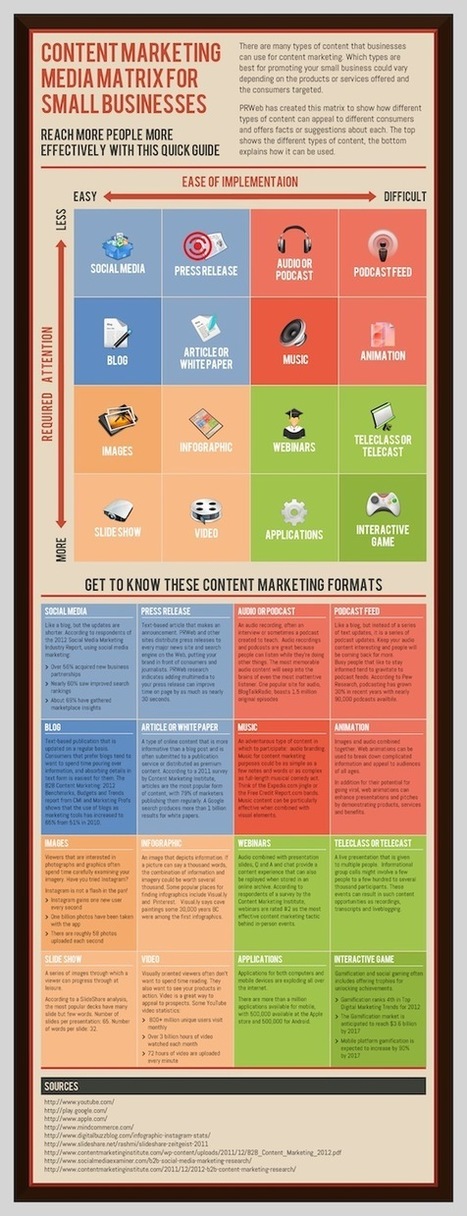
Thankfully, the folks at PRWeb, have created this guide to creating content based on a view of the level of customer engagement and the level of company effort to create. It says it is for small business but I think it’s relevant for all businesses. So check it out. And tell me what you think:


Is content marketing the new branding?
Is content marketing the new advertising?
Will marketing simply become synonymous with content marketing?


#FlowConnection

#ChannelConnect

#TrustCloud


Via Laurens ten Hagen, Gerrit Bes
No comment yet.
Scooped by Lionel Reichardt / le Pharmageek
October 4, 2012 4:53 AM
Scoop.it!

Twitter s’associe à Nielsen pour introduire des sondages sponsorisés

Twitter s’associe à Nielsen pour introduire des sondages sponsorisés | E-SANTÉ : COMPRENDRE. RELIER. TRANSFORMER. | Scoop.it
Cet outil mis à disposition des annonceurs permettra à des marques d’insérer des sondages sous la forme de tweets sponsorisés qui apparaissent dans le flux des utilisateurs.
No comment yet.
Rescooped by Lionel Reichardt / le Pharmageek from Social media and Influence in Pharma
October 4, 2012 4:52 AM
Scoop.it!

Can a doctor’s website influence physician referrals? | Articles | Main

Can a doctor’s website influence physician referrals? | Articles | Main | E-SANTÉ : COMPRENDRE. RELIER. TRANSFORMER. | Scoop.it

If only this doctor had better SEO, the patient might not have seen these negative reviews. (Yep. Can a doctor’s website influence physician referrals?


Via Gilles Jourquin
No comment yet.
Rescooped by Lionel Reichardt / le Pharmageek from The Pharmaceutical Industry
October 4, 2012 2:58 AM
Scoop.it!

Boehringer Ingelheim prepares to launch oncology franchise

Boehringer Ingelheim has long been associated with treatments for stroke prevention, COPD and HIV/AIDS, but not cancer. That's about to change, if a cornucopia of 13 abstracts presented at the European Society for Medical Oncology (ESMO) is any evidence.


Closest to market is afatinib, an oral tyrosine kinase receptor inhibitor, which is currently in Phase III clinical development in advanced non-small cell lung cancer (NSCLC), head and neck cancer, and breast cancer. Next is likely to be nintedanib, an oral triple angiokinase inhibitor that is also in Phase III clinical development in NSCLC and ovarian cancers. A third candidate for which early stage trial data were presented is volasertib, an inhibitor of polo-like kinase.


Kevin Lokay, who heads BI's oncology franchise (and whom MM&M interviewed last month) had this to say about the company's preparation to build its oncology footprint:


“Our commitment to enter the oncology space over 20 years ago has resulted in a robust oncology pipeline with investigational agents in all stages of clinical and pre-clinical development, including several in Phase III trials, that address a variety of targets across a range of tumor types. These are targeted therapies that can lead to a more personalized approach to lung cancer treatment, with the goal of improved patient outcomes. The rigor and breadth of the data we presented at the ESMO 2012 Congress, which include patient-reported health-related outcomes from the pivotal Phase III trial, LUX-Lung 3, demonstrate our commitment to oncology patients and their families.”


“Commitment is crucial when developing personalized cancer therapies,” Lokay continued. “Boehringer Ingelheim is focused on bringing a broad range of potential therapies to patients through its diverse pipeline.”


The financial community also is starting to take note of BI's moves. Dr. Marc Engelsgjerd, senior analyst, inThought Research sees the data as an encouraging milestone in BI's gear-up to participate in this market: “Boehringer has a very extensive lung cancer program for Afatnib which is great to see because they are asking a lot of different questions, looking at different combinations and patient subsets. That's really the right way to develop a drug; you have to make sure you don't leave any stone unturned.”


Among the multiple abstracts presented during ESMO, the one the company spotlighted is the afatinib LUX-Lung 3 results, a pivotal Phase III trial that demonstrated a significant progression-free survival (PFS) advantage vs. standard chemo and impressive quality of life improvement among first-line treatment of advanced NSCLC patients with an EGFR mutation.


According to a company representative, “Results of the LUX-Lung 3 trial -- the largest trial of patients with EGFR mutation-positive advanced NSCLC -- showed a median improvement in PFS of 11.1 months (the primary endpoint) with afatinib within the general study population, versus 6.9 months for those patients treated with pemetrexed/cisplatin, which is considered a standard chemotherapy in advanced and metastatic lung cancer.”


Dr. Engelsgjerd points out that the LUX-Long 3 trial has resuscitated hopes for the development of this candidate: “In lung cancer, Afatnib had a failed trial a couple of years ago, but the most recent positive study -- the LUX long 3 study -- has really renewed interest and made people focus again on the potential of this compound.”

Based upon these datasets, BI is working on marketing applications for afatinib in a number of countries in the US and EU. The company was unable to comment on whether it would seek accelerated approval for the product.


Dr. Engelsgjerd added: “The LUX Lung-3 data was impressive in terms of the PFS benefits. We'll have to wait until next year to see if there is an overall survival benefit. Part of me is wondering if regulatory bodies will want to hold out for an overall survival benefit. I assume Boehringer will want to push ahead for approval and there is precedent for that.”


Lokay is keen to point out that the strategy behind the compound is a personalized one. “The strategy behind afatinib is to focus on developing a personalized therapy for patients who can benefit from the treatment.”


In keeping with this approach, the LUX Lung 3 trial incorporated a diagnostic test to confirm an EGFR mutation status and mutation. BI has partnered with Qiagen to develop a real-time polymerase chain reaction assay (real-time PCR) companion diagnostic. Of note, between 10-15% of Caucasians and approximately 40 percent of Asians with NSCLC have EGFR mutations – 90 percent of which are the result of two mutations (Del19 or L858R). In Lokay's words, “We've taken the personalized medicine approach further … to develop a companion diagnostic to determine a patient's biomarker status to better matching their unique genetic profile with an appropriate targeted therapy, like afatinib.”


The question now is how these assets will fare in comparison to existing treatments for NSCLC, which include Avastin (bevacizumab), marketed by industry heavyweight Genentech, Tarceva (erlotinib), which is co-marketed by Genentech and Astellas Oncology, and AstraZeneca's Iressa (gefitinib).


“There are other lung cancer studies with Afatnib where they are pitting it against Tarceva and Iressa. Those are gutsier trials but those are the exact kind of trials we need to see more of because it's one thing to show that your drug works against placebo but the relevant question is, is it better that what is currently being used,” asks Dr. Engelsgjerd. “Many companies shy away from those types of studies but lung cancer is a crowded space and Boehringer really has to swing for the fences.”


From a promotional standpoint, the company already has launched an unbranded disease awareness program called Let's Test, which is designed to educate HCPs and the oncology community about the important role of biomarker testing.


Lokay notes, “Five or six years ago, there were a relatively low number of patients who were tested for biomarkers in cancer. With advances in personalized medicine and the discovery of unique biomarkers -- like EGFR, ALK and HER2 -- this number has increased, but not all lung cancer patients are tested. It is our hope that biomarker testing will become an immediate first step that a doctor takes when diagnosing a patient with lung cancer. We want it to be automatic, or reflexive, which means that the oncologist will be able to get the right treatment to the right patient at the right time. In fact, the aim of our ‘Let's Test' program is to encourage the adoption of biomarker testing as standard practice and thereby increase the frequency of testing. We're encouraging a multidisciplinary approach by working with physicians involved in the diagnosis process, such as pulmonologists, pathologists and oncologists, to demonstrate the importance of biomarker testing with the goal of improving patient outcomes.”


Another effort the company has made to carve a footprint out in the category is in building an online community called My Cancer Circle -- a free, private, customizable tool for caregivers of people facing cancer. Company market research found that while the information needs of patients themselves was largely satisfied, there was an unmet need for information among caregivers. The company collaborated with CancerCare, a patient advocacy organization, to build the tool, which helps caregivers organize and coordinate support from their circle of family and friends. According to Lokay, “We are excited that to date, over 100 private communities, or ‘circles,' have been created.”


At the end of the day, the company recognizes that the health care system is no longer simply rewarding innovation, but is looking for value. In response to how BI plans to position its franchise for optimal success in light of the Affordable Care Act, Lokay points out, “Boehringer Ingelheim is committed to providing patients who currently have limited treatment options with therapies that have a demonstrated value. As a company committed to the health of patients and their families, we are not aiming to develop treatments that work 10% of the time, in 90% of the population – but rather products that work 90% of the time, in 10% of the population.”


Via Thibaud Guymard
No comment yet.
Rescooped by Lionel Reichardt / le Pharmageek from Health3.0- Migration towards Health as a Service
October 5, 2012 11:01 AM
Scoop.it!

Mayo study proves value of smartphones in stroke treatment | mHIMSS

Mayo study proves value of smartphones in stroke treatment | mHIMSS | E-SANTÉ : COMPRENDRE. RELIER. TRANSFORMER. | Scoop.it

Mayo study proves value of smartphones in stroke treatment http://t.co/cMuMhkY2 #hcsmeu #mhealth...


Via Gilles Jourquin
No comment yet.
Scooped by Lionel Reichardt / le Pharmageek
October 5, 2012 3:16 AM
Scoop.it!

Tutorial shows physicians how to set up their iPad for medical use | Doctor

Tutorial shows physicians how to set up their iPad for medical use | Doctor | E-SANTÉ : COMPRENDRE. RELIER. TRANSFORMER. | Scoop.it
One of the most popular mobile devices amongst physicians is the iPad due to its powerful feature set combined with a great form factor.
No comment yet.
Rescooped by Lionel Reichardt / le Pharmageek from Digital et Santé
October 5, 2012 2:53 AM
Scoop.it!

m-santé : Actelin, nouvelle application mobile pour les diabétiques #hcsmeufr

m-santé : Actelin, nouvelle application mobile pour les diabétiques #hcsmeufr | E-SANTÉ : COMPRENDRE. RELIER. TRANSFORMER. | Scoop.it

La société ACTIMAGE en  partenariat avec le CeeD (Centre Européen d’Étude du Diabète) a développé une nouvelle application mobile dédié aux patients diabétiques : Actelin. Cette application Actelin...


Via Tiffany Jésus
No comment yet.
Scooped by Lionel Reichardt / le Pharmageek
October 5, 2012 1:05 AM
Scoop.it!

TweetPharm Pharma Social Media Infographic | Intouch Solutions

TweetPharm is a free interactive infographic that tracks pharmaceutical companies' use of Twitter.
No comment yet.
Scooped by Lionel Reichardt / le Pharmageek
October 5, 2012 12:56 AM
Scoop.it!

What medical smartphones apps do You use?

What medical smartphones apps do You use? | E-SANTÉ : COMPRENDRE. RELIER. TRANSFORMER. | Scoop.it
I’ve recently described how I use a Samsung Galaxy Tab in medicine and in all my online activities.  There is no doubt about the power of mobile health and as now there is a medical category ... (What medical smartphones apps do You use?
No comment yet.
Rescooped by Lionel Reichardt / le Pharmageek from Health3.0- Migration towards Health as a Service
October 4, 2012 11:54 AM
Scoop.it!

Visual Wednesdays: Your Health in One Drop

Visual Wednesdays: Your Health in One Drop | E-SANTÉ : COMPRENDRE. RELIER. TRANSFORMER. | Scoop.it

RT @Rock_Health: RT @Rock_Health: Visual Wednesdays: Your Health In One Drop from @WellnessFX http://t.co/7Mwj7bic @sano_int #digitalhealth #healthtech...


Via Gilles Jourquin
No comment yet.
Rescooped by Lionel Reichardt / le Pharmageek from Digital et Santé
October 4, 2012 11:53 AM
Scoop.it!

Learning to love e-health

Learning to love e-health | E-SANTÉ : COMPRENDRE. RELIER. TRANSFORMER. | Scoop.it

Doctors love paper. Just think about it — we use paper hospital notes, send each other printed or even hand-written letters, use paper radiology and lab forms, write or print our scripts, and we worship the voluminous textbooks on our shelves.


The good old fax machine, introduced in the 1970s, was much more successful in winning over health care professionals than e-health has been. At the same time we feel the paper-dominated health care ecosphere is not very efficient, to say the least.


Many of us own a smartphone, tablet device or laptop and we love it. We make our devices sync with work email and agendas or other software. We may have a few cool apps. And about one in 10 Australian doctors is even using social media to connect with patients and other health professionals.But in our day-to-day work, many of us rely heavily on paper and the fax machine. How do we change this?


In an innovative blog post titled “We have to wean doctors off paper. But how?” a group of Silicon Valley designers explained how to make software for doctors more user-friendly.


To successfully design clinical software that competes with pen and paper, the authors mention three key factors — ease of use, flexibility and simplicity.


“If an [electronic health record] isn’t easy to adopt, doctors will quickly get frustrated and return to familiar paper. If it isn’t flexible, it will be impractical for many specialties and doctors with unique workflows”, the designers wrote.


In other words, medical software should be just as easy to use as paper.


Quick access to the clinical data is important. Long boot up times and multiple screens to click through should be avoided. Buttons and screens should be placed intuitively to reduce mouse movements and clicks.


But even if these three key factors are met, there’s still something missing.


Health care providers increasingly need immediate access to data. We’re connected 24/7 to networks and use so many different electronic applications to access all sorts of data sources, that it sometimes feels like it’s all too much.


How easy would it be if all the different tools were integrated in one software package?


The fourth requirement is integration of applications.


Imagine this: You’re sitting behind a large wide screen at work (see image below). If you click on the screen it responds immediately; the system is fast. The home screen provides online access to all the health providers in your direct network, including GP practices, specialists, hospitals, and allied health professionals at different locations.


You can see who is online and who isn’t. Your incoming email and agenda sit in the right top corner, and in the bottom of the screen are your social networks of choice and a video consultation tool.Included in the package would be professional resources like electronic therapeutic guidelines, secure enterprise social networks and encrypted video consultation tools. Smart phone and tablet apps would be available to improve ease of access.


With two clicks of the mouse you can select and upload data from your clinical management software to the secure health network. Other health professionals can immediately read and comment on problems and questions. You can have a videoconference with colleagues while the patient data is still visible on the same screen.


Via nrip, Philippe Marchal, Tiffany Jésus
No comment yet.
Scooped by Lionel Reichardt / le Pharmageek
October 4, 2012 5:59 AM
Scoop.it!

Your phone will soon be your new doctor

Your phone will soon be your new doctor | E-SANTÉ : COMPRENDRE. RELIER. TRANSFORMER. | Scoop.it
Soon, your phone will know more about your health history and fitness goals than your doctor does. Imagine a day when your phone has all of your health information. It knows your goals, your time horizons and what activities you need to focus on to achieve those goals. It knows your schedule, whether you like to do things alone or in groups and who you like to train with. It knows what you eat, how much you’ve slept and all of your vital signs in real-time.
No comment yet.
Rescooped by Lionel Reichardt / le Pharmageek from #eHealthPromotion, #SaluteSocial
October 4, 2012 4:54 AM
Scoop.it!

La e-santé, c'est quoi ? Ça sert à quoi ? - E-Health Centre

La e-santé, c'est quoi ? Ça sert à quoi ? - E-Health Centre | E-SANTÉ : COMPRENDRE. RELIER. TRANSFORMER. | Scoop.it

La e-santé a pour objectifs :


- Amélioration de la qualité des soins
- Faciliter l’accès aux soins notamment en zones de désertification médicale
- Maintien à domicile et retour rapide à domicile dans des conditions de qualité et de sécurité optimales pour un suivi dans un environnement familier
- Meilleure coordination des professionnels
- Efficience du système de santé (maîtrise des coûts de santé)
- Formation des professionnels


Via Delphine Eriau, Giuseppe Fattori
Géraldine GOULINET FITE's curator insight, January 31, 2013 11:39 AM

Toujours un plaisir de vous rescooper !

Rescooped by Lionel Reichardt / le Pharmageek from HealthWatch
October 4, 2012 4:53 AM
Scoop.it!

L'accès du patient aux protocoles médicaux

L'accès du patient aux protocoles médicaux | E-SANTÉ : COMPRENDRE. RELIER. TRANSFORMER. | Scoop.it

L'idée derrière ces " Map of Medicine Healthguides" et ce principe du "See what your doctor can see" qui fait tant de buzz ces jours-ci, est de donner la possibilité au patient de voir la liste des protocoles et examens recommandés aux médecins par les autorités de santé pour une pathologie, des symptomes et des signes cliniques donnés :


Que doit et va faire le médecin dans tels ou tels cas (examens, diagnostics, soins, etc) ?


Cela nous amène donc à prendre conscience :

- D'une part de ce que l'activité du médecin présente de (nécessaire) standardisation - 

- Et d'autre part donc, de la consécration du principe d'un pilotage croissant du médecin par les autorités de santé, et d'un contrôle possible du respect du "protocole" par le patient.


L'accès à ces cartes ne sera pas sans posé quelques problèmes aux "empowered patients" un peu trop hypocondriaques :-).


"Map of Medicine Healthguides shows you the ideal, evidence-based patient journey for common and important conditions. It is a high-level overview that can be shared by patients and healthcare providers."


Via Jean-François Gouhier
No comment yet.
Scooped by Lionel Reichardt / le Pharmageek
October 4, 2012 4:53 AM
Scoop.it!

TOP !! Must read ! L'Indice de confiance de la e-Santé en France #hcsmeufr

TOP !! Must read ! L'Indice de confiance de la e-Santé en France #hcsmeufr | E-SANTÉ : COMPRENDRE. RELIER. TRANSFORMER. | Scoop.it

Une initiative du Cercle des Décideurs Numérique & Santé

No comment yet.
Rescooped by Lionel Reichardt / le Pharmageek from Digital marketing pharma
October 4, 2012 2:58 AM
Scoop.it!

Should pharma get more social? | Management Thinking

Should pharma get more social? | Management Thinking | E-SANTÉ : COMPRENDRE. RELIER. TRANSFORMER. | Scoop.it
Why embracing social media is no longer optional for the struggling pharma sector http://t.co/IgNEtfxi #socpharm http://t.co/HXCMefUx...
Via Olivier Delannoy
No comment yet.