E-SANTÉ : COMPRENDRE. RELIER. TRANSFORMER.
316.0K views | +115 today
E-SANTÉ : COMPRENDRE. RELIER. TRANSFORMER.

Une veille sur la santé numérique en France et à l’international : politiques publiques, données, infrastructures, IA, services et usages. Études, rapports et retours de terrain sélectionnés par Lionel Reichardt, Pharmageek, pour comprendre les transformations et éclairer les décisions.

ESSAI
Your new post is loading...
Scooped by Lionel Reichardt / le Pharmageek
April 3, 2013 1:26 AM
Scoop.it!

E-publicité: les news de la semaine

E-publicité: les news de la semaine | E-SANTÉ : COMPRENDRE. RELIER. TRANSFORMER. | Scoop.it
Google plus que jamais leader du marché display aux Etats-Unis… Le digital qui représente près de 20%...
No comment yet.
Scooped by Lionel Reichardt / le Pharmageek
April 3, 2013 1:13 AM
Scoop.it!

» AVC: des vidéos « virales » pour sensibiliser aux signaux d’alerte MyPharma Editions | L'Info Industrie & Politique de Santé

RT @LeemFrance: Des vidéos pour rappeler au grand public les trois signaux d’alerte d’un #AVC ! http://t.co/rSbMpb1Y08 #hcsmeufr cc @iscom
No comment yet.
Scooped by Lionel Reichardt / le Pharmageek
April 3, 2013 1:11 AM
Scoop.it!

Pharma Marketing Blog: BI Launches Official Version of Syrum Facebook Game in U.S.

BI Launches Official Version of Syrum Facebook Game in U.S. http://t.co/ltDZiKZLFz
No comment yet.
Rescooped by Lionel Reichardt / le Pharmageek from Health3.0- Migration towards Health as a Service
April 3, 2013 12:58 AM
Scoop.it!

YouTubes Channels reboot gives pharmas pause

YouTubes Channels reboot gives pharmas pause | E-SANTÉ : COMPRENDRE. RELIER. TRANSFORMER. | Scoop.it
Googles latest YouTube update aims to make its Channels more social, and even as the company has given its pharma clients an extra month to hold on to their old page designs, the new format is inspiring anxiety among drug firms and medical agencies.

Via Gilles Jourquin
No comment yet.
Rescooped by Lionel Reichardt / le Pharmageek from Digitized Health
April 3, 2013 12:53 AM
Scoop.it!

More Doctors Starting To Prescribe Mobile Apps for Chronic Conditions

To aid patients with chronic conditions, physicians increasingly are prescribing mobile applications that offer health-related reminders or link to medical devices.


Via Emmanuel Capitaine
No comment yet.
Scooped by Lionel Reichardt / le Pharmageek
April 2, 2013 1:26 PM
Scoop.it!

Etude sur les usages des tablettes en France

Etude sur les usages des tablettes en France | E-SANTÉ : COMPRENDRE. RELIER. TRANSFORMER. | Scoop.it
Du petit au gros utilisateur, des spécificités hommes-femmes en passant par les usages en fonction de l'âge, Prixtel l'opérateur de téléphonie s'est intéressé avec IPSOS aux habitudes...
No comment yet.
Rescooped by Lionel Reichardt / le Pharmageek from NTIC et Santé
April 2, 2013 1:15 PM
Scoop.it!

Haute Autorité de Santé - Cédric Grouchka – Éducation thérapeutique : une chance de refonder la relation soignant-soigné

Haute Autorité de Santé - Cédric Grouchka – Éducation thérapeutique : une chance de refonder la relation soignant-soigné | E-SANTÉ : COMPRENDRE. RELIER. TRANSFORMER. | Scoop.it

Aider les pouvoirs publics à mieux décider. Aider les professionnels à mieux soigner. Aider nos concitoyens à mieux s’informer. De ces ambitions affichées par la Haute Autorité de santé pour les prochaines années la dernière n’est pas la moindre. Car derrière ce souci d’informer se profile celui de responsabiliser, avec son lot commun de réalités et de phantasmes. Réalités pour tous dans le besoin exprimé de mieux juger ce qu’on nous propose. Phantasmes pour certains de croire en une panacée pour tous les maux du système de santé. À ce titre l’éducation thérapeutique occupe une place singulière. Car elle porte en elle les ferments d’une refondation de la relation soignant-soigné.

Refondation d’une relation plus juste, tout d’abord. Plus juste parce qu’elle permet de diminuer les inégalités entre les patients. Entre ceux qui disposent des moyens et des outils intellectuels et psychologiques de compréhension et d’appréhension de leur maladie, et ceux qui n’ont pas cette chance. En s’adaptant à chacun, l’éducation thérapeutique réduit les iniquités d’aptitudes personnelles.
Plus juste aussi, parce qu’elle diminue les écarts de connaissance, ou plus précisément des savoirs, entre soignant et soigné. C’est indéniable. Et mieux vaut d’ailleurs parler à ce titre d’écart plus que d’asymétrie comme on le fait habituellement. Le but est bien de réduire les distances, pas forcément d’en contester le bien-fondé.

Refondation d’une relation plus éthique, ensuite. Parce qu’elle permet de sortir de la relation de sujétion. De passer d’une relation sujet-objet à une relation vécue dans l’intersubjectivité. D’établir un véritable espace de dialogue.
Elle rejoint d’une certaine façon l’immense réflexion de Jürgen Habermas sur son « éthique de la discussion ». En continuation de la morale kantienne, Habermas formule un principe de discussion selon lequel une « norme » n’est valide que si elle est jugée comme telle par toutes les personnes concernées, qui doivent donc toutes pouvoir prendre part à la discussion. Et qu’est-ce qu’un soin si ce n’est la « norme » du soignant et du soigné ? Tout espace de dialogue est donc intrinsèquement source de plus d’éthique.

Refondation d’une relation plus humaniste, enfin. En obligeant le soignant à se départir d’une vision du soin parfois trop techniciste, trop segmentée, trop biologiste il regagne le cœur de la médecine. Car il permet à son patient de redire « je » en parlant de ce qui le précarise le plus. Sa maladie, sa souffrance, ses peurs.

Refondation, oui. Mais à conditions.
De ne pas accepter de réduire l’éducation thérapeutique à un effet de mode. Pour que les uns ne puissent y voir un quelconque effet d’aubaine ni les autres une pierre philosophale. D’éviter l’incapacité de sa mise en œuvre par des moyens insuffisants ou inadaptés. De ne pas tolérer l’envahissement de son espace par le jeu concurrentiel de l’industrie pharmaceutique. Et surtout, de ne jamais permettre un transfert de charge morale du système de santé sur le patient contre sa volonté. La limite de la responsabilisation du patient c’est lui qui doit la fixer en acceptant d’être responsabiliser, ou non.

À ces conditions, c’est un devoir pour la Haute Autorité de santé d’accompagner une véritable refondation de la relation soignant-soigné. Refondation, qui pourrait, qui sait, finir en métamorphose.


Via dbtmobile
No comment yet.
Rescooped by Lionel Reichardt / le Pharmageek from Digital marketing pharma
April 2, 2013 1:07 PM
Scoop.it!

Pharma Marketing Blog: Lack of FDA Clarity Regarding Internet Rules Leads to Greater Pattern of Enforcement Against Digital Pharma Promotion

Pharma Marketing Blog: Lack of FDA Clarity Regarding Internet Rules Leads to Greater Pattern of Enforcement Against Digital Pharma Promotion | E-SANTÉ : COMPRENDRE. RELIER. TRANSFORMER. | Scoop.it

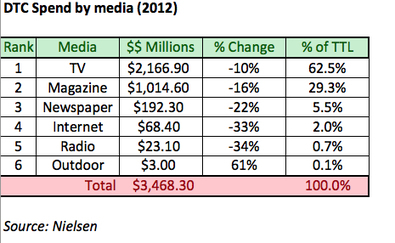
digital is very much OVER REPRESENTED in terms of violations and warning letters. As I pointed out in a previous post (here), only 2% of pharma's DTC budget is devoted to digital (not counting search advertising). Now I know that Senak's data also includes professional promotion and is not limited to consumers promotion. Even taking all that into account, it's impossible that pharma spends 27-43% of its promotional budget/effort on digital channels.


Via Olivier Delannoy
No comment yet.
Scooped by Lionel Reichardt / le Pharmageek
April 2, 2013 11:32 AM
Scoop.it!

Urinal games for prostate health

Urinal games for prostate health | E-SANTÉ : COMPRENDRE. RELIER. TRANSFORMER. | Scoop.it

A health system in Pennsylvania has made a novel use of technology to remind men about their prostate health: urinal games. The healthier the prostate, the higher the score should be.


Reuters’s Joe McDonald reported late yesterday on installation of urinal-mounted games at Coca-Cola Park in Allentown, PA., by sponsor Lehigh Valley Health Network. Players steer snowmobiles across a course (dodging penguins) via their “aim.” Coca-Cola Park is home to a minor league baseball team called the “IronPigs.”


“Baseball fans know all about RBI, ERA and OBP,” said Angelo Baccala, MD, of Lehigh Valley Urology Specialty Care and chief of Lehigh Valley Health Network’s division of urology. “But when it comes to their own PSA, many men don’t have a clue. We see this game as a fun and unique opportunity to remind men about the importance of prostate health.”


The gaming system was created and developed by United Kingdom-based Captive Media, and was first deployed publicly in the U.K. in 2012. The average game lasts 55 seconds, the company says. Score are streamed in real-time on videoboard displays within the stadium and can be followed on a Web site.

No comment yet.
Rescooped by Lionel Reichardt / le Pharmageek from Web2Shop
April 2, 2013 5:00 AM
Scoop.it!

30+ fascinating stats from Econsultancy's Q1 2013 reports

30+ fascinating stats from Econsultancy's Q1 2013 reports | E-SANTÉ : COMPRENDRE. RELIER. TRANSFORMER. | Scoop.it

- Businesses use mobile for brand engagement rather than profit

- Looking ahead, 32% believe that apps will become their most important mobile asse

- 74% of businesses believe user experience is key for improving sales

- 61% of businesses believe new products and services are key to growth


Via Jerome Chasques
No comment yet.
Rescooped by Lionel Reichardt / le Pharmageek from Digital marketing pharma
April 2, 2013 3:34 AM
Scoop.it!

The Successful Social Marketing Framework

The Successful Social Marketing Framework | E-SANTÉ : COMPRENDRE. RELIER. TRANSFORMER. | Scoop.it
Social marketing should not be an add-on to other marketing efforts. Far too often, marketers put together a promotion or other marketing program and then look to tag on social. As dictated by user...

Via Olivier Delannoy
No comment yet.
Rescooped by Lionel Reichardt / le Pharmageek from la santé "digitale"
April 2, 2013 3:31 AM
Scoop.it!

BioPharmaBuzz #8 - mars 2013 - Pharmaceutiques x Substance Active | e-santé,m-santé, santé 2.0, 3.0

BioPharmaBuzz #8 - mars 2013 - Pharmaceutiques x Substance Active | e-santé,m-santé, santé 2.0, 3.0 | E-SANTÉ : COMPRENDRE. RELIER. TRANSFORMER. | Scoop.it
BioPharmaBuzz est un tableau de bord du Web santé français réalisé par Substance Active pour Pharmaceutiques.

Via Mélanie Toussaint
No comment yet.
Rescooped by Lionel Reichardt / le Pharmageek from La pharma dans tous ses états
April 2, 2013 3:29 AM
Scoop.it!

Plan National Maladies Rares 2011-2014

Plan National Maladies Rares 2011-2014 | E-SANTÉ : COMPRENDRE. RELIER. TRANSFORMER. | Scoop.it
Les présentations de la réunion du Comité de Suivi et de Prospective du Plan national maladies rares 2011-2014 du mardi 19 mars 2013 sont accessibles, sur le site du ministère de la santé et aux liens suivants :...

Via Mélanie Toussaint, Pharmacomptoir / Corinne Thuderoz
No comment yet.
Scooped by Lionel Reichardt / le Pharmageek
April 3, 2013 1:15 AM
Scoop.it!

So what's really going with DTC internet spending ?

So what's really going with DTC internet spending ? | E-SANTÉ : COMPRENDRE. RELIER. TRANSFORMER. | Scoop.it
I have to say that the latest information from Nielsen (see yesterday's post) has me confused.  It showed that DTC media internet spending was down -33% in 2012 and the recent report from Cegedim i...
No comment yet.
Scooped by Lionel Reichardt / le Pharmageek
April 3, 2013 1:13 AM
Scoop.it!

ConsoSanté : nouvelle plateforme communautaire dédiée aux produits santé et parapharmacie

ConsoSanté : nouvelle plateforme communautaire dédiée aux produits santé et parapharmacie | E-SANTÉ : COMPRENDRE. RELIER. TRANSFORMER. | Scoop.it
La 1ère plateforme communautaire et interactive dédiée aux produits santé et parapharmacie est en plein essor !
No comment yet.
Rescooped by Lionel Reichardt / le Pharmageek from E-Pochondriac
April 3, 2013 12:59 AM
Scoop.it!

Pharma DTC ad spending sinks 11.5%, a $2B slide from 2006 peak

Pharma DTC ad spending sinks 11.5%, a $2B slide from 2006 peak | E-SANTÉ : COMPRENDRE. RELIER. TRANSFORMER. | Scoop.it

Via uri goren
No comment yet.
Rescooped by Lionel Reichardt / le Pharmageek from Social media and Influence in Pharma
April 3, 2013 12:54 AM
Scoop.it!

Bridging the Gap Between Traditional and Digital Marketing | Business 2 Community

Bridging the Gap Between Traditional and Digital Marketing | Business 2 Community | E-SANTÉ : COMPRENDRE. RELIER. TRANSFORMER. | Scoop.it
As the marketing landscape increasingly goes digital, does the traditional marketing mindset need to shift as well?

Via Gilles Jourquin
No comment yet.
Rescooped by Lionel Reichardt / le Pharmageek from Healthcare Social Media News
April 3, 2013 12:52 AM
Scoop.it!

Infographic: 8 ways to use Vine in Healthcare Marketing

Infographic: 8 ways to use Vine in Healthcare Marketing | E-SANTÉ : COMPRENDRE. RELIER. TRANSFORMER. | Scoop.it
In our first ever infographic, we explore 8 ways that Vine can be used in Healthcare Marketing.

Via Dean Berg
Franklin Delano Williams's curator insight, April 3, 2013 2:08 PM

Social Media gets more innovated every day...

Scooped by Lionel Reichardt / le Pharmageek
April 2, 2013 1:24 PM
Scoop.it!

La santé pour 99 centimes

La santé pour 99 centimes | E-SANTÉ : COMPRENDRE. RELIER. TRANSFORMER. | Scoop.it
Les smartphones rendent meilleur marché la médecine avec des technologies plus personnelles mais aussi plus invasives.
No comment yet.
Scooped by Lionel Reichardt / le Pharmageek
April 2, 2013 1:08 PM
Scoop.it!

7 health benefits of playing video games

7 health benefits of playing video games | E-SANTÉ : COMPRENDRE. RELIER. TRANSFORMER. | Scoop.it

Your parents may have tried to kick you off your Super Nintendo just about every time you sat down in front of it because they were concerned about how it might affect your long-term health. Plenty of studies have shown that games that don't require a lot of physical movement can have an adverse effect on children as they grow older. But perhaps counter-intuitively, there have also been several studies touting the health benefits of gaming.


1. Video games are therapeutic for children with chronic illnesses
The University of Utah released a study last year that examined the effects of regular gaming on children diagnosed with illnesses like autism, depression, and Parkinson's disease. Kids who played certain games, including one designed just for the study, showed signs of improvement in "resilience, empowerment, and a 'fighting spirit.'" Researchers believe the games' ability to act on "neuronal mechanisms that activate positive emotions and the reward system" helped improve kids' demeanors as they faced the daily challenges of their illnesses.


2. Video games improve preschoolers' motor skills
Letting a 4-year-old sit in front of a TV with a game controller might not seem like the most productive use of her time. But researchers from Deakin University in Melbourne, Australia, would disagree. Their study examined the development of 53 preschool-aged children, and found that those who played "interactive games" had better "object control motor skills" than those who didn't. It's not clear, though, whether children with better-than-average motor skills tend to gravitate toward video games in the first place.


3. Video games reduce stress and depression
2009's Annual Review of Cybertherapy and Telemedicine included a study that found that gamers who suffered from mental health issues such as stress and depression were able to vent their frustration and aggression by playing video games — and showed a noted improvement. The study hypothesized that games gave certain "Type A" personalities time to relax in "a state of relative mindlessness" that allowed them to avoid reaching "a certain level of stressful arousal" as they tried to relax.


4. Video games can provide pain relief
Video games don't just provide relief from emotional pain. They can also help those who are suffering from physical pain. Psychologists at the University of Washington developed a gamethat helps hospital patients suffering from immense physical pain by using an age-old mental trick: distraction. The virtual reality game "Snow World" put patients in an arctic wonderland in which they throw an endless arsenal of snowballs at a series of targets, such as penguins and snowmen. Military hospitals found the experience helped soldiers recovering from their battlefield wounds. The soldiers who played "Snow World" required less pain medicine during their recuperation. 


5. Video games can improve your vision
Mom may have warned you that sitting in front of the TV wasn't good for your eyes. But one developmental psychologist found it could actually be beneficial to your vision. Dr. Daphen Maurer of the Visual Development Lab of Ontario's McMaster University made a surprising discovery: People suffering from cataracts can improve their vision by playing first-person shooter games like Medal of Honor and Call of Duty. She believes these games are so fast-paced that they require an extreme amount of attention, training the visually impaired to view things more sharply. They can also produce higher levels of dopamine and adrenaline that "potentially may make the brain more plastic," she said. 


6. Video games can improve your decision-making skills
Most video games require fast reactions and split-second decisions that can mean the difference between virtual life and virtual death. Cognitive neuroscientists at the University of Rochester in New York found these games give players' brains plenty of practice for making decisions in the real world. Researchers suggest that action-oriented games act as a simulator for the decision-making process by giving players several chances to infer information from their surroundings and forcing them to react accordingly.


7. Video games can keep you happy in old age
Researchers from North Carolina State University looked closely at our aging population to see if there was a link between playing video games and mental well-being — i.e. "happiness." They found that senior citizens who said they played video games — even occasionally — reported "higher levels of happiness, or well-being," says Rick Nauert at PsychCentral. "Those who did not play video games reported more negative emotions" and were more likely to be depressed. It's unclear what exactly is behind this link — or if the relationship is even causal.

Amanda Eikenes's curator insight, November 14, 2017 11:37 AM
Inquiry Session 4: Technology
Rescooped by Lionel Reichardt / le Pharmageek from URPS et e santé
April 2, 2013 1:07 PM
Scoop.it!

Vidal lance sa base de donnée en ligne pour les médecins libéraux

Vidal lance sa base de donnée en ligne pour les médecins libéraux | E-SANTÉ : COMPRENDRE. RELIER. TRANSFORMER. | Scoop.it
Déjà très présent sur le web et le mobile, Vidal lance son portail web d’information sur le médicament pour les médecins libéraux. Présentation. Ce nouveau portail web accessible à l'adresse Vidal....

Via Rémy TESTON, Géraldine GOULINET FITE
No comment yet.
Scooped by Lionel Reichardt / le Pharmageek
April 2, 2013 5:17 AM
Scoop.it!

Digitas Health examines effectiveness of digital marketing within pharma | Pharmalive

No comment yet.
Rescooped by Lionel Reichardt / le Pharmageek from Buzz e-sante
April 2, 2013 3:53 AM
Scoop.it!

Internet et santé. Acteurs, usages et appropriations

Internet et santé. Acteurs, usages et appropriations | E-SANTÉ : COMPRENDRE. RELIER. TRANSFORMER. | Scoop.it
L'ouvrage collectif Internet et santé : Acteurs, usages et appropriations récemment publié aux Presses de l'Université du Québec, propose un tour d'horizon des enjeux liés aux usages de l'Internet par les patients, les populations, les soignants et...

Via Rémy TESTON
No comment yet.
Rescooped by Lionel Reichardt / le Pharmageek from Health around the clock
April 2, 2013 3:33 AM
Scoop.it!

La Reco 2013 du Think Tank ECONOMIE SANTE

La recommandation 2013 du Think Tank ECONOMIE SANTE propose une nouvelle organisation des soins qui s’articule autour de la création d’une plateforme territoriale de coordination pour :

 - améliorer la qualité de vie des personnes âgées de plus de 75 ans et vulnérables,

- optimiser les dépenses sanitaires et sociales, publiques et privées.


Via Philippe Bédère, AttractiveHealthcare
Philippe Bédère's comment, March 28, 2013 7:10 AM
Reco 7 :

Élaborer un système d’informations, base de données et outil de transmission de l’information et de support de procédures

La création d’un dossier de suivi et d’anticipation est capitale. Ce dossier sera numérisé et accessible à tous les acteurs sanitaires et sociaux.

La mise en place réussie d’un authentique parcours de santé repose sur la qualité du système d’information : accès aux données, transmission des informations de pilotage, bonne synthèse des informations relatives aux personnes et bonne connaissance de l’offre.
Philippe Bédère's comment, March 28, 2013 7:15 AM
RECO 1 / Cibler les personnes âgées de plus de 75 ans et vulnérables
RECO 2 / Créer une plateforme territoriale
RECO 3 / Organiser un guichet et un numéro de téléphone unique
RECO 4 / Assurer le repérage
RECO 5 / Structurer la coordination
RECO 6 / Adapter le financement et la rémunération des acteurs pour favoriser les activités transversales de coordination
RECO 7 / Élaborer un système d’informations, base de données et outil de trans mission de l’information et de support de procédures
RECO 8 / Former, évaluer et développer de nouveaux métiers
RECO 9 / Mettre en oeuvre dans les conditions du réel
Rescooped by Lionel Reichardt / le Pharmageek from market access pharmaceutique
April 2, 2013 3:30 AM
Scoop.it!

Qui pilote la politique du médicament ? - Blog Le Monde (Blog)

Qui pilote la politique du médicament ?
Blog Le Monde (Blog)
L'Agence nationale de sécurité des médicaments et des produits de santé (ANSM) vient de publier un bilan des effets indésirables des contraceptifs oraux.

Via Mélanie Toussaint
No comment yet.