


|
Rescooped by
Lionel Reichardt / le Pharmageek
from mHealth- Advances, Knowledge and Patient Engagement
August 4, 2013 5:06 PM
|


Une veille sur la santé numérique en France et à l’international : politiques publiques, données, infrastructures, IA, services et usages. Études, rapports et retours de terrain sélectionnés par Lionel Reichardt, Pharmageek, pour comprendre les transformations et éclairer les décisions.
 Your new post is loading...
 Scoop.it!

From
www

Paris le vendredi 2 aout 2013- Quel pharmacien n’a pas eu des sueurs froides en délivrant une ordonnance pédiatrique comportant plusieurs sirops, des médicaments en goutte buvable à une personne âgée atteinte de démence ou à... Via Pharmacomptoir / Corinne Thuderoz
Scoop.it!

Après la première grande enquête RegionsJob sur le recrutement et les réseaux sociaux, réalisée l’an passé, nous sommes heureux de vous présenter les résultats de la deuxième édition de cette étude. Via Jacques FROISSANT, Pharmacomptoir / Corinne Thuderoz

IGS FC's curator insight,
June 12, 2013 5:04 PM
Est ce que les réseaux sociaux sont un outil de sourcing complémentaire pour trouver LE candidat ou bien cette étude est une photo déjà obsolète du e-recrutement? Quid des réseaux de cooptation qui ont fait leur apparition comme KEYCOOPT et MYJOBCOMPANY? Ou encore du GRAPH SEARCH développé par FACEBOOK?
Scoop.it!

Healthcare has some of the best stories ever told. That's why House & Grey's Anatomy have such rave reviews. But does your digital content display the same? Via Marie Ennis-O'Connor, Giuseppe Fattori

eMedToday's curator insight,
August 4, 2013 8:18 PM
The most effective advertising is stories. Hospitals need to learn how to develop medical minute stories from doctors and patients.
Scoop.it!

An effort to build a public database of BRCA gene variants joins with Silicon Valley startup Syapse. Via Emmanuel Capitaine
Scoop.it!

From
yagg
C'est la première fois que le TRT-5, qui réunit les principales associations contre le sida, lance une telle initiative. Via EVELYNE PIERRON
Scoop.it!

While the number of mobile applications have steadily proliferated across all mobile devices, Apple holds the lead in the number of mobile medical apps Via Olivier Delannoy
Scoop.it!

Treato, an Israeli company that scours thousands of social media sites to glean patient insights about pharmaceuticals and treatments, has landed $14.5 million in new capital.
Launched about a year and a half ago, Treato has developed an algorithm to search across social media sites large and small, from Facebook on down to local online communities for patients with specific medical conditions, to ascertain what people are saying about medications. Treato looks for patterns that could signify adverse reactions to drugs, off-label uses, reasons why people switch from one medication to another and other bits of intelligence. Via ehealthgr

ehealthgr's curator insight,
July 31, 2013 6:47 PM
Not semantic yet, but this is trully more close to the future. Social media without the filtering is just a big load of unrelevant, fuzzy data. Besides that filtering forums and online communities is not something so exotic. Online communication and experience exchange existed even before web 2.0 and social media. 
Franklin Delano Williams's curator insight,
July 31, 2013 8:36 PM
ehealthgr's insight: Not semantic yet, but this is trully more close to the future. Social media without the filtering is just a big load of unrelevant, fuzzy data. Besides that filtering forums and online communities is not something so exotic. Online communication and experience exchange existed even before web 2.0 and social media.
Scoop.it!
Cancer drug sales reps find access to oncologist most restricted The Pharma Letter Oncology remains the most restrictive specialty for pharmaceutical sales representative access this year for the second year in a row, according to the spring 2013... Via eMedToday
Scoop.it!

According to the study, conducted by Ideahaus and published in the current issue of the Journal of Communication in Healthcare, professionals within the healthcare space are rapidly shaping best practices for marketing communications, despite the lack of FDAguidance in the use of social media in healthcare. Via Philippe Marchal
eMedToday's curator insight,
August 4, 2013 8:21 PM
The smart Pharma are using you tube to tell their story
" data indicates healthcare communications professionals are most reticent to adopt Twitter, a mainstream corporate communications tool. YouTube's acceptability was pervasive, in fact twice that of Flickr or Twitter. The study also flushed out a number of perceived risks of embracing social media marketing in healthcare communications"
Scoop.it!

Mobility and the use of smartphones is a growing trend that's here to stay, as shown in today's screen-reader friendly infographic. Via Vincenzo Storti, Gilles Jourquin

Lindsay Wilson's curator insight,
August 2, 2013 11:59 AM
Interesting especially if you work with or in the health field
eMedToday's curator insight,
August 2, 2013 9:48 PM
The future is on the smartphone.
What are Pharma doing to take advantage of this trend
Scoop.it!
Hampshire, 17th July 2013. ---Cardiac and chronic disease remote patient monitoring to result in less time in hospital and fewer outpatient visits ---... Via eMedToday
eMedToday's curator insight,
July 29, 2013 8:12 PM
"Juniper Research’s latest report on the mHealth market forecasts cumulative cost savings from remote patient monitoring of up to 36 billion USD globally over the next five years - under Juniper’s most optimistic forecast scenario"
Scoop.it!

The last few years have presented an unprecedented shift in the computing world as PCs are being replaced with mobile devices. But now that a large portion of the market has already shifted, what comes after it? Via Alex Butler
|
Scoop.it!

Video produced by Akron Children's Hospital focussing on the growing number of families using social media as their primary source for health and wellness information and advice. Via Pharmacomptoir / Corinne Thuderoz
Scoop.it!

By Jeff Goldsmith One hesitates to make too much of a single report, but the Altarum Institute’s July Report, “Health Care Price Growth at 20+ Year Low,” certainly commands one’s attention. According to Altarum’s analysis, the health sector... Via Pharmacomptoir / Corinne Thuderoz
Scoop.it!

Healthcare IT News's third annual list of 100 healthcare IT social media influencers Via Philippe Marchal, Rémy TESTON
Scoop.it!

UPMC has invested more than $1.6 billion in its IT infrastructure over the past five years, according to Pamela Peele, chief analytics officer of UPMC Health Plan. That's more money, she points out, than its home city has spent on three pro sports stadiums combined – "and we take sports seriously in Pittsburgh." Those massive investments have paid big dividends, said Peele, speaking July 24 at the The Institute for Health Technology Transformation's Denver Health IT Summit, and showed how UPMC's strategies could be useful even for smaller organizations without that sort of financial muscle. One of the advantages of being an integrated delivery system is that the physicians, patients and payers exist in what's essentially a "natural laboratory" where different types of data can be mined about what works and what doesn't, she said. Robust analytics tools are essential to uncovering inefficiencies and pointing the way toward best practices. But many organizations miss the big-picture when implementing the technology: "Analysis is the generation of new knowledge," said Peele. "It's not reporting." But a crucial first step, of course, is getting data that's uniform and usable – "fit for consumption," as she put it. Alas, "the sad part of it is, there's nothing sexy or fun about making data fit for consumption." Whether it's claims data, prescription information, lab results or some combination thereof, aggregating and normalizing data is key, she said. "You can't manage what you can't see." But "no vendor tool is going to do this for you," she added. The way towards "a single source of truth," is to "roll up our sleeves and make it happen." The future is promising, as healthcare organizations are increasingly "using data in a way it was never intended to be used," said Peele. "Lab data wasn't meant for pop health management." UPMC has gained valuable knowledge from its self-developed care management platform, and has been able to make big strides in predictive analytics. "When someone shows up to the ED we predict the risk that they will be readmitted within 30 days." The nature of those doing the analyzing has changed, too. Back several years ago, analysts tended to be business-minded bean counters, unable even to arrive at a consistent number identifying the number of diabetics in a given Pennsylvania county. Now, UPMC's analytics personnel each have different tasks, from clinical evaluation to strategic business analysis to database quality to modeling.
UPMC has invested more than $1.6 billion in its IT infrastructure over the past five years, according to Pamela Peele, chief analytics officer of UPMC Health Plan. That's more money, she points out, than its home city has spent on three pro sports stadiums combined – "and we take sports seriously in Pittsburgh." Those massive investments have paid big dividends, said Peele, speaking July 24 at the The Institute for Health Technology Transformation's Denver Health IT Summit, and showed how UPMC's strategies could be useful even for smaller organizations without that sort of financial muscle. One of the advantages of being an integrated delivery system is that the physicians, patients and payers exist in what's essentially a "natural laboratory" where different types of data can be mined about what works and what doesn't, she said. Robust analytics tools are essential to uncovering inefficiencies and pointing the way toward best practices. But many organizations miss the big-picture when implementing the technology: "Analysis is the generation of new knowledge," said Peele. "It's not reporting." But a crucial first step, of course, is getting data that's uniform and usable – "fit for consumption," as she put it. Alas, "the sad part of it is, there's nothing sexy or fun about making data fit for consumption." Whether it's claims data, prescription information, lab results or some combination thereof, aggregating and normalizing data is key, she said. "You can't manage what you can't see." But "no vendor tool is going to do this for you," she added. The way towards "a single source of truth," is to "roll up our sleeves and make it happen." The future is promising, as healthcare organizations are increasingly "using data in a way it was never intended to be used," said Peele. "Lab data wasn't meant for pop health management." UPMC has gained valuable knowledge from its self-developed care management platform, and has been able to make big strides in predictive analytics. "When someone shows up to the ED we predict the risk that they will be readmitted within 30 days." The nature of those doing the analyzing has changed, too. Back several years ago, analysts tended to be business-minded bean counters, unable even to arrive at a consistent number identifying the number of diabetics in a given Pennsylvania county. Now, UPMC's analytics personnel each have different tasks, from clinical evaluation to strategic business analysis to database quality to modeling. Via Chatu Jayadewa
Scoop.it!
Scoop.it!

Derek Woodcock gives an overview of the Pharmacovigilance System Master File in our safety and pharmacovigilance themed month. The requirement for a Pharmacovigilance System Master File (PSMF) has been in place since July 2012 for all Centrally... Via EVELYNE PIERRON
Scoop.it!
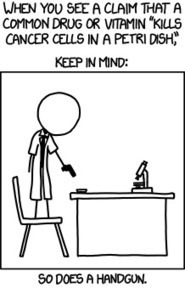
"The key thing to remember is that many, many substances have been found to attack and kill cancer cells in the laboratory. The cartoon above, from the wonderful site xkcd, illustrates the problem. This is generally how promising anti-cancer agents are first identified: we test them against cancer cells growing in a dish. These are called in vitro (“in glass”) studies. But once a potential cancer treatment is found there is a long way to go. First of all, can the concentrations of the agent that showed cancer-killing activity in the dish be safely achieved in the body? And, if they can, does the agent still show that ability in the incredibly complex system of the body? Often such in vivo (“in life”) studies are first done in experimental animals before they are tried in humans." Via Curated by A4BC.ORG, Giovanna Marsico
Scoop.it!

How Moore's Law and the convergence of science and technology (INFO + BIO + NANO + NEURO) affects the future of healthcare, with market drivers & inhibitors. ... Via eMedToday
eMedToday's curator insight,
July 31, 2013 7:49 PM
Great summary of the future of healthcare for every organization in the health care space
eMedToday's curator insight,
July 31, 2013 7:51 PM
The future of health care is not with sales reps but technology.
Scoop.it!

¨Plus qu'un simple effet de mode, focus sur le Quantified self, un véritable phénomène amené à bouleverser notre quotidien de demain. Via France Silver Eco
Scoop.it!

In the world of health and fitness tracking, smartphone connected devices like Fitbit Flex, Jawbone UP, and Basis Band have scoped out the wrist as the ideal place for accelerometers, pulse, and galvanic skin response sensors to give people feedback about their workouts. Via nrip
Scoop.it!
In the demand for a new business model for pharma, the roadmap from current promotion via detailing to a more engaging way to physicians and health care provide Via Pere Florensa, eMedToday
|






Great list of new apps.