


Google’s new company aimed at addressing problems of health and ageing has taken a step forward – with its own website and ... »
Via COUCH Medcomms


Une veille sur la santé numérique en France et à l’international : politiques publiques, données, infrastructures, IA, services et usages. Études, rapports et retours de terrain sélectionnés par Lionel Reichardt, Pharmageek, pour comprendre les transformations et éclairer les décisions.
 Your new post is loading...
 Scoop.it! Google’s new company aimed at addressing problems of health and ageing has taken a step forward – with its own website and ... » Via COUCH Medcomms 
No comment yet.
Sign up to comment
Scoop.it!

La lenteur du déploiement de la e- Santé en France devient inquiétante, alors que les impératifs économiques sont déjà là. La digitalisation de la santé est pourtant certainement l’une des solutions les plus radicales à cette hémorragie financière. Via Clinique PASTEUR

Le Lab Marketing Digital's curator insight,
August 20, 2014 5:02 AM
La révolution digitale est une fabuleuse opportunité pour résoudre l’un des enjeux majeurs auquel le pays est confronté.
Scoop.it!

Cela fait des années que la firme américaine Google investit dans la recherche médicale et se paye les meilleurs scientifiques du monde. Le géant d'Internet a décidé il y a peu d'investir dans le stockage et l'analyse du génome humain. Google X Lab : un délire de milliardaire ou bien le laboratoire d'un futur ultra-technologique ? Via Jerome Leleu, Isabelle Delignière-Léglise
Scoop.it!

I’m not sure that the best way to improve Health IT is to get more physicians trained in IT so they can move into IT roles. Goodness knows the time and education required to become, and continue to perform as, a really good clinician is demanding enough. Via Philippe Marchal
Scoop.it!

E-health closer to reality with electronic health privacy rules Lexology (registration) E-health is closer to becoming a reality in Italy with the Data Protection Authority's approval of a decree which sets out the requirements for electronic...
Scoop.it!

In today’s technological savvy world, it is not enough for a physician to rely on referrals or word of mouth to build a patient base. Running a private practice is a business, just like any other, and marketing is a key part of creating a connection not only with potential patients, but also with networking partners and collaborates. Consider some ways a physician can leverage online tools to expand his or her reach. Hospital Websites Becker’s Hospital Review points out a website is a critical business tool for hospitals. The relationship between a medical facility and a physician is symbiotic. Doctors can use this to their advantage when planning marketing strategies. The “Find-a-Doctor” database allows you to become part of the hospital community. You should check regularly to ensure your name appears in the hospital directory. Consider creating listings under the doctor’s name and name of the practice to increase the odds of a hit, too. Physicians can use the hospital website to gain exposure in other ways, as well. Query the hospital administrator about guest blogging or writing an article for the newsletter. Volunteer for a social media Q and A. The more people who see your name in connection with the hospital, the better. Ask about paid ads either online or as part of the newsletter, too. Directories Add your name and practice to online databases such as Healthgrades.com or ZocDoc.com. These sites target searches to connect patients with physicians in their area. While you are at it, add a posting to business directories, as well. Google MyBusiness, for example, puts your name and practice on local maps. Other options include: Yellow PagesMD.comYelpFoursquare Social Media Becker’s also states that patients between the ages of 18 and 24 rely on information from social media sites. Leveraging this form of communication will increase your access to lifelong patients and emerging families. Facebook and Twitter are obvious choices, but expand your social media horizons to include video options. Film short discussions on current health care issues and post them to your YouTube channel. For example, a quick blurb about controlling blood pressure through diet or summer eating habits provides helpful information on a topic you can cover quickly. Ecommerce University suggests that videos under two minutes get the most views on YouTube. Tip: If the video is shorter in length, transcribe the video in the notes section for better SEO results. Once you have videos uploaded, use your other social media and website assets to promote them. You can embed a video directly onto the practice’s Facebook page. Create discussion groups or a video blog with a comments section on the website to talk about current issues covered in the videos, too. The more personal you make it, the stronger the impact. Don’t lose sight of the big picture when planning your marketing campaigns. The goal is to connect. Doctors can leverage a number of online tools to make that happen. Improving communication options though patient portals, dedicated social media pages and videos are practical, cost-effective approaches to physician marketing.
Via Plus91, Rémy TESTON
Scoop.it!

Trois étapes majeures viennent d’être franchies dans le déploiement du système des Messageries Sécurisées de Santé MSSanté : - L’espace de confiance MSSanté, permettant les échanges par messageries sécurisées de données de santé interopérables est... Via Festival Communication Santé
Scoop.it!

La lenteur du déploiement de la e- Santé en France devient inquiétante, alors que les impératifs économiques sont déjà là. … Via Rémy TESTON
Scoop.it!

Par Barbara Chazelle, France Télévisions, Directions stratégie et prospective La technologie est un moyen. Quoi donc de plus réjouissant que de voir le foisonnement d'initiatives visant à aider co... Via Rémy TESTON
Scoop.it!

Serge Cannasse's curator insight,
August 2, 2014 3:32 AM
bonne idée ! mais qu'en pense Madame Girardin, secrétaire d'Etat au Développement et à la Francophonie ?
Scoop.it!

3D Pediatrics is taking part in DreamIt Ventures' Open Canvas@CHOP. It wants to use 3D printing technology to provide customized medical devices for kids.
Scoop.it!

Scoop.it!

Health IT literacy goes hand-in-hand with health literacy. In today's updated healthcare system, patients need both. Via Angel Gonzalez
|
Scoop.it!

Learn more about the variety of e-health tools that are available to help you manage your health and your family's health.
Scoop.it!
@IntelHealth Is Digital health getting desired benefits? Maybe. http://t.co/Ut023p9noX (Beyond the hype, what's the evidence for digital health benefits?
Scoop.it!
Face à toutes les applications d'e-santé présentées par Emmanuel Viale, Principal Executive des Tech Labs d'Accenture, à Sophia Antipolis, l'avocat Alain Ben... Via Festival Communication Santé, Celine Sportisse
Scoop.it!

“Health Information Technology: A Game Changer for Population Health Healthcare Informatics Jat Sandhu, Ph.D., an epidemiologist and regional director of Vancouver Coastal Health Authority's Public Health Surveillance Unit in British Columbia,...”
Scoop.it!
The Mayo Clinic’s Center for Innovation will be holding its 2014 Transform Symposium Sept. 7-9. The event offers both in-person and online opportunities (5Q blog with Dr. Douglas Wood from @MayoInnovation on the future of virtual health.
Scoop.it!

This year in the U.S. and Canada, 75 million of 600 million appointments with general practitioners will involve electronic visits, or eVisits, according to new research from Deloitte.
Via Philippe Marchal
Scoop.it!

What’s the ultimate extension of 3D printing technology? Where could 3D printing take us in the future? Eventually, we will have nano-factories, 3D printing at the molecular level. We will be able to turn our garbage into just about anything we want, via a sophisticated computer system, along with hardware capable of breaking any mass down to its molecular level, before using those molecules to construct a brand new object. The two men have now combined the ideas of 3D printing with that of molecular self assembly to create a process which they call ‘genetic 3D printing’. For those who are not biologists, molecular self assembly is simply the process in which molecules arrange themselves in a particular order without guidance from an outside source. Molecular self assembly is a bottom-up approach like that of 3D printing. The discovery, which was accidental, allowed the researchers to create proteins which have the ability to self assemble into fibers. The discovery was made while they were simply trying to produce gluten adhesives, by cutting out a section of the gluten protein. What happened next surprised them. When the section of the protein was removed, fibers self assembled themselves in the beaker. The quality of the fibers were on par with those produced by silk spiders, something which researchers have been trying to produce for years. Spider silk has a strength-to-weight ratio which is five times that of steel, making it an ideal material for all sorts of applications. The researchers went back and realized that they can manipulate the protein structures of the fibers to change their colors, but this wasn’t all. By combining the gluten protein with other proteins, they are able to molecularly print fibers with varying electrical properties, strengths and colors. In ordinary 3D printing, individuals use a software to translate a computer code and raw material into a physical object. In this case the researchers found that they were able to use a genetic blueprint as their computer code and back-calculate the DNA, which was inserted into a host bacterium, in this case e-coli. From there, the protein (raw material) grew, left the cell, and interacted with one another to build the fibers which the researchers had predetermined. If this seems amazing, both Barone and Senger believe that they could eventually utilize this method as a way to molecularly manufacture all sorts of objects. Because the protein fibers are natural building blocks, once a method is figured out in which they are able to get the fibers to organize into larger structures, anything could be possible. From a coffee pot, to human bone, or even muscle, the researchers believe that one day this method of 3D printing fibers could manufacture it all. The researchers are currently working to further their discovery, and produce the silk-like fibers in large quantity for a variety of uses. Additionally they are looking for ways to increase the size of each fiber, eventually enabling the manufacturing of larger objects. Via Dr. Stefan Gruenwald
Scoop.it!

Today, the American Heart Association has launched the Chicago Open Innovation Challenge, a crowdfunding competition to uncover new innovative digital health tools to prevent or manage heart disease and stroke. The top three finalists will receive... Via Emmanuel Capitaine , Philippe Marchal
Scoop.it!
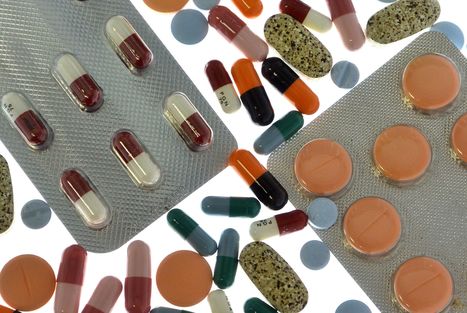
Medication management for patients, as well as their physicians and pharmacists, is going digital. Via Philippe Loizon

John Lemos Forman's curator insight,
August 11, 2014 3:19 PM
São inúmeras as possibilidades de uso das TICs em benefício tanto dos pacientes como dos gestores das unidades de saúde.
Scoop.it!

SANTE - Mieux connaître le corps humain pour prévenir les maladies, voici le domaine de recherche du nouveau projet de Google : Baseline Study.

serge zen's curator insight,
July 29, 2014 2:28 AM
philanthropie ou mise en place d'une gigantesque base de données ?!?
Scoop.it!

Dossier complet : les actuelles initiatives e-santé en France http://t.co/A4mYpYsd5L RT@Callimedia #esante #telemedecine #hcsmeufr Via Emmanuel Capitaine
Scoop.it!

Part of the 3D Printed Anatomy Series (credit: Monash University) A kit of 3D-printed anatomical body parts could revolutionize medical education and Via Xavier SEDES
|





