Le géant américain Google est en train de modifier son application de recherche mobile, en particulier l’espace « Knowledge Graph », afin d
Via Chanfimao


Une veille sur la santé numérique en France et à l’international : politiques publiques, données, infrastructures, IA, services et usages. Études, rapports et retours de terrain sélectionnés par Lionel Reichardt, Pharmageek, pour comprendre les transformations et éclairer les décisions.
 Your new post is loading...
 Scoop.it! Le géant américain Google est en train de modifier son application de recherche mobile, en particulier l’espace « Knowledge Graph », afin d Via Chanfimao 
No comment yet.
Sign up to comment
Scoop.it!

Google will today start presenting healthcare information in a new way – both for users of traditional Internet browsers as well as on its Google mobile app. The change will...
Scoop.it!

On ne cesse de nous dire que l'on meurt à des âges de plus en plus élevés et c'est vrai. On nous dit aussi que les progrès médicaux profitent aux plus âgés et c'est encore vrai. «Mais ce que les médias oublient souvent de préciser, c'est que si l'espérance de vie explose, l'espérance de vie sans incapacité, elle, stagne. Les années de vie que l'on gagne ne sont pas identiques à celles de nos vingt ans, mais plutôt à celles de nos quatre-vingts ou quatre-vingt-dix ans! Autrement dit, il y aura de plus en plus de gens très âgés et fragiles. Et cette période de fragilité est susceptible de basculer à tout moment vers une perte de l'autonomie. Or, lorsqu'il y a des troubles cognitifs à la clé, le choix se limite à partir vivre chez un enfant suffisamment disponible ou à rentrer dans une institution comme l'Ehpad», explique Jean-Marie Robine, gérontologue, démographe et directeur de recherche Inserm. Via Florentin Clère
Scoop.it!

IBM has struck a deal SoftBank Telecom Corporation to bring the IBM Watson artificial intelligence (or, as IBM calls it, cognitive computing) system to Japan. The was announced on Tuesday. Via Raphaelle LAUBIE
Scoop.it!
People who can't stand can now walk by putting on a device called Rewalk. Rewalk is a robotic exoskeleton that works like a mechanical set of legs and crutches. It was unveiled over the weekend at ...
Scoop.it!
Dans le cadre d’une initiative visant à améliorer la médecine de précision, le président américain propose 225 millions de dollars et l’étude de l’ADN d’un million de personnes.
Scoop.it!

My immediate response to it was that it needed to be shifted 2 years. If you make 2013=2015 and so forth, then I think the chart is pretty accurate and interesting. As I look at it again now, I also think that the appointment scheduling might be a little larger than reality as well. Nitpicking aside, I think it illustrates an interesting movement that we see happening in healthcare IT. EHR is basically implemented. A few patient services like appointment scheduling are making good progress. Many organizations have started opening up electronic messaging to patients and patient access to records. Of course, that all leaves the next frontier of healthcare IT: quality monitoring and preventive engagement. You could probably expand that into a few more areas, but at its core it’s all about improving the care that’s provided. This is the most exciting part of what we’re doing in healthcare IT and will be the next 5-10 year challenge. I’m excited to see the results. Via Raphaelle LAUBIE
Scoop.it!

Premier site français d’information en continu sur les technologies de l’information et de la communication (TIC, NTIC) dans la santé - TIC santé Via Anne-Sophie Hardel
Scoop.it!

The United States has proposed analyzing genetic information from more than 1 million American volunteers as part of a new initiative to understand human disease and develop medicines targeted to an individual’s genetic make-up. At the heart of the “precision medicine” initiative, announced on Friday by President Barack Obama, is the creation of a pool of people – healthy and ill, men and women, old and young – who would be studied to learn how genetic variants affect health and disease. Officials hope genetic data from several hundred thousand participants in ongoing genetic studies would be used and other volunteers recruited to reach the 1 million total. “Precision medicine gives us one of the greatest opportunities for new medical breakthroughs we’ve ever seen,” Obama said, promising that it would “lay a foundation for a new era of life-saving discoveries.” The near-term goal is to create more and better treatments for cancer, Dr. Francis Collins, director of the National Institutes of Health (NIH), told reporters on a conference call on Thursday. Longer term, he said, the project would provide information on how to individualize treatment for a range of diseases. The initial focus on cancer, he said, reflects the lethality of the disease and the significant advances against cancer that precision medicine has already made, though more work is needed. The president proposed $215 million in his 2016 budget for the initiative. Of that, $130 million would go to the NIH to fund the research cohort and $70 million to NIH’s National Cancer Institute to intensify efforts to identify molecular drivers of cancer and apply that knowledge to drug development. A further $10 million would go to the Food and Drug Administration to develop databases on which to build an appropriate regulatory structure; $5 million would go to the Office of the National Coordinator for Health Information Technology to develop privacy standards and ensure the secure exchange of data. The effort may raise alarm bells for privacy rights advocates who have questioned the government’s ability to guarantee that DNA information is kept anonymous. Obama promised that “privacy will be built in from day one.” Via Dr. Stefan Gruenwald

Risto Suoknuuti's curator insight,
February 13, 2015 6:59 PM
I wellcome this inititive in the name of all camcer patients who have suffered current hard and heavy teatments exspeacially remembering those of us who did not survive. Give them more hope.
Scoop.it!

Scoop.it!

The Internet is full of blogs. They are multi-themed sites, self-managed by the authors and demonstrative of, and only limited by, the authors’ level of creativity. They are potentially accessible to anyone and everyone. There are numerous health blogs, but the proportion of health professionals who are bloggers is low. Having a blog is a cost-effective option to share health information, to promote interaction between professionals and patients, and for global communication. Via ChemaCepeda, Usalbiomedica

ChemaCepeda's curator insight,
February 5, 2015 2:51 AM
Artículo escrito junto a Gabriel Heras y Salvador Casado, publicado en el blog de HealthManagement.org, y que saldrá en papel en el próximo número de ICU Management
Scoop.it!
"With the Internet and social media becoming woven into the modern medical practice, Penn State College of Medicine researchers contend that professional medical societies must update or amend their Internet guidelines to address when it is ethical to "Google" a patient. "As time goes on, Googling patients is going to become more and more common, especially with doctors who grew up with the Internet," says Maria J. Baker, associate professor of medicine."
Scoop.it!

Within 10y the health business will look and feel much more like other consumer-oriented, technology-enabled industries. It will have its own Amazon-style, iconic brands—companies that give consumers an easy way to access information, doctors, and treatments; provide them with a variety of services and products at a variety of prices; and centralize their care through user-friendly interfaces.
Via JP DOUMENG, Bart Collet, Celine Sportisse
|
Scoop.it!

Google says that last update the SEO community noticed was not related to the Penguin or Panda algorithms.
Scoop.it!

Google’s ambitious plan to change how it displays healthcare information is a major shift in how health information is searched and used online. But Google’s product manager on the project... Via COUCH Medcomms
Scoop.it!

Digital technologies have transformed the way we work, shop, and socialize. Now health care providers are beginning to deploy digital tools to better understand and serve their patients. The prospect that digital technologies will make care more convenient, more coordinated, and more responsive to consumers' needs is something The Commonwealth Fund explores in the report, A Vision for Using Digital Health Technologies to Empower Consumers and Transform the U.S. Health Care System. To realize this vision, health care stakeholders will need to partner with technology developers to ensure that new tools focus on the areas of greatest need. How to achieve such collaborations is the subject of a companion report, Taking Digital Health to the Next Level: Promoting Technologies That Empower Consumers and Drive Health System Transformation. Via Giuseppe Fattori
Scoop.it!
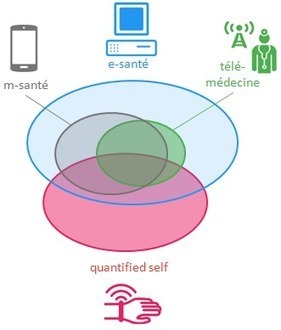
Tour d'horizon de la santé connectée: de la e-santé au quantified self, du dispositif médical aux gadget. Définitions, explications et exemples. Via Philippe Loizon
Scoop.it!
Scoop.it!

According to WHO, cardiovascular diseases (CVDs) are the first cause of death worldwide and in 2012 represented approximately 31% of all global ... Via Celine Sportisse
Scoop.it!

“ eHealth is a relatively new term used to define healthcare practices that take place with the help of electronic processes and communications. Electronic medical services of all kinds have fed in...” Via Philippe Loizon, Gilles Jourquin
Scoop.it!

Annual 2014 recap of some of the most in-depth and well designed health tech infographics including trends transforming health IT , mhealth, etc. Via Sam Stern
Scoop.it!
As a geneticist, talking with George Church or the President of the Personalized Medicine Coalition was a fascinating experience while writing my recently published book, The Guide to the Future of... Via Xavier SEDES
Scoop.it!
|