Your new post is loading...

|
Scooped by
jean lievens
December 12, 2013 4:16 PM
|
For individuals that are employing a CPAP machine, you have to get notes to give to your physician. In the event you expertise any signs and symptoms, like loud snoring, that were eliminated whenever you started off utilizing the CPAP machine plus they revisit, you should let your personal doctor know. Only your personal doctor can correctly assess any troubles. nike air max 90
|
|
Scooped by
jean lievens
December 6, 2013 1:07 AM
|
In the next industrial revolution, will we manufacture goods, or will they construct themselves? architect and computer scientist Skylar Tibbits talks about 4-D printing, programmable matter, and the future of things.
|
|
Scooped by
jean lievens
December 2, 2013 12:48 AM
|
Inside the factory of world’s largest manufacturer of aircraft engines in the fossilized outskirts of Cincinnati, Ohio, GE Aviation is now producing new fuel nozzles using additive manufacturing techniques. The nozzle, which was once constructed by producing and assembling 18 parts is now constructed in a single piece with an overall weight 25% lighter than its predecessor. According to GE Aviation, this new cutting edge technology requires no cutting at all and has given them new degrees of freedom to think about component design.
|
|
Scooped by
jean lievens
November 29, 2013 1:25 AM
|
This talk took place on Wednesday 19th September at the Royal Institution of Great Britain, London.
|
|
Scooped by
jean lievens
November 25, 2013 11:37 AM
|
The recent development of open-source 3-D printers makes scaling of distributed additive-based manufacturing of high-value objects technically feasible and offers the potential for widespread proliferation of mechatronics education and participation. These self-replicating rapid prototypers (RepRaps) can manufacture approximately half of their own parts from sequential fused deposition of polymer feedstocks. RepRaps have been demonstrated for conventional prototyping and engineering, customizing scientific equipment, and appropriate technology-related manufacturing for sustainable development. However, in order for this technology to proliferate like 2-D electronic printers have, it must be economically viable for a typical household.
|
|
Scooped by
jean lievens
November 21, 2013 1:50 PM
|
This essay narrates, from a creator-observation perspective, the production of two works of fiction, a book of short stories and a play, based on the principles and technologies of Commons-based peer production (CBPP). This is potentially interesting from both the CBPP and the literary perspective. Even though both seem well-matched by their prima facie lack of profit orientation, CBPP case studies rarely deal with fiction, and regarding plays, artistic creativity is still mostly associated with one, maybe two. After tracing and analysing the CBPP phenomenon, the case studies show concretely the fate of the specific projects as well as how, nowadays, people can involve in collaborative artistic projects inspired and catalysed by Commons-oriented principles and technologies.
|
|
Scooped by
jean lievens
November 5, 2013 3:44 PM
|
Manufacturing is hard, but it’s getting easier. In every stage of the manufacturing process–prototyping, small runs, large runs, marketing, fulfillment–cheap tools and service models have become available, dramatically decreasing the amount of capital required to start building something and the expense of revising and improving a product once it’s in production.
|
|
Scooped by
jean lievens
October 29, 2013 2:11 AM
|
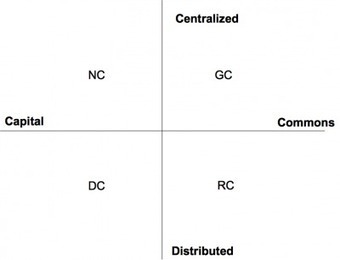
This entry is about the theory of the four future scenarios for a collaborative economy, firstly developed by Michel Bauwens. It is important to mention that Vasilis Kostakis and Michel Bauwens are working on a research monograph that explores the relation of capitalism and the Commons. The book Network Society and Future Scenarios for a Collaborative Economy is contracted by Palgrave Macmillan.
|
|
Scooped by
jean lievens
October 21, 2013 1:09 PM
|
This entry is about the theory of the four future scenarios for a collaborative economy, firstly developed by Michel Bauwens. It is important to mention that Vasilis Kostakis and Michel Bauwens are working on a research monograph that explores the relation of capitalism and the Commons. The book Network Society and Future Scenarios for a Collaborative Economy is contracted by Palgrave Macmillan.
|
|
Scooped by
jean lievens
October 19, 2013 6:50 PM
|
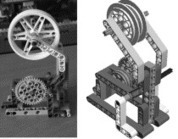
Through the case of the RepRap-based, Lego-built three-dimensional (3D) printing-milling machine, this paper sets out to discuss and illustrate two points: First, on a theoretical level, that modularity, not only in terms of development process but also of hardware components, can catalyze Commons-based peer production’s (CBPP) replication for tangible products enabling social experimentation and learning. Second, the hybrid 3D printing-milling machine demonstrates the digitization of material and the potential of digital fabrication. We show how the synergy of a globally accessible knowledge Commons as well as of the CBPP practices with digital fabrication technologies, which are advancing and becoming more and more accessible, can arguably offer the ability to think globally and produce locally.
|
|
Scooped by
jean lievens
October 19, 2013 5:49 PM
|
= an open, non-hierarchical, collaborative community of humans, including tech developers, citizen scientists, activists, artists ... interested in and working towards social change.
|
|
|
Scooped by
jean lievens
December 6, 2013 11:03 PM
|
While trying to start up a makerspace in my home town of Rome, Georgia over the past year or so, I’ve spent a lot of time thinking about this trend called “the maker movement.” It boils down to people banding together in communities to start workshops for creating, inventing and tinkering. Admittedly, I have a tenancy to over-think things like this, and to seek meaning in places where I should just accept that “it just is.” Easier said than done for me.
|
|
Scooped by
jean lievens
December 5, 2013 5:39 PM
|
Chris Anderson, the former editor-in-chief of Wired, is the cofounder of 3D Robotics, which sells small UAVs. How did he make the jump from editor to entrepreneur? These are the three factors lowering the barriers of entry.
|
|
Scooped by
jean lievens
December 1, 2013 11:43 PM
|
For those that are not familiar with it, open hardware is a practice where designs are shared through open licenses in a community, and those designs can then be used by manufacturers, who can make and sell the product, eventually making a profit, but they cannot rely on any rents deriving from intellectual property. We will see later why open design and free hardware are also linked to new modalities of production, i.e. open and distributed manufacturing
|
|
Scooped by
jean lievens
November 25, 2013 4:47 PM
|
The recent development of open-source 3-D printers makes scaling of distributed additive-based manufacturing of high-value objects technically feasible and offers the potential for widespread proliferation of mechatronics education and participation. These self-replicating rapid prototypers (RepRaps) can manufacture approximately half of their own parts from sequential fused deposition of polymer feedstocks. RepRaps have been demonstrated for conventional prototyping and engineering, customizing scientific equipment, and appropriate technology-related manufacturing for sustainable development. However, in order for this technology to proliferate like 2-D electronic printers have, it must be economically viable for a typical household.
|
|
Scooped by
jean lievens
November 25, 2013 1:30 AM
|
Our colleague Hephaestus, has already embarked on his 3D printer voyage, and so we thought it time to come on board. Being advocates of Open Source, what better way to start than RepRap. RepRap takes the form of an almost free desktop 3D printer capable of printing plastic objects. Since many parts of RepRap are made from plastic and RepRap prints those parts, RepRap self-replicates by making a kit of itself – a kit that anyone can assemble given time and materials. It also means that – if you’ve got a RepRap – you can print lots of useful stuff, and you can print another RepRap for a friend…
|
|
Scooped by
jean lievens
November 17, 2013 10:56 AM
|
"We are a Chilean group called “Red de Evolución Colaborativa” (Collaborative Evolution Network), RedEC. We work in the study, analysis, implementation and promotion of alternative production models.
|
|
Scooped by
jean lievens
October 29, 2013 3:47 PM
|
Creating Self-Building, Self-Tooling, Semi-Autonomous, and Self-Replicating Manufacturing Plants.
|
|
Scooped by
jean lievens
October 21, 2013 1:35 PM
|
This essay set out to show, through the case of the RepRap-based, Lego-built 3D printing-milling machine, two points: First, on a theoretical level, that modularity, not only in terms of development process but also of hardware components, can catalyze CBPP’s replication for tangible products enabling social experimentation, learning and innovation. Second, that the synergy of a globally accessible knowledge Commons as well as of the CBPP practices with digital fabrication technologies, which are advancing and becoming more and more accessible, can arguably offer the ability to think globally and produce locally.
|
|
Scooped by
jean lievens
October 19, 2013 6:51 PM
|
This essay narrates, from a creator-observation perspective, the production of two works of fiction, a book of short stories and a play, based on the principles and technologies of Commons-based peer production (CBPP). This is potentially interesting from both the CBPP and the literary perspective. Even though both seem well-matched by their prima facie lack of profit orientation, CBPP case studies rarely deal with fiction, and regarding plays, artistic creativity is still mostly associated with one, maybe two. After tracing and analysing the CBPP phenomenon, the case studies show concretely the fate of the specific projects as well as how, nowadays, people can involve in collaborative artistic projects inspired and catalysed by Commons-oriented principles and technologies.
|
|
Scooped by
jean lievens
October 19, 2013 6:23 PM
|
This research project attempts to examine to what extent the technological capabilities of open source 3D printing could serve as a means of learning and communication. The learning theory of constructionism is used as a theoretical framework in creating an experimental educational scenario focused on 3D design and printing. In this paper, we document our experience and discuss our findings from a three-month project run in two high schools in Ioannina, Greece. 33 students were tasked to collaboratively design and produce, with the aid of an open source 3D printer and a 3D design platform, creative artifacts. Most of these artifacts carry messages in the Braille language. Our next goal, which defined this project's context, is to send the products to blind children inaugurating a novel way of communication and collaboration amongst blind and non-blind students. Our experience, so far, is positive arguing that 3D printing and design can electrify various literacies and creative capacities of children in accordance with the spirit of the interconnected, information-based world.
|
|
Scooped by
jean lievens
October 19, 2013 8:58 AM
|
A list of P2P Lab collaborators' publications in international peer-reviewed journals, starting from 2013:
|