The technological development of open source three-dimensional (3D) printers is creating more affordable Additive Manufacturing (AM) machines for society in different applications. For this reason, the machines’ capability should be evaluated in order to establish minimum standards of performance. This paper deals with the development, manufacture and testing of a geometrical benchmarking model (GBM) in order to evaluate the geometrical accuracy performance of open source 3D printers. The methodology is demonstrated with a case study based on fused deposition modelling (FDM). The case study positions the evaluated machine according to ANSI-ISO's International Tolerance (IT) Grades. Furthermore, root-mean-square deviation (RMSD) value is employed as an accuracy estimator, while Taguchi tools are employed to determine the control factors with the highest accuracy for the fabrication of the GBM.
"This exploratory paper is a contribution to the discussion of the re-politisation of Participatory Design. After a brief introduction of this Scandinavian design tradition, the Fairphone, a sustainable and fair mobile phone, is introduced as a case to rethink design as politics. Concern for planetary destruction, as a result of climate change, motivates the discussion of Tony Fry's notion of redirective design in the analysis of the Fairphone. Is the Fairphone just 'less bad' or is it paradigmatic example of an alternative technological vision? There are many lessons to be learned from Fairphone, not just by Participatory Design. Most importantly, Fairphone shows the importance of relating the things we help design to futures that become possible or impossible. Participatory Design, with its focus on democratic practices and 'having a say', needs to find ways to bring the voices of future generations into today's design practices." (http://philo.at/ocs2/index.php/oslo14/ctnewd14/paper/viewFile/295/65)
In the past several years, one of the topics covered in detail on these pages has been the surge in such gimmicks designed to disguise lack of demand and end customer sales, used extensively by US automotive manufacturers, better known as "channel stuffing", of which General Motors is particularly guilty and whose inventory at dealer lots just hit a new record high. But did you know that when it comes to flat or declining sales and stagnant end demand, channel stuffing is merely the beginning? Presenting... Where the World's Unsold Cars Go To Die
"this paper reflects a long tradition of utopian thought in engineering, a tradition in which the progressive application of human reason to nature is projected to make the market obsolete. This promise comes in at least two versions. One tendency, epitomised by the ‘red cyberneticists’ in the Soviet Union, primarily objects to the irrationality of the price mechanism, and strives to replace the market with computers as a means of allocating resources (Dyer-Witheford, 2013).
Policy Horizons Canada, a predictive planning organization within the federal government, compiled these and other emerging technology predictions through consulting with experts in a project called MetaScan 3: Emerging Technologies. As part of the report, the group partnered with futurist and data visualization specialist Michell Zappa and his organization Envisioning.
It’s become something of a cliché to talk about the disruptive power of technology, but this doesn’t make it any less of a truism. And if SXSW is about anything, it’s about disruption.
"This article deals with the phenomenon of hackerspaces and sheds light on the relationship of their underlying values, organizational structures and productive processes to those of the online communities of Commons-based peer production projects. While hackerspaces adopt hybrid modes of governance, this article attempts to identify patterns, trends and theory that can frame their production and governance mechanisms. Using a diverse amount of literature and case studies, it is argued that, in many cases, hackerspaces exemplify several aspects of peer production projects’ principles and governance mechanisms."
"DIY Drones, which has blossomed into a community of 30,000 registered members. The site gets 1.4 million page views a month, has 6,000 blog posts, 8,000 discussion threads, and 80,000 comments a year. Anderson has marshaled that community to create open-source software for all sorts of drones." (http://venturebeat.com/2012/07/27/open-source-model-disrupts-the-commercial-drone-business/)
This article deals with the phenomenon of hackerspaces and sheds light on the relationship of their underlying values, organizational structures and productive processes to those of the online communities of Commons-based peer production projects. While hackerspaces adopt hybrid modes of governance, this paper attempts to identify patterns, trends and theory that can frame their production and governance mechanisms. Using a diverse amount of literature and case studies, it is argued that, in many cases, hackerspaces exemplify several aspects of peer production projects’ principles and governance mechanisms.
1. Language, information and the virtual space were distinctive features of the previous generation. Craft, matter and the fusion of the digital and the material are defining generation M, the first generation of the 21st century.
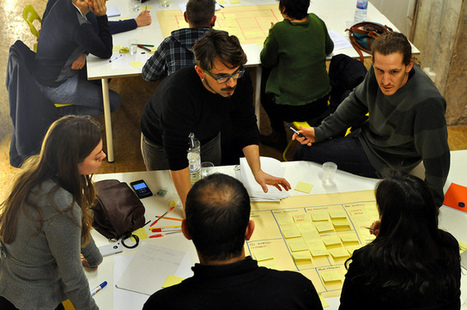
It’s been quite a hectic period during Xmas break, and the year started big with a superb workshop session in Barcelona. Indeed I had the chance to run the third workshop about the Platform Design Toolkit, this time again with more than 50 participants. It was a great experience that spurred new ideas and feedbacks I’m going to incorporate soon in the Toolkit.
More importantly, however, these new technologies enable individuals to reclaim some of the manufacturing independence that was lost with the beginning of industrialization. FabLab manufacturing will never overshadow traditional manufacturing, but it can help to educate the public about modern technology and localized production.
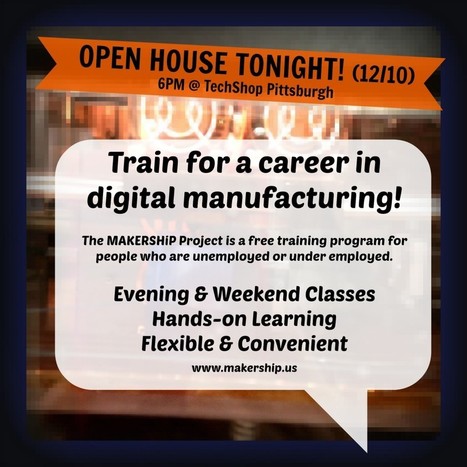
ELYRIA, Ohio—Communities across the U.S. are setting up shops that let the general public experiment with 3-D printers and other high-tech manufacturing tools, in an attempt to encourage young people to consider manufacturing careers, foster entrepreneurs and create jobs.
Pick-and-place (PNP) machines are the robots that grab and drop tiny components onto circuit boards. Designed to make thousands of boards an hour, these super-fast machines are part of the multi-part ballet that is modern manufacturing. And they’re amazingly expensive – sometimes reaching into the millions of dollars.
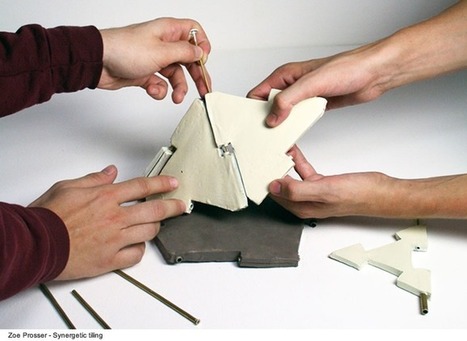
Ceramic Futures: From Poetry to Science Fiction is a project organized by Cersaie – International Exhibition of Ceramic Tile and Bathroom Furnishings to link ceramic, social networks, design and creativity by students coming from four international schools (http://www.ceramicfutures.com/2/).
A couple weeks ago, Daniel Grigg had two problems with the career fair he hosted at Guilford Technical Community College, where it's his job to get graduates on payrolls.
SRI is developing new technology to reliably control thousands of micro-robots for smart manufacturing of macro-scale products in compact, integrated systems.
"Farmers are going to need to rebuild the bee population, and that means more hives and more beekeepers. The Open Source Beehives Project is hoping to achieve that by spreading simple, low-cost hive designs to make it easy for anyone to start their own, and encouraging collaboration among designers, technologists, researchers, and bee lovers. So far, it has two templates: the Colorado Top Bar and the Warré. The groups behind the designs are working on improvements all the time.
A new partnership between GE and Local Motors, an open-source hardware innovator, will pair co-creation and micromanufacturing to build and commercialize next-evolution GE cooking appliances—and expects to have new appliances available to consumers by the end of 2014.
"Using open supply chain mapping software and connecting with local mappeo groups the workgroup's aim is to complete a detailed map of global production networks controlled by 147 largest TNCs managing the world economy. Overall objective is to identify bottle-necks and critical points, spaces, processes on the networks to target stratigically, in case of a union actions or solidairty strikes."
This article deals with the phenomenon of hackerspaces and sheds light on the relationship of their underlying values, organizational structures and productive processes to those of the online communities of Commons-based peer production projects. While hackerspaces adopt hybrid modes of governance, this article attempts to identify patterns, trends and theory that can frame their production and governance mechanisms. Using a diverse amount of literature and case studies, it is argued that, in many cases, hackerspaces exemplify several aspects of peer production projects’ principles and governance mechanisms.
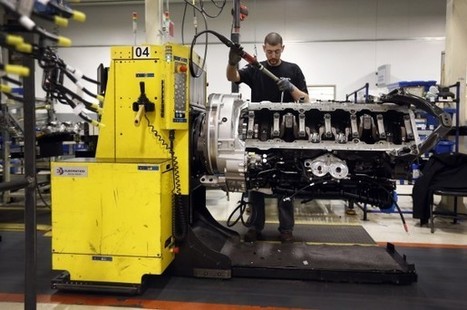
There’s been a lot of discussion recently around the changing face of manufacturing, the forces causing that shift, and how those forces are leading to a world that’s smart and connected — what some refer to as the Internet of Things (IoT). As defined by McKinsey & Company, the “IoT is embedding sensors and actuators in machines and other physical objects to bring them into the connected world.”
To get content containing either thought or leadership enter:
To get content containing both thought and leadership enter:
To get content containing the expression thought leadership enter:
You can enter several keywords and you can refine them whenever you want. Our suggestion engine uses more signals but entering a few keywords here will rapidly give you great content to curate.


 Your new post is loading...