For 17 hours the Greeks are bombarded with the same message to stay inside the Euro you must surrender control or your economy dies. This ultimatum causes ou...
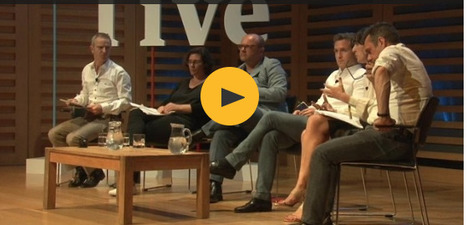
Welcome to the RSA's shiny new YouTube series! '5 mins with...' gives you exclusive, backstage access to the brilliant minds of some of the speakers who've g...
In a preview article at The Guardian last July for his new book Post-Capitalism (“The end of capitalism has begun,” July 17), Paul Mason — following a path previously trodden by John Holloway and by Toni Negri and Michael Hardt — argued that the emergence of a successor system to capitalism would resemble not so much the 19th and 20th century models of storming the bastions of power and seizing control of state and corporate institutions, as the earlier evolution of capitalism itself from within the interstices of feudalism. Post-capitalism will grow from many building blocks in the present system, now present only in nascent form, as the old system succumbs to chronic crisis tendencies and the seeds of the new system grow together into a whole and finally supplant the old one.
This excerpt, chosen and provided to us by Nathan Cravens, is from Paul Mason’s latest book on PostCapitalism: “At present, the community of thinkers and activists around the peer-to-peer movement are heavily focused on experimental, small-scale projects – credit unions or co-ops, for example. When they think about the state, it is at the level …
Excerpted from a critique of the PostCapitalism thesis by Kate Aronoff: “Matt Taibbi wrote in 2010, banks are a “highly sophisticated engine for converting the useful, deployed wealth of society into the least useful, most wasteful and insoluble substance on Earth — pure profit for rich individuals.” Technology is just another hurdle they can ably …
Channel 4's economics editor Paul Mason shows how, from the ashes of the recent financial crisis, we have the chance to create a more socially just and ...
For Mason and others networks are a key liberating tool in moving beyond capitalist relations, but networks are not inherently democratising nor free of hierarchy.
Paul Mason, Economics Editor for Channel 4 News, presents the thesis from his latest book 'PostCapitalism: A Guide to our Future' at St Paul's Cathedral for ...
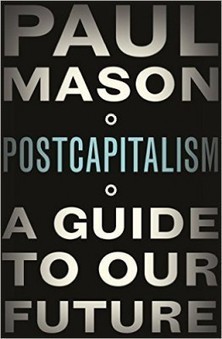
Postcapitalism: A Guide to Our Future by Paul Mason Red Pepper On the one hand are the distributed, peer-to-peer forms of production made possible by new information and communication technologies and especially commons-based peer-to-peer...
The problem with Postcapitalism is that Mason’s strategy doesn’t take into account the moves that capitalists themselves might make. True, it may be easier to imagine the end of the world than the continuation of the capitalist ruling class—but those who currently preside over that system have strong reasons to try to preserve it, and we should assume that their collective powers of imagination are at least as strong as ours. It is all too plausible that as the crises of the twenty-first century start to bite even harder, the ideological structure of the capitalist state—along, perhaps, with its embedded racial hierarchies—will harden, not fall apart. The threat of environmental disaster will serve to justify rather than undermine increasing inequality. Mounting pressure on resources will provide cover for more repressive, retrogressive measures. There will be new ways to silence and buy off the opposition.
The Oscar-nominated account of 2008’s financial collapse shows us the cunning of the men who profited from the sub-prime crash. So where will today’s mavericks be placing their bets?
https://www.youtube.com/watch?v=JnWPltcD-MY An interesting five minutes with Paul Mason courtesy of RSA. Marxist theory of value: labour plus materials plus capital. We now have a fourth factor, information. Information flows freely, all that prevents this flow is repressive intellectual property rights and the Copyright Mafia. Networks of people are information networks. We fail to take a…
Excerpted from Paul Mason‘s latest book on Post-Capitalism (selection by Nathan Cravens): “Given that we are decades into the info-tech era, it is startling that – as Oxford maths professor J. Doyne Farmer points out – there are no models that capture economic complexity in the way computers are used to simulate weather, population, epidemics …
90 minutes of lecture and dialog to explore the theme: “Paul Mason, Economics Editor for Channel 4 News, presents the thesis from his latest book ‘PostCapitalism: A Guide to our Future’ at St Paul’s Cathedral for an event organised by St Paul’s Institute and Penguin UK. Responses from Ann Pettifor (Director, PRIME) and Phillip Blond …
When you want something, all the universe conspires in helping you to achieve it. – Paulo Coelho, The Alchemist Professor of Economics and former Greek Finance Minister Yanis Varoufakis in conversa...
Paul Mason’s recent book ‘Post-Capitalism’ has generated a lot of debate amongst those on the left of British politics; most obviously in interminable and reassuringly repetitive Guardiandebates and opinion pieces. It has also inspired an equal amount of derision from those on the right; most predictably in ‘common-sensey’ reviews from the Telegraph and Spectator. In the book, Mason attempts to explain why he believes the end of capitalism has begun. We can (and do) endlessly debate whether capitalism is in its endgame. What can’t be denied is the increasing importance of one of the causes of Mason’s belief, that is, the advent of ‘commons-based peer production’.
Paul Mason’s latest book, PostCapitalism, presents a vision of a new society, without the horrors of the current capitalist system. However, he no longer sees the possibility of mass working-class struggle to change society and dismisses socialism as an old idea whose time has passed. Peter Taaffe reviews.
Alexis Tsipras’ final election rally had the usual soundtrack and familiar props but a different cast. After more than a fifth of his MPs split to form a new left party, the inner core of party activists behind the stage were nervous. Would anybody more than the party faithful come?
To get content containing either thought or leadership enter:
To get content containing both thought and leadership enter:
To get content containing the expression thought leadership enter:
You can enter several keywords and you can refine them whenever you want. Our suggestion engine uses more signals but entering a few keywords here will rapidly give you great content to curate.


 Your new post is loading...
 Scoop.it!