Pavlos Georgiadis (33) is an international, interdisciplinary food systems researcher, ethnobotanist and social entrepreneur. In this video, he presents his idea for the creation of an online interactive platform to map the food system of Greece.
Greece's ruling party looks likely to will split in two after Thursday's Central Committee session saw the Left Platform accusing Tsipras of "shackling Greece."
The truth of the matter is, the very powerful Troika of creditors were not interested in coming to a sensible, honorable mutually beneficial agreement. -- Yanis Varoufakis The euro was flawed from ...
Whether the crushing of Syriza in Greece for daring to challenge the dominant narrative of the crisis would help or hinder the emergence of a movement for the long awaited political reform of Europe remains to be seen. The only ‘contradiction’ that remains in the eurozone is the utopian expectation that a monetary union will work under German hegemony without political union. ‘Muddling-through’ is no substitute for rational policymaking in the second largest economy in the world.
The Greek debt crisis offers another illustration of Wall Street’s powers of persuasion and predation, although the Street is missing from most accounts. The crisis was exacerbated years ago by a deal with Goldman Sachs, engineered by Goldman’s current CEO, Lloyd Blankfein.
In the face of being excluded from desperately needed funds and the threat of being kicked out of the European Union, the Greek parliament has now voted to accept the Troika memorandum. The Greek Prime Minister Alexis Tsipras acknowledged -- unlike social democrats choosing to implement neoliberalism as part of their ‘modernization‘ -- that this was ‘a bad deal’ forced on the Greeks.
Plan A is the name for the capitulation towards the demands of the creditors, now the most realistic possibility; plan B is the Grexit which offers Greece an independent path within the same economic logic, but with basic sovereign powers to protect and advance their own interests; plan C stands for a Commons Transition, which can take place either under conditions laid out by Plan A or Plan B, but which could become the main strategy under conditions of a revival of popular power and democracy.
Suppose you consider Tsipras an incompetent twerp. Suppose you dearly want to see Syriza out of power. Suppose, even, that you welcome the prospect of pushing those annoying Greeks out of the euro.
It is increasingly likely although not a done deal that Greece will come to an agreement with the 19 European Union countries that use the Euro, the European Central Bank (ECB) and the International Monetary Fund (the troika) in the next week or so. The Greek proposal which can be found on the New York Times website for July 10, 2015 is similar to what the European Union proposed last week and that Greek voters overwhelmingly voted no to last Sunday, July 5th, 2015. There will be a new three year loan to the Greek government of $59 billion dollars and there will be an infusion of Euros into Greek banks so that they can reopen and make loans. Although it is not in the proposed agreement that the Greek parliament has ratified and the European Union countries, the IMF and the ECB still have to ratify, there will be further negotiations that will lead to some reduction of the Greek government debt or extending the payment period after the agreement is signed. It is probable that the Eurozone countries, the IMF and the ECB will accept the latest Greek proposal.
The Italian philosopher Giorgio Agamben said in an interview that "thought is the courage of hopelessness" ─ an insight that is especially pertinent for our historical moment, when even the most pessimistic diagnosis as a rule finishes with an uplifting hint at some version of the proverbial light at the end of the tunnel. The true courage is not to imagine an alternative, but to accept the consequences of the fact that there is no clearly discernible alternative: the dream of an alternative is a sign of theoretical cowardice; it functions as a fetish that prevents us thinking through to the end the deadlock of our predicament. In short, the true courage is to admit that the light at the end of the tunnel is most likely the headlights of another train approaching us from the opposite direction. There is no better example of the need for such courage than Greece today.
By 2010, Greece was bankrupt, no way could Greece repay the debt. But more money was lent to Greece. To help the Greeks? Oh no, the money was used to bail out the feckless bankers.
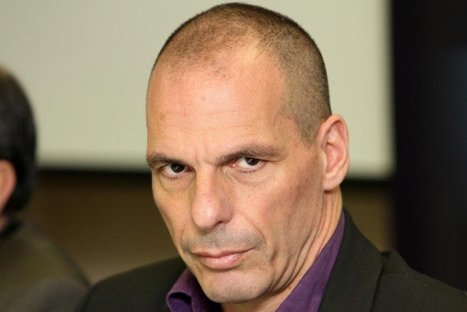
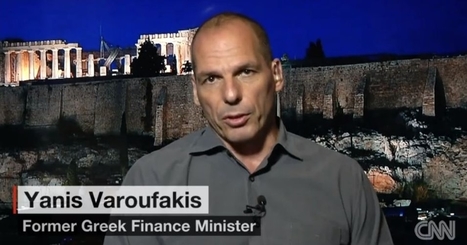
According to former Greek Finance Minister Yanis Varoufakis, prior to making a deal with European creditors, he was authorized to find an alternative way to keep the country's financial health in good standing.
Look, I’ve always been against Grexit – like Varoufakis. But now, as a result of the bailout agreement, Greece is a situation where the costs of staying in the euro have gone up so much that it’s possible to establish that there is a trade-off between going out – and facing all of the short-term costs of leaving the euro – versus staying in a circumstance where you are forced to renounce your sovereignty without getting any economic relief in exchange. I think that Tsipras has made up his mind on this issue and has concluded that the best thing for Greece is to stay in the euro, regardless of the costs. And it’s a respectable decision. But once you start assessing the economic logic and everything that has happened, you can’t but conclude that Greece has no future in the euro.
“A progressive Europe—the Europe of sustainable growth and social cohesion—would be one thing. The gridlocked, reactionary, petty, and vicious Europe that actually exists is another. It cannot and should not last for very long.”
The crushing of political choice is not a side-effect of this utopian belief system but a necessary component. Neoliberalism is inherently incompatible with democracy, as people will always rebel against the austerity and fiscal tyranny it prescribes. Something has to give, and it must be the people. This is the true road to serfdom: disinventing …
After a bruising few days, the Greek government has come up with a new proposal. Helped by the French, who appear to have decided that under no circumstances should Greece be forced out of the Euro, they have produced a detailed document that includes commitments to reform of pensions and taxation. The distinction between this and the European Commission’s unofficial proposal of June 26th is vanishingly small: longer timeframes for elimination of the EKAS supplementary pension and ending of VAT subsidies for the islands makes this proposal a little less like a cliff edge, but as far as I can see that’s about the only difference. Faced with a stark choice between crossing its “red lines” or being forced out of the Euro, the Greek government has caved in.
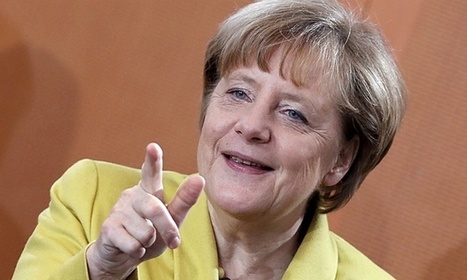
Angela Merkel and Jean-Claude Juncker seek to justify their Greek bailout deal, but what kind of family asset-strips one of its members in broad daylight?
To get content containing either thought or leadership enter:
To get content containing both thought and leadership enter:
To get content containing the expression thought leadership enter:
You can enter several keywords and you can refine them whenever you want. Our suggestion engine uses more signals but entering a few keywords here will rapidly give you great content to curate.


 Your new post is loading...
 Scoop.it!










![[Commentary] | Greece, Europe, and the United States, by James K. Galbraith | Harper's Magazine | Peer2Politics | Scoop.it](https://img.scoop.it/LffcwBYINyNNnEecNuYBWzl72eJkfbmt4t8yenImKBVvK0kTmF0xjctABnaLJIm9)