Your new post is loading...

|
Scooped by
jean lievens
November 24, 2014 8:47 AM
|
Today, knowledge-based work is replacing manufacturing jobs. Robots and software are displacing routine work. Meanwhile, collaborative work is dominating both transactional and production work. The future of valued, human work is in addressing complex problems and coming up with creative solutions.
|
|
Scooped by
jean lievens
November 11, 2014 8:06 AM
|
The internet and technology are often essentialized which then results in versions of technological gnosticism, where technology is either seen as a false god that inevitably plays an evil role in human society, or the different forms of cyber-utopianism. In its most recent iterations, the dark vision takes root in the revelations of Edgar Snowden about NSA and other surveillance, to argue that the internet has become a tool of control and oppression; while for example the bitcoin enthusiasts often see the mis-identified ‘peer to peer’ currency as the tool that will bring down governments and large banks to usher in a anarcho-capitalist utopia.
|
|
Scooped by
jean lievens
November 1, 2014 8:23 AM
|
“We are, it would seem, in the midst of a historical crisis of the capitalist system. As the dynamo effects of the sub-prime collapse ripple through the economy, from financial markets to consumer spending and industrial production, it has become common to point at how our present capitalist system lacks long-term sustainability. If this used to be the privilege of a handful of left-leaning economists like André Gunder Frank (2005) or Robert Brenner (2004), economists, politicians and business leaders who used to be more than happy with the existing order of things have now joined the ranks. Even Richard Florida, whose theories of the ‘creative class’ stood at the heart of the gentrification-driven real estate boom that preceded the present crisis now proclaims that ‘[t]he housing bubble was the ultimate expression, and perhaps the last gasp, of an economic system some 80 years in the making, and now well past its “sell-by date” (Florida, 2009:9).
|
|
Scooped by
jean lievens
October 14, 2014 12:02 PM
|
Reddit’s CEO, Yishan Wong (formerly of Facebook) is doing the right thing. He’s planning to make Reddit’s users into owners, depending on their contribution to the site. There’s a way to create a form of liquid ownership that doesn’t require Wall Street. This new method is based on the bitcoin blockchain. That technology makes it possible to issue ownership to contributors in a decentralized and trusted way. The combination of blockchain stock, Yishan’s example, and the experience of participants will set in motion a wave of change in Silicon Valley. The message is: if you want to build an online company, you better find a way to make your customers/contributors owners.*
|
|
Scooped by
jean lievens
October 2, 2014 5:48 PM
|
Back in the days, one of the proposed demands of the Free Culture Forum in Barcelona, was for proprietary platforms to re-invest 15% of profit back into the community of contributors, but without turning the contributions into commodities, to avoid a return to pure production for money.
|
|
Scooped by
jean lievens
September 2, 2014 12:59 AM
|
Some technology critics, with their laments of cultural decline enabled by Twitter and e-books, are partly to blame. Instead of engaging with attention and distraction socio-economically — as was done with earlier media by Walter Benjamin and Sigfried Kracauer — we get Nicholas Carr, with his embrace of neuroscience, or Douglas Rushkoff, with his biophysiological critique of acceleration (8). Whatever the salience of such interventions, they end up decoupling the technological from the economic, so that we end up debating how the screens of our iPads condition the cognition of our brains — instead of debating how the information gathered by our iPhones conditions the austerity measures of our governments. To be critical of technology today should mean questioning how it and its boosters let the current system buy more time, and stave off an even more existential crisis.
|
|
Scooped by
jean lievens
August 15, 2014 4:49 PM
|
When marketing executives at “values-led” companies try to cultivate communities around ethical consumerism, it creates a new class of problems. Much like religious cults, cult brands manipulate their customers’ emotional and psychological needs and encourage them to construct their identities and lives around the brand. The collapse of the ideal would be felt as a personal catastrophe for its community, so the brand becomes practically immune to criticism.
|
|
Scooped by
jean lievens
July 15, 2014 12:54 PM
|
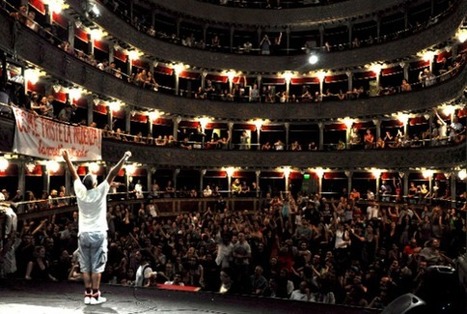
The three-year occupation of Teatro Valle in Rome is now legendary: a spontaneous response to the failures of conventional government in supporting a venerated public theater, and the conversion of the theater into a commons by countless ordinary citizens. Now the mayor of Rome is threatening to end the occupation, evict the commoners and privatize the management of the facility.
|
|
Scooped by
jean lievens
June 24, 2014 3:50 PM
|
Over here the situation is very bad, and people abroad are completely disinformed about it. Every day we read nonsense and bullshit on Grillo by people who completely ignore the reactionary, authoritarian nature of his movement. A harsh reality is biting our arses and we need to send a message in a bottle right now.
|
|
Scooped by
jean lievens
June 11, 2014 5:55 PM
|
Continuing our serialization of Penny Nelson’s interview with Douglas Rushkoff for HiLobrow magazine, this week the conversation turns to the emotional components of debt, the inherent structures of corporations and why men must be kept busy with the front lawn. We recommend that you read the first part if you haven’t already, to get some context. Please, check back on Friday for the third and final installment.
|
|
Scooped by
jean lievens
May 26, 2014 2:12 PM
|
Reposted from the New Economics Foundation website. Here, Alice Martin explores the rising concern about the preponderance of neoclassical economic models in higher education curricula, and what’s being done about it.
|
|
Scooped by
jean lievens
May 19, 2014 1:32 AM
|
At this year’s White House Correspondents’ Dinner — the annual opportunity for the President to engage directly, and humorously, with reporters who cover him — it was expected that most of the jibes would be aimed at Barack Obama. Sure, he gets the chance to defend himself, but it’s pretty much a roast: A leading comedian is invited every year to make jokes, while the commander in chief tries to laugh instead of squirm.
|
|
Scooped by
jean lievens
May 11, 2014 3:09 PM
|
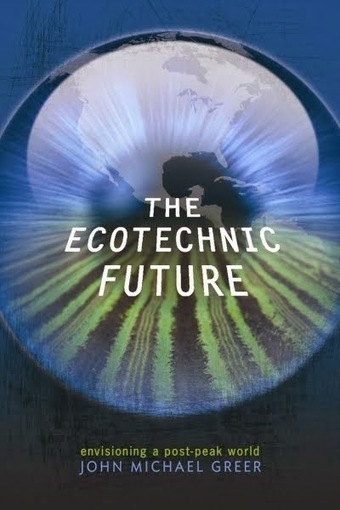
The suicide of peak oil writer Mike Ruppert two days ago puts a bit of additional emphasis on that last point. I never met Ruppert, though we corresponded back in the days when his “From The Wilderness” website was one of the few places on the internet that paid any attention at all to peak oil, and I don’t claim to know what personal demons drove him to put a bullet through his brain. Over the last eight years, though, as the project of this blog has brought me into contact with more and more people who are grappling with the predicament of our time, I’ve met a great many people whose plans for dealing with a postpeak world amount to much the same thing. Some of them are quite forthright about it, which at least has the virtue of honesty. Rather more of them conceal the starkness of that choice behind a variety of convenient evasions, the insistence that we’re all going to die soon anyway being far and away the most popular of these just now.
|
|
|
Scooped by
jean lievens
November 21, 2014 10:09 AM
|
Second of a series of videos from the New School on Digital Labor, includes two video lectures on the future of the sharing economy.
|
|
Scooped by
jean lievens
November 8, 2014 1:37 PM
|
“The past decade has seen a growing emphasis on the social and juridical implications of peer production, commons-based property regimes and the nonrivalrous circulation of immaterial content in the online domain, leading some theorists to posit a digital communism. An acquisitive logic, however, continues to operate through intellectual property rights, in the underlying architecture that supports the circulation of content and in the logical apparatuses for the aggregation and extraction of metadata. The digital commons emerges, not as a virtual space unfettered by material exploitation, but as a highly conflictive terrain, situated at the centre of a mode of capitalism that seeks valorisation for the owners of network infrastructure, online platforms and digital content.
|
|
Scooped by
jean lievens
October 24, 2014 12:42 PM
|
“By controlling their ecosystems, platforms create a stage on which every economic transaction can be turned into an auction. Nothing minimizes cost better than an auction – including the cost of labour. That’s why labour is the crucial societal aspect of platform capitalism. It is exactly here that we will have to decide whether to harness the enormous advantages of platform capitalism and the sharing economy or to create a ‘dumping market’ where the exploited amateurs only have the function to push professional prices down.”
|
|
Scooped by
jean lievens
October 11, 2014 2:08 PM
|
Reddit’s CEO, Yishan Wong (formerly of Facebook) is doing the right thing. He’s planning to make Reddit’s users into owners, depending on their contribution to the site. There’s a way to create a form of liquid ownership that doesn’t require Wall Street. This new method is based on the bitcoin blockchain. That technology makes it possible to issue ownership to contributors in a decentralized and trusted way. The combination of blockchain stock, Yishan’s example, and the experience of participants will set in motion a wave of change in Silicon Valley. The message is: if you want to build an online company, you better find a way to make your customers/contributors owners.*
|
|
Scooped by
jean lievens
September 14, 2014 10:21 AM
|
The political economy of the information machine is discussed within the Marxist tradition of Italian operaismo by posing the hypothesis of an informational turn already at work in the age of the industrial revolution. The idea of valorizing
|
|
Scooped by
jean lievens
August 23, 2014 10:59 AM
|
|
|
Scooped by
jean lievens
July 23, 2014 11:22 AM
|
“The political economy of the information machine is discussed within the Marxist tradition of Italian operaismo by posing the hypothesis of an informational turn already at work in the age of the industrial revolution. The idea of valorizing information introduced by Alquati (1963) in a pioneering Marxist approach to cybernetics is used to examine the paradigms of mass intellectuality, immaterial labour and cognitive capitalism developed by Lazzarato, Marazzi, Negri, Vercellone and Virno since the 1990s. The concept of machinic by Deleuze and Guattari (1972, 1980) is then adopted to extend Marx’s analysis of the industrial machine to the algorithms of digital machines. If the industrial machine can be described as a bifurcation of the domains of energy and information, this essay proposes to conceive the information machine itself as a further bifurcation between information and metadata. In conclusion, the hypothesis of the society of metadata is outlined as the current evolution of that society of control pictured by Deleuze (1990) in relation to the power embodied in databases.”
|
|
Scooped by
jean lievens
July 12, 2014 4:04 PM
|
Thomas Piketty has written a book called Capital that has caused quite a stir. He advocates progressive taxation and a global wealth tax as the only way to counter the trend towards the creation of a “patrimonial” form of capitalism marked by what he dubs “terrifying” inequalities of wealth and income. He also documents in excruciating and hard to rebut detail how social inequality of both wealth and income has evolved over the last two centuries, with particular emphasis on the role of wealth. He demolishes the widely-held view that free market capitalism spreads the wealth around and that it is the great bulwark for the defense of individual liberties and freedoms. Free-market capitalism, in the absence of any major redistributive interventions on the part of the state, Piketty shows, produces anti-democratic oligarchies. This demonstration has given sustenance to liberal outrage as it drives the Wall Street Journal apoplectic.
|
|
Scooped by
jean lievens
June 15, 2014 2:01 AM
|
The ongoing Snowden revelations about NSA surveillance have all sorts of implications for the rule of law, constitutional democracy, geopolitical alignments, human rights and much else. The disclosures deserve our closest attention for these reasons alone. But what do these revelations have to do with the commons?
|
|
Scooped by
jean lievens
June 9, 2014 2:07 AM
|
“Fortunately, Edward Snowden also showed us a pathway out. Governments can maybe made accountable, and mass surveillance can surely be evaded, and made much more costly. By moving away from technology that controls us, we can use, promote and develop technology that makes us more free. It is a long path, requiring efforts, to break away with the habits and the blind trust we placed in the Machine, and requiring an appropriation of technology by everyone. Through the use of free software, decentralized architectures and end-to-end encryption, we can –probably– take back control of the Machine.
|
|
Scooped by
jean lievens
May 24, 2014 5:03 PM
|
In the beginning, there was sharing. That, at least, is the story according to Dominik Wind, a German environmental activist with a genial smile and a cycling cap whom I met in Paris while attending a conference earlier this month about the sharing economy. Years ago, out of curiosity, Wind visited Samoa for half a year; he found that people shared tools, provisions and even sexual partners with their neighbors. Less encumbered by industrial civilization, they appeared to share with an ease and forthrightness long forgotten in the world Wind knew back home.
|
|
Scooped by
jean lievens
May 18, 2014 1:31 AM
|
The voluntariat performs skilled work that might still command a wage without compensation, allegedly for the sake of the public good, regardless of the fact that it also contributes directly and unambiguously to the profitability of a corporation. Like the proletariat, then, the voluntariat permits the extraction of surplus value through its labor.
|