Sarah Corbett is a craft-activist, or "craftivist". She is the founder of Craftivist-Collective, and has worked as a campaigner for NGOs like Oxfam and Christian Aid. Sarah takes a very unique and thoughtful approach to activism. We talked about the intersection between activism and craft-making, how activism can be slow, gentle, and kind, and about the surprising story behind why she made a handkerchief for her Member of Parliament.
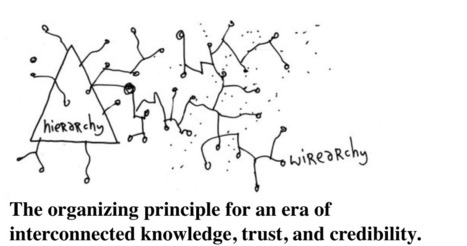
Over the past 10+ years, thousands of people have asked me “what is wirearchy?” There’s one common misconception that I’d like to clear up first, which is that wirearchy is mainly about technology. If anything, wirearchy is about the power and effectiveness of people working together through connection and collaboration … taking responsibility individually and collectively rather than Read More →
Politics and polling data reveal a remarkable shift in American attitudes toward socialism. More Democrats now view socialism favorably (42 percent) than unfavorably (34 percent). Among young adults, socialism does even better with a 43 percent favorable view vs. only 26 percent unfavorable. Presidential candidate Bernie Sanders, a self-described Democratic Socialist, has surprised the establishment with the strength of his campaign.
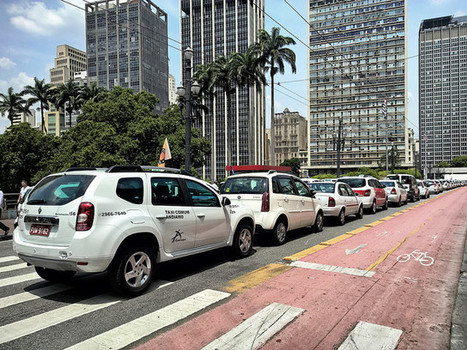
Taxi drivers in Sao Paulo recently protesting the regularization of TNCs such as Uber. Photo by: Diego Torres Silvestre / Flickr How to regulate and manage the emerging services of shared and on-demand mobility? This was a topic of much debate during the most recent Transforming Transportation event, a major global conference of transport professionals organized by the World Bank and the World Resources Institute in Washington DC in January 2016. One recent development from Sao Paulo stands out as a worthwhile effort to balance the objectives of promoting innovation by Transportation Network Companies (TNCs, such as Uber, Lyft, EasyTaxi, 99Taxi, and others) and ridesharing services (such as BlablaCar, Caronetas, Tripda and others) with the interests of the city and its residents. The Municipal Government of Sao Paulo has published for public comments until January 27, 2016 a draft decree to charge TNCs an upfront fee based on an estimate of vehicle-kilometers, also referred to as “credits”, to be used by its fleet of passenger cars in a two month period, plus a surcharge if credits are exceeded. The idea is that any registered TNC could bid in an online public auction to purchase credits periodically and with certain limitations to ensure competition. This approach would create a market for these credits and be aligned with the principle commonly known in the vehicle insurance industry as “pay-as-you-drive”, and would allow the city to receive a fee from TNCs for the commercial use of its public road infrastructure, which can then be used to better manage and maintain it. The decree would exempt free ridesharing services which the city believes would help reduce the total number of vehicle-kilometers on its congested road network.
What are the world's most pressing problems? Every day governments, foundations, and individuals need to make hard choices about what to prioritise. Limited resources must be wisely split between worthwhile causes. But prioritising requires sophisticated methods, especially when it involves un
Here are some impressions after reading Karatani Kōjin's Teikoku no kōzō: Chūshin shūhen ashūhen (The structure of empire: Centre, margin, submargin), which is a follow-up on his Rekishi no kōzō (published in English as The Structure of History). Although covering much of the same terrain as the latter, the new work's substantial historical discussions centered on China and Japan are a welcome addition to the older work. The new book also introduces a theoretical novelty, namely the distinction between two kinds of nomadism (an idea that also plays a central role in Yûdôron, a companion piece on Yanagita Kunio and nomadism which also appeared last year). Finally, the new book is notable for its carefully celebratory description of empire, which is shown to contain utopian elements..
The 'Not Alone' report offers solution for freelance workers with analyses, useful detail and lessons from the history of co-operatives and mutual aid.
Part Three in my video series on the wage gap aims to open a creative conversation about the future of work, money and gender. I start by discussing some o
Tammy Lea Meyer and Katalin Hausel explore unMonastery, a social clinic for the future. It is a place-based social innovation is aimed at addressing the interlinked needs of empty space, unemployment and depleting social services by embedding committed, skilled individuals within communities that could benefit from their presence.
In the context of our foresight project on the “sharing economy” we carried out a second workshop on 25-26 February. Building on the relevant drivers of change identified in the 1st workshop in December 2015, a set of four future scenarios was developed to be further enriched and used as a basis for discussion. About 40 participants from “sharing economy” platforms, academia, international organisations, trade unions, agency work industry, think tanks, and Commission Services shared their views and ideas about future platform-mediated labour markets, a sector of the ‘sharing economy’ with potentially strong implications for the future of work, and the focus of this workshop.
We live in a time of digital Darwinism, an era when technology and its impact on business and society are constant with varying, but inevitable, degrees of both evolution and revolution. The effect of
What happens when a darling Brooklyn start-up succumbs to capitalist greed? Uh, the dreams go poof; you lose your job, and most of your faith in humanity.
Today I head out to a month-long series of events associated with identity: I’m starting with the 22st (!) Internet Identity Workshop next week; then I’m speaking at the blockchain conference Consensus about identity; next I am part o
Ralph Nader presents Breaking through Power—Citizens Revolutionary Week. Celebrating the 50th anniversary year of Ralph Nader’s book Unsafe at Any Speed, the Center for Study of Responsive Law announces four days of civic mobilization at Constitution Hall in Washington, D.C. on May 23, 24, 25 and 26, 2016.
"Karatani Kojin’s (1941- ) recent thought offers a novel way of grappling or dealing with the dilemma which we pointed to in Yoshimoto and Asada, namely how the aspiration to work for societal change could be combined with an affirmation of the masses’ withdrawal from public involvement. The question is particularly timely since the 90’s has been a decade in which much discontent with the system has taken the form of exit – from school, marriage, the labor market or (in the case of the social withdrawal) from social life tout court. Can such discontent be turned into effective forms of resistance? Can it be channeled in ways that could further social change? Today questions such as these have gained renewed importance.
Yanis Varoufakis on Democracy Now discussing the fiscal waterboarding Greece was subjected to. Greece dared challenge the EU dictatorship. For that Greece had to be punished. The loans to Greece did not bail out Greece, they were bailouts for French and German banks. The money flowed into Greece, and straight…
To get content containing either thought or leadership enter:
To get content containing both thought and leadership enter:
To get content containing the expression thought leadership enter:
You can enter several keywords and you can refine them whenever you want. Our suggestion engine uses more signals but entering a few keywords here will rapidly give you great content to curate.




 Your new post is loading...
 Scoop.it!