Your new post is loading...

|
Scooped by
jean lievens
May 11, 2014 2:30 PM
|
"Based on the examples of two collectives preparing lunches and giving them for free with an option of donation at Montreal universities, this article considers how services of general interest could be organized in an alternative way — namely how the combination of paid and unpaid work, spontaneous work involving high number of volunteers, and the dissociation of annual income from sale of output can serve as a model for providing needed public services. The probable expansion of such services in the future is supported by several current trends in the developed countries: for example, underemployment of human resources, a new work ethos, and the democratic deficit inherent in the current system of service provision by state or market providers. This article applies the case study method to illustrate citizens’ attitudes and to consider what structural and organizational changes may be needed to set up an alternative form of service provision potentially applicable to other venues."
|
|
Scooped by
jean lievens
April 17, 2014 1:07 AM
|
"Peer production has often been described as a ‘third mode of production’, irreducible to State or market imperatives. The creation and organisation of peer projects allegedly take place without ‘managerial commands’ or ‘price signals’, without recourse to bureaucratic apparatuses or the logic of competitive markets. Instead, and mimicking the technical architectures upon which many peer projects are based, production is described as non-hierarchical and decentralised. Group dynamics are also commonly described as ‘flat’ and this is captured, of course, in the very notion of the ‘peer’. When tested against the realities of actual projects, however, such early conceptions of peer production are, at best, in need of further elaboration and qualification. At worst, they were always off the mark. Hierarchies persist in peer production, as does competition and market-like arrangements. But perhaps it is the qualities of these new hierarchies and competitive forms that is novel. After all, liberal democracies, dictatorships, corporations, local sports clubs, and families all have their hierarchies but none is reducible to the others.
|
|
Scooped by
jean lievens
March 27, 2014 4:08 PM
|
* Article: Echo Chamber or Public Sphere? Predicting Political Orientation and Measuring Political Homophily in Twitter Using Big Data. By Elanor Colleoni1, Alessandro Rozza and Adam Arvidsson. Journal of Communication, Vol. 64 Issue 1, March 2014.
|
|
Scooped by
jean lievens
February 14, 2014 3:31 PM
|
This article deals with the phenomenon of hackerspaces and sheds light on the relationship of their underlying values, organizational structures and productive processes to those of the online communities of Commons-based peer production projects. While hackerspaces adopt hybrid modes of governance, this paper attempts to identify patterns, trends and theory that can frame their production and governance mechanisms. Using a diverse amount of literature and case studies, it is argued that, in many cases, hackerspaces exemplify several aspects of peer production projects’ principles and governance mechanisms.
|
|
Scooped by
jean lievens
January 22, 2014 2:53 PM
|
P2P Lab is an independent media lab interested in interdisciplinary research on free/open source technologies and practices.
|
|
Scooped by
jean lievens
January 11, 2014 4:37 PM
|
= the Program on Liberation Technology seeks to understand how information technology can be used to defend human rights, improve governance, empower the poor, promote economic development, and pursue a variety of other social goods.
|
|
Scooped by
jean lievens
November 25, 2013 4:47 PM
|
The recent development of open-source 3-D printers makes scaling of distributed additive-based manufacturing of high-value objects technically feasible and offers the potential for widespread proliferation of mechatronics education and participation. These self-replicating rapid prototypers (RepRaps) can manufacture approximately half of their own parts from sequential fused deposition of polymer feedstocks. RepRaps have been demonstrated for conventional prototyping and engineering, customizing scientific equipment, and appropriate technology-related manufacturing for sustainable development. However, in order for this technology to proliferate like 2-D electronic printers have, it must be economically viable for a typical household.
|
|
Scooped by
jean lievens
November 21, 2013 1:50 PM
|
This essay narrates, from a creator-observation perspective, the production of two works of fiction, a book of short stories and a play, based on the principles and technologies of Commons-based peer production (CBPP). This is potentially interesting from both the CBPP and the literary perspective. Even though both seem well-matched by their prima facie lack of profit orientation, CBPP case studies rarely deal with fiction, and regarding plays, artistic creativity is still mostly associated with one, maybe two. After tracing and analysing the CBPP phenomenon, the case studies show concretely the fate of the specific projects as well as how, nowadays, people can involve in collaborative artistic projects inspired and catalysed by Commons-oriented principles and technologies.
|
|
Scooped by
jean lievens
October 21, 2013 1:35 PM
|
This essay set out to show, through the case of the RepRap-based, Lego-built 3D printing-milling machine, two points: First, on a theoretical level, that modularity, not only in terms of development process but also of hardware components, can catalyze CBPP’s replication for tangible products enabling social experimentation, learning and innovation. Second, that the synergy of a globally accessible knowledge Commons as well as of the CBPP practices with digital fabrication technologies, which are advancing and becoming more and more accessible, can arguably offer the ability to think globally and produce locally.
|
|
Scooped by
jean lievens
October 20, 2013 11:38 AM
|
Unfortunately, not everyone has access to the scholarly literature, despite advances in communications technology. The high cost of academic journals restricts access to knowledge; in some fields, prices can reach $20,000 for a single journal subscription1 or $30 for an individual article.2 Despite these high prices, authors of scholarly articles are not paid for their work. The profits from these publications go solely to the publishers of the journals. A vast amount of research is funded from public sources – yet taxpayers are locked out by the cost of access.
|
|
Scooped by
jean lievens
October 19, 2013 8:58 AM
|
A list of P2P Lab collaborators' publications in international peer-reviewed journals, starting from 2013:
|
|
Scooped by
jean lievens
October 1, 2013 1:16 AM
|
"The Transition Research Network (TRN) is a self-organising peer group of academics and community activists which aims to: Help advance understanding and practice in Transition; Support Transition groups to address their research needs Help transform the crisis in our universities into an opportunity for positive change in research culture, making research relevant, fulfilling, and fun.
|
|
|
Scooped by
jean lievens
April 17, 2014 3:59 PM
|
* Value and Currency. Ed. by Nathaniel Tkacz, Nicolas Mendoza and Francesca Musiani. Journal of Peer Production, ISSUE 4: JANUARY 2014. (April 2014)
|
|
Scooped by
jean lievens
March 28, 2014 5:21 PM
|
"MOOR (massive online open research) is a project at the University of Amsterdam which seeks to create software so that qualitative research can be performed open, online and collaboratively. Specifically, we are looking for ways to discuss and draw conclusions about data materials (such as text and imagery) collaboratively.
|
|
Scooped by
jean lievens
March 20, 2014 4:50 PM
|
A cursory glance at the comment section of the UK's leading newspapers suggests that democratic engagement is at an all time low; we are generation apathetic. In their annual health check, the Audit of Political Engagement, the Hansard Society paint a bleak picture of participation trends in Britain. Only 41% of those surveyed are committed to voting in the next General Election. Moreover, less than 1% of the population is a member of a political party. However, 38 Degrees, the political activist movement, bucks these downward trends. In the four years since their foundation in 2009, 38 Degrees have amassed a membership of 1.8 million individuals—more than three times the entire combined memberships of all of Britain’s political parties.
|
|
Scooped by
jean lievens
January 23, 2014 3:35 PM
|
"When the world recession in 2008 began, the economy wars, which had been dormant for two decades, flared again. After thirty years of the culture wars, this came as a bit of a relief.
|
|
Scooped by
jean lievens
January 19, 2014 11:46 AM
|
Zotero is a powerful, easy-to-use research tool that
helps you gather, organize, and analyze sources and then
share the results of your research.
|
|
Scooped by
jean lievens
November 29, 2013 10:48 AM
|
This studentship is jointly funded by EPSRC and the School of Business, Management and Economics at the University of Sussex. Applicants are sought for a three-year, fully funded PhD scholarship at SPRU, in the School of Business, Management and Economics at the University of Sussex.
|
|
Scooped by
jean lievens
November 22, 2013 6:50 PM
|
This essay narrates, from a creator-observation perspective, the production of two works of fiction, a book of short stories and a play, based on the principles and technologies of Commons-based peer production (CBPP). This is potentially interesting from both the CBPP and the literary perspective. Even though both seem well-matched by their prima facie lack of profit orientation, CBPP case studies rarely deal with fiction, and regarding plays, artistic creativity is still mostly associated with one, maybe two. After tracing and analysing the CBPP phenomenon, the case studies show concretely the fate of the specific projects as well as how, nowadays, people can involve in collaborative artistic projects inspired and catalysed by Commons-oriented principles and technologies.
|
|
Scooped by
jean lievens
October 27, 2013 7:06 PM
|
"D-CENT will provide civil society with immediately useable digital tools for direct democracy and economic empowerment. It will also grow longer-term alternatives to today’s highly centralised platforms and power structures. D-CENT will create an open, federated, and decentralised social networking platform based on integrating already successful open-source codebases, with tens of thousands of users in three pilots. The modular platform enable to share in real-time open data, democratic decision making tools, and digital social currency for the social good. The D-CENT platforms will go beyond data aggregation to enable deliberation and collective judgement, informed by feedback.
|
|
Scooped by
jean lievens
October 21, 2013 1:09 PM
|
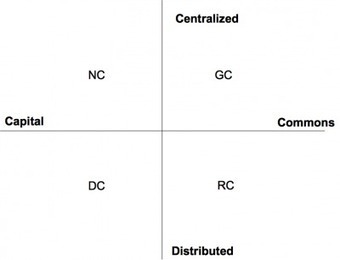
This entry is about the theory of the four future scenarios for a collaborative economy, firstly developed by Michel Bauwens. It is important to mention that Vasilis Kostakis and Michel Bauwens are working on a research monograph that explores the relation of capitalism and the Commons. The book Network Society and Future Scenarios for a Collaborative Economy is contracted by Palgrave Macmillan.
|
|
Scooped by
jean lievens
October 19, 2013 6:51 PM
|
This essay narrates, from a creator-observation perspective, the production of two works of fiction, a book of short stories and a play, based on the principles and technologies of Commons-based peer production (CBPP). This is potentially interesting from both the CBPP and the literary perspective. Even though both seem well-matched by their prima facie lack of profit orientation, CBPP case studies rarely deal with fiction, and regarding plays, artistic creativity is still mostly associated with one, maybe two. After tracing and analysing the CBPP phenomenon, the case studies show concretely the fate of the specific projects as well as how, nowadays, people can involve in collaborative artistic projects inspired and catalysed by Commons-oriented principles and technologies.
|
|
Scooped by
jean lievens
October 5, 2013 11:43 AM
|
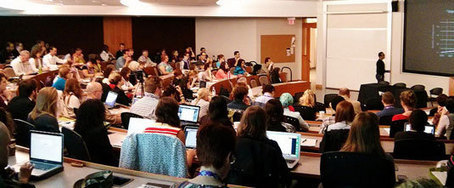
Nearly 200 researchers and professionals attended Canada’s second major interdisciplinary symposium looking at the effects of social media on society.
|