Your new post is loading...

|
Scooped by
jean lievens
July 29, 2015 2:04 PM
|
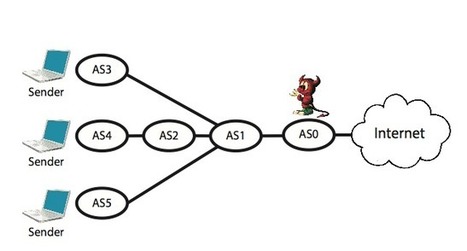
This is a paper proposing improvements to onion routing, which anonymises data traffic and communications on the internet. The proposal is to put the routing protocol at network level, providing higher speed transmission and adding encryption features. HORNET: High-speed Onion Routing at the Network Layer In this paper, we address the question of “what minimal …
|
|
Scooped by
jean lievens
July 6, 2015 12:22 PM
|
We see the internet not as a given or a ‘essentialized technology’, but as a locus of struggle between different values and usages, determined by the design of the systems, ‘by whom and for whom’. Right now the internet is the result of a mix of influences, the original military research and public funding, the mentalities of the scientists who worked on it, the influence of private investors and designers, and the influence of the choices of the public and user communities. The internet we would want would be significantly more ‘socialized’, made sustainable, and used for a fundamental transition of the mode of production, i.e. creating and distributing value.
|
|
Scooped by
jean lievens
July 2, 2015 3:12 PM
|
Watch this short introductory film about SourceMap:
|
|
Scooped by
jean lievens
June 22, 2015 5:38 AM
|
Excerpts selected by Hudson Luce: Section “106. The basic problem goes even deeper: it is the way that humanity has taken up technology and its development according to an undifferentiated and one-dimensional paradigm. This paradigm exalts the concept of a subject who, using logical and rational procedures, progressively approaches and gains control over an external …
|
|
Scooped by
jean lievens
June 2, 2015 3:03 PM
|
Excerpted from a transcript of a lecture by Moglen in New Delhi, India (“Software Patents and the Commons”), by Tech Chords: Eben Moglen: “In the 21st century though, the economies of scale of the hierarchical production don’t quite work. Moglen believes that digital culture and digital economic life do not reward economies of scale. They …
|
|
Scooped by
jean lievens
May 19, 2015 5:41 PM
|
Source: shareable.net. Nice overview by Nina Misuraca Ignaczak of the rapidly maturing technologies which are set to move power out of the hands of centralised organisations and help usher in a new world of resilient distributed networks. Featuring OpenGarden, whose FireChat iPhone app is proving immensely popular, even outstripping Facebook and Twitter in daily download …
|
|
Scooped by
jean lievens
May 8, 2015 3:37 PM
|
“Latinamerica is particularly well equipped for these changes (peer production) by their cultural affinity with the values of P2P”, said Michel Bauwens on an interview for Pagina/12 the Argentinian journal.
|
|
Scooped by
jean lievens
April 18, 2015 4:54 AM
|
Excerpted from William Irwin Thompson: “DECENTRALIZATION of cities and the miniaturization of technology will alter the center-periphery dialectic of traditional civilization and make a whole new cultural level possible. What will take place in the metaindustrial village will be that the four classical economies of human history, hunting and gathering, agriculture, industry, and cybernetics, will …
|
|
Scooped by
jean lievens
April 7, 2015 9:12 AM
|
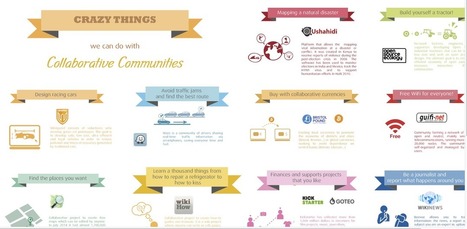
The last in the series of free posters about Commons-Based Peer Production produced by P2Pvalue & designed by Laura Recio shows some of the crazy things we can do with collaborative communities.
|
|
Scooped by
jean lievens
April 3, 2015 7:05 PM
|
Technology for big computers, electric cars and high-technology microcontrollers to operate things like power tools and engines is now given away. These ideas used to be valued at hundreds of millions of dollars. To the new generation of technologists, however, moving projects and data fast overrides the value of making everything in secret. Excerpted from …
|
|
Scooped by
jean lievens
March 18, 2015 6:35 PM
|
Excerpted from Marc Chataigner:
“Technology is a specific set of know-how and habits that will shape the way you interact with the world surrounding you, thus shape the way you see the world.
|
|
Scooped by
jean lievens
March 15, 2015 4:42 AM
|
Bitcoin has taken quite a beating for its libertarian design biases, price volatility due to speculation, and the questionable practices of some currency-exchange firms. But whatever the real or perceived flaws of Bitcoin, relatively little attention has been paid to its “engine,” known as “distributed ledger” or “blockchain” technology. Move beyond the superficial public discussions about Bitcoin, and you’ll discover a software breakthrough that could be of enormous importance to the future of commoning on open network platforms.
|
|
Scooped by
jean lievens
March 11, 2015 2:42 AM
|
Skype is part of TechCrunch’s newsroom workflow. It’s the standard way that individual authors converse, share, collaborate and the like. We use other software to work as a team, but for one-on-one chats, Skype is our jam.
|
|
|
Scooped by
jean lievens
July 28, 2015 5:05 PM
|
Tufekci: Autocratic regimes don’t stay in power for decades by governing randomly; rather, they do so by following a tried-and-tested playbook of strategic censorship, isolation and repression of dissent. And control over information flows and the public sphere is a key element of this model of autocratic regime. Regimes in the Middle East actively sought to prevent and control the spread of information because they understood that keeping sparks of dissent from lighting prairie fires of uprisings was crucial. Dissidents were punished disproportionately – long prison sentence for the smallest offenses, torture — not just because the security forces happened to be composed of sadists, but because of the same problem: to prevent cascades of dissent from taking off. The Internet has opened up the public sphere; it has allowed citizens to express their views and coordinate with each other. Does that always lead to revolution? No, you need the dissent to be there on the ground. But it does mean that such that regimes cannot continue to govern as before. They are forced to play a new game.
|
|
Scooped by
jean lievens
July 4, 2015 12:51 PM
|
B4RN is a documentary by James Uren and Suzette Heald, starring the volunteers who have built their own gigabit fibre network in rural Lancashire. An example for all! Watch the video here:
|
|
Scooped by
jean lievens
June 23, 2015 1:52 PM
|
This post from the P2Pvalue blog by Florian Glatz is based on an article by Primavera de Filippi posted on Internet Policy Review – read the full article here Today we want to point you to one of the many studies we are conducting at P2PValue, regarding the different applications of peer-to-peer technology in today’s networked information …
|
|
Scooped by
jean lievens
June 7, 2015 10:05 AM
|
“Many of the brand-name gizmos that we associate with the Internet age—iPhones, Facebook, Twitter and Google—are indeed formidable tools for distraction, extraction and surveillance. But these are not, in fact, our only options. This month in The New Republic, I propose a different way: “Slow Computing.”
|
|
Scooped by
jean lievens
May 24, 2015 1:27 PM
|
A new legal and technological entity called a Distributed Collaborative Organization represents a new way of organizing multi-stakeholder cooperatives at scale. Could the difference between dystopia and protopia pivot on the structure of ownership? Excerpted from Noah Thorp, on Disintermediating Banking and User Accounts: “The revolution in progress can generally be described as “disintermediation”. It …
|
|
Scooped by
jean lievens
May 16, 2015 3:04 AM
|
“Should we fear or welcome the internet’s evolution? The latest smart televisions now watch us, and report on our behavior to their manufacturers. If you don’t pay the bills on your car loan, the bank may shut down your car while you are hiking in a park. The latest pacemaker may save your life, but the data on your heartbeats doesn’t belong to you or your doctor. Recently, a refrigerator was caught sending spam. The “internet of things” is made up of device networks–connected objects—eyeglasses, cows, thermostats—with sensors and internet addresses.
|
|
Scooped by
jean lievens
April 19, 2015 11:38 AM
|
‘machines don’t explain anything, you have to analyze the collective apparatuses of which the machines are just one component’ * Article: Italian Operaismo and the Information Machine. Matteo Pasquinelli. From the abstract: “The political economy of the information machine is discussed within the Marxisttradition of Italian operaismo by posing the hypothesis of an informational turn …
|
|
Scooped by
jean lievens
April 17, 2015 4:50 PM
|
Breaking The Frame is a growing network, which aims to democratise decisions about technology. We are bringing together different campaigns in order to learn from each others’ experience and strengthen our work. They explain: “Breaking the Frame started around the Breaking the Frame Gathering in 2014, aimed at a deeper understanding of the politics of …
|
|
Scooped by
jean lievens
April 4, 2015 4:16 PM
|
Technology for big computers, electric cars and high-technology microcontrollers to operate things like power tools and engines is now given away. These ideas used to be valued at hundreds of millions of dollars. To the new generation of technologists, however, moving projects and data fast overrides the value of making everything in secret. Excerpted from …
|
|
Scooped by
jean lievens
March 18, 2015 6:50 PM
|
You may think that, in order to free yourself from that specific way to see the world, you should free yourself from technology ; you’ll be partly right, only partly, because without any set of given technology, a human cannot perceive nor interact much with the world around him.
|
|
Scooped by
jean lievens
March 17, 2015 4:50 PM
|
We are all hackers now, apparently—or are trying to be. Guilty as charged. I am writing these words, as I write most things, not with a pen and paper, or a commercial word processor, but on Emacs, a command-line text editor first developed in the 1970s for that early generation of free-software hackers. I had to hack it, so to speak, with a few crude lines of scripting code in order that it would properly serve my purposes as a writer. And it does so extremely well, with only simple text files, an integrated interpreter for the Markdown markup language, and as many split screens as I want. I get to feel clever and devious every time I sit down to use it.
|
|
Scooped by
jean lievens
March 14, 2015 2:33 PM
|
Behind the superficial public discussions about Bitcoin you’ll discover a software breakthrough that could change the future of commoning on open networks
|