Your new post is loading...

|
Scooped by
jean lievens
October 23, 2014 1:39 PM
|
Instead of waiting for political policy makers to lure clean manufacturing jobs back into domestic markets, some entrepreneurs have turned to the latest 3-D printing technology to take matters into their own hands. For example, Peter Weijmarshausen, Founder and CEO of Shapeways, has big plans for his 3-D printing start up.
|
|
Scooped by
jean lievens
October 1, 2014 6:30 PM
|
"As Tomás Diez, director of the Fab Lab Barcelona project, explains in interview at owni.eu held in November 2011, their idea is to make Barcelona a Fab City. The current urban layout of Barcelona can be seen as a product of major events like the 1992 Olympics and the Universal Forum of Cultures in 2004. For the future of Barcelona, Vincente Guallart (former director of the IAAC and chief architect of Barcelona), and Antoni Vives (deputy mayor in charge of urban planning and information and technology) aim to build Barcelona 5.0.
|
|
Scooped by
jean lievens
September 30, 2014 1:51 PM
|
The maker movement is on the rise. There are already over one million Etsy sellers worldwide. Together, they sold over $1.35 billion worth of goods in 2013. The emerging maker movement offers the tantalizing promise of a better economy—one that puts people at the center of commerce, promotes local, sustainable production, and empowers anyone to build a creative business on their own terms.
|
|
Scooped by
jean lievens
September 15, 2014 12:19 PM
|
"This research project attempts to examine to what extent the technological capabilities of open source 3D printing could serve as a means of learning and communication. The learning theory of constructionism is used as a theoretical framework in creating an experimental educational scenario focused on 3D design and printing. In this paper, we document our experience and discuss our findings from a three-month project run in two high schools in Ioannina, Greece. 33 students were tasked to collaboratively design and produce, with the aid of an open source 3D printer and a 3D design platform, creative artifacts. Most of these artifacts carry messages in the Braille language. Our next goal, which defined this project’s context, is to send the products to blind children inaugurating a novel way of communication and collaboration amongst blind and non-blind students. Our experience, so far, is positive arguing that 3D printing and design can electrify various literacies and creative capacities of children in accordance with the spirit of the interconnected, information-based world."

|
Suggested by
Inside3DP.com
September 11, 2014 4:57 PM
|
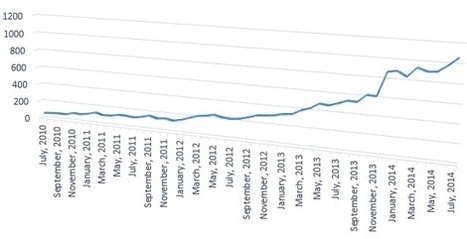
A recent analysis of trends shows a massive increase in demand for jobs in additive manufacturing and rapid prototyping over the past four years.
|
|
Scooped by
jean lievens
August 24, 2014 11:37 AM
|
* Paper: A systems and thermodynamics perspective on technology in the circular economy. By Crelis F. Rammelt and Phillip Crisp. real-world economics review, issue no. 68
|
|
Scooped by
jean lievens
August 20, 2014 5:50 PM
|
Around the globe, intelligent and pervasive industrial automation has been catapulted in recent years to a top national or regional priority. Known by different names, e.g., “Advanced Manufacturing”, “Smart Manufacturing”, “Industry 4.0” or “Factories of the Future” to highlight a few, these initiatives all bear the same characteristics, i.e., transforming the manufacturing process from a patchwork of isolated silos to a nimble and seamless whole fully integrated with the downstream and upstream production environment.
|
|
Scooped by
jean lievens
August 13, 2014 12:47 PM
|
Have you heard about the open-source revolution? Like 3D printing, it only recently made its way into the mainstream, but like the additive manufacturing machines, it has been around for a while.
|
|
Scooped by
jean lievens
August 7, 2014 5:25 PM
|
|
|
Scooped by
jean lievens
July 23, 2014 9:59 AM
|
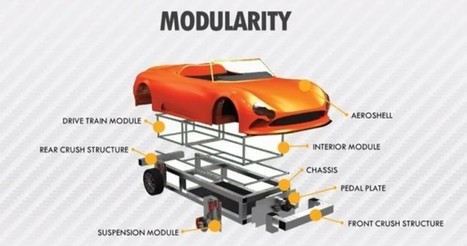
Welcome to the Agile eXtreme Manufacturing Build Party! Use Scrum to build a car in 60-minute sprints.
|
|
Scooped by
jean lievens
June 27, 2014 3:18 PM
|
Not long ago, if you were a mechanical engineering student, that meant hours and hours in the machine shop, perfecting your lathing and milling. But with the rise of 3-D printers — machines that can build objects based on a computer design — that is beginning to change.
|
|
Scooped by
jean lievens
June 19, 2014 5:03 PM
|
Over the last few years, 3D printing has become all the rage as the technologies behind it are gradually commercialized. Bidness Etc looks at how 3D printing is used in industrial-level manufacturing processes
|
|
Scooped by
jean lievens
June 15, 2014 2:25 AM
|
The Arts and Crafts Movement of late 19th century England professed to democratize art and the production wares. The most prominent character of the Movement was poet, craftsman and socialist William Morris. I claim that today open source philosophy and peer production combined with 3D printing technology represents a similar philosophy about the democratization of production as the 19th century Arts and Crafts Movement. 3D printing is a nascent technology which allows the physical rendering (prototyping) of computer models. As The Arts and Crafts Movement was opposed to machines, I try to ascertain to what extent the Movement’s opposition toward the machine extends and what it is based on. Therefore, I discuss the machine’s two-sided role as, on the one hand, the destroyer of art, and on the other hand, the saviour of art.
|
|
|
Scooped by
jean lievens
October 11, 2014 1:30 PM
|
New section to focus on the link between open hardware, distributed manufacturing, and ecological/sustainability concerns
|
|
Suggested by
Inside3DP.com
September 30, 2014 3:06 PM
|
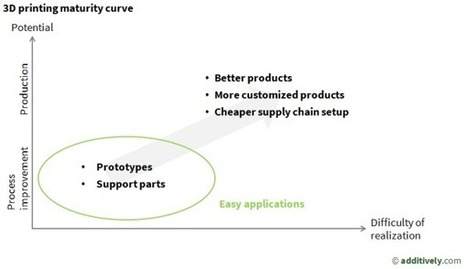
Companies and start-ups have started using 3D printing. Matthias Baldinger gives you three reasons why you should use 3D printing in manufacturing.
|
|
Scooped by
jean lievens
September 16, 2014 5:54 PM
|
The "maker movement" is getting so mainstream that the White House recently hosted its own fair for makers.
|
|
Scooped by
jean lievens
September 11, 2014 5:18 PM
|
WikiSpeed is a social enterprise applying cutting-edge collaboration techniques from the open-source software world, to solve problems for social good.
|
|
Scooped by
jean lievens
September 7, 2014 1:45 PM
|
This document examines the application of social knowledge economy principles to the secondary economic sector, with an emphasis on manufacturing. The first part of the Introduction dissects the concept of the knowledge economy, highlighting the role of access to knowledge as the fundamental criterion for determining the character of a knowledge economy: in contrast to capitalist knowledge economies which block access to knowledge through the use of patents and restrictive IP rights, social knowledge economies use inclusive IP rights to provide free access to knowledge. In the second part of the Introduction, we look at how the use of restrictive IP rights has been theoretically justified: in short, IP rights are supposed to promote innovation and increase productivity. However, the available empirical evidence on the effect of IP rights on innovation and productivity furnishes no such proof. On the contrary, looking at the way in which capitalist firms actually use IP rights reinforces the conclusion that they do not promote innovation but are in fact hindering it.
|
|
Scooped by
jean lievens
August 21, 2014 5:16 PM
|
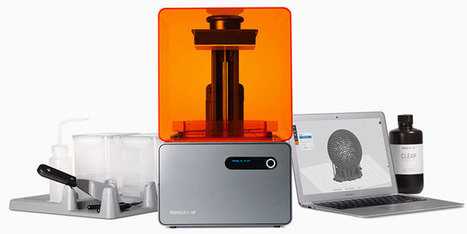
As an associate partner and managing director of Ideo’s Boston studio, Colin Raney’s typical day at the office revolved around designing drug-dealing robotsand gadgets that can read your mind. Raney spent eight years traveling the globe, helping the largest companies in the world solve their most interesting problems, and inventing the future. Despite holding one of the cushiest gigs in the design world, Raney recently decided to trade in his designer desk to join the Cambridge-based 3-D printing upstart Formlabs as their new head of global marketing.
|
|
Scooped by
jean lievens
August 13, 2014 1:16 PM
|
Have you heard about the open-source revolution? Like 3D printing, it only recently made its way into the mainstream, but like the additive manufacturing machines, it has been around for a while.
|
|
Scooped by
jean lievens
August 7, 2014 5:27 PM
|
"The city council expects to open at least 12 labs in the coming years. There are emerging community based initiatives like MADE, and private initiatives as Fab Café (brought from Tokyo and Taipei by MOB). We have been pushing hard to get the city council to support those community and private initiatives in order to build a richer ecosystem around digital fabrication, it seems that will work, right now there is a lot of collaboration being built, and it is hard not to fall into the dynamics of a “small” city like Barcelona, and move from competition to real collaboration, I think is a matter of time and will happen at FAB10 and the Mini Maker Faire, will bring different communities together and help to build the Fab City, which is not one-side vision of the city as a laboratory, but a complete ecosystem which includes also industry, universities, commerce and many more actors which could benefit and participate of it. The municipality is a big entity, and they have their vision of creating their very own spaces, which are being also called Ateneus de Fabricació (in a more local basis), my concern is the interpretations that the public sector can make of Fab Labs, we are try to work as close as possible and is working, but there are always risks.
|
|
Scooped by
jean lievens
August 6, 2014 2:41 AM
|
"After two hundred years’ development, the capitalist production mode evolves into a new shape---network economy. The traditional mode of production features the vertical control of final product producers, while the new global production network allocates resource effectively around product standards on a global scale, forming modular production and composition under the control of standards. The rise of ICT provides the conditions for transnational production. If the second industrial revolution, by introducing science into production process, enabled capital to stand, for the first time, on the material bases belonging to capitalism’s own nature, then today’s technology network comprised of autonomous computer terminals, fiber optic cables and digital technology, once again constitutes the technical basis in line with the nature of contemporary market economy agents. Modular production network not only incorporate enterprises into organizational structure with fuzzy borders, but also integrates national and local economy, resulting in complex geography-economy. The network effects inherent in network structure subvert the negative feedback mechanism of market competition, leading to multi equilibrium, path dependence and lock-in effect, which hastens economic change and increases uncertainty.
|
|
Scooped by
jean lievens
June 27, 2014 3:36 PM
|
“There are significant opportunities and jobs within manufacturing that are not being filled. It’s about training and matching those skills with the jobs that exist,” says Bob McCutcheon, U.S. Industrial Products leader for the professional services network PricewaterhouseCoopers (PwC).
|
|
Scooped by
jean lievens
June 26, 2014 1:13 AM
|
"Hackerspaces and medialabs in unusual and traditional cultural places seem to be the alternative to the educational and digital gap between rich and poor in Brazil. Raquel Renno analyses this gap and reconstructs the subversive potential auf heterotopic spaces.
|
|
Scooped by
jean lievens
June 17, 2014 11:52 AM
|
"The factory is designed as an integrated system. It brings together multiple production steps from raw materials and energy to finished items. Each part of the factory produces resources needed by the other parts to function, making it self-sustaining. Since the parts are all in one place, the whole production chain can take advantage of automation and robotics. Integrated processes can also take waste outputs from one step, and use them as inputs for another. The combination results in a highly efficient design.
|