Your new post is loading...

|
Scooped by
jean lievens
September 10, 2014 11:38 AM
|
In this paper we look at how information in societies is organized and how power relationships arise as a consequence of this organization. We argue that many of the observed information asymmetries are not happenstance and, drawing from a wealth of scholarship from the economics and finance literature, we posit that outcomes are inevitably detrimental. The paper concentrates on the techniques that foster information imbalances, such as media and propaganda, knowledge production, educational systems, legal and organizational structures, exclusive information networks, and surveillance. We conclude that in the absence of greater transparency, the deleterious effects of unequal access to information will continue and deepen.
|
|
Scooped by
jean lievens
August 18, 2014 5:28 PM
|
"Rejecting the dichotomy of centralism and horizontalism that has deeply marked millennial politics, Rodrigo Nunes’ close analysis of network systems demonstrates how organising within contemporary social and political movements exists somewhere between – or beyond – the two. Rather than the party or chaos, the one or the multitude, he discovers a ‘bestiary’ of hybrid organisational forms and practices that render such disjunctives false. The resulting picture shows how social and technical networks can and do facilitate strategic action and fluid distributions of power at the same time. It is by developing the strategic potentials that are already immanent to networks, he argues, that contemporary solutions to the question of organisation can be developed."
|
|
Scooped by
jean lievens
July 30, 2014 8:23 AM
|
Wiredu discusses the consensus principle in the political system of the Ashantis in Ghana as a guideline for a recommendable path for African politics.
|
|
Scooped by
jean lievens
July 15, 2014 2:36 PM
|
A year ago last May, the Real World Economics Review blog published my post, “Why Aren’t We Talking About Public Goods?” In that article I argued that we need to revive and reframe the concept of public goods. A concept of public goods is immensely important because:
|
|
Scooped by
jean lievens
July 15, 2014 12:48 PM
|
= "Solidarity cooperatives” are multi-stakeholder coops, bringing togther all parties involved in a particular endeavor―workers, consumers, producers and members of the larger community―in a democratic structure of ownership and control. [1]
|
|
Scooped by
jean lievens
July 15, 2014 12:35 PM
|
|
|
Scooped by
jean lievens
June 10, 2014 3:01 PM
|
There’s been tremendous energy behind the movement to change the way that local governments use technology to better connect with residents. Civic hackers, Code for America Fellows, concerned residents, and offices such as ours, the Mayor’s Office of New Urban Mechanics in Boston, are working together to create a more collaborative environment in which these various players can develop new kinds of solutions to urban challenges. In many cities, you can now find out via text message when your bus is coming, taking uncertainty out of your commute. With StreetBump, your phone can report rough stretches of road to the City automatically as you drive over them. Data policies have made available an unprecedented volume of information on safety, health and other pressing urban issues. We often talk about strengthening the relationshipbetween citizen and government; these innovations are pointing in that direction and, hopefully, building trust between the public and their local governments.
|
|
Scooped by
jean lievens
May 29, 2014 2:23 PM
|
Humanity’s strength is in groups. In fact, It is our way of cooperating and communicating together in small and large groups that has allowed us to become a dominant form of life on Earth.
|
|
Scooped by
jean lievens
April 13, 2014 3:14 PM
|
Today’s adversaries are decentralized transnational networks that appear in many sizes and shapes; they are not geographically fixed, hierarchically governed, or bureaucratically managed.
|
|
Scooped by
jean lievens
March 29, 2014 3:45 AM
|
|
|
Scooped by
jean lievens
March 16, 2014 6:18 PM
|
A bioregion is a geographic area that has roughly the same geology and plant life, that is different from the man-made borders imposed upon it. For example, the North Downs, South Downs and the Weald are all distinctive geographic features. Hampshire, Surrey, West Sussex and Kent are all man made counties. The Weald and Downland is possibly a bioregion. It shares distinctive landscape and farming practices, and also building styles, as revealed at the Weald and Downland museum.
|
|
Scooped by
jean lievens
March 9, 2014 7:14 PM
|
"The common good is a term that can refer to several different concepts. In the popular meaning, the common good describes a specific "good" that is shared and beneficial for all (or most) members of a given community. This is also how the common good is broadly defined in philosophy, ethics, and political science. This concept is increasing in popularity as moral vision for the progressive left in American politics."
|
|
Scooped by
jean lievens
February 17, 2014 3:25 PM
|
How much would you pay for staying alive? How much would you pay for breathing pure air? That may seem a silly question since air is everywhere, accessible to all. Air is a global public good, part of the commons – and yet in China a smart entrepreneur is already selling canned air at around 50p a can.
|
|
|
Scooped by
jean lievens
September 3, 2014 4:35 PM
|
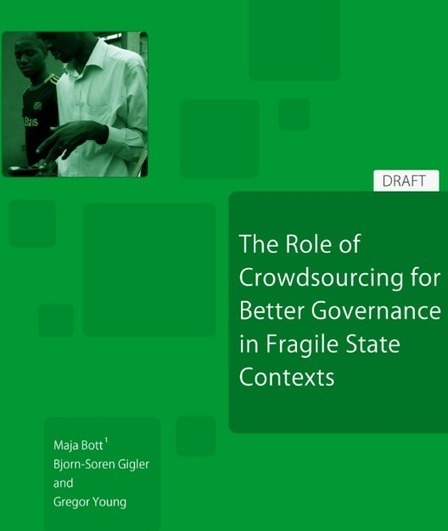
I was recently asked to review this World Bank publication entitled: “The Role of Crowdsourcing for Better Governance in Fragile States Contexts.” I had been looking for just this type of research on crowdsourcing for a long time and was therefore well pleased to read this publication. This blog posts focuses more on the theoretical foundations of the report, i.e., Part 1. I highly recommend reading the full study given the real-world case studies that are included.
|
|
Scooped by
jean lievens
August 4, 2014 10:14 AM
|
"What is complexity governance and how can this be implemented in a world complexity observatories grid? Complexity governance is the governance of any human relation (complexity pattern) on a peer-to-peer (complexity expression) level. This
|
|
Scooped by
jean lievens
July 28, 2014 1:14 AM
|
= A social charter is a social and institutional framework providing incentives for the management and protection of commons resources. Creating a social charter requires the support and involvement of people across a region or community of interest who depend on specific common goods for their livelihood and welfare. A social charter can be developed for a single commons or for overlapping commons.
|
|
Scooped by
jean lievens
July 15, 2014 12:52 PM
|
"If Oakeshott is correct in identifying the absence of overwhelming concentrations of power as the essence of liberty, how can we account for the peculiar character of the state in Britain? According to Oakeshott, modern European states can best be understood as torn between two contradictory methods of association which are the legacy of the medieval age. The first mode of association he calls `civil association' and the second `enterprise' or `purposive association'.
|
|
Scooped by
jean lievens
July 15, 2014 12:39 PM
|
So what does the evidence about citizen engagement say? Particularly in the development world it is common to say that the evidence is “mixed”. It is the type of answer that, even if correct in extremely general terms, does not really help those who are actually designing and implementing citizen engagement reforms.
|
|
Scooped by
jean lievens
June 14, 2014 2:55 PM
|
What do bitcoin and the sharing economy have in common?
|
|
Scooped by
jean lievens
June 10, 2014 2:45 PM
|
"Justin believes open development is crucially important for long-term success and notes that two ‘flavours’ of open source are emerging. He says: ‘We are seeing a difference between open source and open development. So what we are seeing is some projects and entities who are saying here is the source code, it is under Apache licence or GPL or whatever but the decisions about how the code got to that state are behind some wall—it is not in public’. This means that a developer has all the requisite rights to edit, modify and redistribute the code, but doesn’t have any real understanding as to how or why the code developed that way in the first place. Justin says: ‘So you run into some bug and you are saying why is the code this way? There is no historical context or archiving or rationale…So, [with the open development method] what we are seeing is, that in addition to “here is the code” we are seeing “here are all the decisions being made in public”.’
|
|
Scooped by
jean lievens
April 15, 2014 12:57 PM
|
I've talked a bit about the ideas surrounding the Decentralized Autonomous Society, but what makes a society a society? How does it operate? How does it run? What are the laws and how are they enforced? To be completely honest... no one really knows. Many of these ideas are very new, and almost none of them have been executed on any scale in the real world.
|
|
Scooped by
jean lievens
March 30, 2014 3:35 PM
|
For PeerLibrary project we had discussions on how much distributed or centralized should we make it. It is a cloud service and centralizing (unifying) user base and content has clear benefits for both end users and developers. End users have better user experience and ease of use, all content is available quickly and easily, and all other users are there, making social experience better. For developers, code can be much simpler and maintenance of only one instance makes it easier to deploy new versions and push security fixes quickly. It is easier to collect statistics and do A/B testing on a large sample. On the other hand, having multiple instances of PeerLibrary distributed around the world makes whole system more robust, specialized instances could be offered, privacy of users increased. Having PeerLibrary distributed would make forkability easier, encouraging more community control of both the project and the content (commons), preventing corruption of the main instance or core project.
|
|
Scooped by
jean lievens
March 16, 2014 6:19 PM
|
"As realistically the most documented example, drawing from the history of Athens (ca. 500 BCE to around 322 BCE) direct democracy was analyzed either in its own era (Plato) or after it collapsed (Aristotle) as descending into its own forms of tyranny when corrupted. Tyranny hardly only comes from more royalist or oligarchic frameworks, they argued. It could come from a corrected constitutionalism and direct democracy as well. Following Aristotle's analysis in his Politics, a corrupted constitutional government becomes a form of tyranny which he called 'democracy.' Even most in the Enlightenment, when they discussed 'democracy,' were using this negative use of the term [lknk to the sweden and elgnad book], contrary to some that later attempted to pretend that the Enlightenment was some harbinger or precursor of more widespread mass representative thought about democracy.
|
|
Scooped by
jean lievens
March 12, 2014 1:55 PM
|
Our current governments do not work. I'm talking broadly here, but this is no generalization. You would be hard pressed to find a government on the planet today that operates as efficiently and effectively as it should, given the collective knowledge generated by our scientific and larger academic enterprises. This is true for the decisions our governments make about economic, social, and environmental problems. To make matters worse, our government institutions do not even work for the people (which, after all, was the whole point of the democracy!).
|
|
Scooped by
jean lievens
February 22, 2014 2:16 AM
|
business-empowered communities: they are not companies linked to a community, but transnational communities that have acquired enterprises in order to gain continuity in time and robustness [1]
|