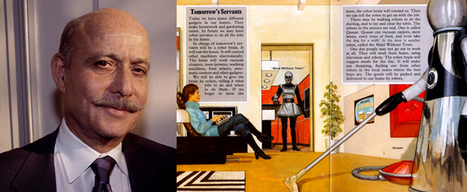
In “The Zero Marginal Cost Society,” Jeremy Rifkin argues that, within 50 years, technology will have developed to the point where there will be virtually no more jobs, where the marginal cost of everything will be zero and where capitalism will cease to exist. There are so many problems with this analysis that it is hard to know where to start, says Robert Atkinson. Productivity growth rates are low; corporate profits are up; wages are stagnant; and the marginal cost of producing virtually most goods is not anywhere near zero. Faddish accounts of how technology will either save us or immiserate us are great for book sales, but don't tell us much about the future.
Jeremy Rifkin talked about his book, The Zero Marginal Cost Society: The Internet of Things, the Collaborative Commons, and the Eclipse of Capitalism, in which he argues that capitalism is on its way out. Mr. Rifkin said it would be replaced with a global neural network created from the combined communications internet, energy internet, and logistics internet. He argued the increased production and distribution would effectively eliminate corporate profits. Mr. Rifkin spoke about his theory with the author of The Googlization of Everything, Siva Vaidhyanathan. close
The trick to reading Jeremy Rifkin’s latest work is to treat it less like a book and more like a mystical text. That’s because Rifkin, a prolific writer and the management guru most likely to be found at an Occupy sit-in, has synthesised so many ideas within it that laboring over the contradictions seems like missing the point.
Is it possible that the Industrial Revolution, the roots of which go back 250 years, has finally accomplished what it set out to do—free humans from the drudgery of working to survive? And, if it has, now what? Rifkin’s controversial prognostications are legendary and emerge in a new book.
In The Zero Marginal Cost Society, Jeremy Rifkin describes how the emerging Internet of Things is speeding us to an era of nearly free goods and services, precipitating the meteoric rise of a global Collaborative Commons and the eclipse of capitalism.
The Zero Marginal Cost Society: The Internet of Things, the Collaborative Commons, and the Eclipse of Capitalism, by Jeremy Rifkin, Palgrave Macmillan, RRP£16.99/RRP$28, 368 pages Machines are about to change what it means to be human.
How will the ‘collaborative commons’ transform our lives? Jeremy Rifkin, one of the world’s most popular public thinkers and political advisors, argues that capitalism will no longer be the dominant paradigm in the second half of the 21st century.
Capitalism is driving itself out of business as the marginal cost to produce just about everything inches closer to zero, Jeremy Rifkin's new book, "The Zero Marginal Cost Society," proposes.
Don't miss new Big Think videos! Subscribe by clicking here: http://goo.gl/CPTsV5 Economic theorist and author Jeremy Rifkin explains his concept of The Int...
In the last few days a number of, more or less enjoyable, articles introducing the latest book by Jeremy Rifkin, released earlier in March, saw the light on all the most important online newspapers worldwide.
Rifkin's intellectual sweep is more illuminating and will serve as a surer guide to the future of capitalism and markets. He sees them surviving as a niche within an emerging open-source, technologically based, sharing economy now growing rapidly in all mature industrial mixed economies. This new economy is building on a base of social capital and what I term "the unpaid Love Economy," (The Non-money Economy, Ethical Markets TV), the uncounted 50% of all productive work underpinning all societies, as well as all the non-profit groups and cooperative enterprises flourishing worldwide beyond the blinders of current economists, political scientists and mainstream media.
A new economic system is entering onto the world stage. The collaborative commons is the first new economic paradigm to take root in recent years and is allowing hundreds of millions of people to produce information, energy, and goods and services at near zero marginal cost and exchange them with each other in a sharing economy. Not surprisingly, the emergence of this new economic system is coming at a time of low growth, rising unemployment and greater inequality.
I recently read Jeremy Rifkin's new book, The Zero Marginal Cost Society: The Internet of Things, the Collaborative Commons, and the Eclipse of Capitalism, and it made me think about the future of work.
Imagine a world where cheap, 3D-printed, zero-emission, driverless, shared cars roam our roads; where human organs are easily replicated, ordered and delivered to those needing transplants on demand and where we generate and share our own green electricity for zero cost ...
"In The Zero Marginal Cost Society, New York Times bestselling author Jeremy Rifkin argues that the capitalist era is passing—not quickly, but inevitably. The emerging Internet of Things is giving rise to a new economic system—the Collaborative Commons—that will transform our way of life.
For a couple of centuries now, the whole point of industry has been to produce more stuff. But look what havoc that’s caused to the planet. A necessary fashion accessory for residing in New York City might soon be hip waders.
Jeremy Rifkin’s new book, The Zero Marginal Cost Society, covers lots of interesting territory but isn’t my cup of tea. One reason for that is apparent in the subtitle: “The internet of things, the collaborative commons and the collapse of capitalism” – wide-ranging is good, but ranging wide over such a disparate set of topics is a bit of a stretch.
In The Zero Marginal Cost Society, Jeremy Rifkin argues that growing efficiencies will make production costs a thing of the past. (Is capitalism driving itself out of business?
JoatU is a transitional application that allows us to smoothly transition into a post-capitalist, heavily (and happily) unemployed world. There may be fewer jobs, but that isn’t to say there isn’t work. We are trading financial capital for social capital (Jeremy Rifkin) and JoatU allows us to begin measuring and rewarding the people who work hardest for our communities. No longer is a good deed just its own reward. You get a reward on top of that! And if you don’t think you ought to receive such a reward? Pass it along to someone else as a gift!
To get content containing either thought or leadership enter:
To get content containing both thought and leadership enter:
To get content containing the expression thought leadership enter:
You can enter several keywords and you can refine them whenever you want. Our suggestion engine uses more signals but entering a few keywords here will rapidly give you great content to curate.


 Your new post is loading...