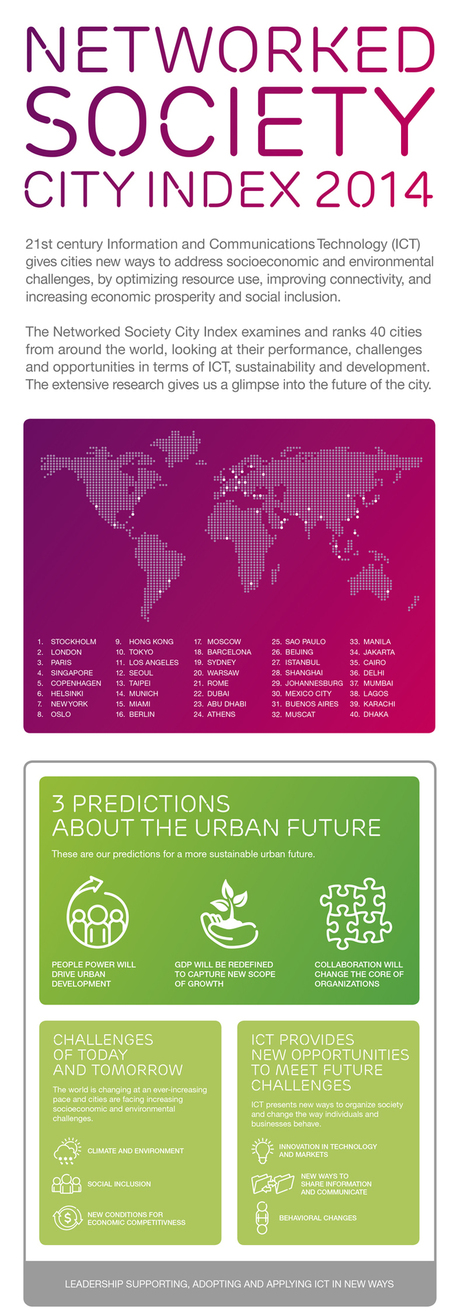
Ericsson, a Swedish multinational provider of communications technology and services, has released a report on the latest Network Society City Index that ranks 40 cities and measures their ICT maturity in terms of leverage from ICT investments in...
To fulfill the potential of the Networked Society, billions of people must be able to trust that communication networks are reliable and that the information carried over them is secure.
Cooperatives are traditionally understood as entities that are owned by their members, whether these are consumers or producers/workers. I don't think incentives are really the problem, since coops already hire more workers than private multinational companies (Page on davegraceassociates.com) and for example, 80% of tech coops still exist after 3 years vs 60% for private startups.
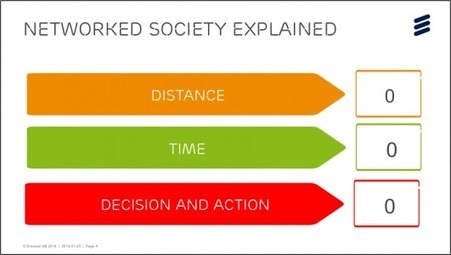
The Networked Society makes you be everywhere at any time. This could create a feeling that there is not enough time , and it becomes difficult to prioritize well. I can feel that way sometimes.
Being a small, remote nation, Bhutan does things a bit differently than the rest of the world; for example, Bhutan is the only country in the world to measure development by Gross National Happiness. Thanks to online connectivity, the country has kept its individuality and implemented an innovative approach to education.
This video highlights interviews from several leading people offering their perspectives on where learning and education is heading in our networked society.
If you look at the fact that we process 20 or 30 kids at a time in a batch just like in the factory. If you fail 3rd grade we hold you back and reprocess you. All matching the way the factory works. We built it on purpose and it was really useful for its function but we don’t have a shortage of factory workers anymore.” Seth Godin
Seth says that “there’s a big difference between access to information and school. They used to be the same thing. Information is now available online to anyone who has access and wants it.”
Traveling is all about capturing the essence of a place, to become a temporary native. Now, no matter where you are or where you going, there is a place to stay at your fingertips. This connected community has enabled new encounters, economies and become an integral part of the ‘sharing economy’.
The Networked Society, in which the Internet is connected to everything and everyone and impacts everything and everyone, isn't as far away as we might think.
In 2012, Jason Hoffman, then CTO of Joyent, and I wrote two papers together. The first paper, Changing the Game, attempted to place the massive business changes we are currently experiencing in the telecoms, IT, and cloud industries into a simple and understandable context. The second paper, Winning the Game, explained what conclusions could be drawn and what actions taken if these conclusions are to be believed.
The Networked Society City Index tracks ICT maturity and triple bottom line development for 40 cities all around the world. This video shows how you can use the City Index Interactive Tool to compare cities, share results in social media, add data to cities in the tool, and even add new cities.
People are always telling Halley how lucky she is to be able to work at home. No commute! No boss in your face! You don’t even have to get dressed! She herself used to write up the housebound life, or fully networked society as it was called then, as the great promise of the digital revolution. Now here she is, thrilled to be going to a science fair for teenagers because it gives her an excuse to put on make-up. Be careful what you wish for, she supposes.
Urbanization is a fact of life. City populations currently increase by 7,500 people every hour and mobile data traffic is expected to grow ten times in the next five years. Zero Site solution is designed to make streets safer and mobile communication easier by merging wireless connectivity with energy-efficient lighting.
My colleague Ellen Alarilla, Ericsson Head of Sustainability and Corporate Responsibilities for South East Asia and Oceania, recently traveled to Bangladesh – a trip that inspired her to reflect on how ICT is changing lives in one of the world’s least developed countries. Here’s her story:
Digital media's role in Brazil is being embraced and questioned, reports Alex Howard. Learn how human rights, the right to record, and Brazil's Bill of Internet Rights factor into this discussion.
Privacy is not something that one has, but something that one seeks to achieve. It requires constant negotiation as information flows and contexts shift. Privacy is particularly complicated in a networked era because of the ease with which people can share information, the increased availability of persistent data, and the ongoing ways in which contexts collapse. To achieve privacy in a networked world, people must actively try to manage the various social situations in which information is accessed, consumed, interpreted, and shared. They cannot simply focus on restricting the flow of information; they must also account for the ways in which information is inferred and used.
This builds on the proposition that anything that can benefit from being connected will be connected which is the foundation for the Networked Society. At the time of this writing [June 2012], 50B seems perhaps even a conservative prediction.
In the late 1800s, Sweden was the most telephone-dense country in the world, and Stockholm had more telephones than any of the major cities in the world, with 4,832 subscribers. Because of this huge demand, the decision was made in 1887 to build Telefontornet.
This film is part of a global Ericsson project where we have traveled to over 25 different countries in order to find the real-life change-makers who are transforming our world through mobility. The project serves as both a study and a celebration: a study on how connectivity has reshaped the ways in which we communicate, collaborate and innovate, as well as a celebration of pioneers who introduced new applications of technology to transform our businesses, industries and society at large.
This film is part of a global Ericsson project where we have traveled to over 25 different countries in order to find the real-life change-makers who are transforming our world through mobility. The project serves as both a study and a celebration: a study on how connectivity has reshaped the ways in which we communicate, collaborate and innovate, as well as a celebration of pioneers who introduced new applications of technology to transform our businesses, industries and society at large.
The Networked Society - by Saskia van Uffelen - Vice-President of the European Commission (RT @VUSaskia: "ICT is the missing link"... Curious what I have to say about the digital future?
To get content containing either thought or leadership enter:
To get content containing both thought and leadership enter:
To get content containing the expression thought leadership enter:
You can enter several keywords and you can refine them whenever you want. Our suggestion engine uses more signals but entering a few keywords here will rapidly give you great content to curate.




 Your new post is loading...
 Scoop.it!