


“The case of the jasmine flower growers in coastal Karnataka is an example of a local successful grassroots enterprise that has proved robust for over 70 years. The aim of this research is to examine the history, mechanisms, interconnectedness, and success of the jasmine growing program in coastal Karnataka and assess its compatibility with the community-based enterprise (CBE) model as proposed by Peredo and Chrisman [Peredo, A.M., and J.J. Chrisman. 2006. Toward a theory of community-based enterprise. Academy of Management Review 31, no. 2: 309–28]. We found that the existence of a natural, autonomously developed CBE without ‘western’ intervention can help to fine tune our knowledge of sustainable CBE and assist in helping practitioners learn what works and what does not when proposing a CBE.”
Follow, research and publish the best content
Get Started for FREE
Sign up with Facebook Sign up with X
I don't have a Facebook or a X account
Already have an account: Login

Peer2Politics
143.7K views |
+0 today
on peer-to-peer dynamics in politics, the economy and organizations
Curated by
jean lievens
 Your new post is loading... Your new post is loading...
 Scoop.it!
Want to get out of the basement and into a real office, but have no budget for renting a space? Look no further as co-working spaces are here. Given the intense interest in startups these days, India's young entrepreneurs are extensively using the co-work facilities. We spend a day at one such place to find why it's the perfect solution for so many youngsters, from film makers and entrepreneurs to social marketers and designers. 
Scoop.it!

The following is an interview with Soma Kishore Parthasarathy from the website of the Association for Women’s Rights in Development (AWID) on June 6. The interviewer was Ana Abelenda, and the piece is called “Reclaiming the Commons for Gender and Economic Justice: Struggles and Movements in India.” It is republished here with permission.
Scoop.it!

Following the economic horror story the world had witnessed in the last decade, many of us were forced to rethink our understanding of how things work. One of the root causes behind most of the recognisable problems we are facing today is unchecked consumerism. The more we buy, the more the companies produce and the more they produce, the more we use up some of the key limited resources this planet provides. So why don't we reduce consumption of goods?
Scoop.it!

Ericsson estimates that India's mobile subscriber base will grow from 795 million in 2013 to 1145 million subscribers by 2020. Simultaneously, smartphone penetration will grow from 10 per cent or 90 million devices in 2013 to 45 per cent or 520 million devices.
Scoop.it!

If ever there was a country that needed a serious imaginative rethink of its cities it is India. Since its modern conception after Independence, the Indian city has been a failure of urban politics, economic planning, and constructive thinking on design and demographics.
Scoop.it!

A rapid transition to 4G LTE networks can potentially catapult hundreds of millions into a hyper-connected era. (Is India a leapfrog candidate for the networked society?
Scoop.it!
A rapid transition to 4G LTE networks can potentially catapult hundreds of millions into a hyper-connected era and put the country onto a path of definitive inclusive growth
Scoop.it!

A few months ago, India's Aam Aadmi Party was a curiosity; now, it’s a call for pro-democracy movements elsewhere to step up their game.
Scoop.it!

The Election Commission, which summoned the social media companies to a meeting last Monday, directed them to cooperate in monitoring content.
Scoop.it!

Collective intelligence of the internet is too often sullied by a collective unintelligence, the tendency of people to shoot off unconsidered and ignorant reactions, encouraged by the instant nature of the medium and the cloak of anonymity it gives the user. Public discourse, as witnessed at a literary festival, is a completely different kettle of fish. To start with, experts speak to experts, writers to writers, all of them on a subject they know well, and have worked on for years. The level of conversation and debate, therefore, is at a pretty high level. Interaction with the audience is also well-informed, simply because the people who attend litfests are generally well read, and attend particular sessions because they have a special interest in that subject. The intellectual stimulation that participants and audience derive from a literary festival, not only acts as a spur to further intellectual growth, but it also acts as a catalyst to strike off on diverse and often unplanned intellectual paths.
Scoop.it!
From
qz

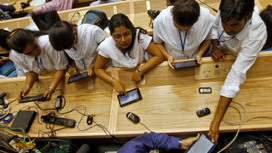
I wrote this article for Times of India. It is India-focused, but the same lessons apply everywhere. Cheap tablets, connectivity, and social media have already fomented revolutions in Middle East. They are causing China to have a harder time controlling its restive population and allowing the world’s children to rise above the fears and biases of their parents. They will open up new technology possibilities and shake up industries—even in the developed world. Wait and see how innovation from the East soon reaches the West.

Jusvic Dublois & Cooper Baddley's curator insight,
November 4, 2014 1:32 PM
This falls under social for India. This article talks about how india is making cheap tablets is making china have a hard time controlling the population. The tablets will open up new technology possibilities and shake up a developed world says the article. This could make chinas population even harder to handle the it already is.
Scoop.it!
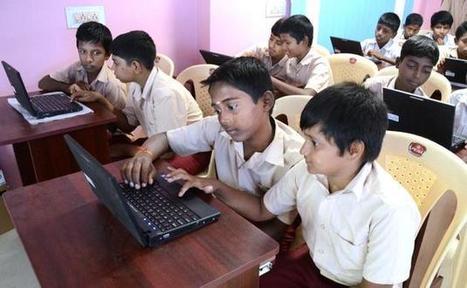
We are on the brink of a fundamental shift in society – and in our journey towards the Networked Society, we are unlocking the full potential of learning and education. Learning has been transformed into an industry. In its report, Understanding Knowledge Societies, the United Nations describes “knowledge economies” as those societies in which information and the creation of knowledge have replaced industrial production as the main contributor to GDP. As part of this development, businesses and governments are integrating ICT into their core processes to increase efficiency, expand scope and improve productivity. One result of this development has been the rapid digitisation of information and knowledge. Technology improves educational opportunities by enabling personalised study, while enhancing the potential for learning through community-based education and access to educational resources, even in remote rural schools.

Richard Platt's curator insight,
September 21, 2013 12:26 PM
Disruption in education - teachers better get better and embrace this thing called the internet |
Scoop.it!

Room n House is a trusted online marketplace for people to list, discover, and book unique accommodations.
Scoop.it!

The world’s existing cropland could feed at least 3 billion extra people if it were used more efficiently, a new study has found, showing that the large increases in population expected in the next three decades need not result in widespread hunger.
Scoop.it!

The explosion of mobile phone use in India has started a revolution that could fuel substantial economic development.
Scoop.it!

Scoop.it!

Scoop.it!

Anand Gandhi will be uploading the raw footage of his critically acclaimed film, 'Ship Of Theseus', for anybody to edit
Scoop.it!

Rice conservationist Debal Deb grapples with 'mindless Indian elite' to reintroduce genetically diverse, drought-tolerant varieties
Scoop.it!

At the root of all innovation is curiosity, a tinkering spirit and an ‘urge to fix something’. There are too many hackathons focusing on contests, hiring events or start-ups but none on hacking because its ‘fun’,” says Venky Goteti (40), co-founder, Devthon. “At the heart of all innovation is the culture of hacking and exploration. We want to encourage this culture,” he explains.
Scoop.it!

Mining big data to arrive at meaningful conclusions will change the way we work forever, says Kenneth Cukier, data editor at The Economist and co-author of the bestselling book Big Data. "Big data will mean for white-collar, professional labour in the 21st century, what machines, automation and the assembly line meant for blue-collar workers in the 20th century.
Scoop.it!
In the wake of the shocking revelations about the covert cyber-surveillance programme PRISM, run by the National Security Agency of the United States, the time is ripe for an evaluation of the current debates on digital rights and privacy and internet governance in India.
Scoop.it!

The demand for floating islands rises with the sealevels. Let´s build a low-budget island out of trash and bamboo, then share the island + manual with the world
Scoop.it!
Selling investors on a radically new approach to waste disposal, one that serves impoverished regions where garbage heaps are common, is no easy feat. It’s a messy business, rife with health and environmental risks. Obtaining the necessary resources to transform waste disposal, then, requires the utmost resourcefulness. The currencies of reputation, social outcomes, and credit trading can become partial substitutes for capital, creating a basis for relationships and transactions that launch the new model.
|





