"I am fascinated by the figure of the anthropologist," author Tom McCarthy wrote this weekend at the Guardian. "What he or she embodies for me is a version of the writer minus all the bullshit, all...
You can read David Graeber’s new collection of essays, The Utopia of Rules: On Technology, Stupidity, and the Secret Joys of Bureaucracy, as a critique of our age of “total bureaucratization,” which he defines as a process of “fusion of public and...
The language with which we talk about regulation has been handed to us by the Right Wing. "Deregulation" means less bureaucratic meddling, and it must be good. But the debate is based on false premises.
In this video, David Graeber, Professor of Anthropology at the London School of Economics, is interviewed about the rising idea that people have “pointless jobs” where they do not actually do much work. Graeber discusses the reasons behind these pointless jobs and claims that while they fail to make sense in a truly capitalistic setting, they do make sense within businesses where people may be more powerful if they have more people working under them. Graeber then goes on to explain why he believes a basic income could solve the problem by freeing people from these pointless jobs in order to pursue their passions.
Where does the desire for endless rules, regulations, and bureaucracy come from? How did we come to spend so much of our time filling out forms? And just how much are our lives being ruined by all this nonstop documentation?
Privateers were buccaneers to whom a king granted legal immunity and safe harbor in return for a share of the booty. Their charge was to extract physical wealth from foreign lands and peoples by whatever means—including the execution of rulers and the slaughter and enslavement of native inhabitants.
David Graeber interviewed in Berlin on 30 May 2012, on the Occupy movement and social movements, with a focus on state and police repression measures and the...
Where does the desire for endless rules, regulations, and bureaucracy come from? How did we come to spend so much of our time filling out forms? And just how much are our lives being ruined by all this nonstop documentation?
Excerpts from TheBaffer.com's "Where did the Future Go?" - a discussion with David Graeber and Peter Thiel. This video is a compilation of Basic Income relat...
Once upon a time, in the heyday of social prognostication, many Americans believed that gadget-related knowledge would surely yield immeasurable leaps forward in the progress of the human species. Yet as David Graeber argued in...
1) Adam Smith first proposed in ‘The Wealth of Nations’ that as soon as a division of labor appeared in human society, some specializing in hunting, for instance, others making arrowheads, people would begin swapping goods with one another (6 arrowheads for a beaver pelt, for instance.) This habit, though, would logically lead to a problem economists have since dubbed the ‘double coincidence of wants’ problem—for exchange to be possible, both sides have to have something the other is willing to accept in trade. This was assumed to eventually lead to the people stockpiling items deemed likely to be generally desirable, which would thus become ever more desirable for that reason, and eventually, become money. Barter thus gave birth to money, and money, eventually, to credit.
Red tape: paintings by Carl Hammoud Nobody seems to like bureaucracy very much, and yet somehow we always seem to end up with more of it. One can see its effects in every aspect of our lives. Indeed, bureaucracy has become the water in which we swim.
David Graeber is an American anthropologist, political activist and author. He is currently a professor at the London School of Economics and was formerly an...
In honor of the release of David Graeber’s The Utopia of Rules, here are some novels haunted by paperwork, documents, reports, and so-called intelligence.
[Josh Martin] In this video, David Graeber, Professor of Anthropology at the London School of Economics, is interviewed about the rising idea that people have “pointless jobs” where they do ...
Professor of Anthropology at the London School of Economics, activist, anarchist David Graeber had written an article for the Guardian in October, in the first weeks of the ISIS attacks to Kobane (North Syria), and asked why the world was ignoring the revolutionary Syrian Kurds.
Many of the internal changes within anthropology as a discipline—particularly the "postmodern turn" of the 1980s—can only be understood in the context of broader changes in the class composition of the societies in which university departments exist, and, in particular, the role of the university in the reproduction of a professional-managerial class that has come to displace any working-class elements in what pass for mainstream "left" political parties. Reflexivity, and what I call "vulgar Foucauldianism," while dressed up as activism, seem instead to represent above all the consciousness of this class. In its place, the essay proposes a politics combining support for social movements and a prefigurative politics in the academic sphere.
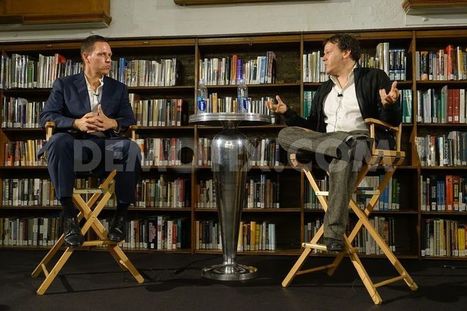
Billionaire Venture Capitalist Peter Thiel debated David Graeber at an event organized by The Baffler Magazine in the library of the Greater Mechanics and Tradesmen in New York.
David Graeber landed a deal with Melville House for a new book entitled The Utopia of Rules: On Technology, Stupidity, and the Secret Joys of Bureaucracy.
In the year 1930, John Maynard Keynes predicted that, by century’s end, technology would have advanced sufficiently that countries like Great Britain or the United States would have achieved a 15-hour work week. There’s every reason to believe he was right. In technological terms, we are quite capable of this. And yet it didn’t happen. Instead, technology has been marshaled, if anything, to figure out ways to make us all work more. In order to achieve this, jobs have had to be created that are, effectively, pointless. Huge swathes of people, in Europe and North America in particular, spend their entire working lives performing tasks they secretly believe do not really need to be performed. The moral and spiritual damage that comes from this situation is profound. It is a scar across our collective soul. Yet virtually no one talks about it.
To get content containing either thought or leadership enter:
To get content containing both thought and leadership enter:
To get content containing the expression thought leadership enter:
You can enter several keywords and you can refine them whenever you want. Our suggestion engine uses more signals but entering a few keywords here will rapidly give you great content to curate.


 Your new post is loading...
 Scoop.it!