There is one notable aspect to the Volkswagen emission-cheating scandal that few commentators have mentioned: It would not have happened if the software for the pollution-control equipment had been open source.
The relationship between law and the commons is very much on my mind these days. I recently posted a four-part serialization of my strategy memo, “Reinventing Law for the Commons.” The following public talk, which I gave at the Heinrich Boell Foundation in Berlin on September 8, is a kind of companion piece. The theme: …
This article tries to present private property rights to allow the justification of inequality by providing a tangible method by which resources are separated- promoting the ideal of private wealth to be striven for due to this inequality providing an incentive for a capitalist free market economy.
Additionally, the article details the Tragedy of the Commons to be a fallacy, due to not representing common land- which would have safeguards/boundaries enforced with the added prospect of communal/social pressures to reduce the exploitation of such ground. This even goes so far as to provide examples of successful implementations while advocating the movement for common property- as opposed to private- due to being a more fair method of resource allocation, instead of market failure as the Tragedy of the Commons usually connotes.
I wish to argue that hunger, poverty, inadequate education and medical care, and assaults on human dignity and human rights, are not bugs in the system. They are features. Indeed, market ideologues often argue that such deprivations are a necessary incentive to human enterprise and economic growth; poverty is supposedly needed to spur people to escape through the work ethic and entrepreneurialism.
The City of Bologna is pioneering a new paradigm of municipal governance that suggests that there are some practical, bottom-up alternatives to bureaucracy.
Anarchist anthropologist David Graeber argues in his recent book, The Utopia of Rules, that bureaucracy is the standard mechanism in contemporary life for coercing people to comply with the top-down priorities of institutions, especially corporations and government. Anyone concerned with the commons, therefore, must eventually address the realities of bureaucratic power and the feasible alternatives. Is there a more human, participatory alternative that can actually work?
What would it be like if city governments, instead of relying chiefly on bureaucratic rules and programs, actually invited citizens to take their own initiatives to improve city life? That’s what the city of Bologna, Italy, is doing, and it amounts to a landmark reconceptualization of how government might work in cooperation with citizens. Ordinary people acting as commoners are invited to enter into a “co-design process” with the city to manage public spaces, urban green zones, abandoned buildings and other urban issues.
The latest issue of Boston Review has a lively forum on the growing power of network-based businesses such as Amazon, Uber and Airbnb. These companies may not be monopolies in the strict conventional sense of the law, but they nonetheless use their market dominance and network platforms to extract all sorts of advantages from competitors, suppliers and consumers.
Two noted activists, David Bollier and Michel Bauwens of the Commons Strategies Group/P2P Foundation, discussed the role of the commons and peer to peer production in meeting people’s needs and the many enclosures of the commons that are abridging their fundamental rights on September 8th 2015 in Berlin.
Watch David Bollier’s presentation just below, followed by my own. The event was organized in Berlin, on September 8, by the Boll Foundation on the occasion of the 800th anniversary of the Magna Carta and the Charter of the Forest. Silke Helfrich of the Commons Strategies Group introduced the speakers and moderated the discussion. 1. …
I recently encountered a brilliant new essay by German writer Ina Praetorius that revisits the feminist theme of “care work,” re-casting it onto a much larger philosophical canvas. “The Care-Centered Economy: Rediscovering what has been taken for granted” suggests how the idea of “care” could be used to imagine new structural terms for the entire economy.
Out now; the Italian translation of Think Like a Commoner: La Rinascita dei Commons: Successi e potenzialita del movimento globale a tutela dei beni comuni
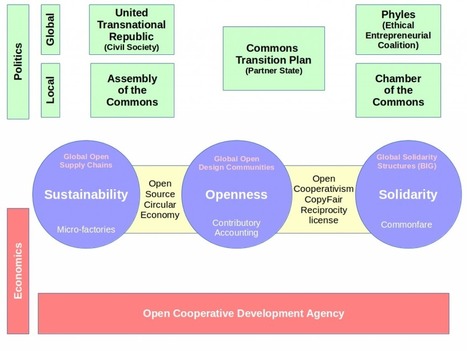
So what might a commons-based economy actually look like in its broadest dimensions, and how might we achieve it? My colleague Michel Bauwens of the P2P Foundation offers a remarkably thoughtful and detailed explanation in a just-released YouTube talk, produced by FutureSharp. It’s not really a video – just Michel’s voiceover and a simple schematic chart – but the 20-minute talk does a great job of sketching the big-picture strategies that must be pursued if we are going to invent a new type of post-capitalist economy.
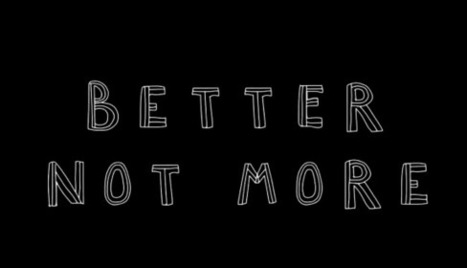
Here is an inspiring five-minute video about the quest for a new post-growth economic system. Better, Not More was produced by Kontent Films for the Edge Funders Alliance, and was released recently at a conference in Baltimore. The video is a beautiful set of statements from activists around the world describing what they aspire to achieve, especially by way of commons.
"The process has focused on a shared goal – the restoration of salmon in the streams and rivers." David Bollier reviews "Seeing the Forest", a documentary.
To get content containing either thought or leadership enter:
To get content containing both thought and leadership enter:
To get content containing the expression thought leadership enter:
You can enter several keywords and you can refine them whenever you want. Our suggestion engine uses more signals but entering a few keywords here will rapidly give you great content to curate.




 Your new post is loading...
 Scoop.it!