


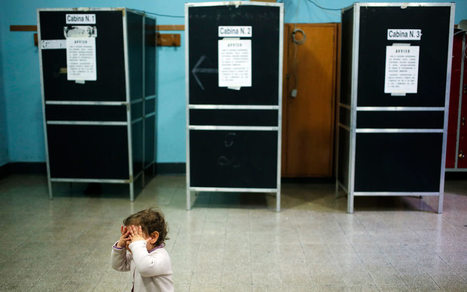

Governments now answer to business, not voters. Mainstream parties grow ever harder to distinguish. Is democracy dead?

 Your new post is loading... Your new post is loading...
 Scoop.it!
Governments now answer to business, not voters. Mainstream parties grow ever harder to distinguish. Is democracy dead? 
No comment yet.
Sign up to comment
Scoop.it!
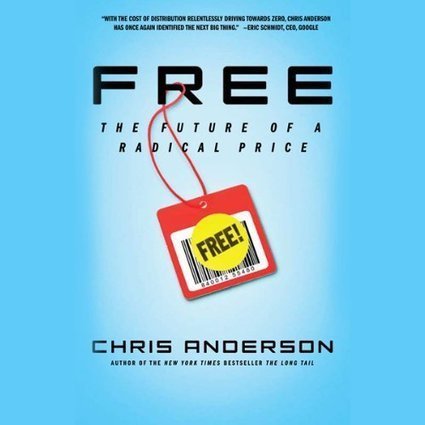
Check out this great listen on Audible.com. The New York Times best-selling author heralds the future of business in Free.
Scoop.it!

"Nina Simon’s new book is essential for museum directors interested in experimenting with audience participation on the one hand and cautious about upending the traditional museum model on the other. The book is well written, interesting, well researched, and useful. It will encourage and support those who wish to begin. Simon dissects the process of participatory change, showing how to make choices that will augment, without overturning, the museum’s current programs or mission. In concentrating on the practical, this book makes implementation possible in most museums. More importantly, in describing the philosophy and rationale behind participatory activity, it makes clear that action does not always require new technology or machinery. Museums need to change, are changing, and will change further in the future. This book is a helpful and thoughtful road map for speeding such transformation."
Scoop.it!
Prior to the 19th century, public goods and social goals such as sanitation, health, affordable housing, education, and environmental protection were largely left up to individuals to sort out for themselves. Beginning in the 19th century, though, more and more governments—particularly in the industrialized, democratized world—began taking these responsibilities on themselves. In the latter half of the 20thcentury, the promotion of public goods and social goals expanded as governments in the developed world intensified their efforts at home and began spreading their attention to the developing parts of the planet, and large non-profits and NGOs started cropping up to help with the issues both domestically and abroad.
Scoop.it!
"In 2010, we set out to create a platform for two things we love and value: freedom of critical thought and digital culture. We wanted to create something that would testify of something major of our contemporary age. Having grown up with the Internet, we, the unknown digital kids, hoped to create a website that would be different from traditional academia: Cyborg Subjects was born. The major idea behind it was not only to freely publish articles that dealt with a broad range of themes and debates of the zeitgeist but to create a transparent and lively debate. We wanted to have an open review system where everything would be published and everyone could add their 2 virtual cents to an essay or artwork. This was an attack on the monopoly publishers in academia.
Scoop.it!

Editor's note: Andrew Keen is a British-American entrepreneur, professional skeptic and the author of "The Cult of the Amateur" and "Digital Vertigo." This article was compiled at FutureCast, a conference in Palo Alto, California, featuring a conversation about the future of work between Keen and technology entrepreneur and writer Vivek Wadhwa.
Scoop.it!

The Internet is an infinite world of information and linkages; fuels the economy, boosts world culture and promotes democracy. But it is also the nest of digital assassins who lie in wait unnoticed and wait for their time to throw verbal, visual and technological bombs to damage reputations — and sign up others via social media to attain their evil motives more quickly. That’s the hideous reality of online life, as described by Richard Torrenzano and Mark Davis in their book Digital Assassination: Protecting Your Reputation, Brand or Business Against Online Attacks. The tome paints an accurate representation — one that brands, businesspeople, public figures and celebrities alike must take seriously if they want to thrive in today’s digital age, as “this power of the new digital assassin to destroy is as powerful asYouTube but as old as civilization,” the authors declare.
Scoop.it!
Ajit Balakrishnan, founder of Rediff.com, talks about his new book, why he wishes he had done some things in life differently, and he why believes financial bubbles have their uses
Scoop.it!
"Radical Social Production and the Missing Mass of the Contemporary Art World Gregory Sholette (Pluto Press UK, forthcoming, 2009.) The premise of this book is that the formal economy of contemporary art is dependent upon a previously suppressed sphere of informal, non-market, social production involving systems of gift exchange, cooperative networks, distributed knowledge, and collective activities, which is becoming increasingly visible and potentially threatening to the symbolic and fiscal cohesion of high culture, especially in its most politicized form as interventionist art."
Scoop.it!

Having previously defined a good society as a sustainable society with a high level of development, significant provision of meaningful jobs, and low levels of inequality and social ills, Toward a Good Society in the Twenty-first Century provides a wide range of principles and policies that would be necessary if we are to achieve a good society.
Scoop.it!

Not For Profit 2.0: Empowering Australian not-for-profits and community projects to start and grow in a digital age.
Scoop.it!

The book launch of Revolucionarios cibernéticos will take place August 28 at 7:30pm at the Fundación Salvador Allende (Av. República 475, Santiago de Chile) as part of a series of events commemorating the 40-year anniversary of the Unidad Popular. Jaime Tohá González, ex-Minister of the Unidad Popular will be presenting the book and I will be sharing stories and answering questions. Spread the word to those who might be interested or perhaps I’ll see you there!
Scoop.it!

An astute observer of culture and technology, Thompson has plenty of terms to share. In Smarter Than You Think, a smart yet scattered book, he champions the idea that the Internet is not, in fact, turning us into a society of facile thinkers. Even as the Internet alters old literacies, it creates new ones. And rather than a society of people enslaved by computer screens, he sees a world where people become solvers of puzzles, fluent manipulators of data, people who use Internet connectivity to break down barriers.
|
Scoop.it!
""Factories of knowledge: fashionable metaphor for the self-proletarization of intellectuals, misinterpratation of ephemeral Marx marginalia, terminological makeshift solution for the situation of precarious knowledge work? There is no doubt that the General Intellect has been increasingly seized by capitalist valorisation in recent decades."
Scoop.it!
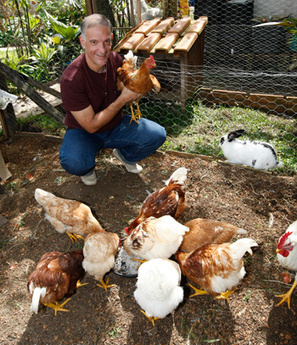
The co-author of a new book on reconciliation with the land reflects on a Brazilian community that models “abundant kingdom homesteading.”
Scoop.it!
The original technological revolution of the late Middle Ages, the eotechnic, was associated with the skilled craftsmen of the free towns, and eventually incorporated the fruits of investigation by the early scientists. It began with agricultural innovations like the horse collar, horseshoe and crop rotation. It achieved great advances in the use of wood and glass, masonry, and paper (the latter including the printing press). The agricultural advances of the early second millennium were further built on by the innovations of market gardeners in the sixteenth and seventeenth centuries—like, for example, raised bed horticulture, composting and intensive soil development, and the hotbeds and greenhouses made possible by advances in cheap production of glass.

Caroline Ivy's curator insight,
March 24, 2015 10:32 AM
Unit 5-This article is about the transition from the Neolithic Revolution to the Second Agricultural Revolution.
The biggest change brought about by the Second Agricultural Revolution was the shift from many small subsistence farms to fewer, larger commercial farms. Improving technology (Steam power, the Mechanical Reaper, intelligent planting methods) meant that, to be cost efficient, agriculture had to be more localized. Harnessing the power of natural gas allowed for faster, more efficient harvesting and yields increased greatly. Thanks to the Second Agricultural Revolution, we are able to feed more people than would have been possible, as it was a stepping stone to even greater production.
Scoop.it!

These are just a few of the many fascinating statistics and technology stories packed into the just-released book by Robert Scoble and Shel Israel, Age of Context: Mobile, Sensors, Data and the Future of Privacy. While my regular Friday Book Share readers know that I’m a real sucker for such “fascinating facts,” Scoble and Israel have also done a decent job of categorizing the five major “forces” driving these technologies: mobile, social, data, sensors and location. Technology is now highly mobile, it empowers us to connect with others in social media, it generates lots of data, much of which comes from sensors, and it often involves specific locations.
Scoop.it!

It's a brave, new, ultra-connected world, and companies that don't embrace the new principles of openness and transparency risk alienating millennial employees and missing out on key sources of innovation and revenue. This was one of the key themes of Don Tapscott's electrifying opening keynote at the 2013 HR Technology® Conference, held this year at the sprawling Mandalay Bay Las Vegas resort.
Scoop.it!
“Can the ethical turn that we are presently witnessing among corporations, consumers, investors, employees, activists, and other stakeholders – their desire to address a number of concerns beyond the profit motive – become a basis for a new “social contract” in which the interests of business and the interests of society can coincide? In other words, can there be such a thing as an ethical economy?”
Scoop.it!
"There are over 400 cities in the world today with a population of more than one million urban residents and close to 20 cities with a population of more than 10 million. Indeed, over half the world’s population now lives in cities, and by 2050 seventy percent of the world’s population will live in cities. This remarkable urban growth has created vast policy and planning challenges related to infrastructure, governance and environmental sustainability. Examining the relationship between “smart cities” and civil society, this collection explores the contours of a new era in urban design.
Scoop.it!
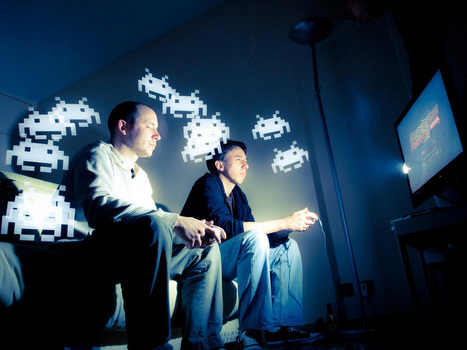
Start with that carton of orange juice in your fridge, which might advertise it’s worth three points, redeemable for discounts and prizes. It’s a game. What about frequent-flier miles, which are games that reward loyalty? Mega Millions, Powerball, Take Five and other state lotteries? Games. Nissan has an in-car gaming system that encourages drivers to compete for best efficiency levels (Bronze, Silver, Gold, and Platinum). Talk about a mobile game. You could look at Twitter as a game, the pay off being more and more followers and greater numbers of retweets the more you use it.
Scoop.it!
“The goal of this book is to succinctly explain the fundamental problems of society’s current economic system, and to propose an evolutionary solution that consists of 11 new economic concepts. The content will be in text, image, and video form. It offers a unique economic analysis of life as a game to enable easier learning opportunities for readers.”
Scoop.it!
Definitions: “Collaboration is the process of two or more people collectively creating emergent, shared representations of a process and or outcome that reflects the input of the total body of contributors” (Elliott, 2007, p. 31).
Scoop.it!

“How did we get from Hollywood to YouTube? What makes Wikipedia so different from a traditional encyclopedia? Has blogging dismantled journalism as we know it?”
|




