Journalist and activist David Bollier talks about his most recent book, co-written with legal scholar Burns Weston,GREEN GOVERNANCE: Ecological Survival, Human Rights, and the Law of the Commons. Then we re-air our 2010 interview with him about the digital commons, VIRAL SPIRAL.
In The New Science of Cities, Michael Batty suggests that to understand cities we must view them not simply as places in space but as systems of networks and flows. To understand space, he argues, we must understand flows, and to understand flows, we must understand networks—the relations between objects that comprise the system of the city. Drawing on the complexity sciences, social physics, urban economics, transportation theory, regional science, and urban geography, and building on his own previous work, Batty introduces theories and methods that reveal the deep structure of how cities function.
Beth Buczynski has written a new book about collaborative consumption that not only makes the case for why sharing is necessary, but how it is possible, as well.
Work is clearly evolving which means that we are seeing new technologies and behaviors enter our organizations. These new behaviors and technologies are largely being fueled by the consumer web and now organizations are struggling to adapt. I wanted to create something which visually shows how exactly work is evolving and what areas are being impacted. To help do that my team from Chess Media Group and I put together a visual explaining the evolution of work. A high level explanation for each area is provided below after the graphic. Share it with your friends and colleagues who are seeking to understand how the world of work is changing.
'With YouTube, Wikipedia, search engines, free chatrooms, blogs, wikis, and video communication, today’s self-learners have power never dreamed-of before. What does any group of self-learners need to know in order to self-organize learning about any topic? The Peeragogy Handbook is a volunteer-created and maintained resource for bootstrapping peer learning.
On Thursday October 7, 2013, over 100 people gathered at Gleebooks in Glebe for the Australian launch of a handbook for activists called Take Back the Economy: An Ethical Guide for Transforming Our Communities. Co-author, Katherine Gibson, research professor at the Institute of Culture and Society at the University of Western Sydney, says: “The book contains many examples of collective actions that are re-shaping the way we work and conduct business so that the needs of people and the planet are met with dignity. We hope community organisations, faith groups, neighbourhoods, high schools, unions and governments will be prompted to think about actions to put the well-being of people and the planet at the centre of economies.”
It's not often that someone stumbles into entrepreneurship and ends up reviving a community and starting a national economic-reform movement. But that's what happened when, in 1983, Judy Wicks founded the White Dog Café on the first floor of her house on a row of Victorian brownstones in West Philadelphia. After helping to save her block from demolition, Judy grew what began as a tiny muffin shop into a 200-seat restaurant-one of the first to feature local, organic, and humane food. The restaurant blossomed into a regional hub for community, and a national powerhouse for modeling socially responsible business. Good Morning, Beautiful Business is a memoir about the evolution of an entrepreneur who would not only change her neighborhood, but would also change her world-helping communities far and wide create local living economies that value people and place as much as commerce and that make communities not just interesting and diverse and prosperous, but also resilient. Wicks recounts a girlhood coming of age in the sixties, a stint working in an Alaska Eskimo village in the seventies, her experience cofounding the first Free People store, her accidental entry into the world of restauranteering, the emergence of the celebrated White Dog Café, and her eventual role as an international leader and speaker in the local-living-economies movement. Her memoir traces the roots of her career - exploring what it takes to marry social change and commerce, and do business differently. Passionate, fun, and inspirational, Good Morning, Beautiful Business explores the way women, and men, can follow both mind and heart, do what's right, and do well by doing good.
"“Whether or not readers are familiar with the concept of presentism—the theory that society is more focused on the immediacy of the moment in front of them (actually more specifically on the moment that just passed) than the moment before or, perhaps more importantly, the future—they’ve certainly felt the increasing pressure of keeping up with various methods of communication, be it texting, Web surfing, live interactions, or a litany of other media for staying “connected.” Using Alvin Toffler’s concept of “future shock” as a jumping-off point, media theorist Douglas Rushkoff (Cyberia; Get Back in the Box; Media Virus; etc.) deftly weaves in a number of disparate concepts (the Home Shopping Network, zombies, Kurzweil’s Law of Accelerating Returns, Internet mashups, hipsters’ approximation of historical ephemera as irony, etc.) to examine the challenge of keeping up with technological advances as well as their ensuing impact on culture and human relations in a world that’s always “on.” By highlighting five areas (the rise of moronic reality TV; our need to be omnipresent; the need to compress time in order to achieve our goals; the compulsion to connect unrelated concepts in an effort to make better sense of them; and a gnawing sense of one’s obsolescence), Rushkoff gives readers a healthy dose of perspective, insight, and critical analysis that’s sure to get minds spinning and tongues wagging.”
When I glanced through the list of publications to be reviewed for the third assignment on the Hyperlinked Library MOOC I realized that Wikinomics: How Mass Collaboration Changes Everything by Don Tapscott and Anthony D Williams was already in my bookshelves, but I hadn’t got around to reading it. The assignment therefore provided the motivation to take it down from the shelf and put my feet up while I skimmed through the book.
“In the 1990s and the 2000s, right-wing parties were the enthusiasts of the market, pushing for the deregulation of banks, the privatisation of core state functions and the whittling away of social protections. All of these now look to have been very bad ideas. The economic crisis should really have discredited the right, not the left. So why is it the left that is paralysed?
The authors' definition of resilience: "The capacity of a system, enterprise, or a person to maintain its core purpose and integrity in the face of dramatically changed circumstances." The book spends considerable time in the natural world, including an Australian coral reef and Borneo, the primary habitat of orangutans. Drawing a line from the natural to the social sciences, the writing makes the case that those attributes that contribute to healthy environmental ecosystems can also be developed and sustained in human organizational systems.
In the past, participatory planning used to be regarded as an annoying factor in the already intricate procedures of urban planning. Fortunately, today participation seems to permeate through a variety of city projects. This time around, the good news comes from Berlin. Self-Made City is a bilingual (German-English) book by the German Jovis. As the title insinuates, the reader is given the chance to page through a panorama of self-made housing projects all situated in the city of Berlin, most of them built during the last decade.
To mark the launch of Katherine Gibson's new collaborative book, Deborah Rose sat down with her to talk about taking back the economy. This interview was conducted in September 2013 in Sydney, Australia.
"Anonymity is nothing new in cities. What is more unusual and perhaps even contradictory is the convergence of sociability and anonymity in the city. Through an analysis of peer-to-peer (P2P) networks, we consider the growing value of systems for sharing and combining individual efforts on the Internet into collective tasks. If we look at the historical development of relationality, this may lead us to challenge any simplistic identification of P2P collaboration with anonymity. What is the potential of P2P for urban development, democratization and innovation? P2P has to be seen as an objectoriented sociality, where person-fragments cooperate around the creation of common value. What connects individuals who participate in open and shared knowledge? How does this collaborative logic seen in software and design projects connect individuals to some transcendental collective goal? How might building a universal operating system, constructing a universal free encyclopedia or constructing an open source car reshape the way we construct our cities?"
“In this chapter I will refer to “government” in the context of currency issue, but keep in mind that like all of our institutions, government is going to change dramatically in coming years. Ultimately, I envision decentralized, self-organizing, emergent, peer-to-peer, ecologically integrated expressions of political will. Parallel to this, I envision an ecology of money as well, an economic system with many complementary modes of circulation and exchange. Among them will be new extensions of the gift, freeing work from compulsion and guaranteeing the necessities of life to all.
The book “The Fifth Age of Work: How Companies Can Redesign Work to Become More Innovative in a Cloud Economy” by Andrew M. Jones is out now. Thanks to an advance copy provided by Genevieve DeGuzman of Night Owls Press, I am able to write a short review and put the book into perspective with regards to the most important trend I see in Coworking at the moment: Free Coworking
Chris Anderson is a guru of the information age. Under his editorship, Wired, the voice of the digital world, has won zillions of prizes. His speeches on the economics of the internet command vast sums. He's a brilliant journalist; I know that, having worked with him before he was a big shot. But it is as an author that Anderson has gained most fame. He writes, broadly, about how digital technology has made the world a better place. His first book, The Long Tail, was hugely influential. In the bricks-and-mortar world, it said, in which the costs of marketing and distribution are high, companies make money by selling vast quantities of a few blockbuster items. In the digital world, in which the costs of marketing and distribution are low, companies can make money by selling small numbers of lots of different items.
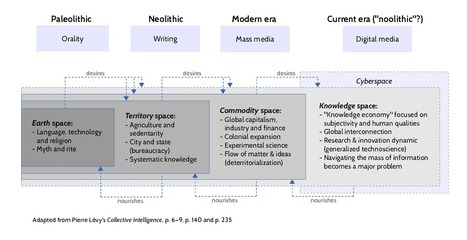
This is a summary and analysis of Pierre Lévy‘s book “Collective Intelligence: mankind’s emerging world in cyberspace”, which provides all direct and indirect quotes in this essay.
“Water Governance for 21st Century, by Shiney Varghese at the Institute for Agriculture and Trade Policy, makes a compelling case urging advcates and policy makers to advance an approach combining the commons framework and the Public Trust Doctrine principles. Shiney notes that the tendency of recent trends to rely on market and rights–based policies has exaccerbated the failures in water governance. These approaches do not “solve problems such as poor management, existing over-allocation or failing water governance.”
To get content containing either thought or leadership enter:
To get content containing both thought and leadership enter:
To get content containing the expression thought leadership enter:
You can enter several keywords and you can refine them whenever you want. Our suggestion engine uses more signals but entering a few keywords here will rapidly give you great content to curate.


 Your new post is loading...