Ignore Bitcoin’s challenges. In this interview, Don Tapscott explains why blockchains, the technology underpinning the cryptocurrency, have the potential to revolutionize the world economy.

 Your new post is loading...
 Scoop.it! Ignore Bitcoin’s challenges. In this interview, Don Tapscott explains why blockchains, the technology underpinning the cryptocurrency, have the potential to revolutionize the world economy. 
No comment yet.
Sign up to comment
Scoop.it!

Welcome to the era of Digital Capitalism! The production of goods is no longer a priority. Instead, digital information is becoming the prime asset of today’s economy. Networked platforms have replaced the factories of the industrial age. Traditional standards of production, work and value are currently being reconfigured. Even our understanding of social values, aesthetics and culture is increasingly shaped by the new paradigms of digital economy.
Scoop.it!

Why are the Commons and P2P movements so male dominated? Is the economy of domestic labor as hidden in the P2P/Commons movement as in the rest of society?
Scoop.it!

A giant flame shooting insect which will travel the globe from New Zealand to USA and back!
Scoop.it!

This is a slightly revised version of an article of the same title originally published in the journal Futures. The full citation for the original article is: Joshua Floyd, Thermodynamics, entropy and disorder in futures studies, Futures, Volume 39, Issue 9, November 2007, Pages 1029-1044, doi:10.1016/j.futures.2007.03.011. Abstract The conceptual bases of futures studies are constrained…
Scoop.it!
Thom talks to caller Jesse, who says we need a 'Chamber of Commerce' for worker-owned co-ops. If you liked this clip of The Thom Hartmann Program, share i
Scoop.it!

Open technologies are becoming increasingly prevalent in many aspects of society.
Scoop.it!

RT @mbauwens: Relational Goods https://t.co/PAav4nxamN A true sharing economy venture satisfies an economic need while also delivering rela…
Scoop.it!

The global meeting “Democratic Cities: Commons Technology and the Right to a Democratic City”, held in Madrid from 23 to 28 May, produced a meaningful international dialogue between some of the world’s most outstanding players on issues surrounding technology, democracy and participation. Extracting Twitter data for hashtags #CiudadesDemocráticas, #DemocracyLab and #DCENTMadrid shapes a network that reveals vital details about the event.
Scoop.it!
Constitutional Crowdsourcing - P2P Foundation https://t.co/w6BH2AXvnG
Scoop.it!

https://t.co/seK1FJm9Q7 "Is unpaid labour always a problem?" Reminds me of french controversy @AntonioCasilli & @Karmacoma (@hesmondthing).
Scoop.it!
Tthe miniaturization of farm machinery may be the agricultural-tech counter-trend that actually encourages smaller, more diverse farms.
Scoop.it!
This is the first of three videos that will tackle an investigation of the gender wage gap going beyond popular rhetoric and analysing its underlying causes
|
Scoop.it!
Spain’s Podemos leftist party printed its program as an Ikea catalog so voters will actually read it
From
qz

Hoping to get the program in the hands of people less interested in politics, the party designed and printed a 192-page catalog featuring its candidates in Ikea-like settings, albeit offering political issues—from financial regulations to increase in pensions to renewable energies—instead of affordable design.
Scoop.it!

The Journal of Labor & Society, in it’s 21st year, is issuing a call for the special issue “Workers Beyond Unions, Parties, NGOs, and the State? to rethink how workers organize and struggle. Co-edited by Robert Ovetz, Ph.D., a political science lecturer San Jose State University, and Gifford Hartman, an independent San Francisco, USA based scholar, the issue seeks submissions from scholars, organizers, and activists critically reexamining the multiplicity of forms of class struggle outside of and inside unions, parties, NGOs, and the state happening around the world.
Scoop.it!
From
medium
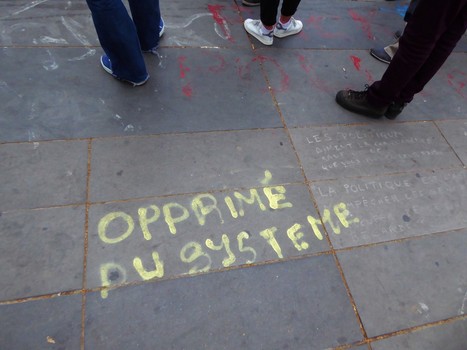
Nuit Debout is kinda the French version of the Occupy movement, 5 years on. Nati and I were involved in Occupy Wellington in 2011, so we were eager to connect while we were in town.
Scoop.it!

In his new book, Douglas Rushkoff reacts to rising inequality and the threat of automation by proposing a new social operating system that distributes wealth more equitably.
Scoop.it!

The commons perspective stresses the democratic governance of knowledge as it identifies knowledge as a shared resource that is a collective responsibility. It emphasizes equitable access to knowledge resources such as health-care and education, the urgent need to prioritize ecological sustainability in knowledge policy and the promotion of an open and democratic Internet.
Scoop.it!
RT @whangam: Top time banking story: Category:Madison Mapping - P2P Foundation https://t.co/gPAE88NhJC, see more https://t.co/lWE19baJPo
Scoop.it!
Technological change has significantly transformed the labour scenario as the result of the diffusion of innovative practices at the micro-level. The technological impact on the future of work was deeply analysed by Jeremy Rifkin.
Scoop.it!

The EC projects the sharing economy to expand robustly after doubling in one year, setting guidelines for member countries to reap the benefits of growth.
Scoop.it!

Defence mechanisms against the iniquities of capitalism are needed now, argues Chris Gray
Scoop.it!

2016 is shaping up to be a turning-point year in which the sharing and collaborative economies enter a period of intense self-examination and reinvention.
Scoop.it!
Where the Sharing Economy meets PlatformCooperativism the Collaborative Economy 3.0 begins. Cooperativism in general & cooperative banking associations in par…
|